Cell bio chp. 18 - Cell-division cycle
 Call Kai
 Learn
Learn Practice Test
 Spaced Repetition
 Match
Match Flashcards
 Knowt Play
1/54

There's no tags or description
Looks like no tags are added yet.
Name | Mastery | Learn | Test | Matching | Spaced | Call with Kai |
|---|
No analytics yet
Send a link to your students to track their progress
55 Terms
general cell cycle
1: Cell growth chromosome duplication
2: Chromosome segregation
3: Cell div. for two daughter cells
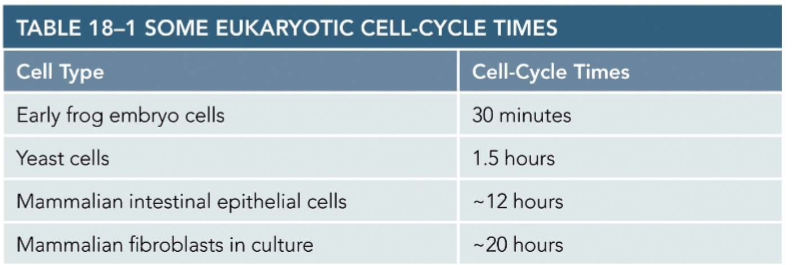
Some eukaryotic cell cycle times
cell cycle time varies among cells
4 phases of cell cycle
M phase: mitosis (nuclear div.) and cytokinesis (cytoplasmic div.)
G1 phase: Cell growth and monitoring of internal and external environment to ensure readiness for S phase
S phase: DNA replication
G2 phase: Cell growth and monitoring of internal and external environment to prepare for M phase (checkpoint)
What makes up interphase
G1, S, and G2
cell cycle control system
Ensures key processes are in check to initiate next step in cycle. Is similar in all eukaryotes
locations of cell cycle control system checkpoints and what
Before S phase: is cell environment ready to duplicate (Biggest one)
Before M phase: Is DNA replicated and is DNA damage repaired
in M phase: Are chromosomes properly attached at mitotic spindle to be pulled apart
What happens if chromosomes are not properly aligned and unevenly pulled apart
Could lead to down syndrome (trisomy)
(M checkpoint is important)
What is cell cycle control system dependent of
CDK’s
Cyclin dependent kinases
(Cell cycle is dependent on series of phosphorylation)
Cyclin
regulatory protein that binds to Cdks to control progression of cell cycle
CDK
Enzyme that activates when bound to cyclin. Triggers events in cell division cycle by phosphorylating target proteins
Are all cyclin-cdk complexes the same
No, they are specific to the step in the cell cycle they trigger
S-Cdk
M-CDK
How can you regulate CDK activity
regulating cyclin concentration
What regulates cyclin concentration
transcription: regulate expression of cyclin
proteolysis: regulate degradation of cyclin (cyclin must be tagged with ubiquitin first)
APC/C
Protein complex that triggers separation of sister chromatids and catalyzes the ubiquitylation of proteins that control cell div. cycle by stopping cell from re entering mitosis.
Anaphase promoting complex
(Not a CDK inhibitor)
cyclin degradation controlling CDK activity process
Active CDK: cyclin binds to CDK
Destruction of cyclin: ubiquitin chain sent by APC/C binds to cyclin, directing it towards a proteasome
Inactive CDK: cyclin is degraded and no longer bound to CDK
What is the activity of Cyclin-CDK complexes dependant of
phosphorylation (inactivating complex) and dephosphorylation (activating complex)
Wee1
inhibitory kinase (adds phosphate to CDK complex)
Cdc25
activating phosphatase (dephosphorylates CDK complex)
M-CDK activation process
M-CDK is formed but phosphorylated by Wee1 (inhibitory kinase)
cyclin can bind to inactive M-CDK but it will still be inactive
Cdc25 (activating phosphatase) will dephosphorylate the complex and activate it
CDK inhibitor proteins
Regulatory proteins that block binding or activity of cyclin-CDK complexes by directly binding to CDK
(APC is not a CDK inhibitor protein because it does not directly act on Cdk)
P27 inhibitory protein example
p27 binds to an active cyclin-CDK complex and inactivates it by preventing it from phosphorylating target proteins essential for progression through G1 to S
Ways that cell cycle control system pauses cycle
At G1 checkpoint: Cdk inhibitors block entry into S phase (P27 ex.)
At G2 checkpoint: inhibition of Cdc25 (activator) blocks entry into mitosis
At M phase: inhibition of APC activation delays exit from mitosis
G1 = inhibitors
G2 = inhibit activator
M = inhibit APC
CDK activity during G1 phase
CDKs are inactivated for majority of the time to ensure that division does not immediately occur before spending time in G1
mitogens
extracellular signals that stimulate cell division
What happens if mitogens are not received by a cell
Cell cycle stays in G1 or will fall back into G0
Mitogen function
Switch on cell signaling pathway that stimulates the synthesis of G1-CDK and G1/S CDKs
(stimulates pathway necessary for DNA synthesis and chromosome duplication)
G1-CDK and G1/S-CDK function
relives negative controls that block progression and start of S phase
Rb protein
cell cycle negative control (inhibitory protein) that inhibits transcription regulators
phosphorylation and dephosphorylation of rb protein
phosphorylated: inactivated
dephosphorylated: activated
mitogen inhibiting rb protein process
dephosphorylated rb protein inhibits transcription regulators
mitogen binds to cell surface receptor triggering a signaling pathway
signal pathway forms and activates G1-CDKs and G1/S-GDKs
CDKs phosphorylate rb protein and inactivate it therefore allowing transcription regulators to transcribe genes needed for S phase
What happens when Rb protein is absent
Transcription factors are not regulated (inhibited) so transcription and translation does not stop and can cause cancer
Cell cycle when DNA is damaged
Cell cycle will halt at G1
p53
Transcription regulator that negatively controls transcription when DNA is damaged by preventing entry into S phase until damage is repaired. Can induce cell death if damage is too severe.
Mutations in p53 leads to what?
Usually cancer as unregulated cell division occurs
p21 gene
encodes for p21 protein, a CDK inhibitory protein, for when DNA is damaged and cell cycle needs to halt at G1
Process of cell cycle arresting in G1
DNA is damaged acting as a signal
Protein Kinases phosphorylate p53 activating it
p53 binds to p21 gene to transcribe p21 mRNA and then translate p21 protein
p21 protein binds and inactivates G1/S-CDK and S-CDK
Cell cycle stays in G1
How might cells delay division
entering specialized nondividing states
G0: temporary arrested state (liver cells)
Permanent withdraw from cell cycle
What phases do most adult cells spend their time in
G1 or G0
S-CDK function
Initiates DNA replication and bocks re-replication
initiation of DNA replication process
During G1 Cdc6 binds to ORC to bind a DNA helicase to DNA
Helicase binds and Cdc6 dissociates forming Pre-RC (Origin loaded)
S phase starts and S-CDK is activated
Activated S-CDK can activate the bound DNA helicases and guide DNA polymerase and other proteins that initiate synthesis at the fork (origin fired)
S-CDK phosphorylates Cdc6 and ORC to inactivate them and prevent re-replication
Where does cell cycle go if error occurs during DNA replication
Halts at G2
How does arrest at G2 occur
Inhibition of Cdc25
When Cdec25 is inhibited it is unable to dephosphorylate M-CDK which will stay inactive and mitosis will not occur
M-CDK positive feedback loop process
phosphorylated Cdc25 phosphatase is activated
Cdc25 removes phosphates from inactive M-CDK activating it
M-CDK phosphorylates more Cdc25 which can then dephosphorylate more M-CDK
cohesin
ring shaped protein complex that holds sister chromatids together. They are broken in late mitosis to allow for seperation.
chromosome condensation
duplicated chromosomes pack into more compact structure so they are not damaged during seperation
condensin
ring shaped protein complex that compacts duplicated chromosomes for segregation by forming loops within loops
cytoskeleton role in mitosis and cytokinesis
microtubules: mitotic spindle that segregate duplicated chromosomes during mitosis
actin and myosin filaments: form contractile ring to divide daughter cells
M phase stages
prophase
metaphase
anaphase
telophase
cytokinesis
interphase
Cell increases in size, DNA is replicated, and centrosomes duplicate
Prophase (Mitosis begins)
Duplicated chromosomes condense. Outside the nucleus mitotic spindles assemble between two centrosomes that begin moving apart.
Prometaphase
nuclear envelope breakdown allows chromosomes to attach to spindles through their kinetochores
Metaphase
Chromosomes align at center between spindle poles. kinetochore microtubules attached to sister chromatids are at opposite spindle poles
Anaphase
Sister chromatids are pulled apart towards opposite spindle poles. Both kinetochore microtubules and spindle poles contribute to pulling apart by microtubules getting shorter and spindle poles moving further apart
Telophase (Mitosis end)
Two sets of chromosomes arrive at poles. Two new nuclear envelopes assemble around each set creating two new nuclei.
cytokinesis
Cytoplasm divides in two by contractile ring (actin and myosin) that pinches the cell into two daughters.