Lecture 2-Introduction to Immunology
 Call Kai
 Learn
Learn Practice Test
 Spaced Repetition
 Match
Match Flashcards
 Knowt Play
1/43

There's no tags or description
Looks like no tags are added yet.
Name | Mastery | Learn | Test | Matching | Spaced | Call with Kai |
|---|
No analytics yet
Send a link to your students to track their progress
44 Terms
Immune System
Complex system of many biological strucutres and processes within an organism that protects against disease
Directs a wide variety of pathogens
Needs to distinguish pathogens from the organisms healthy tissue
Innate Immunity
General protection
Rapid
non-specific
No memory
Early phase
Adaptive Immunity
Antigen specific (B and T cells)
Diverse
Lag time between exposure and maximal response
Produces with immunological memory
Types of Adaptive Immunity
Humoral Immunity
Cellular
Humoral Immunity
Antibody-mediated
B cells (Bone marrow)
Cellular Immunity
Cell-mediated immunity
T cells (Thymus)
Antigens
Substances that produce and immune response
composed of lipids, proteins, and carbohydrates
Epitopes
Antigenic sites
Antigens can have multiple
Antibody
glycoproteins that bind antigens with high specificity
immunoglobulin domains make up heavy and light chains
Antibody-Mediated Immunity
B cells (lymphocytes) make and use an antibody as their specific antigen receptor
The heavy chain region determines the antibody fate
Antibody Classes
Different biological activities
Deal with antigens with different protperties at different sites
IgA
Found in mucous, saliva, tears, & breast milk
Protects against pathogens that enter through mucosal surfaces
IgD
Part of B cell receptor
Activates basophils and mast cells
IgE
Protects against parasitic worms
Responsible for allergic reactions
IgG
Secreted by plasma cells in the blood
Crosses from the placenta into the fetus
Protects against blood-borne virus infections
IgM
Attached to surface of B cells or secreted into the blood
Responsilbe for early stages of immunity
Lock & Key Antibody-Antigen Binding
highly specific, complementary binding between an antibody's paratope (lock) and an antigen's epitope (key)
Antibody (B cell receptor) Diversity
created at the DNA level prior to antigen exposure
Random gene rearrangement of exons
Further diversity created by somatic mutations in V regions
Clonal Selection Theory of Antibody Formation
one B cell produces one antibody and then reproduces
Effector & Memory B cells
Memory cells remain in greater numbers after infection clears
gives rapid response on second exposure to an antigen
basis to pathogen/vaccine induced immunity
Immunological Memory
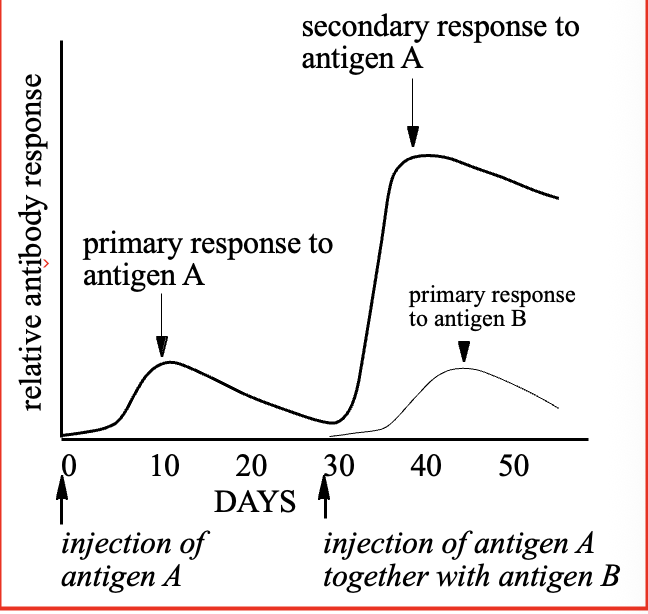
Low levels of antibody one week after first antigen exposure
Second exposure produces faster response in a greater magnitude
Antibody Affinity
Secondary response = faster and greater
Comes from a mechanism that alters the variable regions of light and heavy chains of the memory cells by specific mutation
Re-exposure to antigen is most likely to cause clonal expansion of memory cells which produce the highest affinity antibody.
Antiviral Activities of Antibodies
Antibodies trigger effector system that can lead to viral clearance
Antibody Dependent Cell-Mediated Cytotoxicity (ADCC)
an effector cell (natural killer cells, macrophages) actively lyses a virus-infected cell
Complement dependent cytotoxicity (CDC)
leads to virus-infected cell lysis
Virus Neutralization
Antibody can neutralize virus by tightly binding and blocking a critical biological activity resulting in loss of infectivity
T Helper Cells
regulate immune response by activating other immune cells
B cells and other T cells
Two types
Cytotoxic T Cells
Kill cells infected with intracellular pathogens
T cells
Protects against intracellular pathogens
B cells
Protect against extracellular pathogens
T Cell Mediated Immunity
Caused by direct action of T cells
Major Histocompatibility Complex (MHC)
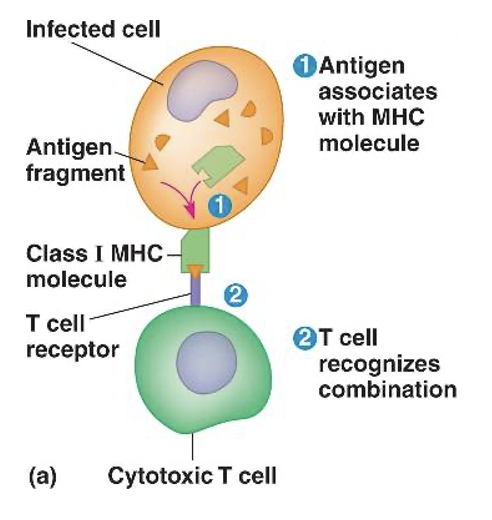
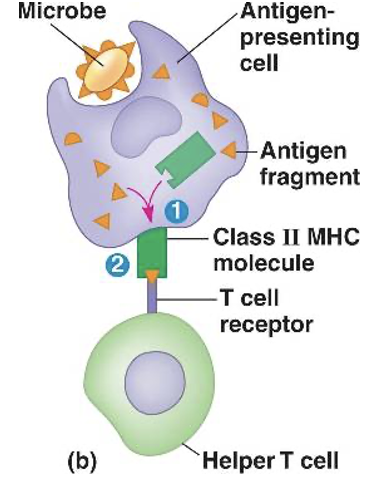
evolved to present forigen antigens to T cells
MHC Class I
Found on all nucleated cells
NOT RBCs
MHC Class II
Found on professional antigen presenting cells
Ex: Dendritic cells, Macrophages, B cells, other specialized cells
MHC Diversity
Based on anchor residues
Do not vary for a specific MHC molecule —> only binds peptides with specigic anchor residues
Anchor Residues
Sites on peptides that bind MHC molecules
B-cell Receptor
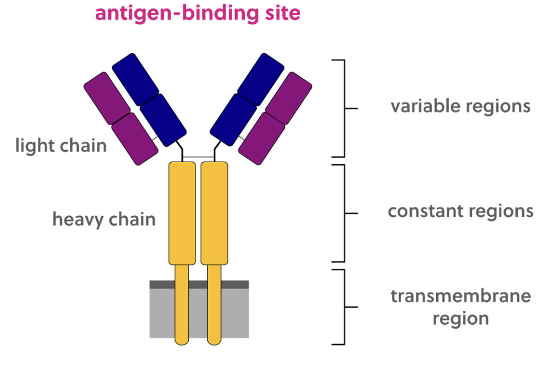
T-cell Receptor
Has a specific antigen binding site (individual T cell specificity)
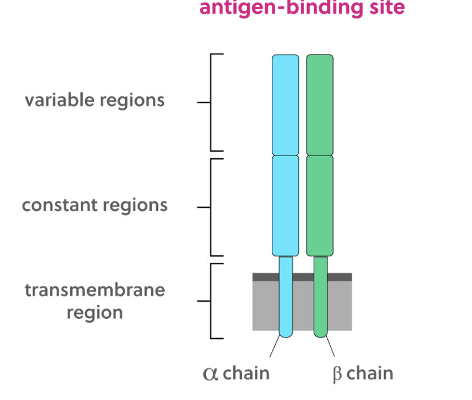
T-cell Receptor Diversity
Stems from gene rearrangements during early T cell development
Occurs randomly in the thymus
Individual T cell specificity
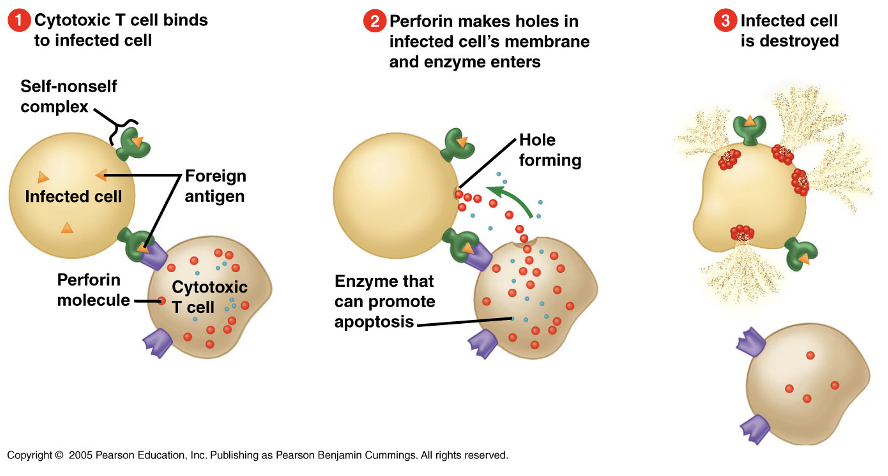
Cytotoxic T cells Kills Infected Cell
Cytotoxic T cell binds to infected cell
Perforin makes holes in infected cell’s membrane and enzyme enters
Infected cell is destroyed
*Apoptosis better than necrosis
Th1
Cell-mediated immunity dominates
inflammatory immune response
Th2
Humoral dominates
Stimulating B cells and antibodies
Memory T cells
Persist long after an infection is resolved
Expand to large numbers of effector T cells upon re-exposure to antigen
Immunity Process
Selection of antigen specific t cells
proliferation, differentiation and development of effector cells of cellular immunity
Cell signalling and lymphokine production (Th, B, macrophages, other T cells)
Cytotoxic T cells eliminate virus infected cells