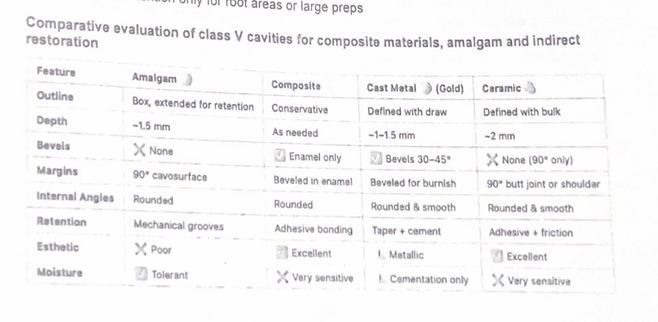
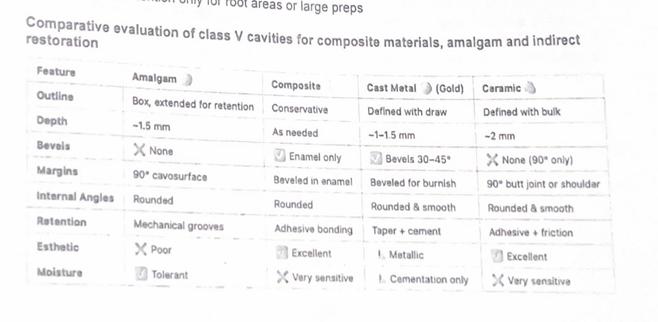
essay 15 - class V cavity prepartion for composite materials - indications, stages of prepartion, comparative evaluation of class V cavities for composite materials, amalgam and indirect restorations
 Call Kai
 Learn
Learn Practice Test
 Spaced Repetition
 Match
Match Flashcards
 Knowt Play
1/7

There's no tags or description
Looks like no tags are added yet.
Name | Mastery | Learn | Test | Matching | Spaced | Call with Kai |
|---|
No analytics yet
Send a link to your students to track their progress
8 Terms
what are class V prepartions?
restorations on gingival third of facial or lingual surfaces of all teeth
Indication for class V cavity preparation for composite materials
most class V lesions in aesthetic zones
lesions that can be adequately isolated
shallow or moderate caries with enamel margins
contraindication for class V cavity preparation for composite materials
poor isolation (e.g excessive gingival bleeding)
deep root lesions with no enamel margin
low aesthetic demand areas where amalgam is sufficient
Modified class V preparation for composite (most common)
used for small/moderate lesions
‘‘scooped out’’ form
no groove retention
minimal depth: -0.2mm into dentin, only if needed
no sharp line angles, walls may be divergent
Conventional class V preparation for composite
used for root surface lesions
90 degree cavosurface margin, 0.75 mm depth
may include groove retention if needed
Bevelled conventional class V preparation for composite
for larger lesions with enamel margins or to replace a defective conventional preparation
Initial 90 degree prep, followed by 0.25-0.5 mm enamel bevels
Bevels made with flame-shaped or round diamond
enhances bonding and aesthetics
retention used for composite
micromechanical bonding
etched enamel + adhesive = strong bond
bevels increase surface are, reduce microleakage
groove retention only for root areas or large preps