BIo208 - Lecture 13
 Call Kai
 Learn
Learn Practice Test
 Spaced Repetition
 Match
Match Flashcards
 Knowt Play
1/29

There's no tags or description
Looks like no tags are added yet.
Name | Mastery | Learn | Test | Matching | Spaced | Call with Kai |
|---|
No analytics yet
Send a link to your students to track their progress
30 Terms
A muscle twitch is called a _____.
A muscle twitch is called a fasciculation
Two phases of muscle twitch are _____ and _____.
Two phases of muscle twitch are latent and contraction.
Latent period has an _____ potential stimulates the _____, and _____ is released from sarcoplasmic _____, where there is no _____ yet.
Latent period has an action potential stimulates the sacrolemma, and calcium is released from sarcoplasmic reticulum, where there is no tension yet.
Contraction phase consists of calcium binding to _____, _____-_____ cycling, and the _____ rising to a peak.
Contraction phase consists of calcium binding to troponin, cross-bridge cycling, and the tension rising to a peak.
Relaxation phase occurs when the _____ drops, _____-_____ detach, and _____ sites are covered. The tension returns to _____ levels, and peak tension to end of twitch around __ msec.
Relaxation phase occurs when the calcium drops, cross-bridge detach, and active sites are covered. The tension returns to resting levels, and peak tension to end of twitch around 25 msec.
Tension produced on a individual muscle fibers on two things: Amount of _____ produced by each fiber, and the _____ of fibers that are _____.
Tension produced on a individual muscle fibers on two things: Amount of tension produced by each fiber, and the number of fibers that are stimulated.
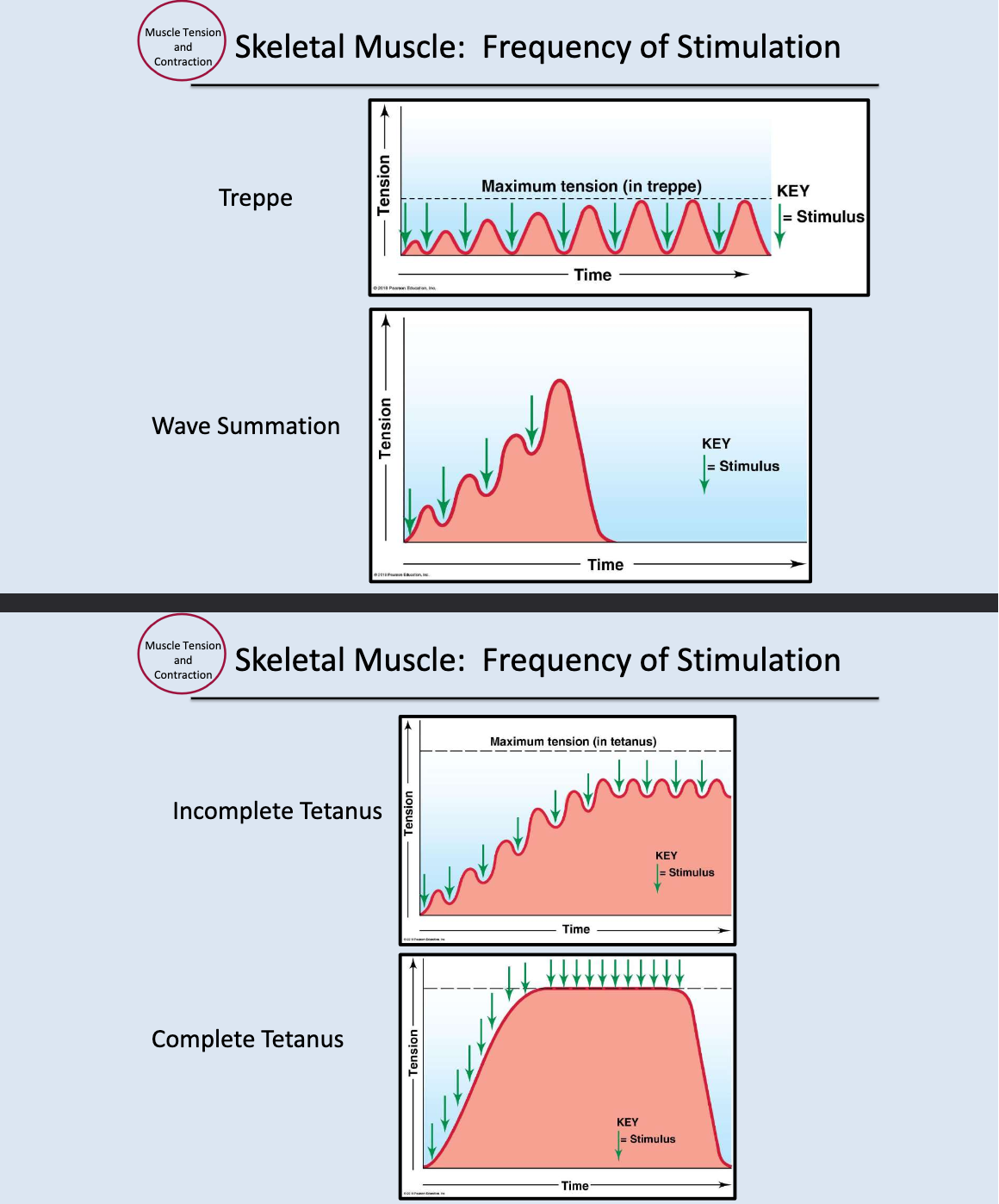
Four types of skeletal muscle frequencies of stimulation are, _____, _____ Summation, Incomplete _____, Complete _____.
Four types of skeletal muscle frequencies of stimulation are, Treppe, Wave Summation, Incomplete Tetanus, Complete Tetanus.
Motor _____ is all the muscle fibers controlled by a single motor _____.
Motor unit is all the muscle fibers controlled by a single motor neuron.
Motor unit recruitment is the _____ of more motor units to produce more _____.
Motor unit recruitment is the activation of more motor units to produce more tension.
Asynchronous motor unit summation is when the motor units activated on _____ basis to maintain sustained _____.
Asynchronous motor unit summation is when the motor units activated on rotating basis to maintain sustained contraction.
Muscle tone is resting _____ in a skeletal muscle.
Muscle tone is resting tension in a skeletal muscle.
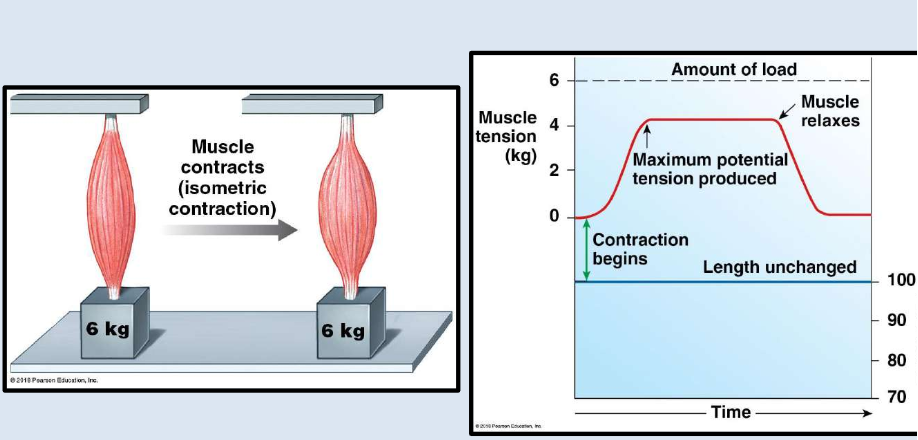
In a concentric contraction, the muscle tension _____ the load, and the muscle _____. Bicep curl going _____.
In a concentric contraction, the muscle tension exceeds the load, and the muscle shortens. Bicep curl going up.
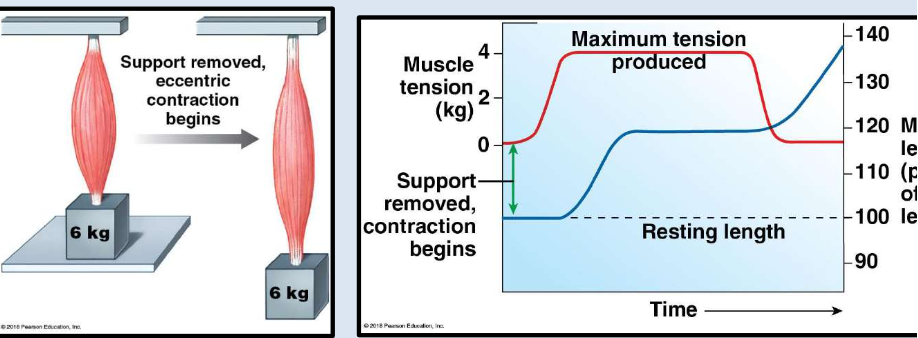
In an eccentric contraction, the peak tension developed is less than the _____, and the muscle _____ because of the contraction of another muscle or the pull of gravity. Bicep curl going _____.
In an eccentric contraction, the peak tension developed is less than the load, and the muscle elongates because of the contraction of another muscle or the pull of gravity. Bicep curl going down.
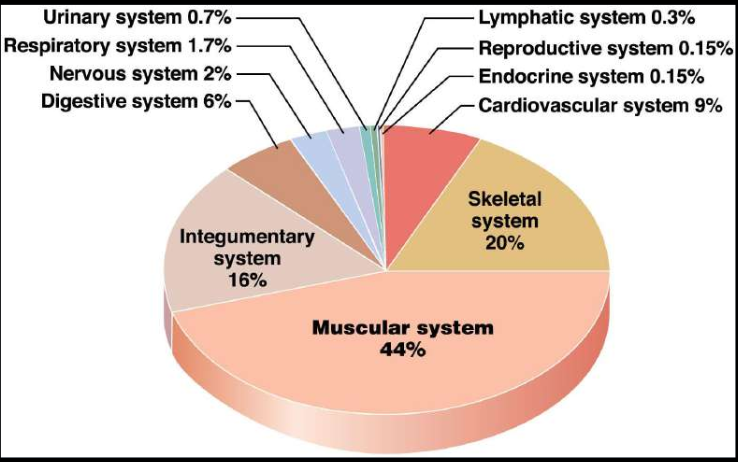
The muscular system makes up half of our body weight, more than any other organ system. Contains ~700 muscles, performance varies by fiber organization and skeletal attachments.
The muscular system makes up half of our body weight, more than any other organ system. Contains ~700 muscles, performance varies by fiber organization and skeletal attachments.
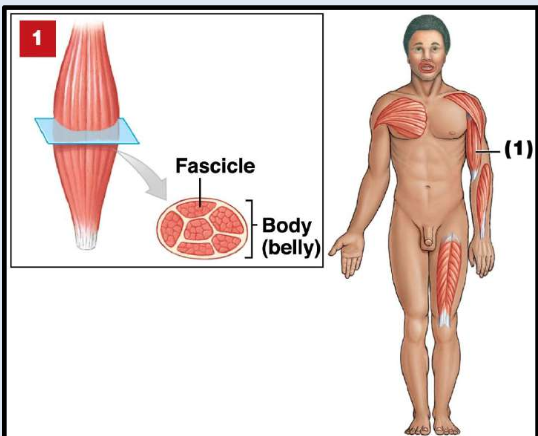
Four patterns of fascicle organization, _____, _____, _____ and _____.
Four patterns of fascicle organization, parallel, convergent, pennate and circular.
In a parallel muscle, the fascicles are _____ to the _____ axis of the muscle. such as the _____ and brachii, Has central body, muscle shortens ~__%.
In a parallel muscle, the fascicles are parallel to the long axis of the muscle. such as the biceps and brachii, Has central body, muscle shortens ~30%.
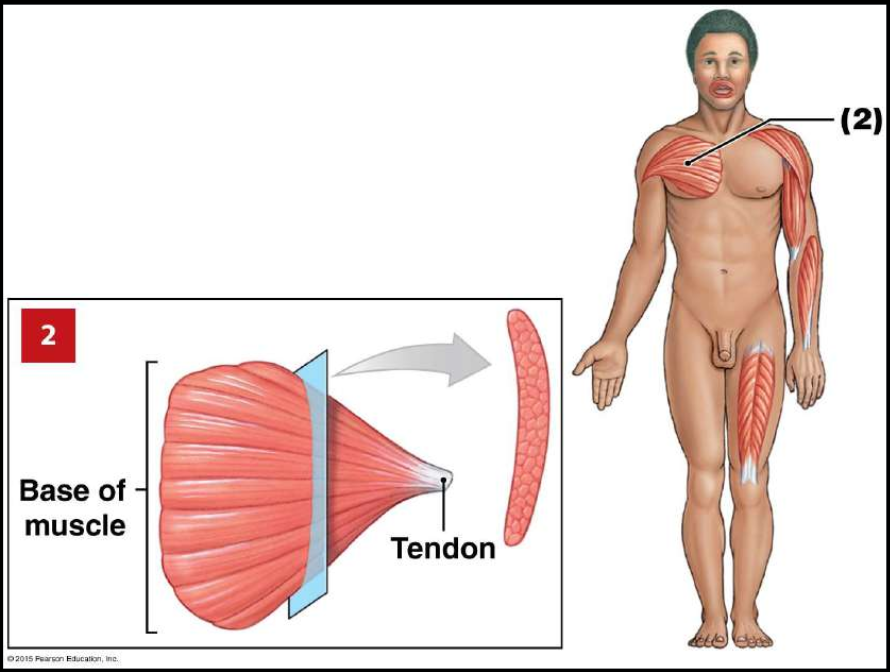
Convergent Muscle
Fascicles extending over a _____ _____ converge on a _____ _____ site
Versatile — different parts can pull in _____ directions
Does not pull as hard on the attachment site as parallel muscles
Example: Pectoralis major
Convergent Muscle
Fascicles extending over a broad area converge on a common attachment site
Versatile — different parts can pull in different directions
Does not pull as hard on the attachment site as parallel muscles
Example: Pectoralis major
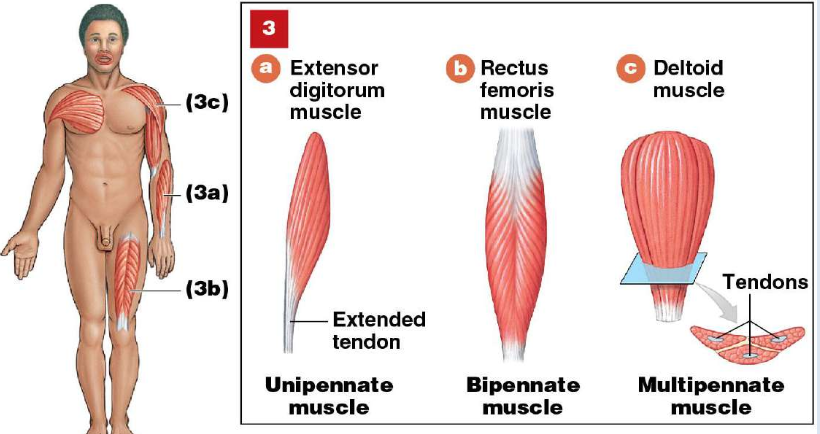
Pennate Muscle
Fascicles form an ____ with the tendon
Do not move as far as parallel muscles
Contain more ____ than parallel muscles
Develop more ____ than parallel muscles
Pennate Muscle
Fascicles form an angle with the tendon
Do not move as far as parallel muscles
Contain more myofibrils than parallel muscles
Develop more tension than parallel muscles
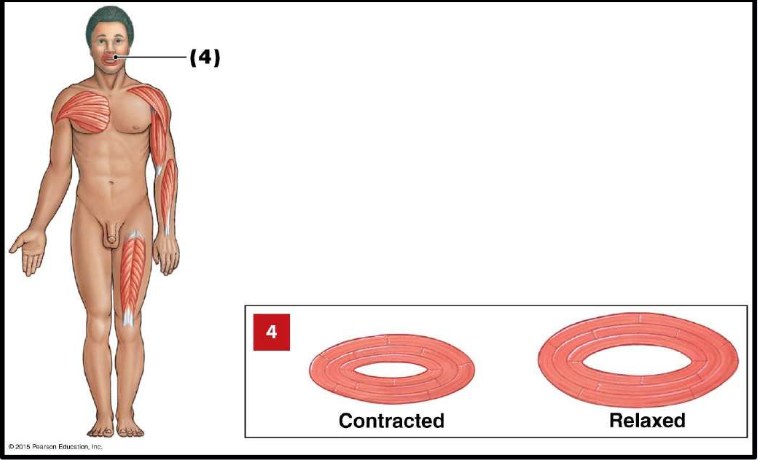
Circular Muscle
Also called sphincters
Fascicles arranged in concentric circles
Contraction decreases the diameter of an opening
Circular Muscle
Also called ____
Fascicles arranged in ____ circles
Contraction decreases the ____ of an opening
Levers
Each bone is a ____ (a rigid, moving structure)
Each joint is a ____ (the fixed point)
Muscles provide the ____ ____ (AF) required to overcome the ____ (L)
Levers
Each bone is a lever (a rigid, moving structure)
Each joint is a fulcrum (the fixed point)
Muscles provide the applied force (AF) required to overcome the load (L)
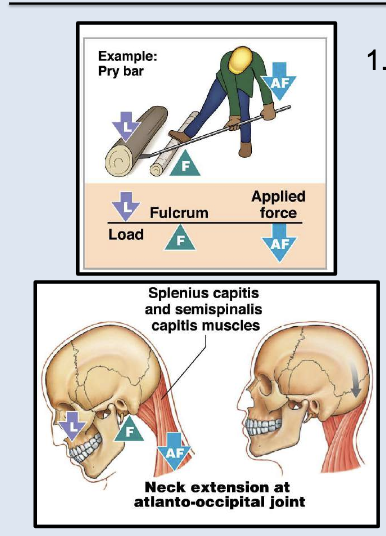
First-Class Lever (AF - F - L)
Fulcrum (F) is between the applied force (AF) and the load (L)
Acts like a ____ ____
Distance moved depends on the size of ____ and ____, and how far each is from the ____
First-Class Lever (AF - F - L)
Fulcrum (F) is between the applied force (AF) and the load (L)
Acts like a pry bar
Distance moved depends on the size of force and load, and how far each is from the fulcrum
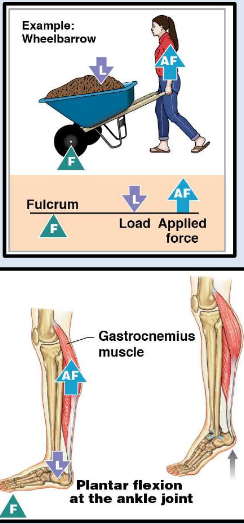
Second-class lever (F - L - AF)
____ is between applied force and ____.
Force farther away from fulcrum than load.
Small ____ moves large ____, increased effective force, but expense of ____.
Second-class lever (F - L - AF)
Load is between applied force and fulcrum.
Force farther away from fulcrum than load.
Small force moves large load, increased effective force, but expense of speed.
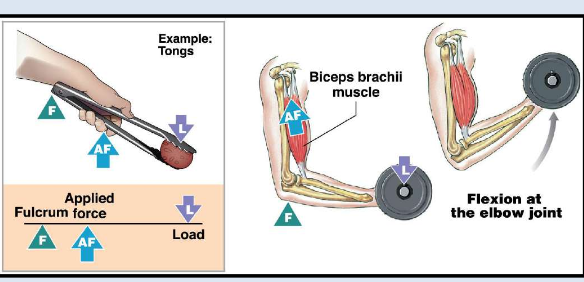
Third-class lever ( L - AF - F)
Most common ____ in body.
____ and distance are increased at expense of ____ .
Third-class lever ( L - AF - F)
Most common lever in body.
Speed and distance are increased at expense of force.
Origin is where fixed end of a ____ muscle attaches. Most of them are ____, or connective ____ sheaths, from ____ to insertion.
Origin is where fixed end of a skeletal muscle attaches. Most of them are bones, or connective tissue sheaths, from proximal to insertion.
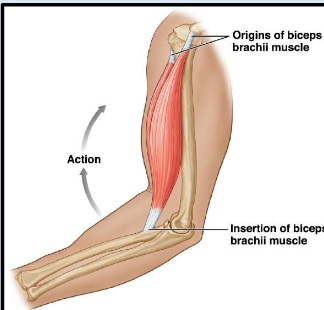
Insertion is where the ____ end of skeletal muscle attaches.
Insertion is where the movable end of skeletal muscle attaches.
____ is a specific movement produced by a skeletal muscle.
Action is a specific movement produced by a skeletal muscle.
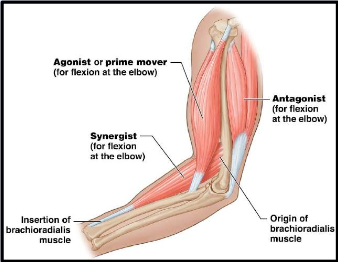
Muscle terminology consists of the ____, ____ and ____.
Muscle terminology consists of the agonist, antagonist and synergist.
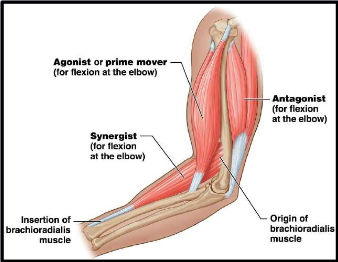
Agonist (prime mover) is a muscle whose ____ is responsible for producing a ____ ____ such as your ____.
Agonist (prime mover) is a muscle whose contraction is responsible for producing a particular movement such as your bicep.
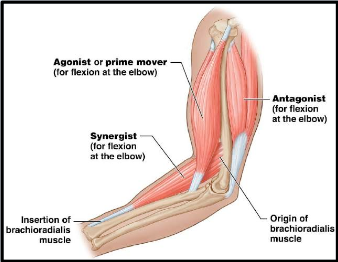
Antagonist muscles whose action ____ movement of a particular agonist like the ____.
Antagonist muscles whose action opposes movement of a particular agonist like the triceps.
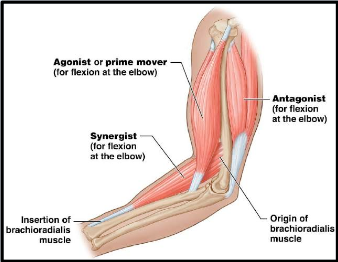
Synergist are a ____ muscle that helps a larger ____ work efficiently by providing additional pull or stabilizing the ____.
Synergist are a smaller muscle that helps a larger agonist work efficiently by providing additional pull or stabilizing the origin.