Helping behaviour studies
 Call Kai
 Learn
Learn Practice Test
 Spaced Repetition
 Match
Match Flashcards
 Knowt Play
1/14

There's no tags or description
Looks like no tags are added yet.
Name | Mastery | Learn | Test | Matching | Spaced | Call with Kai |
|---|
No analytics yet
Send a link to your students to track their progress
15 Terms
Rushton and Teachman (1978)
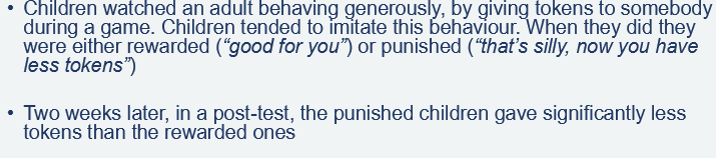
Bryan and Test (1967)

Hornstein (1970)

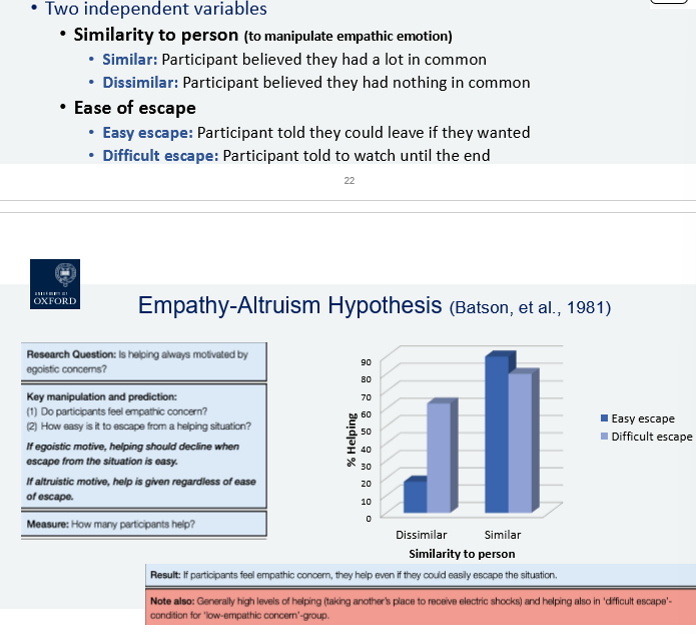
Batson et al (1981)
participants saw a confederate receive ‘electric shocks’
asked if they woul take the place of the person in next trial
Krebbs 1975
Measured the psychophysiological responses (heart rate, skin conductance, and vasoconstriction) of 60 males (average age, 20 yrs) as they observed a performer play a roulette game. 30 Ss were led to believe that they were similar to the performer in personality and values, and 30 were led to believe that they were dissimilar. 15 Ss in each condition believed that the performer won money and experienced pain as he played the game, and 15 believed that he performed a cognitive and motor skill task. Ss who observed a performer who ostensibly experienced pleasure and pain exhibited greater psychophysiological reactions than Ss who did not. Ss who believed they were similar to the performer tended to react more strongly than Ss who believed they were different from him. Similar Ss also reported identifying most with the performer and feeling the worst while he waited to receive shocks. It is concluded that the similar Ss empathized most with the performer who appeared to experience pleasure and pain. When required to make a choice between helping themselves at a cost to the performer or helping the performer at a cost to themselves, the Ss who reacted most empathically behaved most altruistically. Results cast some light on century-old questions about the human capacity for altruism
improvement on batson because recorded physiological reponses so objectively recorded empathy and less social desirability bias
still a problem with whether altruistic or egotisic
argues maybe batson is better measure for that because of the escape paradigm but arguably no because even if can leave might not make them feel better so only way to do that is by helping
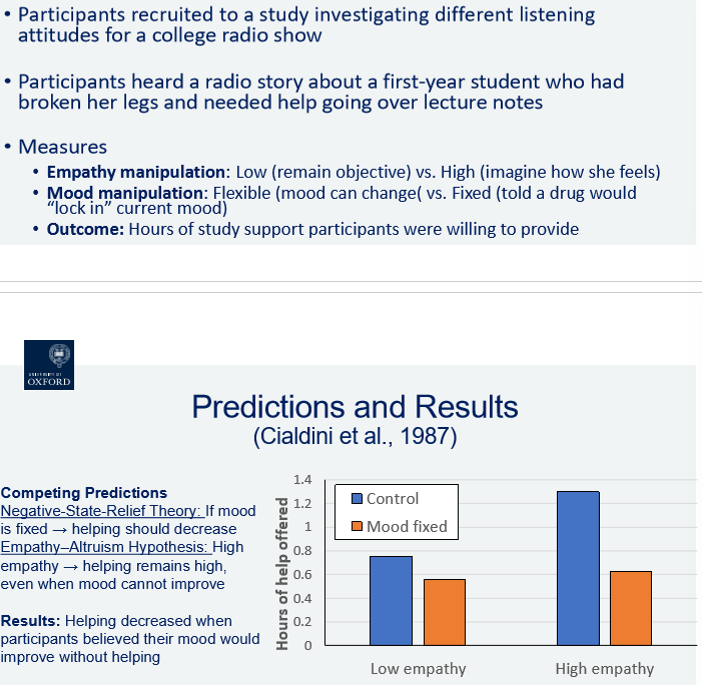
Cialdini et al (1987)
Model = person observes suffering victim then feels negative emotion (sadness) and so helps to alleviate their own sadness (unless alleviated in other way)
Fisher et al (2011)
meta analysis finding robust results for bystander effect
especially when nondangerous situations
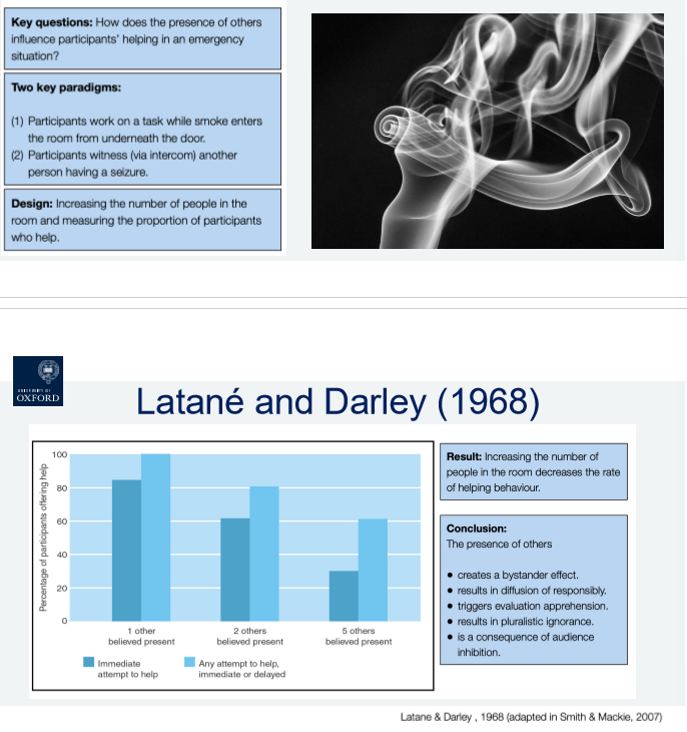
Latane and Darley (1968)
seizure condition
alone in room and communicating via intercomm
thought either with one other, two others or five
during, one participants says they are thinking they’re having a seizure
smoke condition
smoke starts coming in
Piliavin, Rodin and Piliavin (1969)
Researchers staged an emergency on a subway train.
A man would collapse in front of passengers.
They varied the type of victim, including:
A “cane” condition (looked ill, respectable- like a normal commuter)
A “drunk” condition (appeared disheveled, smelling of alcohol- closer to a stereotypical “homeless” or stigmatized person)
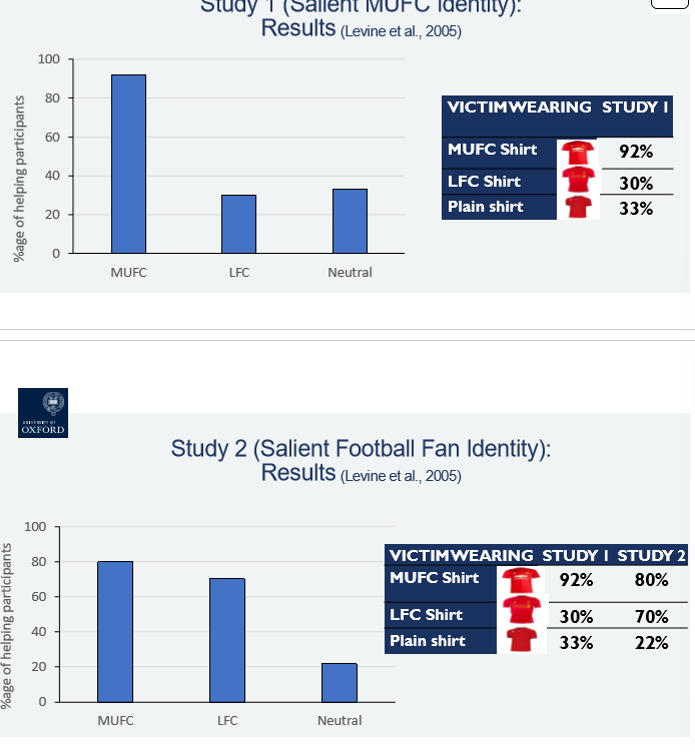
Levine et al (2005)
study of ‘football clubs and their fans’
study 1 = social identity as ManU supporter made salient
study 2 = inclusive identity as gootball fan made salient
participants asked to walk to another building
saw a jogger trip and fall, cluthing ankle in apparent pain
reponses to incident recorded by concealed observers
Pagnini et al (2025)
Lady pregnant - give seat or not
Presence of batman increases prosocial behaviour
67% vs 37%
68 batman and 70 control
68% of prosocial behaviour woman
But perhaps just reflects the composition of train
Asked why helped?
43% didn't see batman
But others could also be - surprising event meant more alert so more noticed her
These findings suggest that unexpected events can promote prosociality, even without conscious awareness, with implications for encouraging kindness in public settings
Bateson et al (2006)
Honesty box for coffee in kitchen
People paid nearly three times as much for their drinks when eyes were displayed rather than a control image
Fathi et al (2014)
Used pictures of watching eyes (NB is this actually being watched, or diff interpretation?)
Eye images did not make people conform more closely to the apparent norm overall.
For an apparent norm of small donations, eye images made many participants more generous than the norm.
For an apparent norm of large donations, there was an excess of participants giving zero in the no-eyes treatment, which was abolished in the eyes treatment.
Our results can be explained by a combination of watching eyes increasing prosocial motivation and reluctance to leave a donation visibly less generous than the norm
suggests is to do with pro social behaviour
Malhotra (2010)
hypothesize that pro-social behavior is linked not to religiosity per se, but rather to the salience of religion and religious norms.
Religious individuals are more likely than non-religious individuals to respond to an appeal “for charity” only on days that they visit their place of worship; on other days of the week, religiosity has no effect
the result persists after controlling for a host of factors that may influence bidding, but disappears when the appeal “for charity” is replaced by an appeal to bid for other (i.e., competitive) reasons
On Sundays, appeals to charity were over 300% more effective on religious individuals compared to non-religious individuals; on other days of the week (taken together), religious and non-religious individuals responded to such appeals almost identically
Kim, Kim, Kim (2025)
Recent studies have found that individuals with intrinsic prosocial tendencies are non-responsive to social observation in various prosocial decision tasks.
This study aimed to investigate whether individuals with intrinsic prosocial tendencies also exhibit a lack of change in their cognitive ability under social observation.
We used the Prosocial Reinforcement Learning Task (PRLT) to assess the interaction effect of social observation and intrinsic prosocial tendency on prosocial learning tendency.
A total of 102 participants were randomly assigned to either the observation or control group while performing a two-armed bandit task under self- and other-reward conditions, and their behavioral outcomes were analyzed using a reinforcement learning computational model.
Under social observation, participants who were previously less prosocial exhibited increased prosocial learning.
In contrast, those who were already more prosocial showed no significant changes in prosociality, and demonstrated only a numerical-but statistically non-significant-increase in learning for self.
Our findings revealed the differential effects of social observation on modulating one's prosociality and cognitive ability according to individual differences in intrinsic prosocial tendencies.
shows that ID matter and a group increase could just be down to the people who were worse initially