AP HUGE Unit 2: Population & Migration Patterns & Processes
 AP Practice
 Call Kai
1/108

Earn XP
Name | Mastery | Learn | Test | Matching | Spaced | Call with Kai | Chat |
|---|
No analytics yet
Send a link to your students to track their progress
109 Terms
Demography
The statistical study of population and its change
Population Distribution
The pattern in which humans are spread out on Earth’s surface
Eurasia
A massive piece of land on Earth that consists of Europe, with just under 10 percent of the human population, and Asia, which accounts for almost 60 percent of humanity
Ecumene
The portion of Earth’s surface with permanent human settlement
Population Clusters
Heavily populated areas that illustrate the unevenness in global population distribution; geographers have identified four population clusters on Earth: South Asia, East Asia, Southeast Asia, and Europe
Metacity
A city with more than 20 million residents
Megacity
A city with more than 10 million residents
Developed (or Industrialized) Country
A country with an advanced economy and a high standard of living
Developing (or Industrializing) Country
Countries that are of relatively low income or economically poorer than developed countries
Snow Belt
States located in the northern and midwestern parts of the country
Sunbelt
States in coastal areas and the South and Southwest
Mean Center of Population
The balancing point given the distribution of population
Population Density
The average number of people per unit of land area
Arithmetic (Crude) Density
The average number of people per unit of land area (usually per square mile or kilometer)
Physiological Density
The average number of people per unit area (a square mile or kilometer) of arable land
Arable Land
Land suitable for cultivation
Agricultural Density
The number of farmers per unit of arable land
Carrying Capacity
The number of people a particular environment or Earth as a whole can support on a sustainable basis
Human Well-being
The state of being comfortable, healthy, or happy
Population Composition
The makeup of the population by age andsex as well as by ethnic, racial, income, and educational background
Age Structure
Refers to the breakdown of a population into different age groups or cohorts
Dependency Ratio
The number of dependents in a population, that each 100 working-age people (ages 15 to 64 years) must support
Youth Dependency Ratio
The number of young dependents in a population (usually people younger than 15 years of age) that every 100 working-age people (ages 15 to 64 years) must support
Elderly Dependency Ratio
The number of elderly dependents in a population (usually people older than 64 years of age) that every 100 working-age people must support
Generations
Groups of people who were born around the same time and share some common traits due to the cultural and societal influences they shared as they grew up
Baby Boomers
People born from 1946 to 1964 during the post-World War II uptick in birth rate
Generation X
People born between 1965 and 1980 and are now in their prime working years
Generation Y (Millenials)
People who were born between 1981 and 2000
Generation Z
People born after the turn of the twenty-first century
Sexx Ratio
The ratio of the number of men to number of women in a population
Androcentrism
A phenomenon in which a culture demonstrates a marked preference for males
Infanticide
The practice of killing infants
Population Pyramid
A very useful graphic device for comparing age and sexstructure
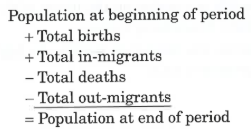
Demographic Equation
The method for calculating total population of a country or place based on natural increase and migration over a period of time (usually a year)
Crude Birth Rate (CBR)
The average number of births per 1000 people; the traditional way of measuring birth rates
(Total # of live births in a year / total midyear population ) * 1000 = CBR
Low Birth Rtae
A crude birth rate between 10 and 20 births per 1000 people
Transitional Birth Rate
A crude birth rate between 20 and 30 per 1000 people
High Birth Rate
A crude birth rate between 30 per 1000 people
Total Fertility Rate (TFR)
The average number of children born per woman during her reproductive lifetime, considered to be from 15 to 49 years of age
Replacement Level Fertility
The average number of children needed to replace both parents and stabilize population over time (TFR = 2.1)
Gender Roles
Culturally specific notions of what it means to be a man or woman
Crude Death Rate (CDR) or Mortality Rate
The number of deaths per year per 1000 people
(Total # of deaths in a year / total midyear population ) * 1000 = CDR
Infant Mortality Rate (IMR)
A measure of how many infants die within the first year of their life per 1000 live births
Child Morality
Deaths of children under five years of age
Rate of Natural Increase (RNI)
The difference between the number of births and deaths in a given year, when expressed as a percentage of total population
(CBR - CDR) / 10 = RNI
Zero Population Growth (ZPG)
When a country has the same number of births and deaths in a given year, its RNA is zero
Doubling Time
The number of years it takes for a population to double in size
Rule of 70
A tool for calculating the doubling time of a population by dividing 70 by a country’s rate of natural increase
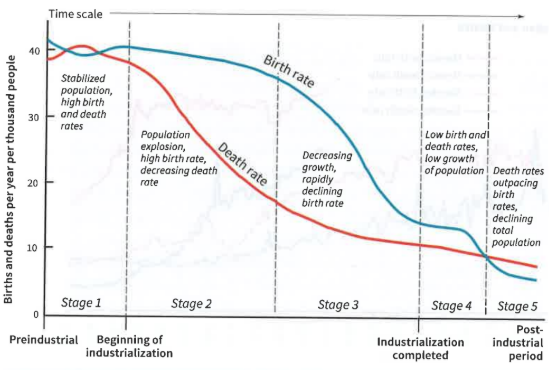
Demographic Transition Model (DTM)
Conceptualizes how CBR and CDR as well as the resulting RNI change over time as countries go through industrialization and urbanization
Epidemiology
A branch of medicine that studies the distribution, determinants, and control of diseases and other health conditions, such as tobacco use and sedentary lifestyle
Epidemiological Transition Theory
Seeks to explain how changes in health services and living standards affect patterns of disease
Degenerative Disease
A disease that causes deterioration over time, such as cancer, heart disease, and stroke
Malthusian
A term derived from the name Thomas Robert Malthus, an English economist and cleric, to mean either “of or relating to Malthus’s Theory” or “a follower of Malthus”
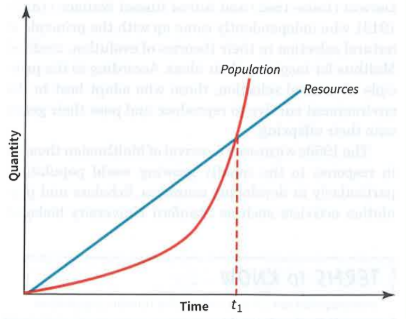
Overpopulation
Occurs when the human population exceeds the food supply
Neo-Malthusians
People who today subscribe to the Malthusian view of population
Cornucopians or Anti-Malthusians
People who disagree with the Malthusian view of population and resources
Boserup Effect
Increase in food production resulting from the use of new farming methods
Antinatalist Policies
Designed to curtail population growth by reducing fertility rates
Pronatalist Policies
Designed to boost fertility rates and ultimately population growth
Women’s Status
The degree of equality between men and women with respect to access to and control over both physical and social resources in the family, community, or society at large
Women’s Empowerment
The increased autonomy of women to make choices and shape their lives
Aging Population
A population of a country or place that ages as the number or proportion of its elderly people increases
Median Age
The age that divides a population into two halves so that one half is younger than this age and the other half older
Spatial Mobility
All forms of geographical movement, including people’s everyday commuting and travels
Social (Upward) Mobility
Mobility that implies a change in social hierarchy
Migration
The long-term or permanent relocation of individuals, families, or entire communities from one place to another
Migrant or Mover
A person who migrates or moves
Non-Migrants or Stayers
People who do not move
Origin
A person’s location before migration
Destination
The place where the migrant is going
Emigration or Out-Migration
The act of a migrant leaving their place (country) of origin
Emigrants or Out-Migrants
People who leave their country of origin
Immigration or In-migration
The act of a migrant arriving at their destination country
Immigrants or In-migrants
People who arrive at their destination country
Migration Stream
The flow of all migrants from an origin to a destination
Counterstream
The flow of all migrants in the direction opposite a particular migration stream, from its destination back to the origin
Net Migration
The difference between the number of in-migrants and out-migrants
Net Migration Rate (NMR)
A gauge of the impact of migration on population change, determined by dividing a country’s net migration by its total population, then multiplying by 1000
Migration Age Profile
The relatively stable relationship between the odds of migration and age across different countries
Brain Drain
A phenomenon where a country or a place loses young, more educated, and skilled people through migration
Brain Gain
A phenomenon where a country or a place gains young, more educated, and skilled people through migration
Push-Pull Theory of Migration
Theory asserting that two contrasting sets of factors are at work in migration decisionsP
Push Factors
Factors that cause people to be dissatisfied with their present locales and want to move somewhere else
Pull Factors
The attributes of other places that make them appealing to potential migrants
Intervening Obstacles
The complications that potential migrants will need to overcome to reach their destination
Social Networks
People’s friends and relatives
Intervening Opportunity
A nearby attractive locale where migrants may decide to settle instead of going to the intended destination farther away
Voluntary Migration
Migration that is done willingly
International Migration
When moves are made across national borders
Guest Worker
Person with temporary permission to work in another country
Transnational Migration
When migrants move back and forth between their home countries and those to which they have migrated
Internal Migration or Interregional Migration
When people move within the borders of a country
Great Migration
The twentieth-century movement of 6 million African Americans from the rural southern states to the cities of the midwestern and northeastern states
Rural-to-Urban Migration
When people move from the countryside to cities
Residential Mobility
Moves that occur within a metropolitan area
Step/Stepwise Migration
Migration carried out in a series of stages, usually from nearby to bigger and more distant places
Chain Migration
The process by which some people’s migration to a new place leads their family members, friends, and others to move to the same place
Return Migration
Migrants going back, or returning, to their previous place of residence or origin
Black Belt
Ethnic homeland in the U.S. South
Seasonal Migration
Migration based on the time of year