Ethics
 Call Kai
 Learn
Learn Practice Test
 Spaced Repetition
 Match
Match Flashcards
 Knowt Play
1/24

There's no tags or description
Looks like no tags are added yet.
Name | Mastery | Learn | Test | Matching | Spaced | Call with Kai |
|---|
No analytics yet
Send a link to your students to track their progress
25 Terms
patient autonomy
right to self-determination in light of personal interests including goals, preferences, and concerns for one’s family
beneficence
promoting good
non-maleficence
avoiding harm
Physician Order for Life Sustaining Treatment (POLST) form
an order that reflects the patient’s goals and wishes for inpatient and outpatient medical care.
Who should I approach for advance care planning?
Chronic progressive and terminal illness
Severe, recurrent psychiatric illnesses
Debility/frailty (e.g., those at risk for delirium associated with an acute illness)
Engaging in risky behavior that is associated with head trauma and coma (e.g., riding a motorcycle without a helmet, riding in cars without seat belts)
Early dementia
At risk for strokes (e.g., those with hypertension)
living will
A living will is a legal document that dictates your preferences for life-sustaining medical treatments—such as ventilators, feeding tubes, and CPR—if you become terminally ill or permanently unconscious and cannot communicate your wishes. It ensures your health care aligns with your personal values
Advance directives fall into two broad categories
instructive and proxy
Instructive directives
allow for preferences regarding the provision of particular therapies or classes of therapies. ie No CPR and living wills
proxy directive
allows for the designation of a spokesperson or surrogate medical decision maker of the patient's choosing. ie Durable Power of Attorney for Health Care (DPAHC)
mental health directive or psychiatric advance directive
the patient informs health care providers about their preferences for future mental health care if s/he were to become decisionally incapacitated.
Robert Buckman's Six Step Protocol for Breaking Bad News
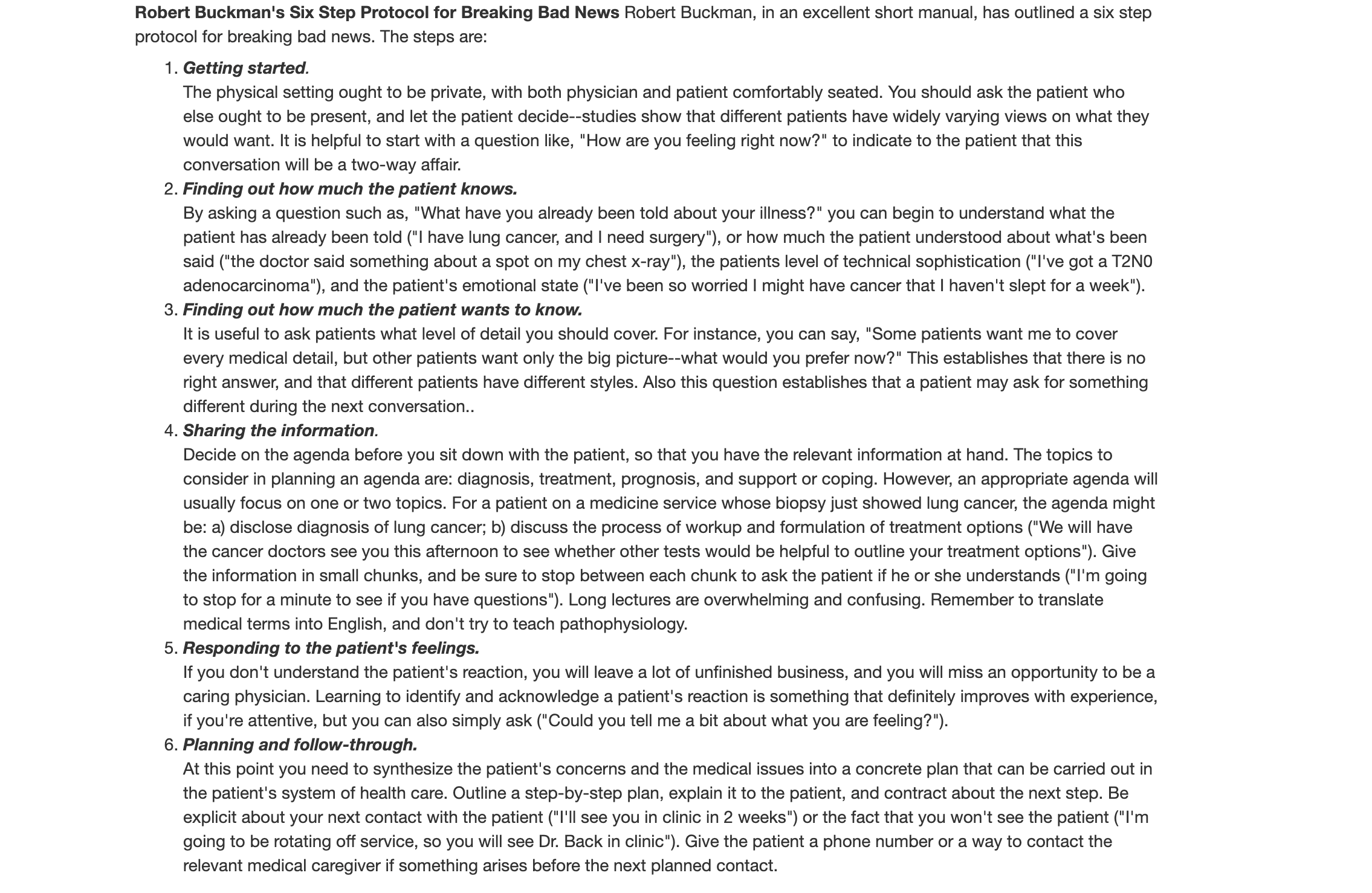
What to say when a patient is crying?
Let's just take a break now until you're ready to start again. Also grab a box of tissues.
I just saw another caregiver tell something to my patient in a really insensitive way. What should I do?
ask yourself why the encounter went badly? If you see the patient later, you might consider acknowledging it to the patient in a way that DOESNT SLANDER THE INSENSITIVE CAREGIVER. "I thought you looked upset when we were talking earlier and I just thought I should follow up on that--was something bothering you?"
integrative medicine
an approach to patient care that fully utilizes both conventional and alternative methodologies.
Informed consent
the ethical and legal process where a healthcare provider fully educates a patient about the risks, benefits, and alternatives of a proposed medical treatment
Belmont principle of beneficence
a research study must be designed to maximize possible benefits and minimize harms
Confidentiality
It requires health care providers to keep a patient’s personal health information private unless consent to release the information is provided by the patient.
HIPAA
institutions are required to have policies to protect the privacy of patients’ electronic information, including procedures for computer access and security.
When can confidentiality be breached?
Exception 1: Concern for the safety of other specific persons, Exception 2: Legal requirements to report certain conditions or circumstances
Why is it important to respect what appear to me to be idiosyncratic beliefs?
patient trust
What are some ways to discover well known sets of beliefs?
patients and family members themselves, staff members with personal knowledge or experience, hospital chaplains, social workers, and interpreters.
What is my responsibility when a patient endangers her health by refusing a treatment?
Adults have a moral and legal right to make decisions about their own health care. The physician has a responsibility to make sure that the patient understands the possible and probable outcomes of refusing the proposed treatment. The physician should attempt to understand the basis for the patient's refusal and address those concerns and any misperceptions the patient may have. In some cases, enlisting the aid of a leader in the patient's cultural or religious community may be helpful
Can parents refuse to provide their children with necessary medical treatment on the basis of their beliefs?
Parents have legal and moral authority to make health care decisions for their children, as long as those decisions do not pose a significant risk of serious harm to the child's health. If there is harm/suffering, CPS may need to be involved
What kinds of treatment can parents choose not to provide to their children?
Parents have the right to refuse medical treatments when doing so does not place the child at significant risk of substantial harm or suffering
Can a patient demand that I provide them with a form of treatment that I am uncomfortable providing?
A physician is not morally obligated to provide treatment modalities that they do not believe offer a benefit to the patient or which may harm the patient,or if they feel incompetent. However, it is important to take the patient's request seriously, consider accommodating requests that will not harm the patient or others, and attempt to formulate a plan that would be acceptable to both the physician and patient.