immuno 4: complement
 Call Kai
 Learn
Learn Practice Test
 Spaced Repetition
 Match
Match Flashcards
 Knowt Play
1/38

There's no tags or description
Looks like no tags are added yet.
Name | Mastery | Learn | Test | Matching | Spaced | Call with Kai |
|---|
No analytics yet
Send a link to your students to track their progress
39 Terms
What is the complement system?
A rapid signaling cascade of ~20–30 proteins in serum and on cell surfaces that destroys pathogens and recruits immune responses; part of both innate and adaptive immunity.
What are the main goals of complement? (Mnemonic)
Destroy!!!
“OLD” = Opsonization, Lysis, Defense (inflammation/recruitment)
Opsonize pathogens
Lyse cells
Recruit immune cells
How are complement proteins named and activated?
Named C1–C9; most are inactive zymogens activated by cleavage in a cascade.
What happens when complement proteins are cleaved? (Mnemonic)
: “a = Away, b = Binds”
“a” = anaphylatoxins. small, soluble (inflammation)
“b” = large, binds pathogen
⚠ Exception: C2 (reversed)
What are the 3 complement pathways?
Classical (antibody)
Alternative (pathogen surface)
Lectin (mannose binding – not emphasized here)
What is shared between all complement pathways?
Same C3 activation → same terminal pathway → same functions (MAC, opsonization, inflammation)
What is opsonization in complement?
C3b and C4b coat pathogens → act as “eat me” signals → increase phagocytosis via complement receptors.
Which complement proteins act as opsonins?
C3b (most important) and C4b
What is the MAC and its function? (Mnemonic)
MAC = “Makes A hole in Cell”
C5b6789 forms pores → lyses membrane pathogens (Gram– bacteria, enveloped viruses).
What are anaphylatoxins and their function? (Mnemonic)
“C3a, C4a, C5a = A for Anaphylaxis”
Increase vascular permeability on vascular endothelial cells
Recruit neutrophils
Promote inflammation
What activates the classical pathway?
Antigen-antibody complexes (IgG or IgM).
Is the classical pathway innate or adaptive?
Adaptive-triggered (requires antibodies), but part of complement effector system.
What is required to activate C1?
Binding to 2 Fc regions of antibodies attached to antigen.
What is the classical pathway sequence? (Mnemonic)
“1-4-2-3-5-9” (weird order!)
C1 → C4 → C2 → C3 → C5–9
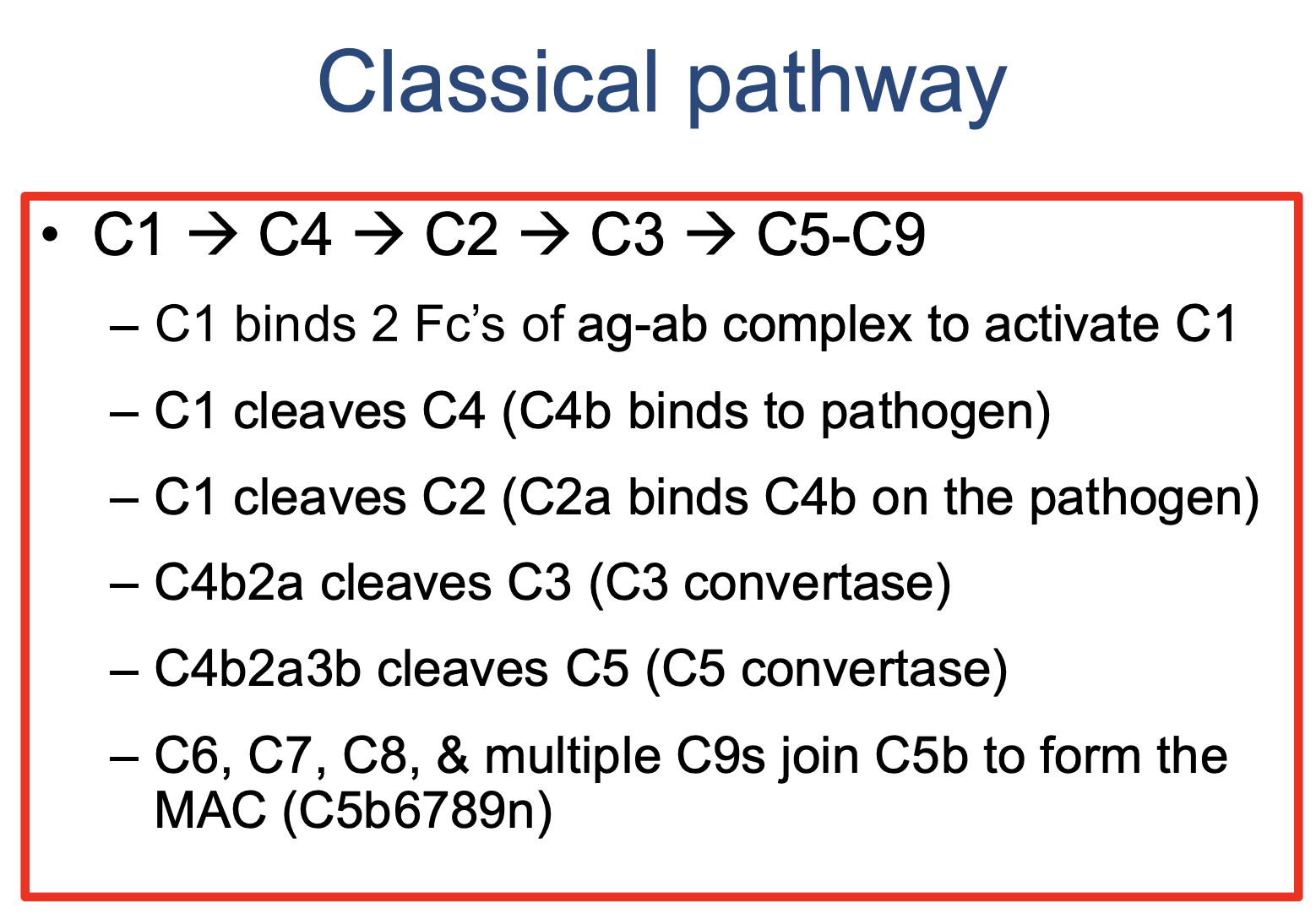
What happens after C1 activation?
Cleaves C4 → C4b binds pathogen
Cleaves C2 → C2a binds C4b > C4b2a
What does C4b2a C3 convertase do?
Cleaves C3 →
C3a (inflammation)
C3b (binds, opsonin, amplifies cascade)
What is the C5 convertase in the classical pathway?
C4b2a3b
What does C5 convertase do?
Cleaves C5 →
C5a (strong anaphylatoxin)
C5b (starts MAC formation)
How is the MAC formed?
C5b + C6 + C7 + C8 + multiple C9 → pore formation
What is the key endpoint of the classical pathway?
Pathogen death via MAC, opsonization, and inflammation
What activates the alternative pathway?
Pathogen surfaces (LPS, microbes, viruses) — no antibodies needed
Why is C3 important in the alternative pathway?
C3 is spontaneously cleaved → provides constant low-level activation.
What happens to free C3b if no pathogen is present?
It is rapidly inactivated (prevents damage to host cells).
What is the alternative pathway sequence? (Mnemonic)
“C3 → B → D → Properdin → C3 → C5–9”
Think: “3 Becomes Dangerous Properly”
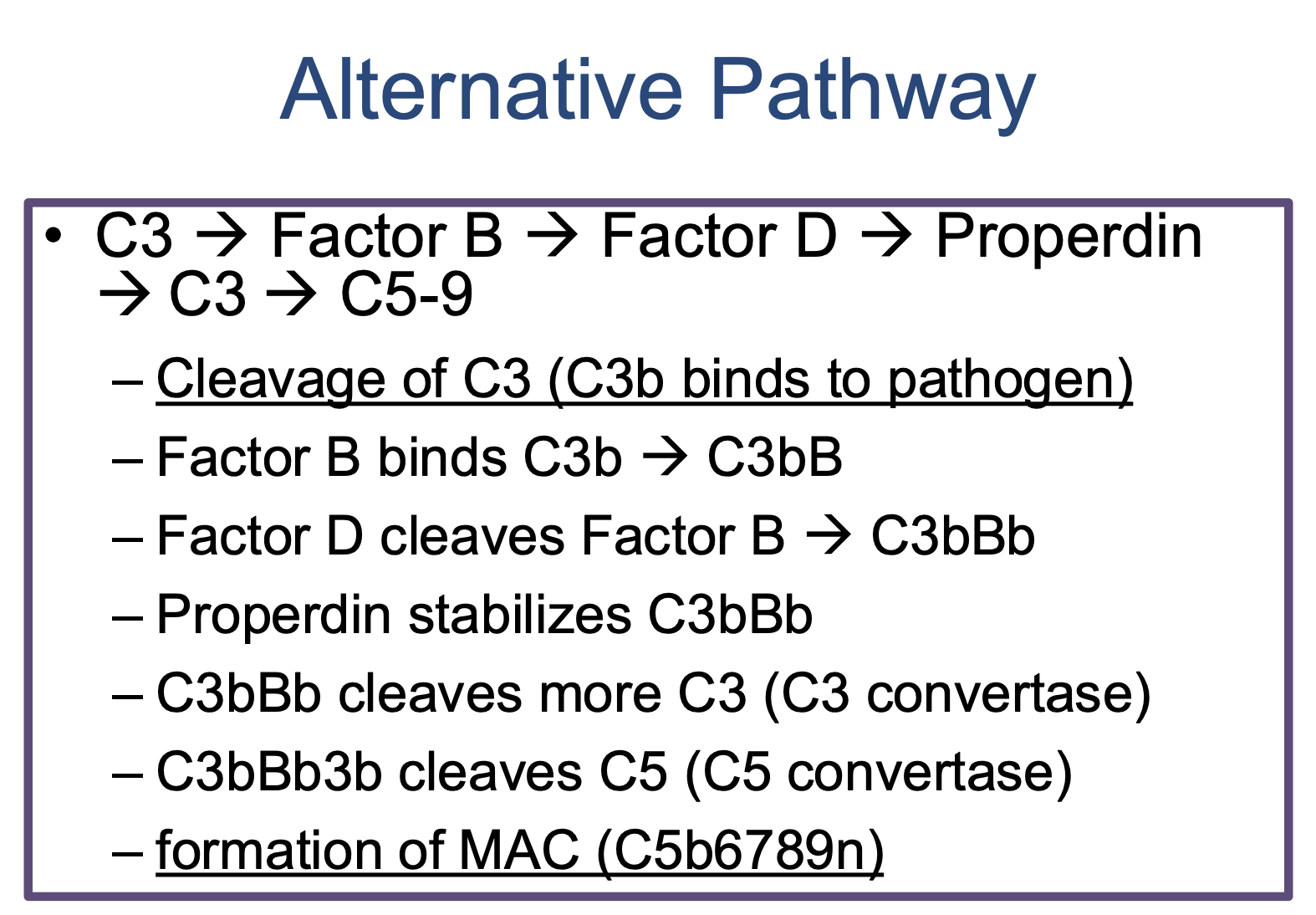
Steps of alternative pathway activation?
C3 → C3b binds pathogen
Factor B binds → C3bB
Factor D cleaves → C3bBb (C3 Convertaase)
Properdin stabilizes
What is the C3 convertase in the alternative pathway?
C3bBb
What is the C5 convertase in the alternative pathway?
C3bBb3b
Final outcome of alternative pathway?
Same as classical → MAC formation (C5b6789)
Why must complement be regulated?
To prevent damage to host cells from uncontrolled activation.
What inhibits the classical pathway?
C1 inhibitor (C1INH) → blocks C4 and C2 cleavage.
How is C3 activity regulated?
Factor H + Factor I → inactivate C3b.
How is MAC formation inhibited?
Protectin (CD59) → prevents C9 recruitment.
What is the most important central component of complement?
C3 — all pathways converge here.
What are the 3 major outcomes after C3 activation?
C3b → opsonization
C3a → inflammation
C5b → MAC
Which complement fragment is the strongest chemoattractant?
C5a
Which pathogens are most susceptible to MAC?
Gram-negative bacteria + enveloped viruses
What cells respond to complement opsonization?
Macrophages and neutrophils via complement receptors.
Key difference: classical vs alternative pathway?
Classical = antibody-dependent
Alternative = antibody-independent (innate)
Ultimate purpose of complement system?
Rapidly tag, recruit, and destroy pathogens through coordinated immune amplification.