Psyc132 Study Guide
 Call Kai
 Learn
Learn Practice Test
 Spaced Repetition
 Match
Match Flashcards
 Knowt Play
1/70

There's no tags or description
Looks like no tags are added yet.
Name | Mastery | Learn | Test | Matching | Spaced | Call with Kai |
|---|
No analytics yet
Send a link to your students to track their progress
71 Terms
What is the Paradox of Perception?
Fundamental conflict between our immediate convincing sensory experience of reality and the scientific reality that perception is subjective
What we perceive is not actually accurate sometimes; context
Why does perception seem “easy”?
We have lots of prior knowledge and many dedicated neural systems devoted to making perception feel “easy”
Recognizing and processing a scene involves a LOT of knowledge and neural machinery
What we perceive, is influenced by our brain’s assumptions and by our existing knowledge
Unconscious Inference (What does it mean? What are Examples?)
What: Helmholtz; rapid, involuntary, unconscious high level choices made by visual system to organize input from eyes into a coherent scene thru inferences and past experience
Example: Depth Perception: assuming a distant object which appears small is actually large based on distance cues
Occlusion: recognizing an object is fully formed even when partially blocked
Brightness & Depth Illusions: What makes these ambiguous problems?
Strong assumptions about how light works in the world
AKA physics built into our brain
For example: lighting almost always varies smoothly (except shadows)
Your brain also knows how shadows work (i.e. a bright square in a shadow sends the same amount of information to your eye as a dark spot in no shadow does)
If we remove the lighting/shadow cues your brain is using, we simply perceive the actual color (which is the same for both squares)
Use context to recognize objects
Anatomy of the Eye
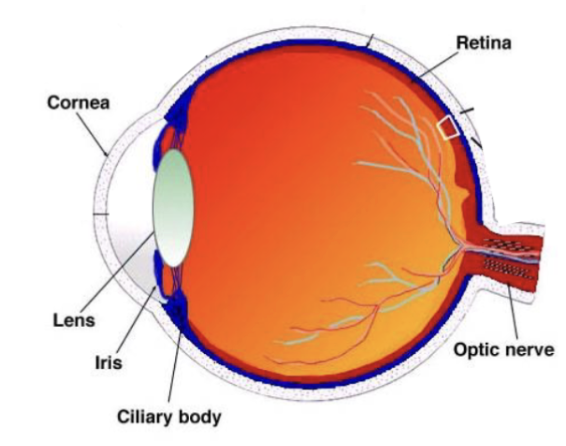
Problems of the backwards design of the eye: Lens Focusing
the lens has to focus the light on the back of the retina correctly
myopia (nearsighted): lens is not properly focusing image onto the back of the eye
Hyperopia (farsighted): behind retina
Astigmatism: asymmetry, projection is tilted
Problems of the backwards design of the eye: blind spot
A mechanical problem with your eye, that your brain ‘fixes’ by filling in your perception with what it thinks is most likely in that spot in the world
Optic Nerve
where visual information exits the eye and travels to the brain (area on the retina with no photoreceptors! Leads to a blind spot)
Problems of the backwards design of the eye: Fading (Adaptation)
Adaptation: If something is faint & never changes, you stop seeing it ()
Problems of the backwards design of the eye: motion-induced blindness
Even if it isn’t faint, if it doesn't move with the world, you stop seeing it
Stationary objects in a moving world tend to fade from our awareness, as our brain thinks those objects are in our eyeball, and not important for us to perceive
Different Distributions of rods and cones
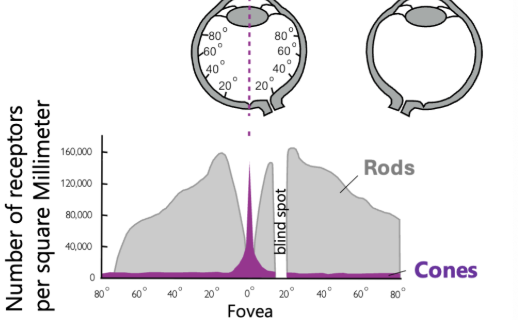
Rods and Cones
Cone (color vision)
Rod (monochromatic vision)
The retina has receptors (rods & cones) that capture light energy, and transform it into neural activity (action potentials)
Rods, cones, and afterimages
We have selective motion cells that care about particular directions of motion
Cells that respond selectively to motion directions
This means we can adapt to motion and get afterimages just like color
Pathway: ? → ? → ?
Enters the eye, captured by photoreceptors located at the back of the retina,
passes through other cells in the retina (on/center, off/surround cells),
then exits the eye via the optic nerve.
Travels thru the LGN (on/center, off/surround cells)
and lands in primary visual cortex (V1)
LGN Cells
Cells encode where light changes
This cell fires only when light shines on the middle of the receptive field
This cell will not fire if light shines on its entire receptive field
Simple Cells
Orientation and position selectivity (predicted from the arrangement of on and off areas)
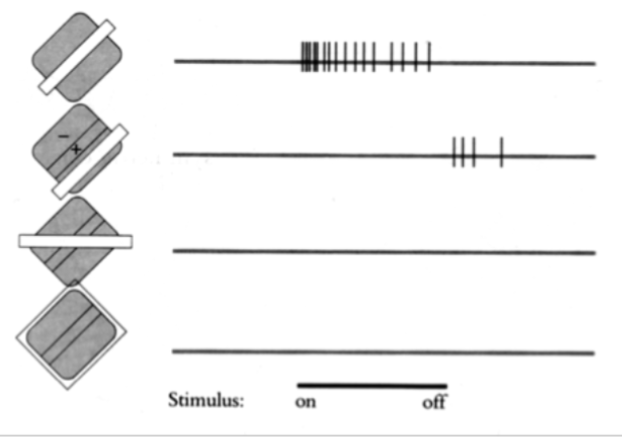
Complex Cells
Generalizes orientation selectivity over an extended region, unlike a simple cell that only respond to a bar in exactly the right spot
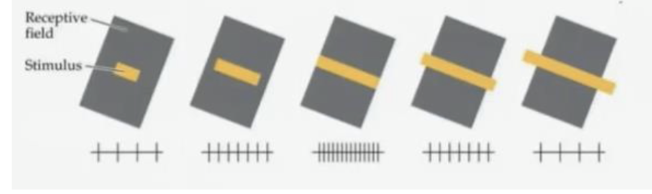
Hypercomplex Cell
Lines that end at exactly the right place codes stimulus size (angles, corners, end of line) = response strength decreases if a stimulus (a line) extends beyond a certain length
Is also sensitive to orientation, motion, and direction
Feature Hierarchies: How does each cell type build on the next?
You can build a simple cell by making it fire if and only if all of the LGN cells, arranged like on the left, fire
You can build a complex cell by making it fire if any of the simple cells, arranged in a line, fire
Photoreceptors → Retinal Ganglion cells → LGN Cells → Simple Cells → Complex Cells → Hypercomplex cells/ end/stopped
Area MT
specific motion-processing area
Special machinery to detect smooth motion
It takes time to process things in the brain
Area MT cares about things moving smoothly, and tries to project the motion about 100ms into the future
Area MT is helping us perceive the world all of the time
Cues to Monocular Depth
Shadows
Perspective
Occlusion
Motion Parallax: we view objects as moving faster than objects that are further away from us
Amodal Completion: We use depth cues and occlusion to help recognize objects – we “compete” occluded back surfaces, but not ones that appear to be in front
Grandmother Cells (Feature Hierarchy) & Main Challenge
Allows for rapid matching of visual input
But they’re not very flexible, so we’d need SO many
Geons/Alphabet View and Challenge of Feature Hierarchy
Combination of component geons defines an object
Solves computational explosion problem
Don’t need a separate template for object
Computational Explosion
If we had a detector for every different object in every pose and from every angle in every lighting condition, we’d need infinite detectors
Ventral vs. Dorsal Pathways
Dorsal, to parietal lobe for location, action, navigating, grasping (motion)
Ventral, to inferior part of temporal lobe for object recognition (perception)
Ventral Visual Pathway: What do LOC cells respond to?
cares about basic shapes
LOC responds mostly to intact and lightly scrambled images that show object ‘parts’
Ventral Visual Pathway: What happens when LOC is damaged?
Visual agnosia
A condition in which a person can see but cannot visually recognize objects
Cannot tell WHAT the object is, but can still tell you the task you do with the object or the function of it
Visual agnosia vs. something else
A patient with visual agnosia will not be able to VISUALLY recognize an object, but they can recognize it if they bypass their damaged LOC and pick it up
How does TMS work
Transcranial Magnetic Stimulation (TMS) is a giant magnet that disrupts neural firing temporarily it ccan allow researchers to localize function
What interesting aspects of vision do action patterns reveal?
There appears to be a dynamic interplay between perception and action, where action doesn’t ‘wait’ until we’ve finished perceiving the world, but is continuous accumulating evidence
How is action fundamental to how we learn and see?
Motion is relevant to how we learn what an object is
Most movement on your retina is caused by your own motion
Kitten Carousel
Passive kitten has the same visual experience as the Active kitten but only the active kitten CAUSES any change in visual experience
Cats with the same exact visual experience and motion experience were very different
“Active” cat saw normally (e.g., did not walk off the visual cliff)
“Passive” cat was severely impaired (walked off cliff, etc.)
Which experiment helped discover location processing in the dorsal stream
Mishkin and Ungerleider Lesion on Monkeys
Temporal lobe removed - object discrimination: find food under particular object
Parietal Lobe removed - Landmark/location Discrimination: find food near landmark
Patient DF as Evidence for 2 Visual Systems
Suffered CO intoxication
Caused damage in her ventral pathway, but spared her dorsal pathway
Activation to object images. The control shows a lot of activation in the ventral stream (red slice) to seeing objects. DF did not
Object agnosia
Dissociation in hand & eye movement as evidence for 2 visual systems
Ebbinghaus Illusion
Fingers grasped (action) the correct shape, even though you said it LOOKED (perception) like a different shape
Object Agnosia
Couldnt match something she was holding to something she was looking at
But when performing the action, she could align the object to the slot
Bad at “perceptual matching” but as good as normal in “active matching”
Suggests that the dorsal stream has its own shape analysis, meant to accurately guide attention and actions
Why are we so good at seeing faces? Signal Detection Theory
Framework to help think about how our brain makes decisions in noisy (i.e., incomplete) environments
Information coming into our senses is not enough to know what’s out there in the world, so our brain is getting ‘noisy’ or incomplete information. It is trying to figure out the signal (what is actually out in the world) from this incomplete information/
Signal detection theory can help us visualize this process & understand why we are so sensitive to faces
What does FFA care about?
located in the fusiform gyrus) is responsible for the holistic (or configural) information, meaning that it puts all of the processed pieces of the face together
Processes and judges the spacing and configuration of the parts of the face to determine identity
Important for recognizing identity (& only works for upright faces)
What does OFA care about?
The occipital face area (OFA – located in the occipital lobe) recognizes the parts of the face at the early stages of recognition (doesn’t care about where)
What area does fSTS care about?
The superior temporal sulcus is involved with perception of gaze
Also involved with perception of biological motion
How are these regions studied? How can they be dissociated in an experiment?
Specific types of illusions/images
i.e. margaret thatcher illusion for FFA,holistic face processing (the whole is greater than the sum of its parts)
Are we born with regions in our brain that care about faces (are they innate)?
Just because something has a dedicated brain region, doesn’t mean it is innate
Characteristics of attention: Selective
We have the impression of a complete representation of the visual world at all times
But really it’s like a crowded cocktail party – you only hear your own conversation. You also only see what you explicitly attend
Characteristics of Attention: Capacity
inattention blindness, we cannot process everything at once attention selects the information
Characteristics of Attention: Limited
visual perception is limited, like the cocktail party effect
you only hear your own conversation. You also only see what you explicitly attend
Inattentional Blindness
When we attend one thing, we often miss other things especially if they are unexpected
We all believe we see everything especially unexpected things
What we are paying attention to = what we see
Attentional Set in the Lab
How likely are participants to see the cross appear on the screen ,depending on what color they were paying attention to (Most et al. 2005 what you see is what you set)
Group A: attend white shapes
Reported seeing the cross more when it was white (or close to white)
Group b: attend black shapes
Reported seeing the cross more when it was black (or close to black)
Critical trail: a unique cross shape appears on the screen
Results: noticing an unexpected object is heavily dependent on its similarity to the items being tracked (set)
Are experts immune to the effects of inattentional blindness/ attentional sets?
No (radiologist gorilla study)
Involuntary vs Voluntary Attention
Involuntary: some features or events grab our attention reflexively
Voluntary: focusing on something in a controlled manner; even without moving your eyes
Covert Attention
Moving our attention without moving our eyes (object of your attention is in your peripheral vision)
How attention influences single-neuron responding
Researchers recorded from a single neuron in V4
The neuron really likes red horizontal lines and doesnt like vertical green lines
Neuron’s response is “biased” towards attended stimulus (e.g., individual neuron response is impacted by attention!)
Attentional effects in early visual processing
refer to how focusing attention on a location or feature modulates initial neural activity in the visual cortex
enhancing perception of relevant stimuli and suppressing irrelevant ones
these effects often involve enhancing contrast sensitivity, increasing neural firing rates, and speeding up processing for attended objects
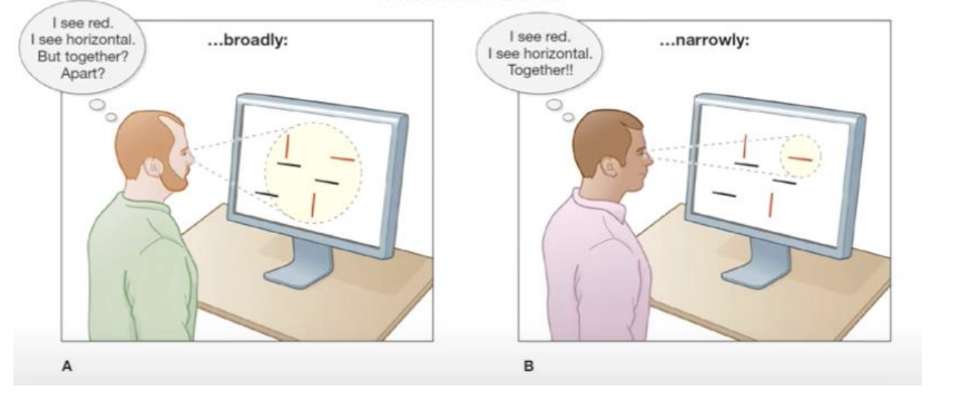
Visual Search: Why are conjunction searches more difficult than pop-out searches? — Feature Integration Theory
Two stages: when perceiving a stimulus, features are “registered early, automatically and in parallel, while objects are identified separately” and at a later stage in processing”
What is ensemble perception?
the average of a group of similar items; the gist (size, emotion, etc)
Visual Crowding & What it Implies
Inability to view a target stimulus distinctly when presented in a clutter
Implies limited attention, prevents precise identification of items outside of our center of gaze
How does low prevalence impact our ability to perceive & find targest?
Prevalence effects: frequency of a target item dictates how often it’s detected
Low prevalence = frequently missed, common items are spotted easily
Signal Detection Theory & How does the criterion shift in low-prevalence conditions?
Framework to help think about decisions in uncertain environments (when targets are hard to find)
Criterion shift in low prevalence: decreases false alarms, increases misses
Physical vs. Perceptual Definitions of Sound
Physical Definition: sound is pressure changes in the air (or other medium)
Perceptual Definition: sound is the experience we have when we hear
Characteristics of soundwaves: amplitude
Different sound sources, even playing the same note (pitch) at the same loudness (amplitude), sound different
Characteristics of soundwaves: frequency
the number of vibrations or cycles a soundwavae completes per second; determines pitch
Structure & Function of Outer Ear
Pinna: collects sound & funnels it into external auditory canal
Helps with sound localization
Ear canal: conducts sound from pinna to tympanic membrane
Tympanic membrane (aka eardrum): elastic sheet that vibrates in response to sound coming through external auditory canal
Structure & Function of Middle Ear
Ossicles amplify sound: necessary so that air vibrations in outer and middle ear can lead to fluid vibrations in inner ear
Ossicles amplify sound by concentrating energy from larger to smaller surface areas
Eustachian tube connects the middle ear with the pharynx and helps equalize air pressure on either side of the tympanic membrane
Structure & Function of Inner Ear
Semi circular canals, oval window, stirrup (stapes), round window, cochlea, vestibular (balance) nerve, auditory (hearing) nerve
Transduction of the Ear
Tectorial membrane and basilar membrane move in response to the waves caused by the liquid in the cochlea
THis causes stereocilia to move and bend
Place Code Theory: Base vs. Apex
Different locations along the basilar membrane respond to different frequencies
Apex = floppy, low frequencies
Base = stiff, high frequencies (as we age, we lose higher frequencies)
Hierarchial and Tonotopic Organization of Auditory Cortex
Pathway:
The MGN relays information to primary auditory cortex in the temporal lobe
Organized hierarchically (like visual cortex)
A1 responds to any sound
Higher auditory cortex *belt & parabelt) respond to complex tones & meaningful sounds (e.g., speech)
Tonotopic organization: Neurons are organized according to the frequencies to which they respond
Where & What Pathways of Auditory Processing
Auditory information is processed in 2 streams
What: identifying sound; basis of speech & music perception
Where: sound localization
When do we use Binaural vs. Monaural cues to localize sound?
Azimuth (left-right)
Binaural cues
Elevation (up-down) & distance
Monaural cues
Interaural Time Differences; What kinds of frequencies arae they most useful for?
Uses the difference in time it takes sound to reach the left and right ears to localize sound
Interaural time difference cue is particularly effective for low frequency sounds that are coming from the left or right of us
Uses the difference in sound level (volume) that reaches the two ears (because your head blocks sound) to localize sound
Interaural Level Differences; What kinds of frequencies arae they most useful for?
Higher frequencies are more disrupted by the head than lower frequencies (so it’s easier to locate high frequency sounds using interaural level difference cues!)
Effective cue for high-frequency sounds coming from the left or right of you