Chapter 14: Chemical signals
 Call Kai
 Learn
Learn Practice Test
 Spaced Repetition
 Match
Match Flashcards
 Knowt Play
1/41

There's no tags or description
Looks like no tags are added yet.
Name | Mastery | Learn | Test | Matching | Spaced | Call with Kai |
|---|
No analytics yet
Send a link to your students to track their progress
42 Terms
hormone
chemical signal secreted into body fluids; does not need a lot to bring a response
target cells
cells that are equipped to response to hormone; in order to respond to chemical signal must have a receptor
gland cells
neurosecretory cells
epithelial cells
what glands secrete hormones
exocrine glands
glands that are ducted and releases products that are not hormones; products such as Na bicarbonate and various digestive enzymes
endocrine glands
glands that are ductless and will release hormones in the IF → capillaries → throughout the body
lipid soluble hormones
steroids from cholesterol
thyroid hormones (T3/T4)
can act in small concentrations
same hormones can have different effects on different animals
same hormone can have different targets and responses in the same mammal
have antagonistic pairs
what are the four characteristics of hormones
signal binds receptor → nucleus
binds to control region of genes
can activate or inactivate genes
signal molecule → long lived
cellular response → slow
duration of response → long term
characteristics of non-water soluble hormones (thyroxine/steroids)
signal transducers are in the membrane which change activity of proteins in cells
signal molecules are short lived
cell response is rapid
characteristic of water-soluble hormones
mRNA → cytosol → ribosome → specific protein
activation of non-water soluble hormones
receptors outside of plasma membrane have a binding site for the hormone outside (which is transmembrane)
how do water soluble hormones pass plasma membrane
hormone passes through plasma membrane
hormone binds to receptor = activation
activated receptor binds to regulatory sequence in gene
activation/inhibition
how do non-water soluble hormones bind to receptor in cell
ion-channel-linked receptor
a type of membrane receptor that are gated (neurons)
enzyme-linked receptor
the type of membrane receptor where the receptor functions directly as an enzyme or is closely linked to an enzyme
tends to be protein kinases
cellular response due to activation or deactivation of proteins in the cell
tyrosine kinase receptor
an enzyme-linked receptor that is a monomer and separates when inactive, as it needs two hormones to bind to the receptor, making two monomers sticky
uses MAPK1 → MAPK2 → MAPK3 pathway
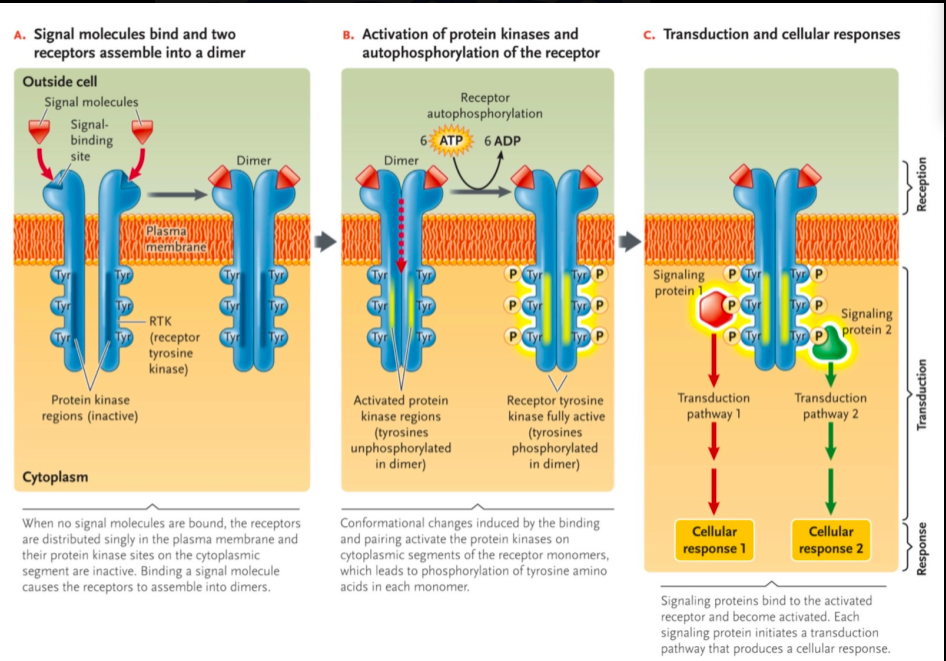
signal molecules bind and two receptors assemble into a dimer
activation of protein kinases. and autophosphorylation of receptor
transduction and cellular responses
process of tyrosine kinase receptor
G-protein linked receptors
a type of membrane receptor that involves a relay protein between the receptor and the effector
the G-protein is a trimer
binding of GDP = inactive
binding of GTP = active
one subunit of activate G-protein interacts with effector protein (enzyme
characteristic of a G-protein linked receptor
acts on the secondary messenger on the cytoplasmic side of the membrane
what does the effector do in a G-protein linked
effector
in a G-protein linked receptor pathway that is membrane-bound protein (usually an enzyme/ion channel) actiated by G-protein subunit/binding to receptor
e.g) Adenylyl cyclase
receptor
a specialized protein molecule located on the surface of a cell, in the cytoplasm, or in the nucleus that binds to specific signaling molecules (ligands) such as hormones, neurotransmitters, or drugs
cAMP phosphodiesterase
a cyclic enzyme where the gene is always active
target is cAMP which breaks down cAMP → AMP
limited number
reception
the first stage of a signal transduction pathway where the hormone will bind to the receptor
transduction
the second stage of the signal transduction pathway that creates the amplification of the signal (phosphorylation cascade)
response
the third stage of the signal transduction pathway which is the end result after the amplification of the signal
second messenger
what the STP generates on the cytoplasmic side of the membrane which relay signals from receptors to effector proteins within the cytoplasm
often cAMP
short term responses
signal amplification
cAMP dependent protein kinases
protein kinases that cAMP activates which will interact with proteins in cell leading to cascade of events changing the behavior of the cell
epinephrine binds to G-linked receptor → inactive G-protein → active G-protein → inactive adenylyl cyclase → active → ATP → cAMP → inactive protein kinase A → active → inactive phosphorylase kinase → active → inactive glycogen phosphorylase → active → glycogen → glucose-1-phosphate
STP pathway of epinephrine
enters target cells
binds to intracellular receptor
alters gene expression
slow/long-lived
summary of steroids (non water soluble)
follows a signal transduction pathway that is transmembrane
receptor → relay → effector → second messenger → phosphorylation cascade
regulates cytoplasmic enzymes/proteins
fast/short lived
transcription factors → slow/long lived
Summary of amino acids/ peptides
neurosecretory cells
cells that produce hormones that are stored in the posterior pituitary gland/ produce releasing or inhibiting hormones that control the release of hormones from the anterior pituitary gland
diffsed → IF → capillaries → body
releasing/inhibiting factors
hormones when the hypothalamus releases own hormones it affects the release from the anterior pituitary gland
hypophyseal portal veins
vessels that are ordered on both sides by capillaries and where the hormones are released into
tropic hormones
hormones that control the realse of hormones from another gland essentially hormones controlling hormones
gigantism
the conditions which is the overproduction of growth hormones in children and will increase the growth zones near the heads of the femur which are cartilage building cells
dwarfism
the conditions that is the underproduction of growth hormone in children where the cartilage will ossify making bones short; however with recombinant DNA technology human growth hormones can be inserted into children
acromegaly
the condition which is the overproduction of growth hormone in adults; essentially stimulates cartilage growth
type I diabetes
a condition which are insulin-dependent (autoimmune) since they have low insulin production
type II diabetes
a condition where it have lower responsiveness of target cells and are not insulin dependent; are insulin resistant where they have a mutation in the insulin receptor
glucogenesis
the function in cortisol where it will convert amino acids into glucose
hypothalamus → corticotropin-releasing hormone → ACTH → adrenal cortex → cortisol
pathway in the release of cortisol
secondary sex characteristics
the characters that are different between males and females and are not related to reproduction (e.g: males having lower voices)