Exam 3, Lecture 4 - Problem Solving and Creativity
 Call Kai
 Learn
Learn Practice Test
 Spaced Repetition
 Match
Match Flashcards
 Knowt Play
1/37

There's no tags or description
Looks like no tags are added yet.
Name | Mastery | Learn | Test | Matching | Spaced | Call with Kai |
|---|
No analytics yet
Send a link to your students to track their progress
38 Terms
Problem
When there is an obstacle between a present state and a goal
need to be identified before they can be solved
Need to be difficult to solve, can’t be immediately obvious how to get around obstacle
Well-defined problems
Easy to identify and solve
clear when solution has been reached
Ex. A crossword puzzle, a maze, etc.
Ill-defined problems
Hard to identify and solve
ex. Picking a career, addressing homelessness, solving for world peace
Hard to know when a solution has been reached
Problem representation
The way a problem is translated (or represented) in our mind
a problem may be presented to us in the same way, but we may represent it differently, resulting in different approaches to solve the problem
Ex. Two people solve a crossword puzzle in different ways
Problem restructuring
The process of changing a problems’ representation
Solving a problem involves first seeing the object, then restructuring/seeing it in a different way

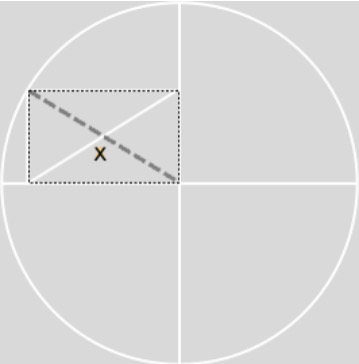
Problem solving: if the length of a circles’ radius is r, what is the length of x?
Perceive: x is unknown
Represent: same as the image (spatial)
Restructure: the triangle is part of a rectangle whose diagonal equal x, which is also r
Insight
Sudden realization of a solution to a problem
ex. Move 3 dots so the triangle is facing down
non insight problem: solve for x —> (1/5)x+10=25
People felt they were closer to the solution for non-insight problems as time continued
Functional fixedness
Tendency to focus on similar functions or uses of objects
Candle problem
Mount the candle to the wall so it will burn without dripping wax on the floor using a matchbox, candle, and tacks
Example of functional fixedness
Solution is to think of the matchbox as a container, tack matchbox to wall and put candle on top
Easier to overcome functional fixedness when the matches are presented outside the box
Two string problem
Tie together the two strings hanging from the ceiling
participants when told to swing their arms or see the researcher brush the string were able to solve the problem as compared to those without a cue
Breaks them out of functional fixedness and allows them to think about their tools
Mental set
Preconceived notion about how to approach a problem
contributes to functional fixedness, based on previous experience with a set of objects
Prior examples can establish a mental set that inhibits participants from using simpler solution later on
Far more likely for participants to use a simpler solution when they didn’t have a mental set
Water jug problem
Measure a specific quantity of water from 3 empty jugs of varying capacities
can you measure 5 quarts of water given a 18 quart jug (A), 42 quart (B), and 10 quart (C)
Fill B, pour into A once, pour into C twice
Measure 20 quarts given 23 (A), 49 (B), or 3 (C)
Fill B, pour into A once, pour into C twice
Fill A, pour into C once
If you solved the problem by starting with B, the first water jug problem established a mental set
Insight is the process of changing the way a problem is represented in your mind. T or F?
False
Information Processing approach
Problem solving is a search between the posing of a problem and its solution
initial state
Goal state
Intermediate states
Problem space
Operators
Initial state
Conditions at the beginning of a problem
Goal state
Solution to the problem
Intermediate states
Conditions after each step is made toward solving a problem
Problem space
All possible states that can occur when solving a problem
Operators
Actions that take the problem from one state to another
governed by rules
Means-end analysis
There are many ways to get from the initial state to the goal state
reduce the differences between the initial and goal states by creating sub goals
Means end analysis ex. Traveling
initial state —> Riverside
Goal state —> Germany
Operators → shortest travel time, cost within budget
Problems with information processing
mutilated checkerboard problem
Russian marriage problem
can’t explain how two problems with the same problem space (same initial, intermediate, and goal states) can vary in difficulty
Mutilated checkerboard problem
If we eliminate two corners of a checkerboard, can we cover the remaining squares with dominos
no!
However, if given a blank checkerboard (without red and black squares), becomes significantly harder to solve
Problem space is the same
Russian marriage problem
Can the matchmaker come up with 31 heterosexual marriages among 62 survivors
In a small Russian village, 32 bachelors and 32 unmarried women. Two bachelors killed each other. Can the matchmaker comes up with 31 heterosexual marriages among the 62 survivors
Same problem space as mutilated checkerboard but not same difficulty
if information processing approach was correct, there should be no difference in ease of solving Russian marriage problem/blank checkerboard/mutilated checkerboard. Since there are differences in difficulty, it means that
Analogical problem solving
Attempting to solve a problem using the solution to a similar problem
the Russian marriage solution can be used to solve the mutilated checkerboard problem
Analogical transfer
Experience solving one problem is transferred to another problem
target problem
Source problem
Requires that you notice, map, and apply the analogy
Target problem
The problem you are trying to solve
Source problem
Another problem that is similar to and may illustrate a way to solve the target problem
Analogical transfer radiation problem + fortress story
Radiation problem —> 10% solved
Radiation problem —> listen to fortress story —> radiation problem → 30%
Radiation problem —> apply the fortress story —> radiation problem
Analogical paradox
It can be difficult to apply analogies in the laboratory, but we routinely use analogies in real world settings
In the example discussed here, the source problem is ______
difficult to transfer
The radiation problem
What needs to be restructured
The fortress story
The fortress story
Expert
Someone knowledgeable or skilled in a particular domain
experts solve problems in their field more quickly and more often than beginners
Experts possess more knowledge about their field
Ex. Chess board with actual game position, masters were more accurate in placing the pieces in the right positions/accurately according to display
Ex. Chess board with random placement, grand masters were just as bad at accuracy with non grand masters
Organize their knowledge differently than novices
Experts gave more specific than basic names, non-experts more likely to generate basic bird names
Creativity
The use of imagination or original ideas
creative problem solving is a process
To increase creativity: daydreaming, solitude, mindfulness
Divergent thinking
Thinking that is open-ended and involves a larger number of potential solutions
Creative cognition
Technique to train people to think creatively
ex. Given a task where you’re given three objects and told to make a new object
Daydreaming
Purposeful mind wandering
solitude
avoiding distractions; giving the mind space and time to make new connections and find meaning
mindfulness
pay attention to what is happening in our mind and in the environment