ERTH2404-L10: Rock Mechanics and Mass Movements
 Call Kai
 Learn
Learn Practice Test
 Spaced Repetition
 Match
Match Flashcards
 Knowt Play
1/87

There's no tags or description
Looks like no tags are added yet.
Name | Mastery | Learn | Test | Matching | Spaced | Call with Kai |
|---|
No analytics yet
Send a link to your students to track their progress
88 Terms
Importance of rock mechanics and mass movements in our future careers
• Rock masses: A large and indistinct body of solid earth materials
• You may be doing engineering work involving rock masses
• You may need to estimate the strength of the rock mass
• This knowledge may help define mitigation strategies against unwanted risks (rock fall, damage to works, deaths, injuries, etc).
Warning for future engineers
I asked my colleague geologists what was the major difficulty in their common projects with engineers...
Most said that engineers had difficulty understanding:
• the highly variable geological environments
• and that geological models are constantly being refined with additional geological data
• In other words: nature is not a controlled-environment like a laboratory, we are working with approximations of reality
ROCK MECHANICS
Issue (Just a Note)
• You need to build a structure that involves rock masses
• Question: is the rock sufficiently competent to resist the changes in local stresses, and if not, what mitigation measures should be taken to insure its integrity?
Strength
Strength [N/m2]: level of stress at failure
• Above the elastic limit, two scenarios:
—• Brittle rocks fail abruptly
—• Ductile rocks undergo plastic deformation before failing
Compressive strength (squeezing)
• Resistance to normal pressure
Tensile strength (stretching)
• Resists tearing apart
Shear strength
• when the material or component fails in shear.
• Most materials have much higher compressive than tensile strengths
![<p><strong>Strength [N/m2]:</strong> level of stress at failure</p><p></p><p>• Above the elastic limit, two scenarios:</p><p>—• Brittle rocks fail abruptly</p><p>—• Ductile rocks undergo plastic deformation before failing</p><div data-type="horizontalRule"><hr></div><p>Compressive strength (squeezing)</p><p>• Resistance to normal pressure</p><p></p><p>Tensile strength (stretching)</p><p>• Resists tearing apart</p><p></p><p>Shear strength</p><p>• when the material or component fails in shear.</p><p></p><p>• Most materials have much higher compressive than tensile strengths</p>](https://assets.knowt.com/user-attachments/b4756a05-92a5-41a9-b853-a6c1a126ea44.png)
Unconfined compressive strength
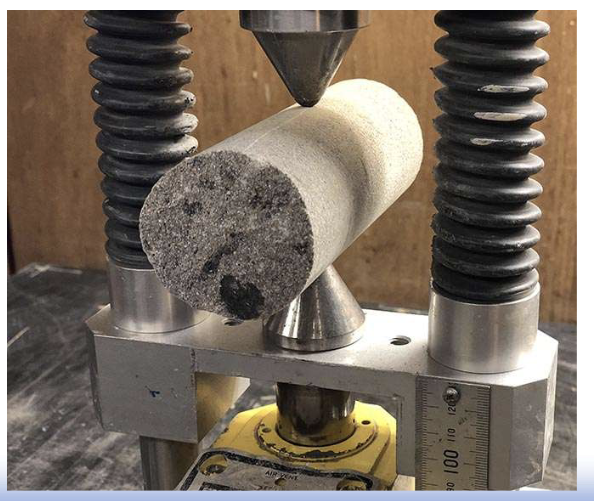
Measuring rock strength
Uniaxial / Unconfined Compressive Strength (UCS):
• An important parameter for a rock’s strength
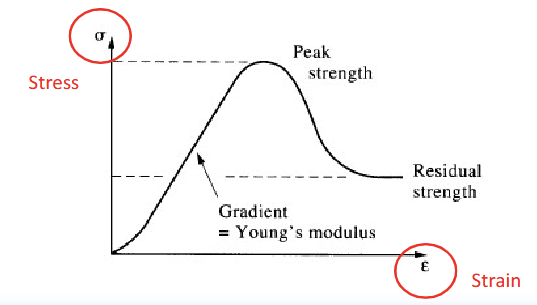
• Peak strength in diagram below
UCS: Unconfined Compressive Strength
UCS test:
• Apply a uniaxial compressive stress
• Intact rocks contain small imperfections where stress
concentrates and initiates tensile crack growth
• Tensile cracks grow along grain boundaries
• Cracks start to interact and merge
• Failure occurs by accumulation of damage
Deere-Miller classification of intact rock
Deere and Miller (1968) developed a classification scheme based on the stress-strain behavior of intact rocks
• Stress-strain behavior chosen because it controls the engineering behaviour of rocks
• Applies only to internally continuous rocks, free of large- scale weakness planes (Intact Rock) (e.g. no shear zones, no joints, no bedding planes)
• Based on laboratory measurements
Strength versus. stiffness
Strength measures how much stress can be applied to an element before it deforms permanently or fractures; The ability of the material to support a load without breaking (physical failure)
Stiffness is an indicator of the tendency for an element to return to its original form after being subjected to a force; The ability of the material to distribute a load and resist deformation or deflection (functional failure)
(opposite of flexibility)
• Remember, strength measures how much stress the material can handle before permanent deformation or fracture occurs,
• whereas the stiffness measures the resistance to elastic deformation.
How mineralogy affects strength
Grain size (sedimentary)
• Micro-fractures propagate faster
• Fractures take a shorter, less circuitous path through large crystals
Interlocking crystals (igneous)
• Rocks with interlocking crystals are stronger
Mineralogy
• Some minerals are weaker
• Minerals with well-developed cleavage are weaker
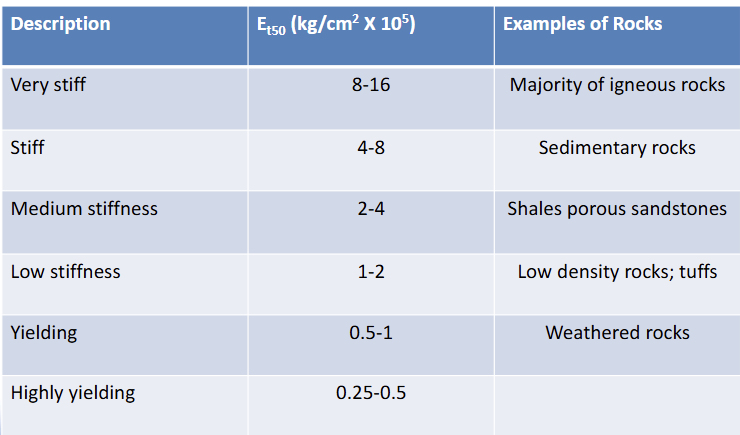
Examples of stiffness
Stiffness is a measure of resistance to deformation
The problem with rock strength
The fundamental problem with laboratory testing:
• Often large discrepancies between laboratory and in situ*
results
• Laboratory measurements do not take into account the
effects of:
—• Structural trends
—• Discontinuities within the rock mass
—• Water
*in situ: in its original position in the field
Empirical methods to assess rock mass strength
Empirical methods to assess rock mass strength
• RQD
• Rock Mass Rating system (RMR)
• Q-system
This is the field of Rock Mechanics
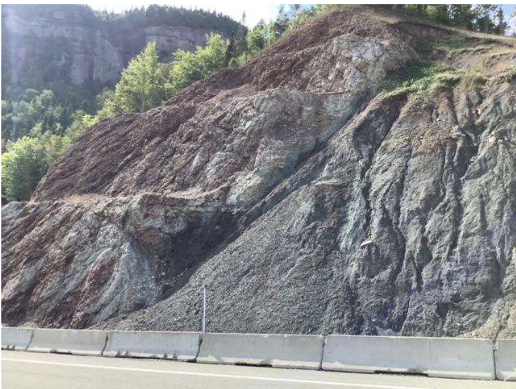
Rock mass
A rock mass: A large and indistinct body of solid earth materials, containing features on the scale of jointing, folding, schistosity, etc.
• Not a hand specimen
Rock mass properties
Rock mass
• Exposed outcrops (road cuts)
• Underground rock (tunneling, mining)
• Containing joint sets
Test results from intact rock samples cannot be directly applied to an in situ rock mass
• Laboratory results are useful for comparison between rock types
Behavior of in situ rock mass under load is controlled:
Mostly by
• Discontinuities: the weakest link in the rock mass fabric
—• Pre-existing fractures in the rock mass
• And to a lesser extent by
—• Strength of intact portions of the rocks
Rock mass properties: Discontinuities
Large scale
• Structural discontinuities: large-scale features dividing the rock mass
into different zones
—• Faults, shear zones, unconformities, etc.
Small scale
• Discontinuities in rock fabric: small-scale features pervasive throughout
the rock mass
—• In igneous rocks: cooling joints, pyroclastic material, etc.
—• In sedimentary rocks: bedding planes, mud cracks, ripple marks, etc.
—• In metamorphic rocks: foliation
Rock mass properties: RQD
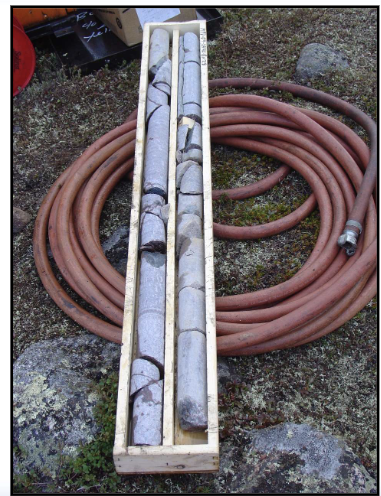
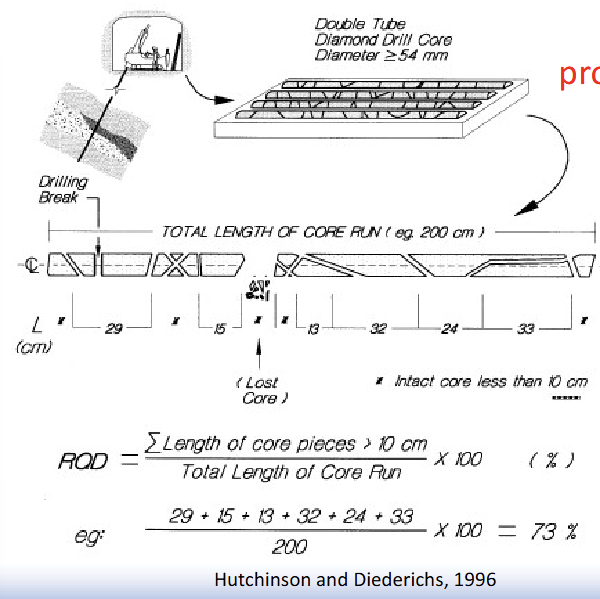
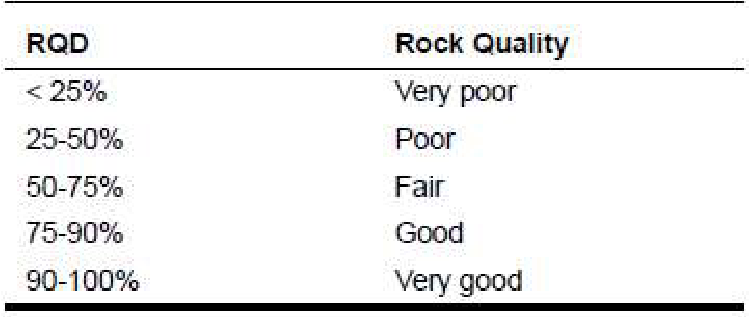
Rock Quality Designation [%]: index based on the cumulative length of core pieces longer than 10 cm in a run divided by the total length of the core run
• Total length of core must include all lost core sections
• Any mechanical breaks caused by the drilling process or in extracting the core from the barrel should be ignored
RQD calculations
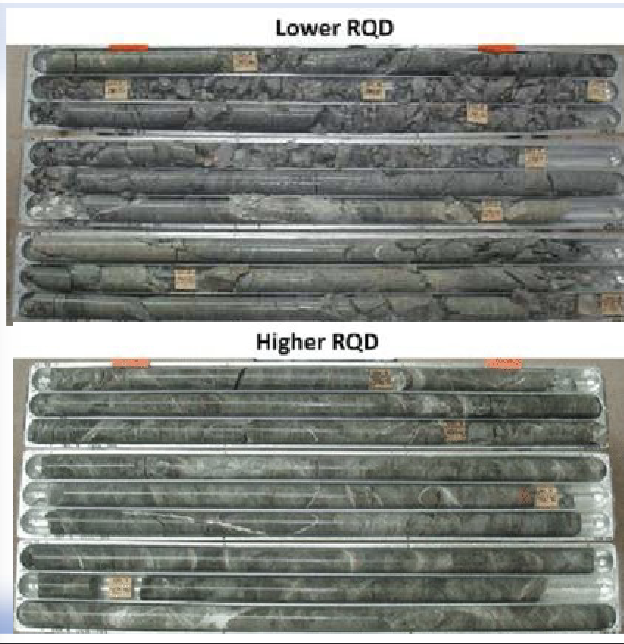
How RQD relates to rock quality
Rock mass classification
Several classification schemes have been developed for specific applications
• Objective:
—• Estimate the “quality of the rock”
—• Strength of the rock
—• Achieve a realistic assessment of factors influencing engineering behavior
• Challenge
—• Large number of variables involved
—• Most parameters are measured in-situ
Rock mass classification schemes
Two most common classification schemes:
• Geomechanics classification scheme (synonym: Rock Mass Rating (RMR))
• Rock tunneling quality index (Q)
General info about both:
• Empirical systems
• Common practice to use both
• Both schemes use RQD (Rock Quality Designation)
Rock Mass Rating (RMR)
From laboratory results and visual inspection of in situ rock mass
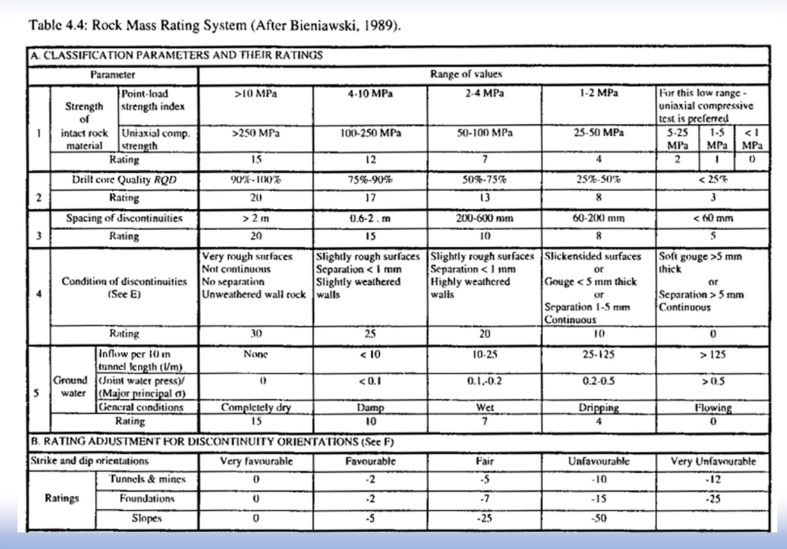
Six criteria:
1. Strength of intact rock material (UCS)
2. RQD
3. Joint spacing
4. Joint condition (surface roughness, separation)
5. Groundwater conditions
6. Others (infilling, weathering, orientation)
Each parameter is ranked and the sum of the factors estimates the “quality” (strength) of rock mass
Factors, what improves rock quality
1. Strength of intact rock material (UCS)
Higher strength = more stable
2. RQD
High RQD: Less broken = more stable
3. Joint spacing
Large interjoint distance: Fewer joints = more stable
4. Joint condition (surface roughness, separation)
Joints rougher, more separated = more stable
5. Groundwater conditions
Less water: more stable
6. Others (infilling, weathering, orientation of joints)
No gouge, not weathered, well oriented = more stable
Rock mass classification: Barton’s surface roughness profiles
• Barton’s surface roughness profiles
• Used to measure Joint Roughness Coefficient (JRC)
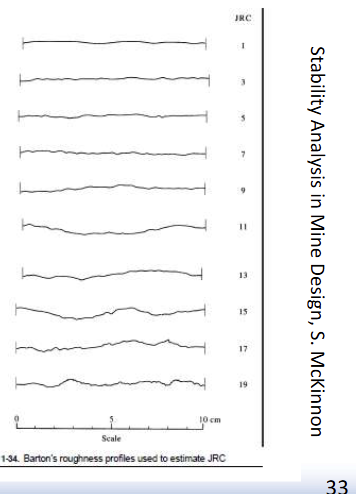
Using the Joint Roughness Coefficient (JRC) to measure surface roughness manually
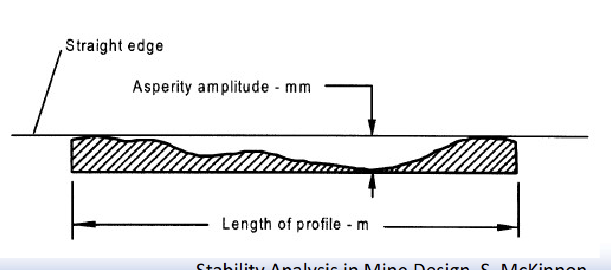
Surface roughness measured manually
Joint Roughness Coefficient (JRC) relates asperity amplitude and length
• JRC = 20, maximum roughness
• JRC = 1, smooth surface
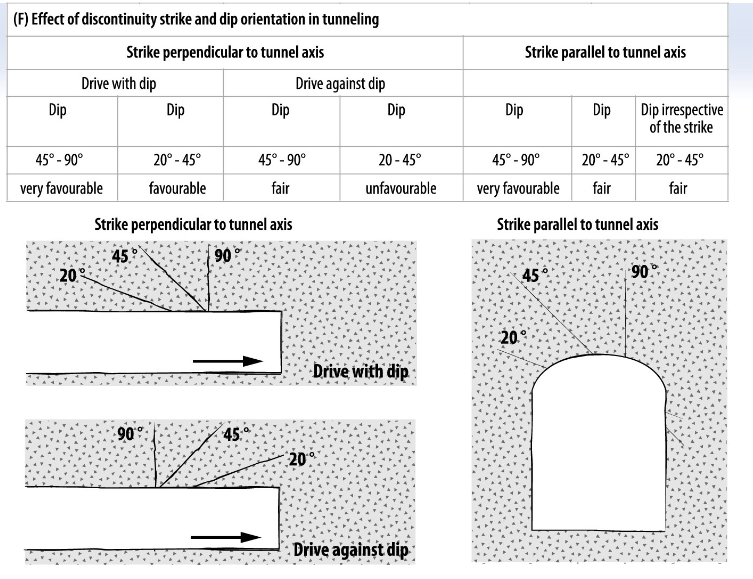
Effect of discontinuity strike and dip orientation in tunneling
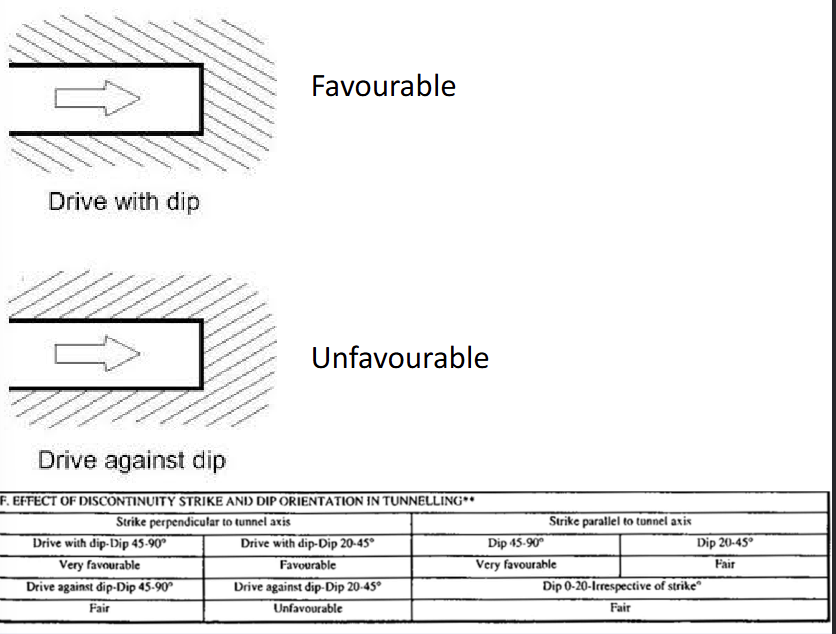
Continued effect of discontinuity strike and dip orientation in tunneling
Classification parameters and their patterns; RMR
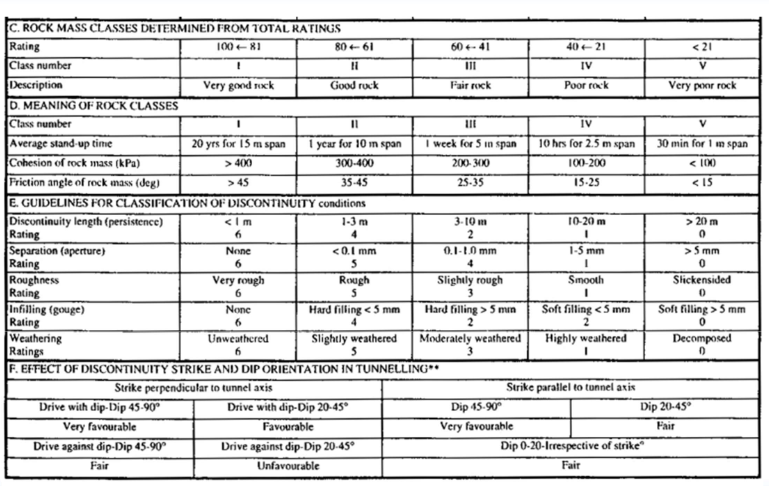
Rock mass classes determined from total ratings; RMR
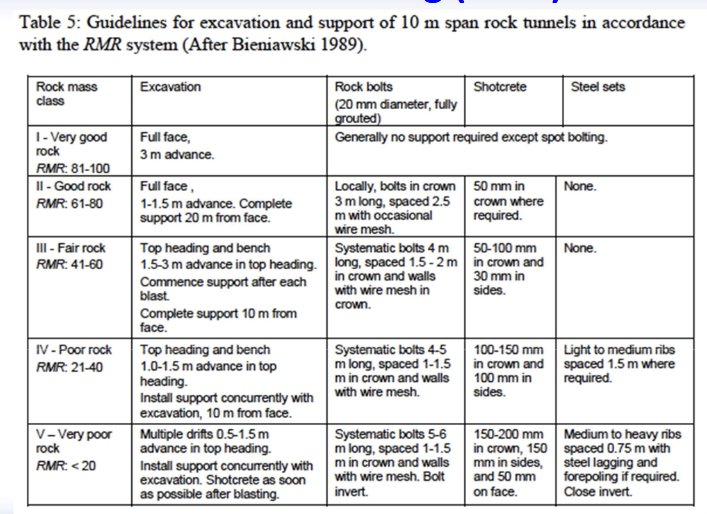
Guidelines for excavation and support of 10 m span rock tunnels in accordance with the RMR system
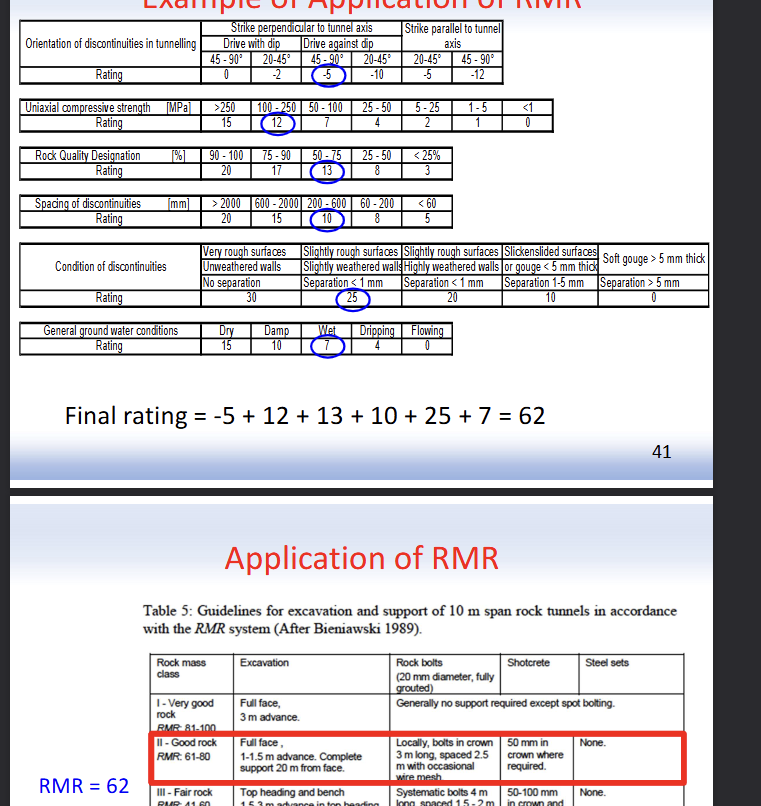
Example of application of RMR
• Core testing gives a uniaxial compressive strength of 150 MPa.
• Logging of diamond drilled core gives average RQD values of 70%.
• The slightly rough and slightly weathered joints with a separation of <1 mm, are spaced at 300 mm.
• Tunneling conditions are anticipated to be wet.
MASS MOVEMENT
Economic and social impacts of mass movements
Mass movements cost Canada $100 to $200 million annually
Since 1850, more than 600 Canadians have been killed by mass movements
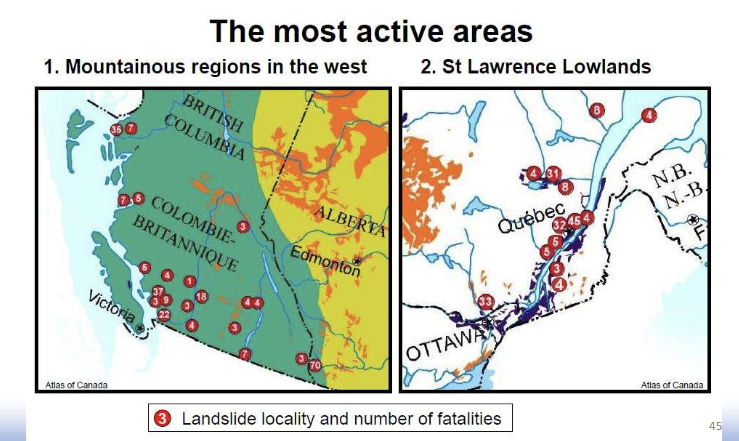
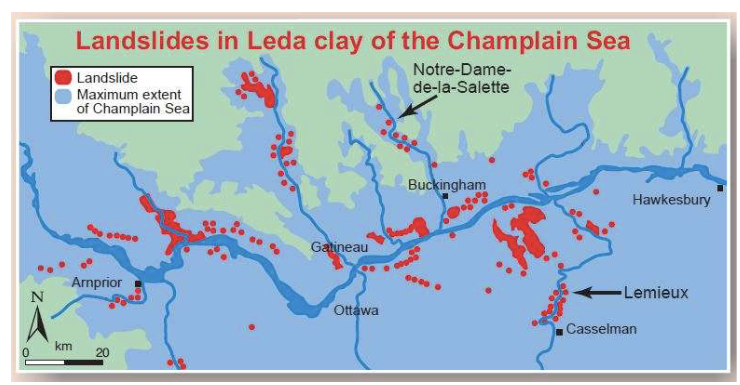
Ottawa River Valley in relation in mass movements
Landslides occur because of the clays
Mass movements
Mass movement: collective name for a variety of processes for the downslope movement of earth materials under the direct influence of gravity and the resulting landform
• Similar expressions: landslide; slope failure, mass wasting
• Note: “Landslide” is a generic term applied to almost any kind of slope failure
Causes of mass movement
Causes:
1. Slope characteristics
2. Lithology with low static coefficient of friction
3. Excess pore water
4. Deforestation / thaw of permafrost / erosion
5. Vibrations
Causes of mass movements; Slope characteristics (1)
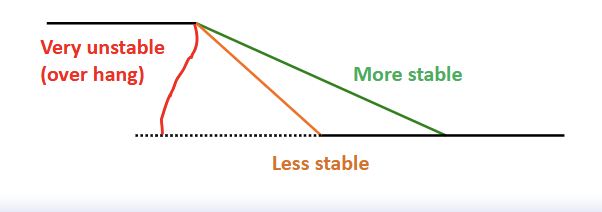
• Steepness of slope decreases stability
—• Road cuts, erosion, can increase slopes and induce mass movements
Slope characteristics (2)
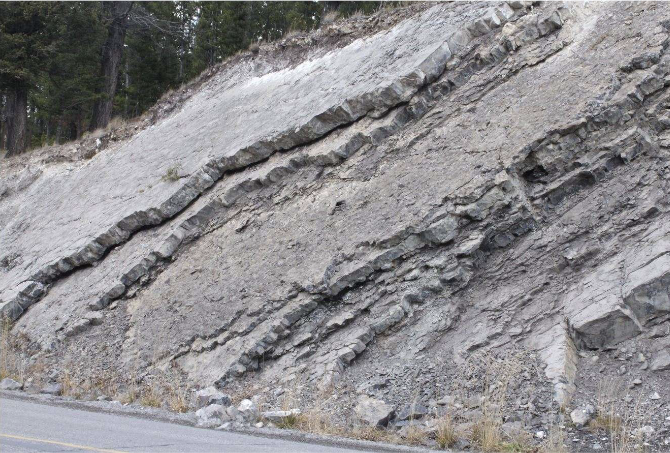
Discontinuities dipping in the slope direction decrease stability
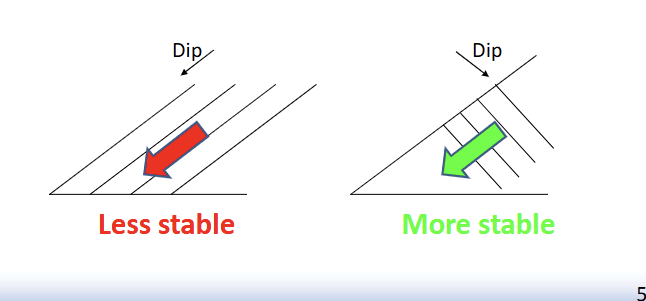
Unstable rock face (Banff)
Slope characteristics (3)
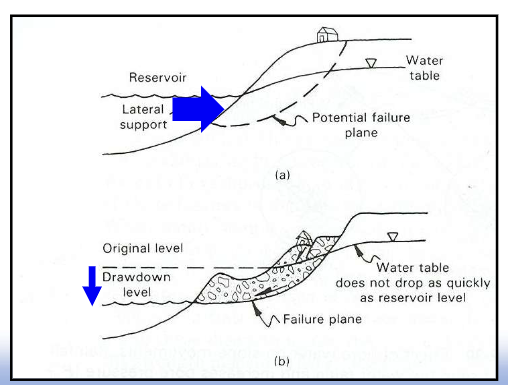
• Loss of lateral support by rapid water level change
• (ex: in a water reservoir, during a prolonged drought)
Causes of slope movement
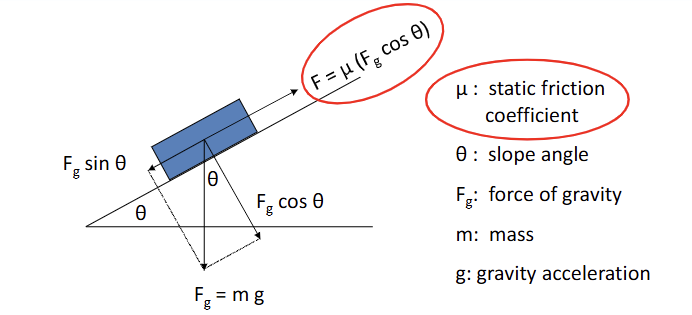
Driving force: downslope component (Fg sin θ)
Normal force: force pressing surfaces together (Fg cos θ)
Resisting force: μ (Fg cos θ)
Causes of mass movement; friction coefficient (1)
• Static friction coefficient μ [ ]: constant proportional to the force restricting the movement of a stationary object on a relatively smooth, hard surface
μ ≤ 1
μ = 0.33 Brick on moist clay
μ = 0.5 Brick on dry clay
μ = 0.6 Granite on granite
μ = 0.75 Limestone on limestone
Friction coefficient (2)
Lithology (physical characteristics of rock unit) is the most important factor controlling slope stability
Geological material with low μ examples:
• Clay (+ possibility of swelling)
• Shale
• Rocks with platy minerals (e.g. mica, chlorite)
• Certain volcanic tuffs, etc.
Friction coefficient (3)
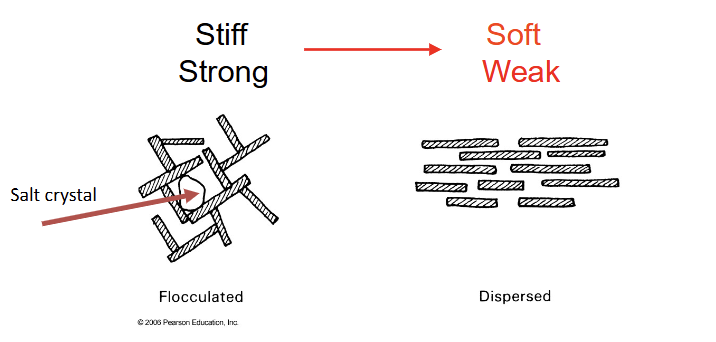
Temporal changes in friction coefficient (example of marine clays with salt being dissolved with time)
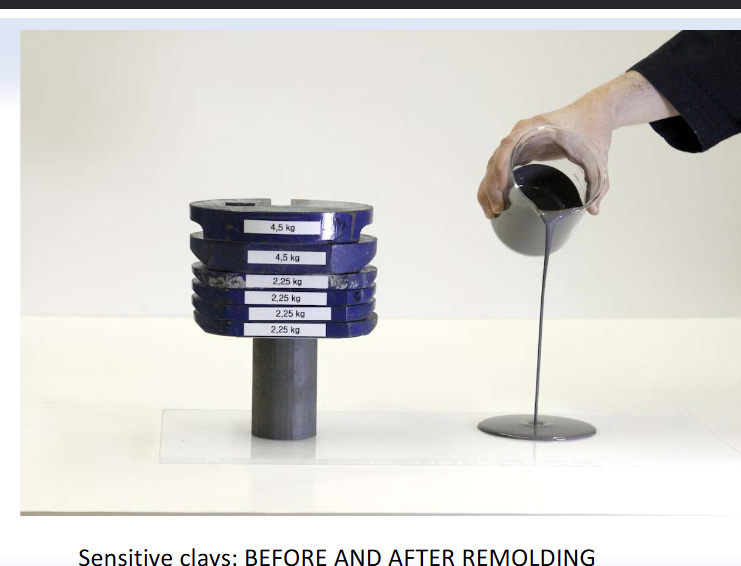
in diagram, originally marine clay has salt supporting structure so it is stiff and flocculated but after it dissolves its week and dispersed
Quick clays of the St. Lawrence Valley
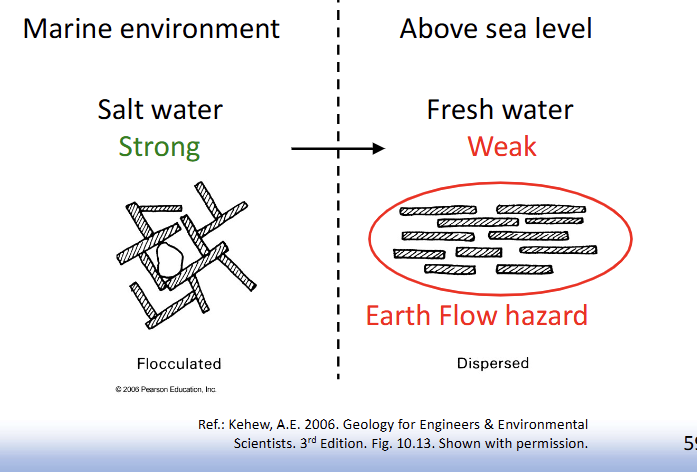
1. Marine clays deposited when continental glaciers melted 10,000 years ago
- Original clay fabric: flocculated
2. Glaciers melt. Rebound (Uplift) of the Earth’s surface.
- Clays are now above water level
3. Over hundreds of years, salt in clays is leached by fresh water from rain and snowmelt
4. Clays become hazardous
- Instantaneous change to dispersed fabric
- Turn into a liquid
Type of movement: Lateral Spread/Earth flows
Causes of mass movement: excess pore water
• Effective stress is the force required to keep the soil rigid
• After a rainfall, the fluid pressure increase causes the effective stress to decrease
• Results in weaker soil mass
• Consequently: after major rain falls or wet seasons (monsoon, hurricanes, spring snow melt), the risk of landslides is higher ... watch for landslides this Spring!
• ... Note: beaver dams can alter the conditions
(construction or destruction)
Causes of mass movement: deforestation/thaw of permafrost/erosion
A) Deforestation (soils without vegetation responds to rain)
• Cutting of trees
• Forest fires
B) Thaw of permafrost
C) Erosion
Causes of mass movements: vibrations
• Warning: Human-made vibrations during construction work can also destabilize slopes (consolidation, blasting)
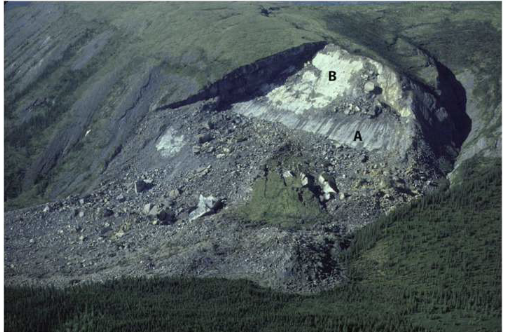
Earthquakes:
EX: 1985 M 6.9 Nahanni earthquake caused a rock avalanche
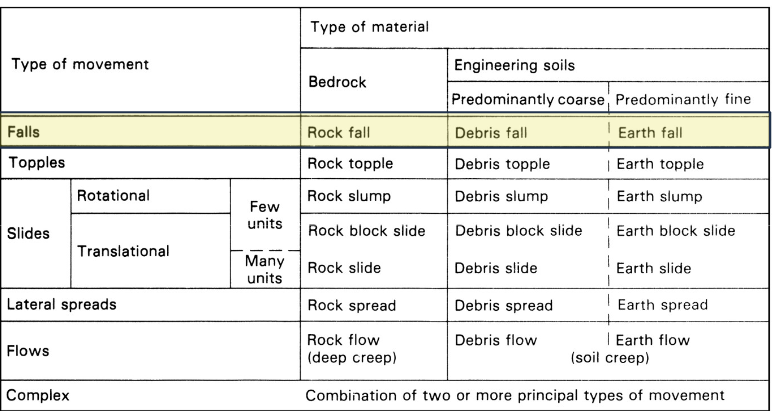
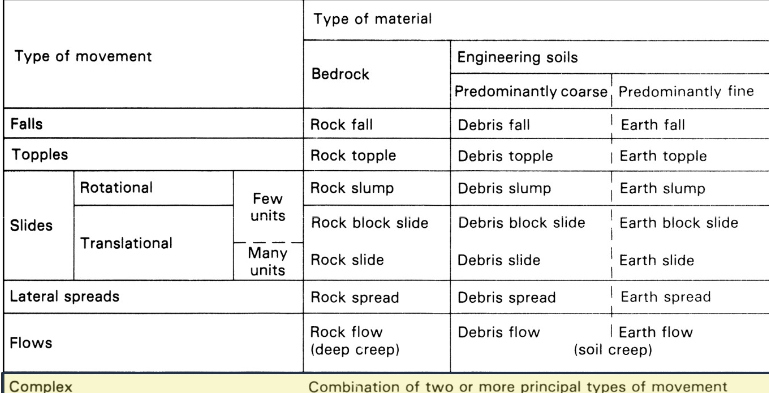
Classification of mass movements
Mass movements classified according to:
1. Type of movement
2. Material-types involved
—• Rock
—• Debris: coarse soil particles
—• Earth: fine soil particles (silt, clay)
3. Speed of movement
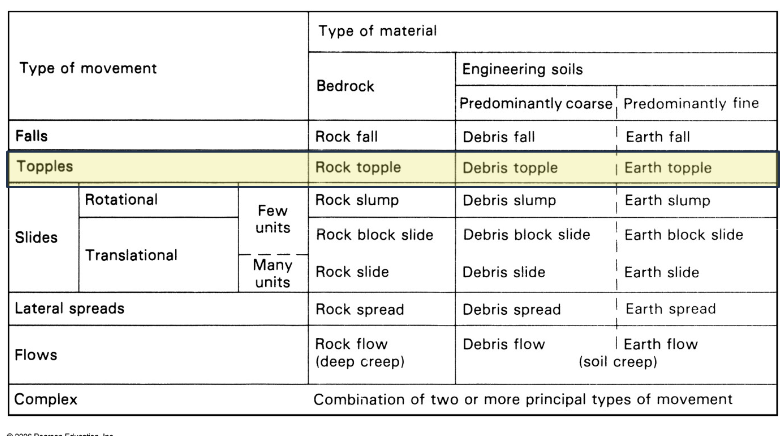
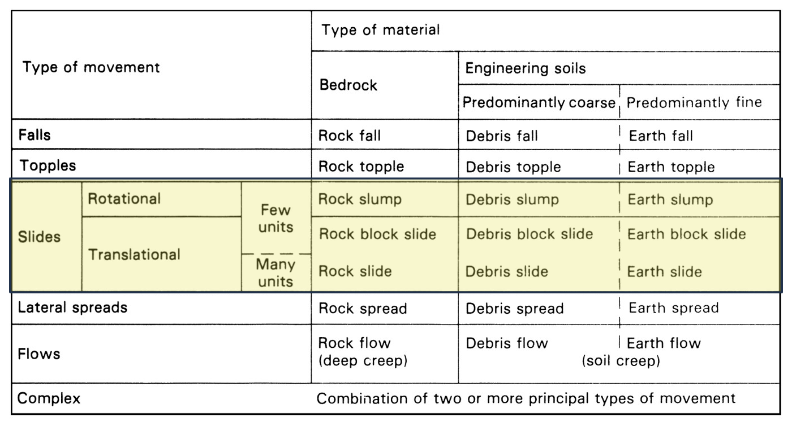
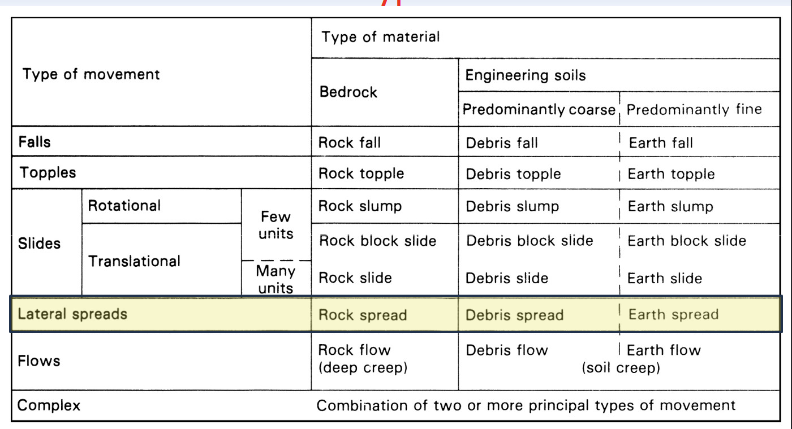
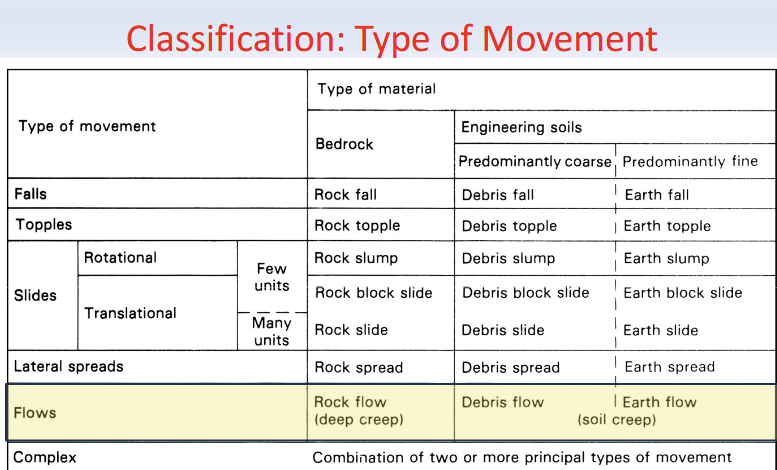
Classification of mass movements: Type of Movement Chart
Type of Movement: Falls
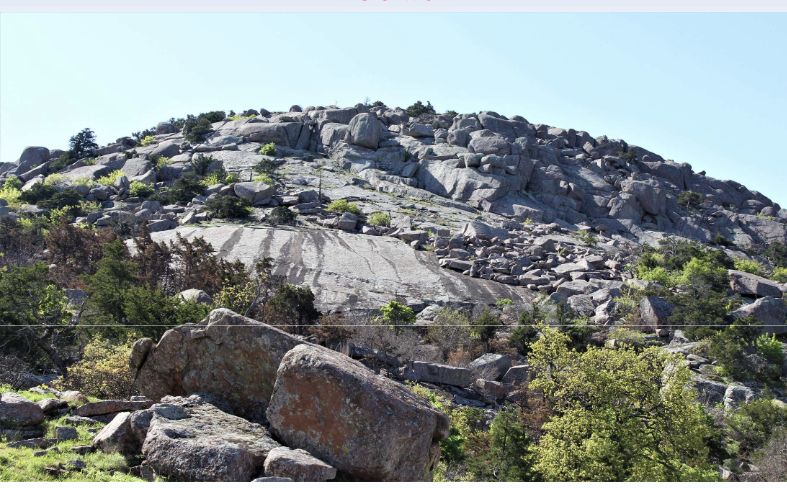
Fall: rapid downslope movement by free fall, bouncing or rolling
• Fragments ranging in size from small grains to large blocks
• Caused by weathering
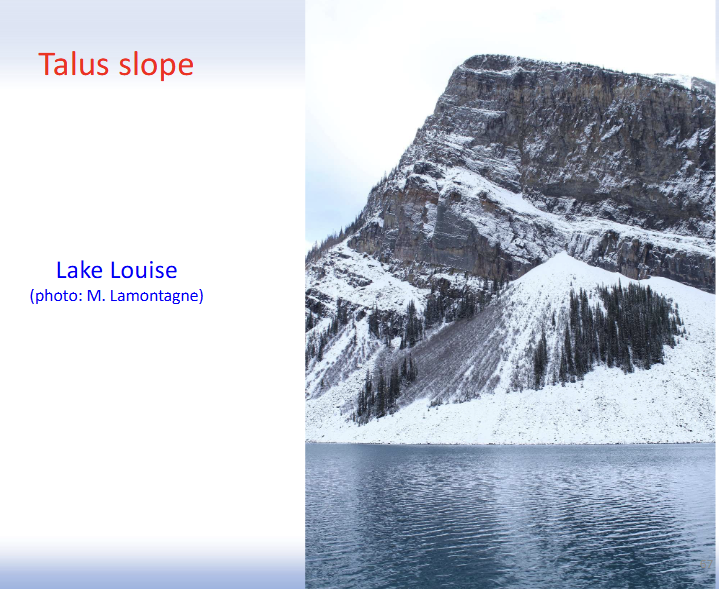
Example: in mountainous areas, congelifraction (fracturing of rock caused by repeated freezing and thawing cycles) contributes to the formation of talus slopes
• Accumulation of rock debris at the base of a cliff or steep mountain slope
Talus slope
Talus slope: Accumulation of rock debris at the base of a cliff or steep mountain slope
Rockfall
Type of Movement: Topples
Topple: rapid, end-over-end motion of material down a slope
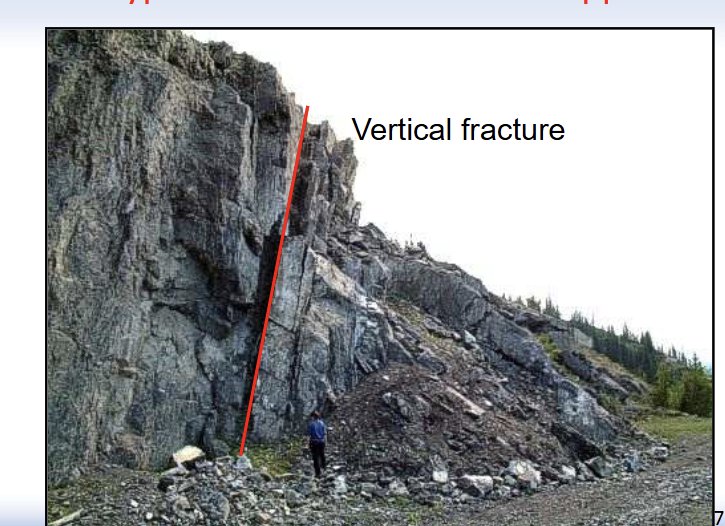
• Develop in material divided into blocks by vertical fractures
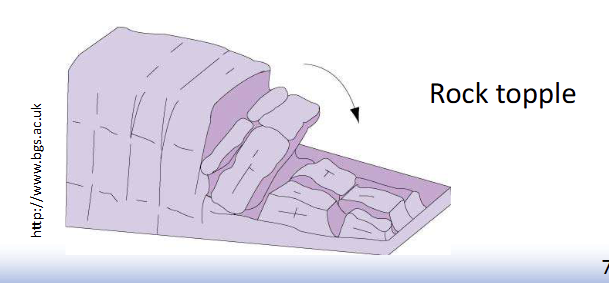
Topples
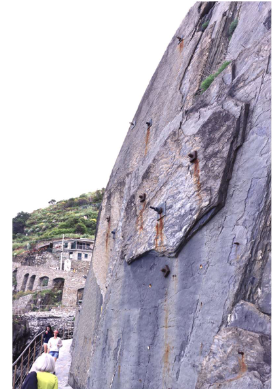
Corrective measures/mitigation (Falls and topple)
Reinforcement of these slopes include:
• Rock bolts and mechanical and other types of anchors.
• Because seepage is also a contributing factor to rock instability, drainage away from the rock mass should be considered and addressed as a mitigative means.
Type of movement: Slides
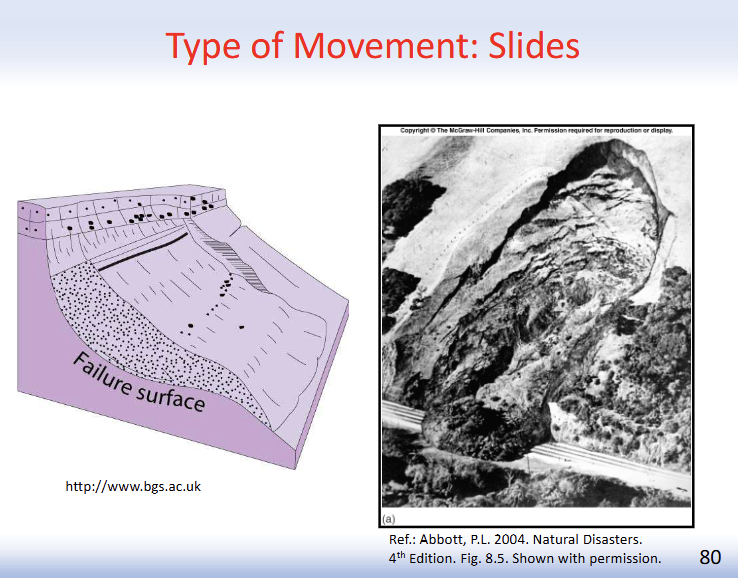
Slide: event involving displacement of material on a shear plane
• Remaining as a unit or block
• Along a well-defined slippage plane
Classification of slides
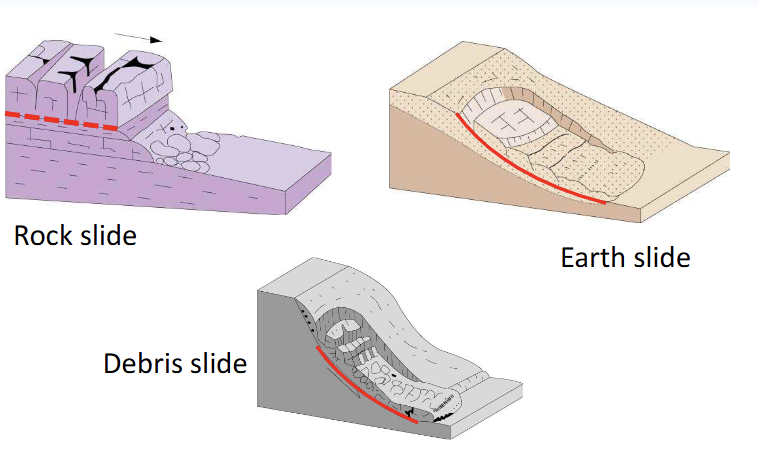
Slides are classified according to the nature of the failure surface:
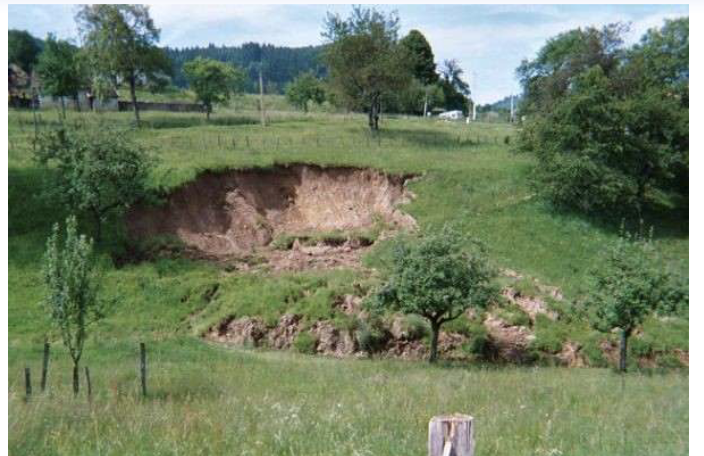
• Curved surface (like a spoon) → Rotational slide (syn. slump)
—-• Common in soils or low shear strength rock
• Planar surface → Translational slide
Slides are also named based on the material:
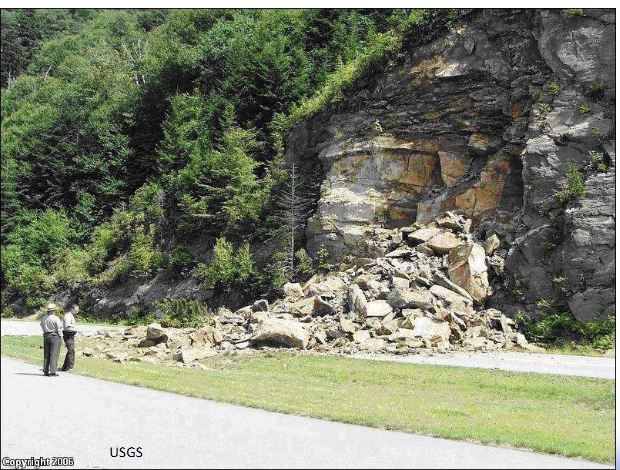
• Rock/rock block slide: translational slide in which blocks of bedrock move parallel to planes of weakness
—• Joint systems are critical in the development of rock/rock block slides
• Debris/Earth slide: unconsolidated material
Rock slide
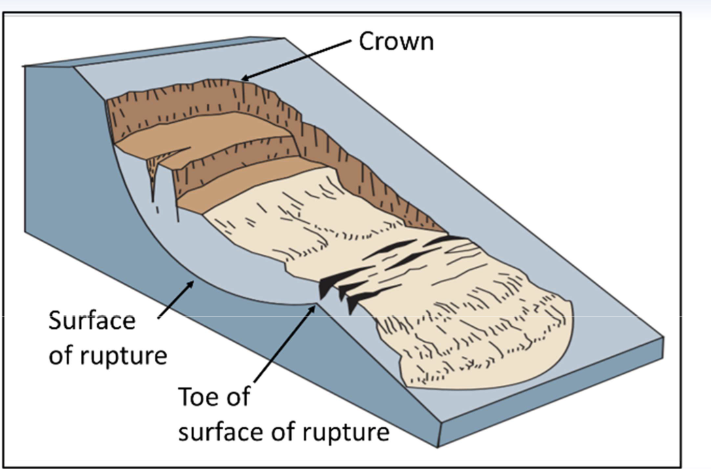
Slump
Type of movement: Slide - Slump
Slump: rotational slide, in which failure occurs on an over-
steepened slope, along a concave rupture surface
• Commonly develops where clay is a foundation under
sand or silt
• Multiple blocks often fail
—• Scarp at the head of slump
—• Thrust-up toe at foot of slump
• Due to natural factors (e.g. wave erosion) or human
activity (e.g. road cuts)
Corrective measures/mitigation (slides)
• Instrumental monitoring to detect movement and the rate of movement can be installed.
• Disrupted drainage pathways should be restored or reengineered to prevent future water buildup in the slide mass.
• Proper grading and engineering of slopes, where possible, will reduce the hazard considerably.
• Construction of retaining walls at the toe may be effective to slow or deflect the moving soil; however, the slide may overtop such retaining structures despite good construction.
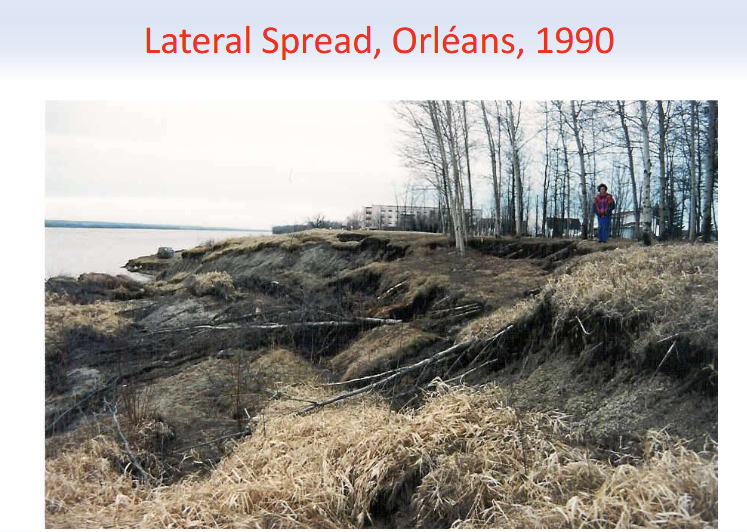
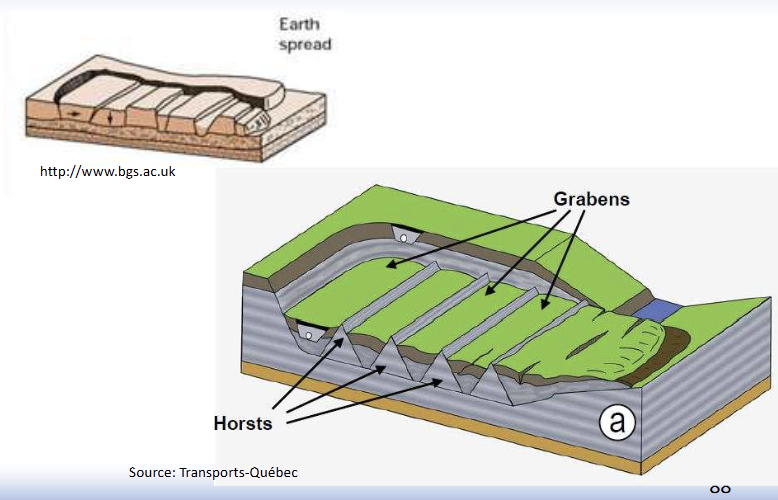
Type of Movement: Lateral Spread
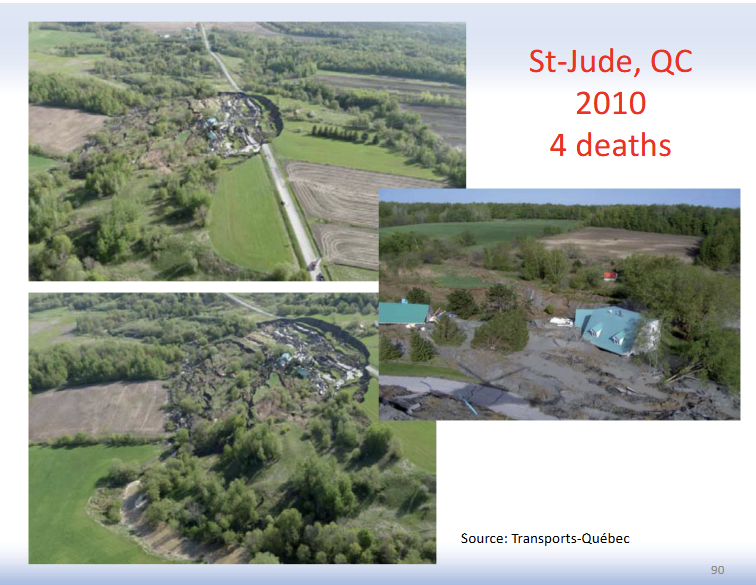
Lateral spread: special case of translational slide in which movement of earth material results from liquefaction of subjacent material
Related to distinct geologic conditions present in northern environments
• St-Lawrence River lowlands, Canada
• Scandinavia
• Alaska
Movement occurs without warning
• Triggering factors: earthquakes, vibrations from construction activities, heavy rain, spring melt, toe erosion, loading, etc.
Failure is progressive
• Starts locally (often on a river bank) and proceeds rapidly from point of failure
Material flows rapidly even on very gentle slopes
• Large masses of clay become completely liquefied and flow as fast as a river
Lateral Spread
St Jude, QC 2010
4 deaths
Type of Movement: Flow
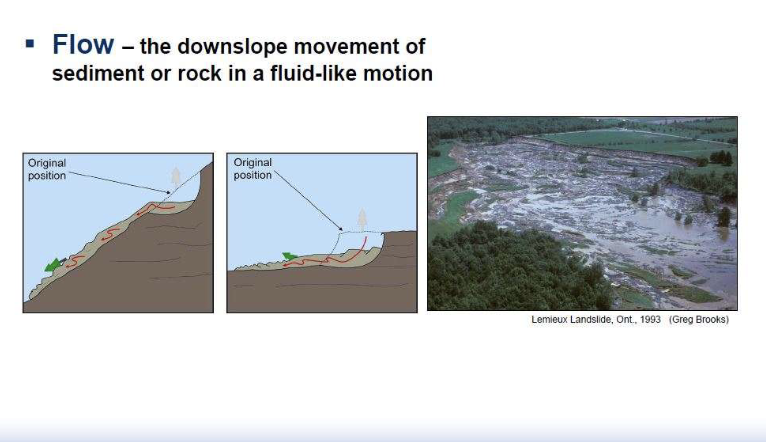
Flow: mass movement involving continuous internal deformation of the moving material
Main difference between slides and flows
Main difference between slides and flows:
• Slides: little deformation within the moving material
• Flows: material thoroughly deformed during movement
Earth flow
Classification of flows
Two main types of flows depending on velocity
• Slow → Creep
• Fast → Rock, debris or earth flow
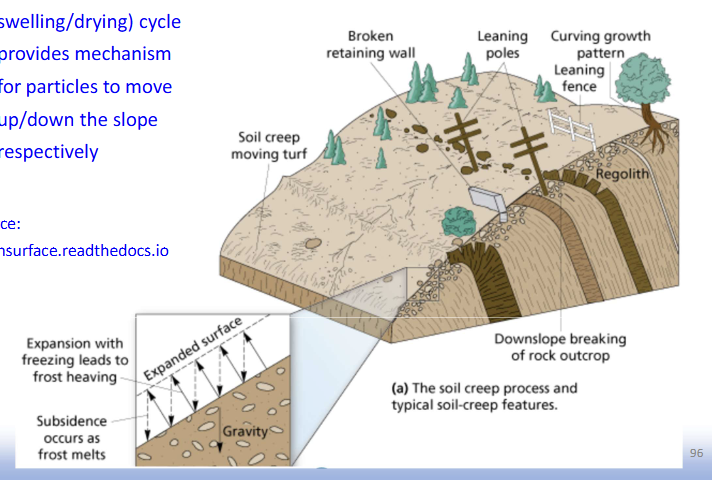
Creep
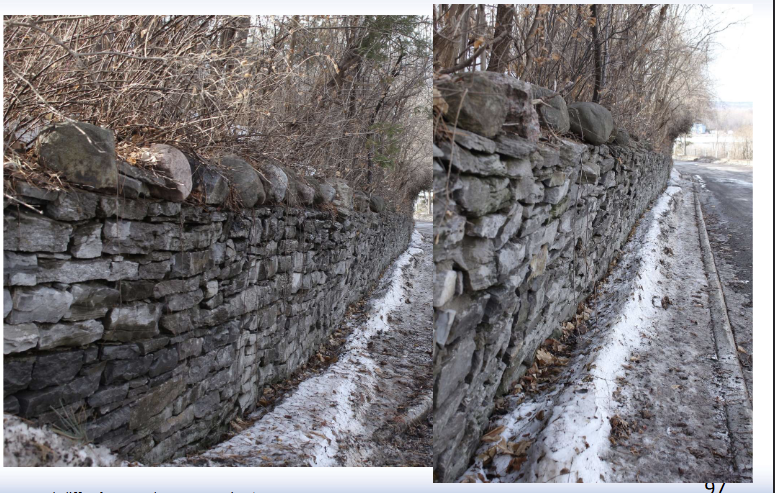
Creep: gradual, slow movement of earth and debris downhill
• Creep is assisted by the alternating seasons
• Soils rich in swelling clays have a greater tendency to experience creep because of the shrinking and swelling behavior of the clays
• Freeze/thaw (or swelling/drying) cycle provides mechanism for particles to move up/down the slope respectively
• Slow surficial movement of ground
• Because it is hard to detect in some places because of the slowness of movement, creep is sometimes not recognized when assessing the suitability of a building site.
• Creep can slowly pull apart pipelines, buildings, highways, fences, and so forth, and can lead to more drastic ground failures that are more destructive and faster moving.
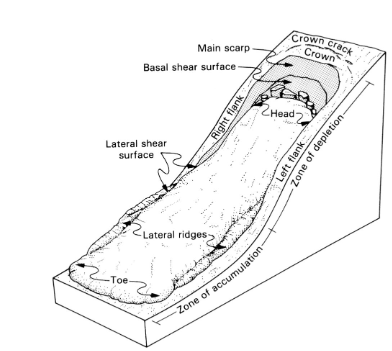
Type of movement: Rock, debris or earth flow
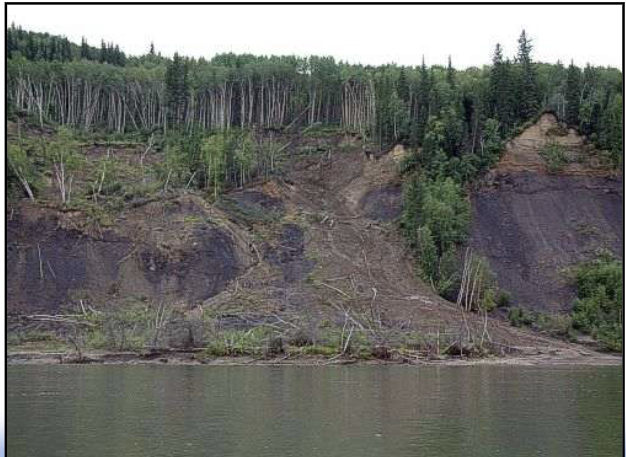
Rock, debris or earth flow: mixture of rock fragments, soil and water that flows downslope as a viscous fluid
• Generally confined to pre-existing channels
• Usually related to high water content
• Often occurs in relation with heavy rain or sudden thaw
Difference between earth flows and slumps
• Generally, earth flows are shallower than slumps
Rock, debris, earth flows
Type of movement: Complex
Complex events: combination of two or more types of mass movement events
• Most mass movements events are complex events
• Rock Avalanche: rapid complex event
Mitigation strategies
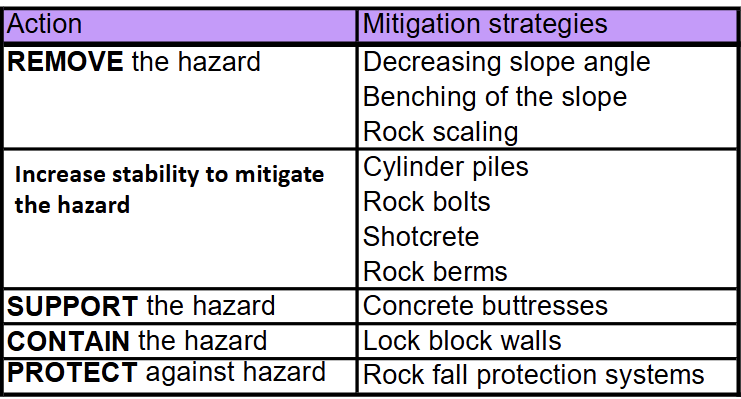
Action: Remove Hazard
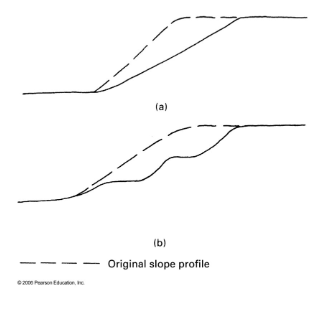
Designing more stable slopes
• Decreasing slope angle
• Benching of the slope
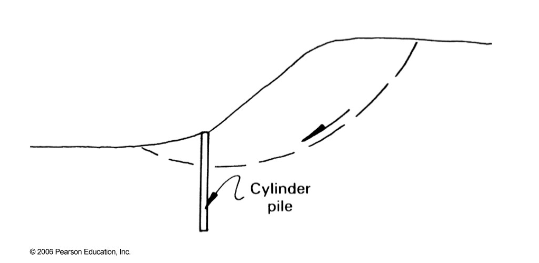
Action: Increase stability to mitigate the hazard
Cylinder piles prevent failure along plane of weakness
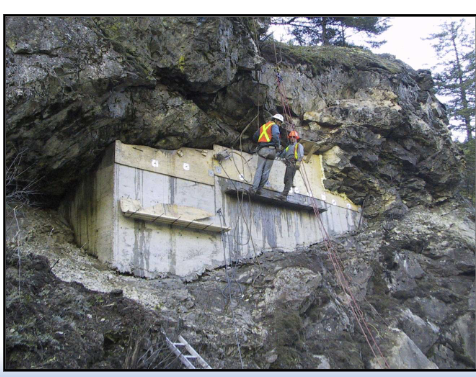
Action: Support the hazard
Specifically designed buttress
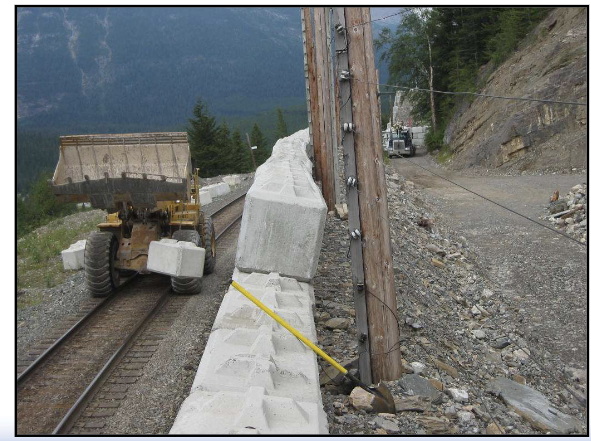
Action: Contain the hazard
Lock block wall
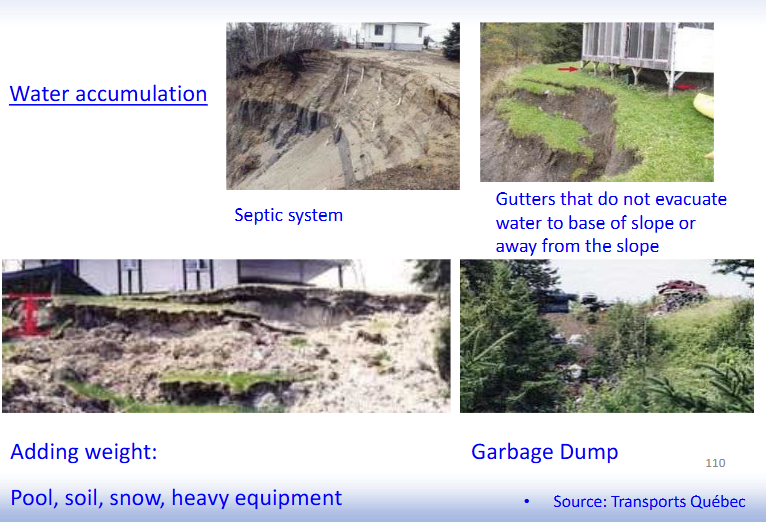
Example of BAD human actions at the TOP of slopes
Water accumulation:
septic system
gutters that do not evacuate water to base of slope or away from slope
Adding weight:
Pool, soil, snow, heavy equipment
Garbage dump
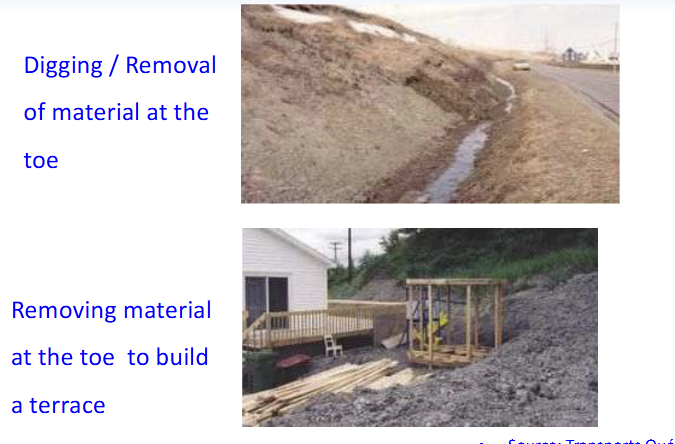
BAD actions near the BASE of a slope
Digging/Removal of material at the toe
Removing material at the toe to build a terrace
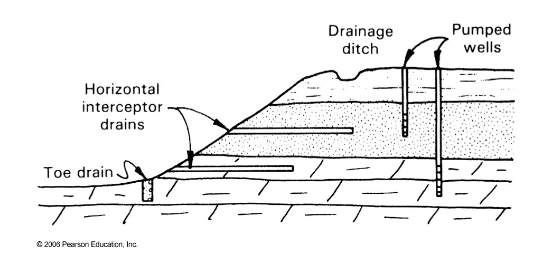
Mitigation strategies:
Manage surface and ground water
Warning signs
Active erosion
Recent landslides
Fissures near the top of slopes
Newly leaning/felled trees
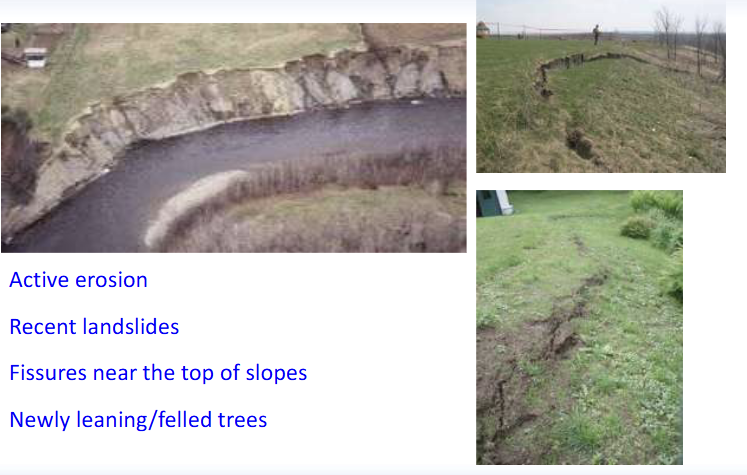
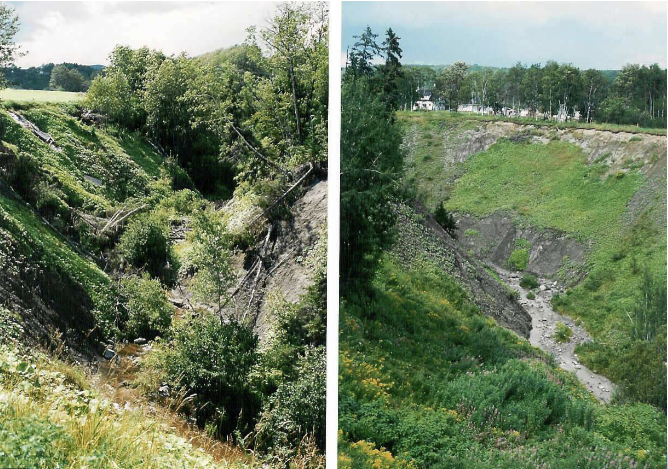
Example of active slopes
Note felled trees and slopes without vegetation
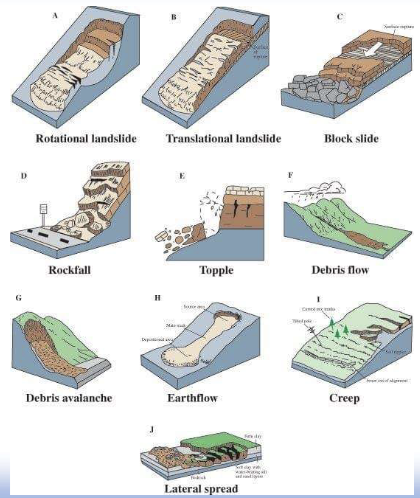
Overview of the types of mass movements
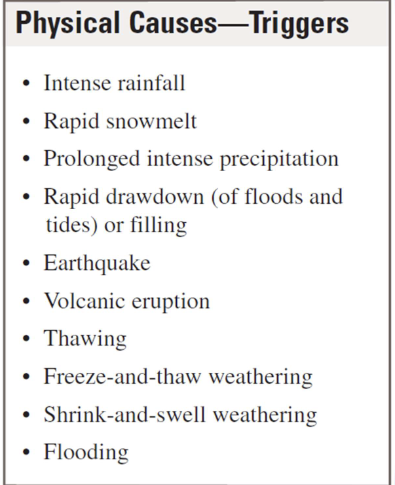
Review: Physics causes/Triggers of Mass Movements
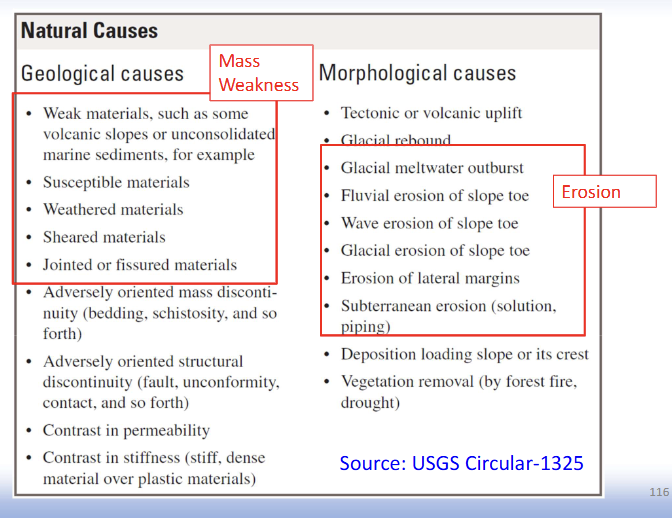
Review: Natural causes (Geological and Morphological) of Mass Movements
Mass weakness
Erosion
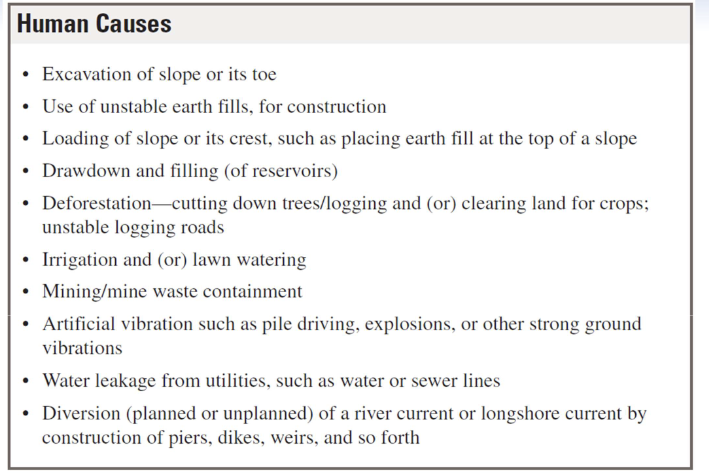
Review: Human causes of Mass movements