FUNDS 4
 Call Kai
 Learn
Learn Practice Test
 Spaced Repetition
 Match
Match Flashcards
 Knowt Play
1/81

There's no tags or description
Looks like no tags are added yet.
Name | Mastery | Learn | Test | Matching | Spaced | Call with Kai |
|---|
No analytics yet
Send a link to your students to track their progress
82 Terms
Competition?
Is an interaction between two or more organisms using the same limited resource.
Competition often occurs when fundamental niches overlap
Resource?
anything an organism consumes or uses that causes an increase in population growth rate when it becomes more available.
The role of resources?
Ecological factors that cannot be consumed, and thus monopolized, (e.g., temperature) are not considered resources.
Resources for plants can include sunlight, water, and soil nutrients.
Resources for animals can include food, water, and space.
Exploitative competition?
Resource competition
Competition in which individuals consume and drive down the abundance of a resource to a point that other individuals cannot persist
Indirect competition because it occurs through a shared resource
Interference competition?
when competitors do not immediately consume resource but defend them, preventing establishment of a competitor
Direct competition because it is an interaction directly with the competitor
Types of interference competition?
Allelopathy (only plants)
Territoriality (only animals)
Preemption
Allelopathy?
a type of interference competition that occurs when organisms use chemicals to harm their competitors
Allelopathy can be an effective strategy for invasive plants
Plants
Preemption?
A type of interference competition determined by who finds and occupies a place first
Territoriality?
Active defense of a resource that excludes other organisms
Animals
Niche?
The constellation of environmental conditions under which a species can survive and reproduce
Often considered a multi-dimensional box that defines the limits to survival for each environmental factor (i.e. each dimension)
Any environment that falls within the multi-dimensional "space" defined by the niche can potentially host the species.
Factors of niche?
temperature, rainfall, nutrient levels, and so on.
They might also include requirements such as the existence of nesting sites
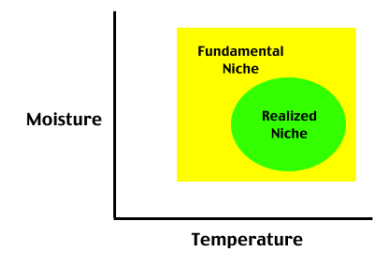
Fundamental Niche?
Complete set of environmental conditions in which the species can potentially survive and reproduce.
This includes both abiotic factors like temperature and precipitation as well as biotic factors like food availability
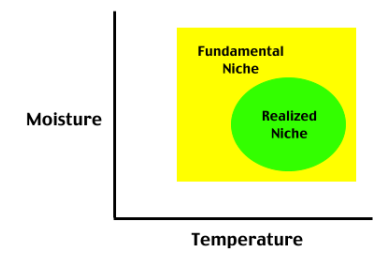
Realized Niche?
The set of environmental conditions in which the species is actually found in nature.
A subset of the species' fundamental niche
Restricted by BIOTIC interactions (i.e., interactions with other living things
BIOTIC interactions?
Competition
Predation
Parasitism
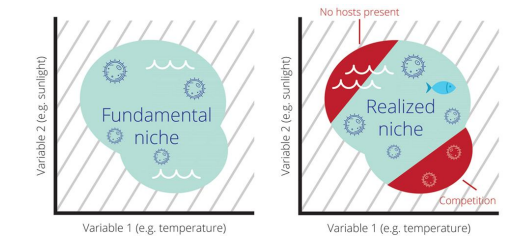
The realized niche is restricted by biotic interactions
Competition?
Competition results in a negative effect on all parties involved
Even when one party “wins”, they would have gained more of the resource if competition were not there in the first place
Competition interactions?
(-/-)
Predation interactions?
(+/-)
Amensalism interactions?
(-/0)
Mutualism interactions?
(+/+)
Commensalism interactions?
(+/0)
Intraspecific competition?
Intra = within
Competition among members of the same species
often the result of density-dependent effects
High densities result in limited resources
Interspecific Competition?
Inter = between
Competition between members of different species
Competition: related species?
Darwin suggested that competition is most intense between related species because they have similar traits and consume similar resources
For related species that compete strongly, natural selection should favor differences in habitat use.
Predation and herbivory?
There are often trade-offs between competitive ability and resistance to predators or herbivores; the most competitive organisms are often the most susceptible to predation or herbivory.
Thus, the presence of predators can reverse the outcome of competition.
Other types of interspecific interactions?
Mutualism
Commensalism
Ammensalism
Competitive exclusion principle?
No two species can coexist in the same niche
If two species are using the same resource, one would win and outcompete the other
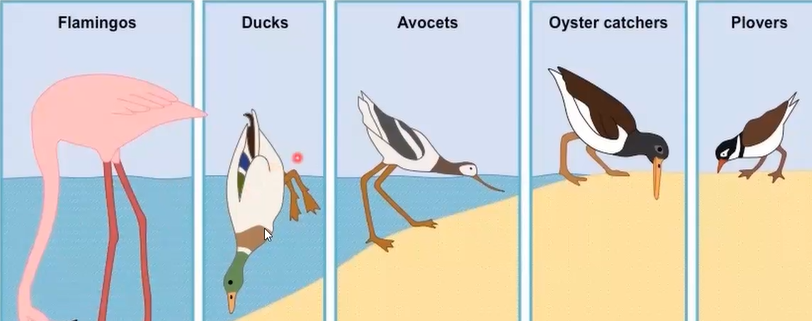
Resource partitioning?
species after their use of the niche to avoid competition, by dividing resources among them
Exemption to Competitive exclusion principle?
The competitive exclusion principle does not hold up in all situations
Paradox of plankton: many species of plankton appear to coexist within a single niche (competing for the same resources: light and few nutrients)
Don’t know why
What can’t be a resource?
Things that can’t be consumed or monopolized
Temperature
Two predators consume the same prey species. Because each predator reduces the availability of this prey organism for the other, we can refer to the interaction between the two predators as one involving __________.
Competition (-/-)
What type of population growth would intraspecific competition result in?
Logistic
Can competition lead to adaptation by natural selection?
Yes
Common garden experiment?
Experiment of growing two organisms together with manipulating resources to see the presence of competition
What can alter competitive interactions?
Disturbances
Predation and Herbivory
Interactions
Consumer?
predator, parasite, or herbivore
Resources?
Prey or food?
Predators?
Consumer of animals
Herbivores?
Consumer of plants
Grazers?
eat herbaceous plants (grass, forbs, herbs)
Browsers?
eat woody plants
Granivores?
eat seeds
Frugivores?
eat fruit
Browsers/grazers and the cellulose problem?
Fruits and seeds are high quality foods, but grasses and woody plants are primarily made of cellulose which mammals can’t digest (we lack the appropriate enzyme).
Browsers/grazers and the cellulose problem: Mammals will often?
Target young plants and new growth, because they have lower cellulose content.
Increase mechanical digestion time (e.g., “chewing cud”).
Mutualistic associations with symbiotic microorganisms that have cellulose digesting enzymes.
Endoparasites?
internal parasites
Harder to detect and remove
Inside organs, lack of protection
Ectoparasites?
external parasites
Easier disease transmission
Why is it harder to treat most parasite infections than bacterial infections?
Parasites are usually eukaryotes, like humans.
Bacteria are prokaryotes (no membrane-bound organelles).
Difficult to create medicine that just targets parasites (not us also)
Consumer-resource dynamics?
Populations of consumers are self-limited
Populations of resources are limited by consumers
Populations of consumers are self-limited?
as they grow, their resources become scarcer
Consumers are limited by density dependent factors
Populations of resources are limited by consumers?
Resources tend NOT to be limited by density-dependent factors.
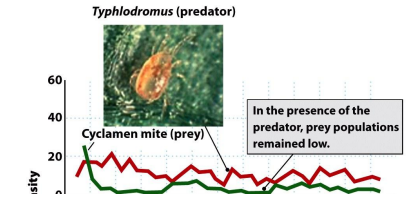
Predator-prey and carrying capacity?
In the presence of the predator, prey populations remained low
Predators can reduce prey below prey’s carrying capacity?
Predator-prey cycle?
Many predator and prey populations increase and decrease in regular cycles
1. Predators eat prey and reduce their numbers
2. Predators go hungry, and their numbers are reduced
3. With fewer predators, prey survive better and their numbers increase
4. With more prey, predator populations increase
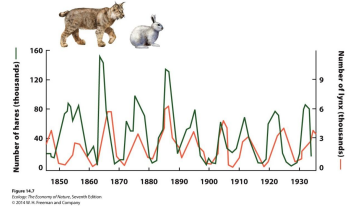
Population cycles?
The synchrony of population cycles between consumers and the populations they consume suggests that these oscillations are the result of interactions between them.
What causes time delays in predator-prey interactions?
Predators have a slower life history
longer gestation
longer parental care
longer to sexual maturity
Lotka-Volterra model?
Simple mathematical model that reproduces cyclic predator-prey interactions
Lotka-Volterra model: Prey growth with predation?
aNpreyNpredator

Lotka-Volterra model: Predator growth with death?

Lotka-Volterra model: Prey population growth with predation?


Prey population growth (change in number of prey over time = instantaneous rate of change)

Per capita growth rate of prey (intrinsic growth rate)

Number of prey

Search efficiency of predator

Number of predators
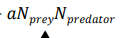
Mortality due to predation
New parameter for prey population growth?
a
a?
search efficiency
– Also known as “attack rate”
– Probability of predators encountering and attacking prey
– If there was constant attack (extremely high search efficiency) this would be 1 (for every search there is attack)
If predators are limited only by prey, what would influence predator population growth?
New babies
Mortality
New babies?
How efficient predators are at finding prey, and converting it into baby predators?
Lotka-Volterra Model: Predator population growth with death?


Predator population growth (change in number of predators over time = instantaneous rate of change)
b?
Conversion rate (converts encounter rate to number of new predators produced)
– # of predators produced per prey item
– If one prey = one offspring, this would be 1
– If 6 prey = 1 offspring, this would be 1/6
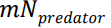
Mortality rate of predators
r?
a * b * Nprey?
per capita growth rate of predators
Lotka-Volterra Assumptions?
• Closed system (one predator, one prey, no immigration)
• No refuges for prey
• No handling time for predators
• Prey grow exponentially in the absence of predators
• Predators consume infinite amounts of prey
Without consumers, what type of population growth would resources (i.e., prey) have?
– Assume resources have unlimited food, space, etc…
Exponential or geometric
Can consumers reduce resource populations below the resource’s K (carrying capacity)?
Yes
Herbivore and predator strategies put selective pressure on “prey”?
Prey have evolved numerous defenses to thwart predators and herbivores at each of these events.
Some of these are phenotypically plastic (occur only when predators are around)
Hunting?
a series of events, including detecting, chasing, and handling / consuming prey.
Nutritional defenses?
Predominantly in plants
Nutrients stored away from available parts of plants. Areas exposed to herbivores are not nutritionally dense.
Tolerance defenses?
Predominantly in plants
changes to plant growth in response to herbivory
• Rapid growth following browsing/grazing
• Rapid flowering and seeding following herbivory
• Increased investment in root and woody stem growth
Behavioral defenses?
Predominantly in animals
• Alarm calling
• Reduced activity
• Mobbing
• Schooling/flocking
• Growing/flowering when herbivores are scarce