(6) Further hypothesis tests
 Call Kai
 Learn
Learn Practice Test
 Spaced Repetition
 Match
Match Flashcards
 Knowt Play
1/6

There's no tags or description
Looks like no tags are added yet.
Name | Mastery | Learn | Test | Matching | Spaced | Call with Kai |
|---|
No analytics yet
Send a link to your students to track their progress
7 Terms
If a random sample of n observations X1, X2, …, Xn is selected from N(µ,σ2), then
(n-1)S2/σ2 ~ X2n-1
100(1-α)% confidence intervals (where α is probability variance falls outside limits)
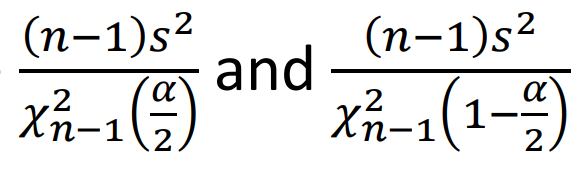
Hypothesis testing for variance of normal distribution
Ho: σ2 = population variance
H1: σ2 ><≠ population variance
Specify sig level
Specific degrees of freedom
Calculate critical region
Identify σ2, s2, and calculate test statistic 1/σ2(n-1)s2
Conclude
For a random sample of nx observations from an N(µx,σx2) distribution and an independent random sample of ny observations from an N(µy,σy2) distribution
(Use tables for F test/distribution)
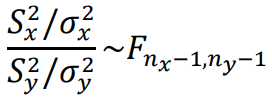
If a random sample of nx observations is taken from a normal distribution with unknown variance σ2 and an independent random sample of ny observations is taken from normal distribution with equal but unknown variance then
(Use tables for F test/distribution)
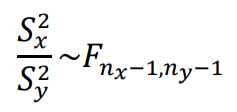
Fv1,v2(p)
(Fv2,v1(1-p))-1
Test whether two variances are the same (F test)
1) Find s21 and s22, the larger and smaller variances respectively
2) Write down null hypothesis
3) Alternative hypothesis
4) Look up critical value of Fvl,vs in tables (where vL is degrees of freedom of larger variance and vice versa) (If two-tailed test half sig level e.g. 10% use FvL,vs(0.05) as critical value)
5) Calculate critical region
6) Calculate Ftest = sL2 / ss2
7) Conclusion