Fluid Balance
 Call Kai
 Learn
Learn Practice Test
 Spaced Repetition
 Match
Match Flashcards
 Knowt Play
1/13

There's no tags or description
Looks like no tags are added yet.
Name | Mastery | Learn | Test | Matching | Spaced | Call with Kai |
|---|
No analytics yet
Send a link to your students to track their progress
14 Terms
Water
40-70% of total body mass
72% muscle weight
20-50% body fat/adipose tissue
55% of individuals body mass
striated muscle, skeleton, adipose tissue
Water - Compartments in Body
Intracellular fluid (ICF)
fluid inside cells
6 types*
1. lymph (colorless fluid circulates through the lymphatic system)
2. saliva (clear liquid secreted into the mouth fromt he salivary glands)
3. eye fluid (two fluids: vitreous humor [colorless gelantinous mass btw the lens and retina], aqueous humor [clear fluid btw lens and cornea]
4. fluids secreted by glands and the digestive tract
5. CSF
6. fluids excreted from skin (water & sweat) and kidneys (filtered fluids & urine)
about 12 L
30% of body mass
Extracellular fluids (ECF)
fluid surrounding cells
about 15 L
23% of body mass
blood plasma (20%)
Total fluid volume (TFV) = ICF + ECF
Water - Functions
transport & receive medium
facilitates gas diffusion
transports waste products in urine & feces
balances body’s chemicals
lubricates joints
provides structure & form through the turgor it imparts to body tissues
shock absorber for brain, spinal cord, fetus
absorbs internally generated heat
regulates body temp
Water Balance
Water Intake:
liquids
foods
metabolic processes
food molecules used for ATP form CO2 + H2O
100g carbs → 55g H2O
100g lipids → 107g H2O
100g proteins → 100g H2O
Normal conditions:
men (3.7 L or 15 cups /day)
women (2.7 L or 11 cups/day)\
sedentary (2.5 L)
Active, warm environment (5-10 L/day)
Water Content in Food
watermelon = 90-99%
apples = 80-89%
avocados = 70-79%
ice cream = 60-69%
hotdogs = 50-59%
Water Balance Cont.
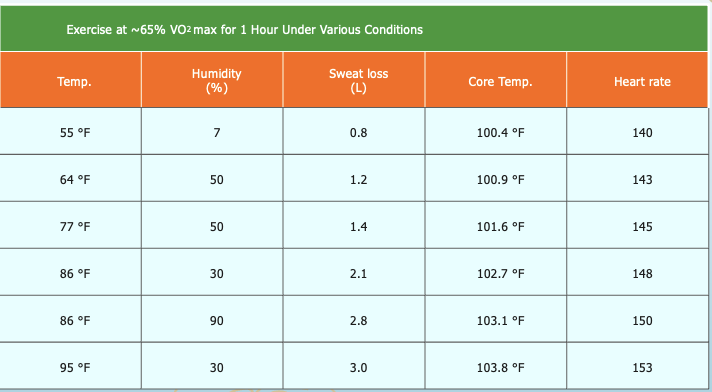
Sweating increase water loss during PA
Depends on:
intensity
environmental temperature
relative humidity
Evaporation of sweat:
cooling mechanism
defense against overheating
Sweat losses = 2-3% of body mass
plasma volume declines
strains circulatory functions
diminished thermo regulatory control
reduced exercise capacity
Temperature & Humidity
sweating is how the body cools itself down
water droplets come to the skin and then they evaporate
when humidity is high, there is a blanket of water droplets along your skin that stop the evaporation process
Challenge of Environmental Stress
most individuals acclimatize to all earth’s environments after 8-14 days
loss of acclimatization occurs in 14-28 days
6 factors impact individual differences in accommodation and acclimatization
genetic characteristics
available resources
age
nature & duration of previous exposures
number of similar prior experiences
emotional & psychological response (worry, fear, panic, self-assurance) to environmental stress
utilize cooling towels, hydration station to stay cool
Thermal Balance
normal body temp 98.6 degrees F (varies depending on the person)
three integrating mechanisms
1. heat transfer to periphery
2. evaporative cooling
3. varying heat production rate
Heat Loss:
Radiation, Conduction, Convection, Evaporation
Heat Gain:
BMR, muscular activity, hormones, thermic effect of food, postural changes, environment
Mechanisms of Thermoregulation
Cold:
stimulated by (decreases heat loss), mechanism (vasoconstriction)
stimulated by (increases heat production), mechanism (shivering, involuntary muscle movement)
Heat:
stimulated by (increases heat loss), mechanism (vasodilation)
stimulated by (decreases heat production), mechanism (decreased muscle tone, slow down muscle movements, sweating)
Hypothalamic Regulation of Core Temp
Hypothalamus:
helps control pituitary gland & regulates heart rate, hunger, mood, & body temp
CNS coordinating center for temp regulation
thermostat of the body
signals:
temp of the blood flow to the brain
receiving signals from afferent nerves in the skin that feel the temperature rising, this causes the hypothalamus to react to change in body temp
Thermoregulation During Heat Stress
Radiation:
electromagnetic waves that increase heat (from the sun or our bodies)
Conduction:
transfers heat from the environment to you (sitting on metal bleachers or leather car seats after they have been in the hot sun)
Convection:
air or water that hovers over the skin (insulation)
Evaporation:
water evaporating from skin surface
Heat Loss at High Ambient Temps
increased ambient temp reduces heat loss by -