IB MET L10 - How can your assets be protected?
 Call Kai
 Learn
Learn Practice Test
 Spaced Repetition
 Match
Match Flashcards
 Knowt Play
1/29

There's no tags or description
Looks like no tags are added yet.
Name | Mastery | Learn | Test | Matching | Spaced | Call with Kai |
|---|
No analytics yet
Send a link to your students to track their progress
30 Terms
What does protecting assets in manufacturing involve?
Assets may include:
Machines and equipment
Products and materials
Data and intellectual property
IT systems and networks
Buildings and infrastructure
People and skills
Protection methods include:
Physical security
Cybersecurity
Safety systems
Maintenance and monitoring
Access control
Backup and recovery systems
Threats include:
Theft and sabotage
Cyberattacks
Equipment failure
Human error
Supply chain disruption
👉 Key idea:
Asset protection combines physical, digital, operational, and organisational measures to maintain safety, security, reliability, and business continuity
Why Intellectual Property (IP) Matters
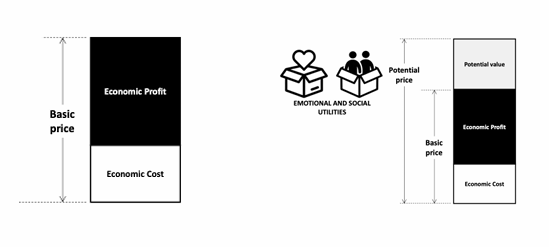
Products must remain profitable over time, but if competitors can easily copy a product or technology, prices and profit margins decline quickly.
IP management helps firms:
Protect innovation from imitation
Maintain competitive advantage
Preserve long-term value creation
Reduce time to market
Extend product market life
Maximise returns during the pay-off period
Firms invest heavily during development, then recover profits after launch. IP protection helps firms sustain higher profits for longer before competitors erode margins.
Competitive advantage may come from:
Patents
Manufacturing know-how
Branding
Data
Ecosystem/customer relationships
👉 Key idea:
IP management is part of a broader strategy for appropriating value from innovation by delaying imitation and sustaining profits over a product’s market life
IP Management and the Pay-Off Period
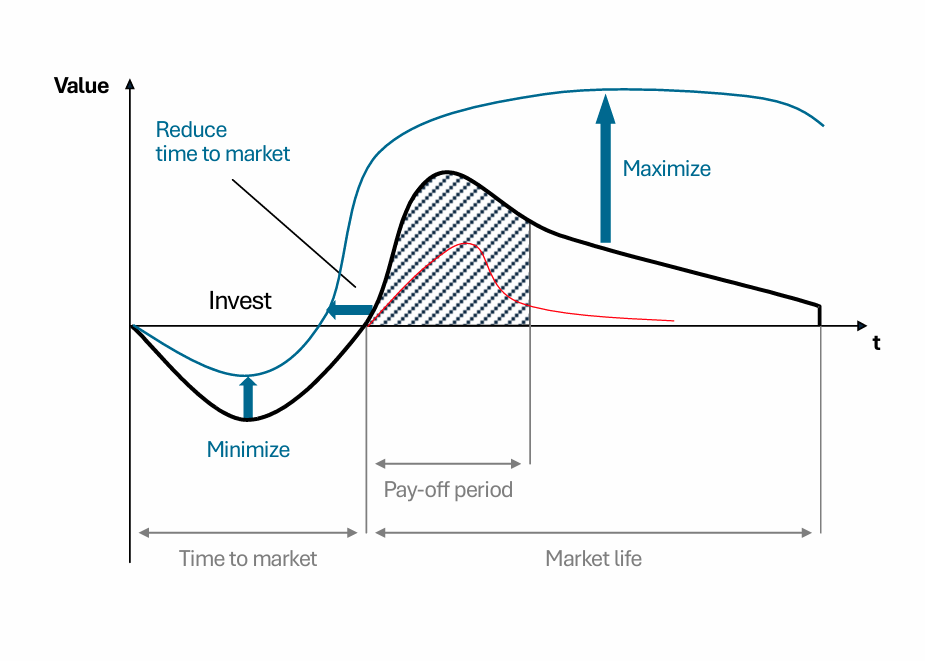
The graph shows that firms:
Invest heavily during development → negative value initially
Need to reach the pay-off period where revenues exceed investment costs
IP management helps firms:
Reduce time to market → reach profitability sooner
Delay imitation/competition
Extend market life
Maintain higher prices and margins for longer
This increases:
Total profit over the product lifetime
The area under the profit curve after launch
Protection can come from:
Patents
Know-how
Branding
Customer/ecosystem lock-in
👉 Key idea:
IP helps firms recover investment faster and sustain profits longer by protecting competitive advantage during the product’s market life
IP Rights vs Industrial Property vs Intangible Assets
Intellectual Property Rights (IPRs)
Legally enforceable rights protecting creations of the mind:
Patents
Trademarks
Copyright
Designs
Allow owners to exclude others from use or imitation.
Industrial Property
A subset of IPRs linked to industrial/commercial activity:
Patents
Trademarks
Industrial designs
Geographical indications
Utility models
Intangible Assets
A broader concept covering non-physical sources of value:
IP rights
Data
Software
Know-how
Brands
Customer relationships
Organisational capabilities/ecosystems
👉 Key idea:
Not all valuable business assets are formal IP rights — many important modern assets (especially in digital and AI industries) are broader intangible assets beyond traditional patent systems
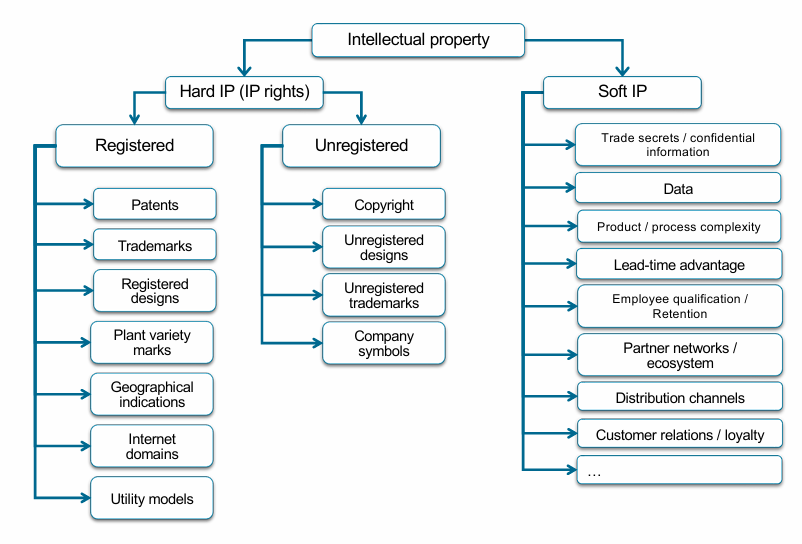
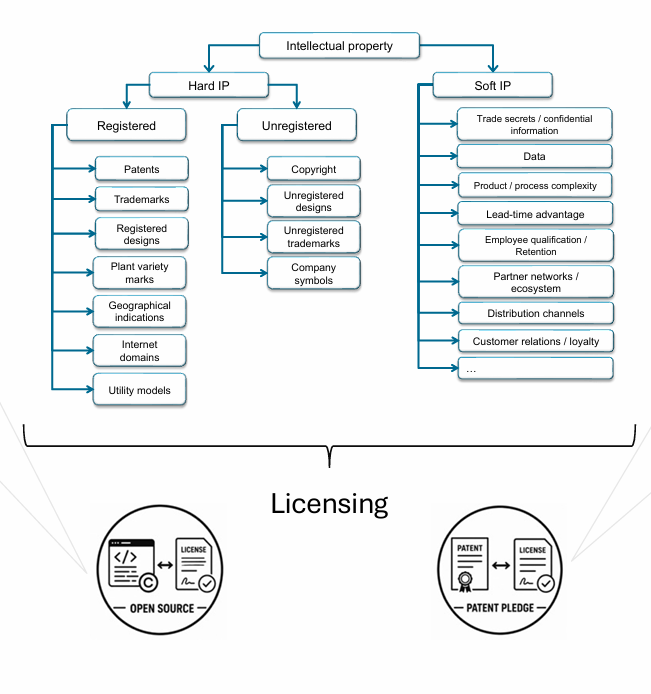
Hard IP vs Soft IP
Hard IP
Formally protected legal IP rights:
Patents
Trademarks
Copyright
Registered designs
Geographical indications
Utility models
Protected through statutory legal systems.
Soft IP
Strategic intangible assets protected mainly through:
Secrecy
Organisational capability
Data/control
Relationships/ecosystems
Complexity or lead-time advantage
Examples:
Trade secrets
Know-how
Customer loyalty
Distribution channels
Employee expertise
Partner networks
Key point
Modern firms often compete using combinations of both hard and soft IP.
👉 Key idea:
Hard IP protects innovation legally, while soft IP protects competitive advantage through knowledge, relationships, data, and organisational capabilities
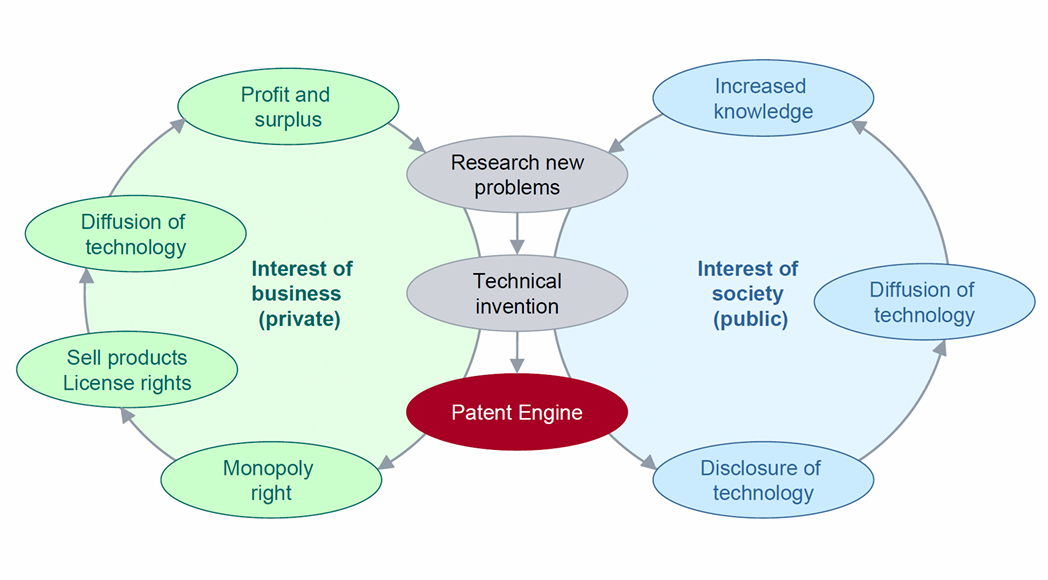
Economic Reasoning Behind IPR Systems
IPR systems balance:
Public interest
Private/business interest
Public interest
Society benefits when inventions are:
Publicly disclosed
Shared as knowledge
Used for further innovation and incremental improvements
This avoids:
Reinventing the wheel
Private interest
Businesses want:
Monopoly protection over innovations
Profit incentives
Control over licensing and commercialization
Patent system logic
Society accepts a temporary monopoly (typically ~20 years for patents) in exchange for:
Public disclosure of the invention
After expiry:
Anyone can use the technology
This supports:
Innovation incentives
Cumulative technological progress and patent cycles
👉 Key idea:
Patent systems trade temporary monopoly rights for disclosure of knowledge, encouraging both innovation incentives and long-term societal technological progress
Why does IP become more strategically important as firms grow?
As firms scale from early-stage innovation to industrial production:
visibility increases,
investment increases,
competitors begin monitoring them,
and internationalisation becomes important.
Successful firms may then face:
imitation risks,
patent litigation,
competitive pressure,
acquisitions,
and strategic attacks from rivals.
IP strategy becomes important for:
protecting technology and know-how,
defending intangible assets and market position,
maintaining competitive advantage,
supporting valuation and attracting investors,
and negotiating partnerships.
👉 Key idea:
As companies become more successful and visible, protecting and controlling intangible assets through IP strategy becomes critical for sustaining growth and competitive advantage.
IP Across Products, Manufacturing & Supply Chains
IP exists throughout industrial systems, not just in final products.
Competitive advantage may come from:
Products and inventions
Manufacturing systems/processes
Operational know-how
Logistics and supply chains
Supplier relationships
Ecosystem coordination
Products often contain multiple overlapping forms of IP simultaneously:
Patents
Trademarks
Registered designs
Copyright
Software
Trade secrets/data
Firms usually rely on IP portfolios rather than a single patent.
👉 Key idea:
IP management is integrated with engineering, manufacturing, and supply chain strategy, with firms combining multiple forms of IP protection to sustain competitive advantage
Samsonite Suitcase Example and IP Portfolios
The Samsonite wheeled suitcase illustrates how a single product can contain multiple forms of IP:
Patents → technical functionality/mechanisms
Registered designs → product appearance
Trademarks → brand identity
Soft IP → design know-how and user experience
The example shows that firms rarely rely on one patent alone — they build broader IP portfolios across products and markets.
👉 Key idea:
Competitive advantage often comes from combining multiple overlapping forms of IP rather than relying on a single protection mechanism
European Patent Requirements (EPC)
Under the European Patent Convention (EPC), a patentable invention must:
Be new (novel)
Involve an inventive step
Be industrially applicable
Patents apply to inventions in all fields of technology.
Important point
Public disclosure before filing can destroy novelty and prevent patent protection.
Therefore:
Confidentiality is important during engineering and product development.
👉 Key idea:
To obtain a patent in Europe, an invention must be novel, non-obvious, and usable in industry, meaning secrecy before filing is often critical
Patent Claims and Patent Scope
Patent protection is defined mainly by the patent claims.
Claims determine:
The legal boundary/scope of protection
Strategic trade-off
Broad claims:
Stronger protection
Harder to obtain/challenge more easily
Narrow claims:
Easier to obtain
Easier for competitors to design around
Patent applications therefore describe inventions in significant technical detail to:
Support broader claims
Cover different architectures/implementations
Maximise protection scope
👉 Key idea:
Small wording differences in patent claims can greatly affect how much protection a patent provides and how easily competitors can avoid infringement
Patents as a Source of Information
Patents are not only legal protections — they are also rich technical information sources because patent applications require public disclosure.
Patent data can be analysed using:
Citation analysis/networks
Text mining and NLP
Clustering/classification
Technology mapping
Patent analytics is used for:
Technology intelligence
Competitive analysis
Innovation strategy
R&D planning
Patent databases contain both:
Structured data (citations, classifications)
Unstructured data (technical text/descriptions)
👉 Key idea:
Patent systems create publicly accessible technical knowledge that firms can analyse to track technologies, competitors, and innovation trends
Trademarks
Trademarks protect branding and commercial identity:
Names
Logos
Colours
Sounds
Shapes
Types:
Registered ®
Unregistered TM
Key features
Registered by product/service class (Nice Classification system)
Can potentially last indefinitely if actively used and defended
Strategic value:
Build brand recognition
Create customer trust and loyalty
Differentiate products from competitors
👉 Key idea:
Unlike patents, trademarks protect brand identity rather than technical inventions and can provide long-term competitive advantage through customer recognition and loyalty
Principles of Trademark Registration
A trademark should:
Be distinctive
Not be purely descriptive of the product/service
Not be misleading or confusingly similar to existing marks
Not resemble protected symbols/flags/hallmarks
Important issue: Genericisation
If a trademark becomes the common product name, exclusivity may be lost.
Example:
Firms actively protect brand usage to prevent genericisation.
👉 Key idea:
Trademark systems protect distinctive branding while preventing misleading or overly generic marks.
Trademark Portfolios (Skype Example)
Firms often develop trademark portfolios across:
Company branding
Product names
Slogans
Ecosystem/service branding
Trademark portfolios:
Grow over time
Become valuable strategic assets
Can increase company acquisition value
Example:
Microsoft acquired Skype partly alongside its brand/IP assets.
👉 Key idea:
Trademarks are strategic long-term business assets, not just logos or names.
Registered vs Unregistered Design Rights
Registered designs
Protect the visual appearance of products:
Shapes
Colours
Contours/configuration
Features:
Must be novel/new
Can be registered up to 12 months after disclosure (grace period)
Stronger legal protection
Protection lasts up to 25 years
Infringement does not require proof of copying
Unregistered design rights
Automatic protection for original designs:
No registration required
Mainly protects 3D shapes
Usually requires proof of copying
Shorter protection duration
UK: ~10–15 years
EU UCD: 3 years
👉 Key idea:
Registered designs provide stronger and longer protection for product appearance, while unregistered rights provide automatic but weaker short-term protection
IP Beyond Consumer Products
IP is important not only for consumer products, but also for:
Manufacturing equipment
Industrial systems
Sustainability technologies
Software interfaces/UI
These may combine:
Patents
Design rights
Software
Know-how
Examples:
Air-curtain supermarket fridge technology
Skype software icons protected by design rights
👉 Key idea:
Industrial technologies and digital systems often rely on multiple overlapping forms of IP protection.
Apple vs Samsung and Design IP
The Apple v Samsung patent disputes showed that:
Design-related IP can be strategically very important
The case involved:
Smartphone appearance
Interface/icon layouts
Device design
Key lesson:
Competitive battles are not only about technical patents
Product appearance and UI design can also create major competitive advantage
The case also showed how:
IP litigation can become part of broader competitive strategy.
👉 Key idea:
Design patents and interface design can be as strategically important as technical inventions in technology industries.
IP Databases as Information Sources
Free public IP databases allow access to:
Patents
Trademarks
Design rights
Geographical indications
Useful for:
Competitor analysis
Technology scouting
Prior-art searches
Market intelligence
👉 Key idea:
IP systems create publicly accessible technical and commercial information that engineers and firms can analyse strategically
What types of IP exist in manufacturing systems and how are they protected?
Manufacturing systems can contain valuable IP, including:
process technologies,
automation and robotics systems,
factory-control software,
AI algorithms,
and operational know-how.
Manufacturing processes themselves can be patented, such as:
chemical synthesis methods,
additive manufacturing methods,
predictive maintenance systems,
and process-control technologies.
Example:
Nexium used patents to protect the manufacturing process for esomeprazole across multiple European countries.
Process innovation can improve:
cost,
quality/purity,
throughput,
and scalability.
Firms must strategically choose whether to:
patent a process,
keep it secret,
or publish it.
Patents → require disclosure but provide legal protection for a limited time.
Trade secrets → avoid disclosure and may last indefinitely if secrecy is maintained.
The decision often depends on whether competitors can reverse engineer the process.
👉 Key idea:
Some of the most valuable industrial IP exists in manufacturing processes, AI-enabled systems, and operational know-how rather than the final product itself.
Process Innovation as Competitive Advantage
Manufacturing competitiveness improves through continuous process innovation.
Investments into process improvement can reduce:
Throughput time
Manufacturing cost
Waste and defects
Example:
Automotive assembly evolved from Ford’s Model T production to highly optimised Toyota systems with much faster assembly speeds.
Over time, firms accumulate:
Manufacturing know-how
Operational routines
Optimisation expertise
These become valuable forms of soft IP and difficult for competitors to replicate.
👉 Key idea:
Long-term competitive advantage in manufacturing often comes from accumulated process know-how and operational excellence, not just individual inventions
Trade Secrets, Know-How & Confidentiality
Trade secrets and know-how are major forms of industrial IP.
Examples:
Recipes/formulas
Manufacturing parameters
Calibration settings
Algorithms/software
Operational routines
Firms may prefer secrecy over patents because:
Patents require full public disclosure
Patents expire (~20 years)
Trade secrets can last indefinitely if protected
Some processes are difficult to reverse engineer
Trade secret protection requires:
Commercial value from secrecy
Limited access to the information
Reasonable protection measures
Typical protection methods:
NDAs/confidentiality agreements
Access controls
Cybersecurity
Restricted information sharing
Employee/partner confidentiality procedures
NDAs (Non-Disclosure Agreements)
Used with:
Employees
Suppliers
Investors
Collaborators
Factory/lab visitors
They help:
Protect know-how
Prevent unauthorised disclosure
Preserve future patentability
👉 Key idea:
Manufacturing industries rely heavily on trade secrets and confidentiality because valuable process know-how is often difficult to patent effectively and hard for competitors to reverse engineer
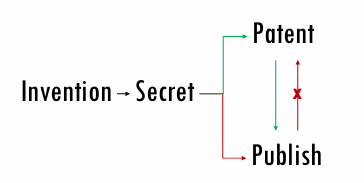
Strategic IP Decisions — Patent, Secret, or Publish?
For a patentable invention, firms have three main options:
1. Patent
Publicly disclose invention
Gain legal monopoly rights for limited time
Prevent others from making/using/selling/importing invention where protected
2. Trade secret
Keep invention confidential
No disclosure required
Protection can last indefinitely
Risk if competitors reverse engineer or information leaks
3. Defensive publication
Publicly publish the idea
Prevent competitors from patenting it later
No exclusive rights gained
The choice depends on:
Reverse-engineering risk
Business model
Market competition
Cost of protection
International strategy
👉 Key idea:
IP management is a strategic decision balancing disclosure, protection, secrecy, and competitive advantage.
Territorial Nature of IP Rights
IP rights are territorial:
Protection only exists in countries/regions where rights are filed or granted.
A patent in one country does NOT automatically protect elsewhere.
Firms therefore build:
Patent families across multiple jurisdictions.
Patent rights may prevent others from:
Making
Using
Selling
Importing
the invention in protected countries.
Territoriality is especially important for:
Patents
Trademarks
Registered designs
This becomes critical when firms:
Internationalise manufacturing
Enter global markets
Build global supply chains
👉 Key idea:
Global firms must strategically decide where IP protection is commercially valuable because IP rights only apply in specific jurisdictions
Copyright & Software Protection
Copyright protects original creative works, including:
Written/artistic works
CAD drawings & engineering drawings
Business plans/reports
Photos/videos/music
PCB layouts
Software code/computer programs
Software is usually protected by copyright as a literary work.
Key points
Protection is automatic when the work is created (registration usually not required).
Copyright protects the specific expression of a work, NOT the underlying idea/algorithm.
Different code implementing the same algorithm may not infringe copyright.
Example:
Rewriting a Python algorithm independently in Java may avoid copyright infringement.
Ownership
Work created during employment is usually owned by the employer.
Commissioned work does not automatically transfer copyright.
Students commonly own copyright to their university work.
Using copyrighted material
Permission is usually required unless covered by exceptions such as:
Fair dealing for study/research
Limited quotation with acknowledgement
Duration
Typically lasts 70 years after the author’s death.
👉 Key idea:
Copyright protects the expression of creative and software works, while patents/trade secrets protect underlying inventions, functionality, or know-how.
Protecting Algorithms, Contracts & Licensing
Protecting algorithms from reverse engineering
Some firms protect algorithms by:
Keeping them as trade secrets
Running them on cloud servers instead of customer devices
Reason:
Software running locally can potentially be reverse engineered.
Thus, technical architecture decisions (e.g. cloud vs local deployment) can act as IP protection mechanisms.
Contracts in supply chains & innovation ecosystems
Contracts are key governance mechanisms in distributed innovation systems.
They define:
Ownership
Usage rights
Confidentiality
Licensing terms
Collaboration structures
Contracts are especially important when multiple firms collaborate across:
Supply chains
AI ecosystems
Manufacturing partnerships
Contracts are not IP rights themselves, but regulate access to and use of IP/intangible assets.
Licensing
Licensing:
Gives permission to use IP
Does NOT transfer ownership
A licensor (owner) grants rights to a licensee through a licensing agreement.
Licenses may include bundles of IP such as:
Patents
Trademarks
Know-how
Software/data
👉 Key idea:
Modern firms protect and commercialise intangible assets not only through patents, but also through architecture choices, contracts, secrecy, and licensing arrangements
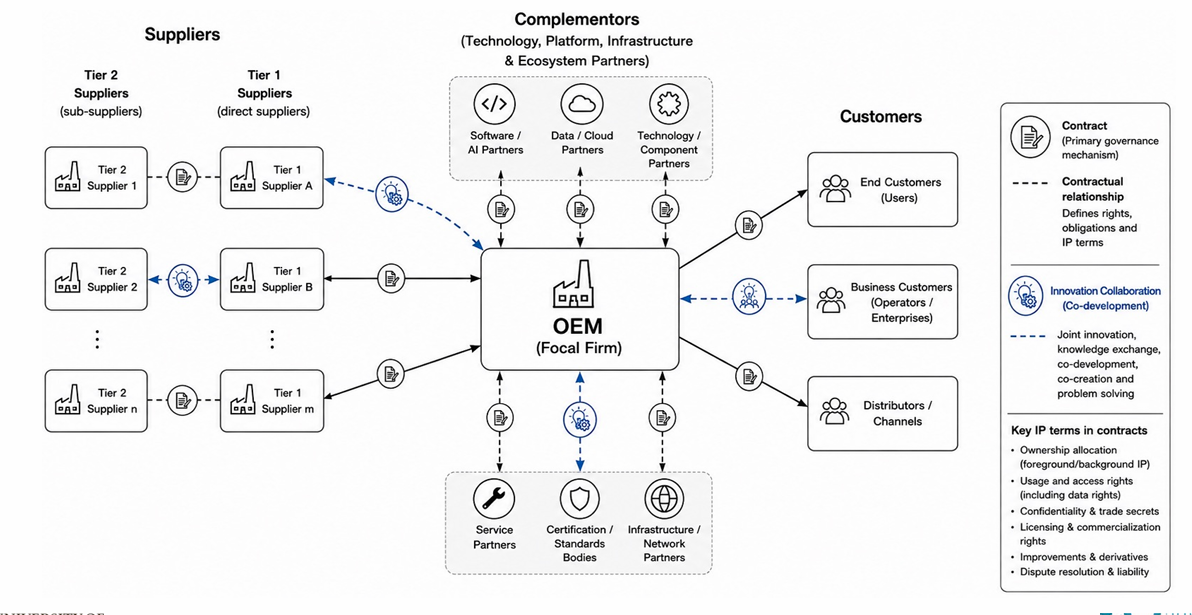
Contracts in Supply Chains & Innovation Ecosystems
Modern supply chains increasingly involve:
Collaborative development
Shared data & AI systems
Software integration
Co-innovation across ecosystems
Contracts help govern relationships by defining:
IP ownership (foreground/background IP)
Data & technology usage rights
Confidentiality/trade secret obligations
Licensing/commercialisation rights
Liability & dispute resolution
Contracts may exist between:
OEMs & suppliers
Suppliers & subcontractors
Firms & customers
Platform operators & ecosystem partners
Strategic issue
Overly aggressive IP ownership/control can:
Reduce trust
Discourage collaboration
Limit knowledge sharing within ecosystems
👉 Key idea:
In modern innovation ecosystems, contracts are strategic governance tools used to coordinate collaboration, manage IP, and balance incentives between partners
IP in Manufacturing Systems & Ecosystems
IP exists not only in products, but also in:
Manufacturing systems
Operational processes
Supply chains & ecosystems
Hard IP examples
Patents on manufacturing/robotic systems
Copyright in factory-control software
Registered tooling/interface designs
Trademarks linked to quality certification
Patented logistics optimisation technologies
Soft IP examples
Trade-secret process parameters
Tacit manufacturing know-how
Yield optimisation expertise
Skilled workforce capabilities
Supplier relationships & ecosystem coordination
Collaborative innovation projects (e.g. Rolls-Royce + universities + suppliers) require coordination of:
Technical relationships
Contracts/licensing
Shared IP ownership & usage rights
👉 Key idea:
Competitive advantage increasingly comes from combinations of hard IP, soft IP, contracts, know-how, and ecosystem relationships.
Copyright & Licensing in the AI Economy
AI shifts strategic importance toward:
Software
Training data
Copyright
Licensing
Ecosystem governance
Why copyright matters in AI:
AI models depend heavily on digital content and code
Model weights/software are often copyright protected
Licensing controls how AI systems can be used commercially
Examples:
Meta Llama → open-weight model under community licence
Tesla → opened patents under conditional patent pledge
Licensing:
Controls access and usage of IP
Does NOT transfer ownership
Can allow free, paid, restricted, or collaborative use
👉 Key idea:
In AI and platform ecosystems, firms strategically combine openness, licensing, and IP control to shape innovation and competitive advantage.
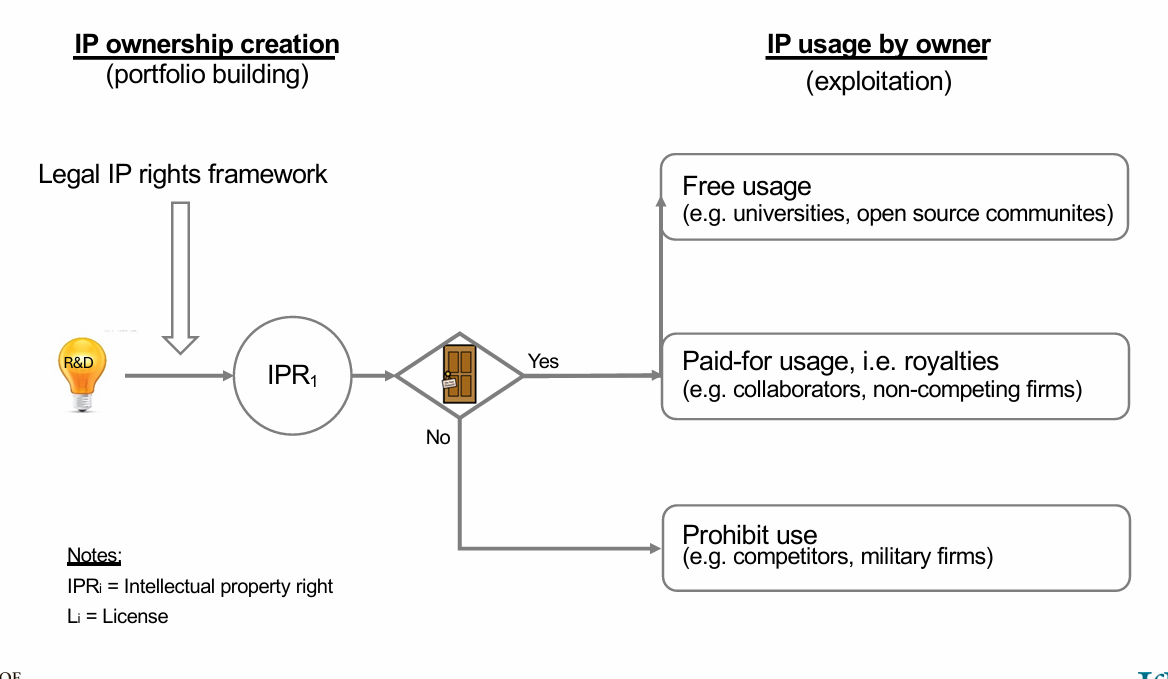
Ownership vs Usage Rights in IP
Two key elements of IP management:
1. IP ownership
Building IP portfolios through R&D
Includes patents, trademarks, copyright, trade secrets, etc.
2. IP usage
Owners decide:
Who can access/use IP
Under what conditions
Whether use is free, licensed, or prohibited
Possible approaches:
Open usage (e.g. open source/universities)
Paid licensing/royalties
Restricted use against competitors
Front-door analogy
IP acts like a house front door:
Decide who enters
Who stays out
What access is permitted
👉 Key idea:
IP management is not just about protection — it is about strategically controlling openness, collaboration, access, and value capture from innovation.