George Kelly - Personal Construct Theory
 Call Kai
 Learn
Learn Practice Test
 Spaced Repetition
 Match
Match Flashcards
 Knowt Play
1/21

There's no tags or description
Looks like no tags are added yet.
Name | Mastery | Learn | Test | Matching | Spaced | Call with Kai |
|---|
No analytics yet
Send a link to your students to track their progress
22 Terms
George Kelly; Background
Born in 1905, in Perth, Kansas
Only child, son of Presbyterian Minister
Education
BA at University of Edinburgh, Scotland
Engineering —> education
PhD at University of Iowa
Public speaking, drama —> psychology
Got PhD in 9 months!
Professor
Small College in Western Kansas
Set up college counseling services and provided rural psychological services
University of Maryland (1 year)
Ohio State
Took Carl Rogers’ former position
Wrote famous, “The Psychology of Personal Constructs”
Brandeis University
Accepted invitation from Abraham Maslow, and worked 1 year before . . .
Died in 1967
“Jackass Theory”
Focuses on the individual’s personality, emphasizing the individual’s thoughts (but not to the exclusion of people’s emotions)
The theory concerns the “nature of the animal” itself
Doesn’t focus on influence of environment that push (“pitchfork theories”) or pull (“carrot theories”) the individual
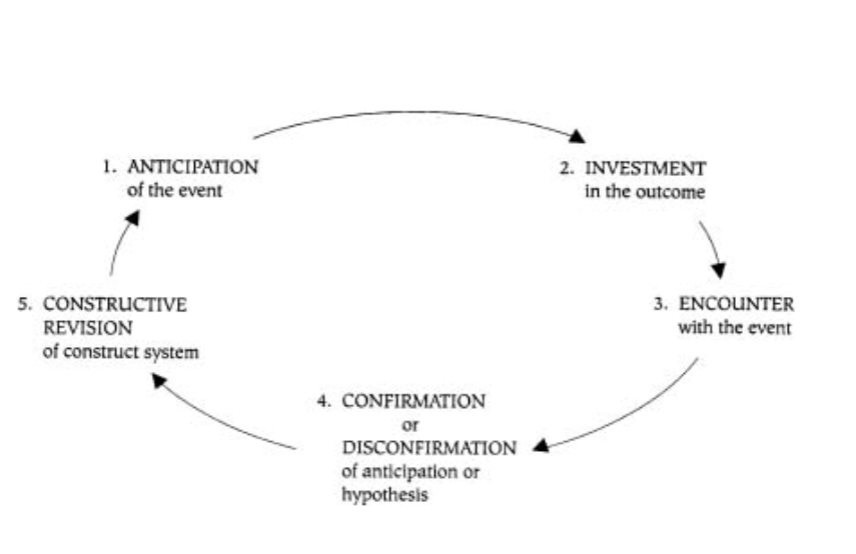
People have “personal constructs”
Personal constructs help people predict what will happen (based on situation, people present, etc.)
“. . . Present interpretations of the world are subject to revision”
Called this “constructive alternativism”
1 Fundamental Postulate (11 corollaries)
“A person’s processes are psychologically channelized by the way in which he anticipates events.”
i.e., We prepare for the events that we anticipate
Following an exam:
Anticipating good grade
Anticipating bad grade
Accurate (validation) or inaccurate (revision of constructs?)
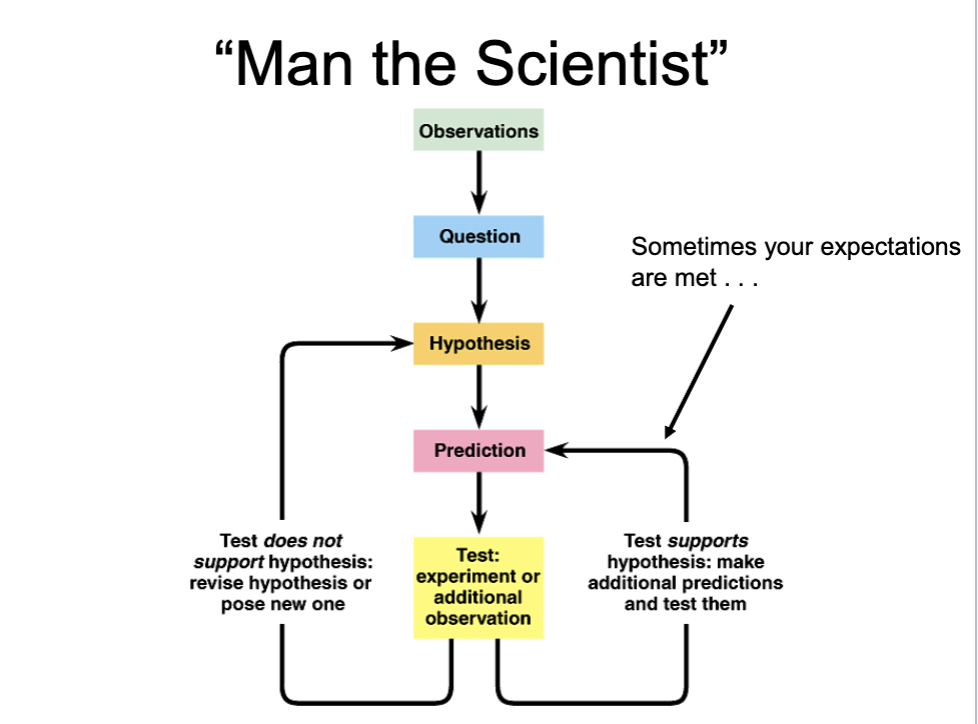
Like a scientist…
Hypothesis Testing…
Observations
“I can swim in water (pools, bathtub, etc.).”
Question
“I wonder how much water I need in order to swim?”
Hypothesis
“I can swim in any any amount of water.”
Prediction
“I can swim in a bowl . . .”
Not like a scientist…
People are biased
Optimists versus pessimists
We tend to think of our capacities more highly than we should!
People tend to view/seek confirmation
Definitely NOT like a scientist (sensitive to counter-factual data)
Construction Corollary
People anticipate confirmation of their constructs
Need not be conscious/cognitive (called a “preverbal construct”)
i.e., people may have “butterflies” in a certain situation (anxiety), and the outcome can either confirm their constructs or, perhaps, their constructs may require adaptation.
Experience Corollary
People change with experience; their constructs change
Is the school bus really that bad?
But . . . There are not universal stages of development (Freud, Erikson).
Choice Corollary
Who are you? Daring to do something different!
People try to extend themselves in ways that are mostly consistent with their own self-view . . .
Steps aren’t too large, or else the person feels “threat”.
If threat gets too great, the person goes back to the way they previously acted, a process called “sedimentation”.
Modulation Corollary
“The variation in a person’s construction system is limited by the permeability of the constructs within whose ranges of convenience the variants lie.”
Permeable Construct
Are Disney characters real? “Good news Daddy . . .”
“The variation in a person’s construction system is limited by the permeability of the constructs within whose ranges of convenience the variants lie.”
Concrete Construct
Can pools be indoors? No!
The structure of constructs
The Dichotomy Corollary
A person’s construction system is composed of a finite number of dichotomous constructs
People differ on constructs
May be logical (happy versus sad) or illogical (ambitious versus happy)
Typical end is called the “likeness end” whereas unusual end is called “contrast end”
People’s constructs often change in response to stress; this is called slot movement.
Nice —> mean!
Organization Corollary
Superordinate constructs
e.g., if a person is “happy,” they must also be X, Y, and Z (nice, giving, and empathic)
If mammal (X), must have hair (Y) and mammary glands (Z)
Subordinate constructs
E.g., break down larger concept to have better anticipation
Have horns (H); (introverted, extroverted)
Fragmentation Corollary
People act differently in different situations
Fierce competitor versus loving friend
At funeral or party
Observers may err if they sample from a limited number of situations
Range Corollary
A construct is convenient for the anticipation of a finite range of events
Do constructs help if we learn the world will end in 1 hour?
How Eddie will behave on the front lines of a war?
Extreme examples, but the point is the same
Individuality Corollary
People differ from one another in their construction of events (important individual difference research):
Different constructs are important to them
They assume different perspectives
Like how BIS/BAS influences perceiving neutral emotions
Commonality Corollary
To the degree that people construct experience the same way, they are similar
Wow!
Use same constructs
View people/situations similarly
Have same hypotheses . . .
. . . and therefore act similarly!
Sociality Corollary
To the degree that one person understands the construction processes of another, he/she may play a role in the social processes of that person
Bilateral: Understanding between two friends
Unilateral: e.g., therapist-client relationship
Role Construct Repertory (REP) Test
List people the person (client) knows including, perhaps, the person himself
3 people are identified by the researcher/therapist
Subject is instructed to identify 1 way in which 1 person is different from the other 2
Can be cognitive (“intelligent” versus “not intelligent”) or emotional (“empathic” versus “insensitive”)
The words used are termed “constructs,” with dichotomous poles (rational or not)
All people are then rated on all constructs
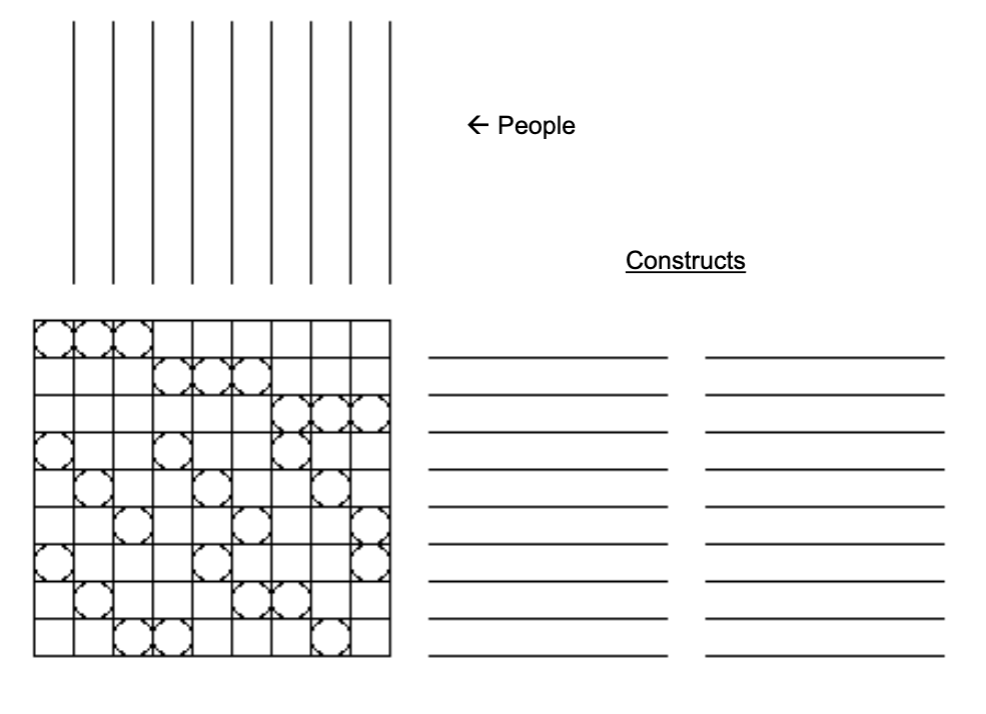
Cognitive Complexity
The number of different constructs used
The greater the number, the more flexibility the person has . . . s/he can see more dimensions in a person
E.g., freshmen with greater cognitive complexity adjust to school more easily
Personality Change
Can occur . . .
Quickly, as in PTSD
More slowly, as in development or therapy
Use REP Test to see how individuals change over time (looking at “real self” and “ideal self”)
Change can be threatening, even if the change is desirable (e.g., a prisoner’s self constructs could change dramatically upon release)
“Constructivist” Therapy
Understand the client’s constructs
“Understand the client in the client’s own terms”
Exploring constructs
Identify superordinate and subordinate constructs
Changing constructs by “tightening” them:
Time binding: “That happened long ago, not recently.”
Word binding: “That’s exploitation, not love.”
Fixed Role Therapy
Client experiments with new self-constructs via role-playing
Sometimes roles are reversed, with the therapist playing the “new,” experimental client
Often, this is not just about changing poles on the current constructs, but by identifying new constructs (i.e., increasing cognitive complexity).