Implantable Loop Recorders (ILR)
 Call Kai
 Learn
Learn Practice Test
 Spaced Repetition
 Match
Match Flashcards
 Knowt Play
1/13

There's no tags or description
Looks like no tags are added yet.
Name | Mastery | Learn | Test | Matching | Spaced | Call with Kai |
|---|
No analytics yet
Send a link to your students to track their progress
14 Terms
Implantable Loop Recorder
AKA implantable cardiac monitors (ICMs)
Implanted under the skin to monitor heart rhythm
Capture, record, and classify rhythm
Send alerts using RM
Did the device get it right?
Modern ILRs
1-2 inches long
Implanted in left parasternal region
Up to 5 years
Continuously loop over data, saving specific episodes
Patients with infrequent symptoms
Unable to document using another method
Holter Monitor
electrodes on chest (24-72 hours)
Event Recorder
only record events or when patient presses button (week to a month)
External Loop Recorder
patch with continuous monitoring like ILR (week to a month)
ILR Indications
Document arrhythmia correlated to symptoms
Syncope: bradycardia, pauses, VT, VF
Palpitations: bradyarrhythmia, tachyarrhythmia
Monitor VT, assess medications
Post AF ablation monitoring
Cryptogenic stroke
ILR Implant
Sometimes called injectable loop recorders
Left parasternal region for best signal
A: Diagonal between 4th and 5th ribs (most common)
B: Parallel to sternum
C: Horizontal
ILR Implant Steps
Numbed with local anesthetic
Initial incision
Delivery-system inserted
Delivery-system rotated 180°
Device advanced using plunger
Delivery system removed
Incision sealed
Clinical Specialist Role
Coach physician on implant procedure
Check device sensing
Reposition if signal is bad
Program device to match indications
Input patient info
Educate patient
Set up RM
ILR Sensing
Electrodes under skin: small signals
Typically < 1 mV, recommended R waves > 0.2 mV
Auto-adjusting sensitivity
Avoid P waves and T waves
Lowest programmable value for max sensitivity: 0.025 mV
ILR Programming
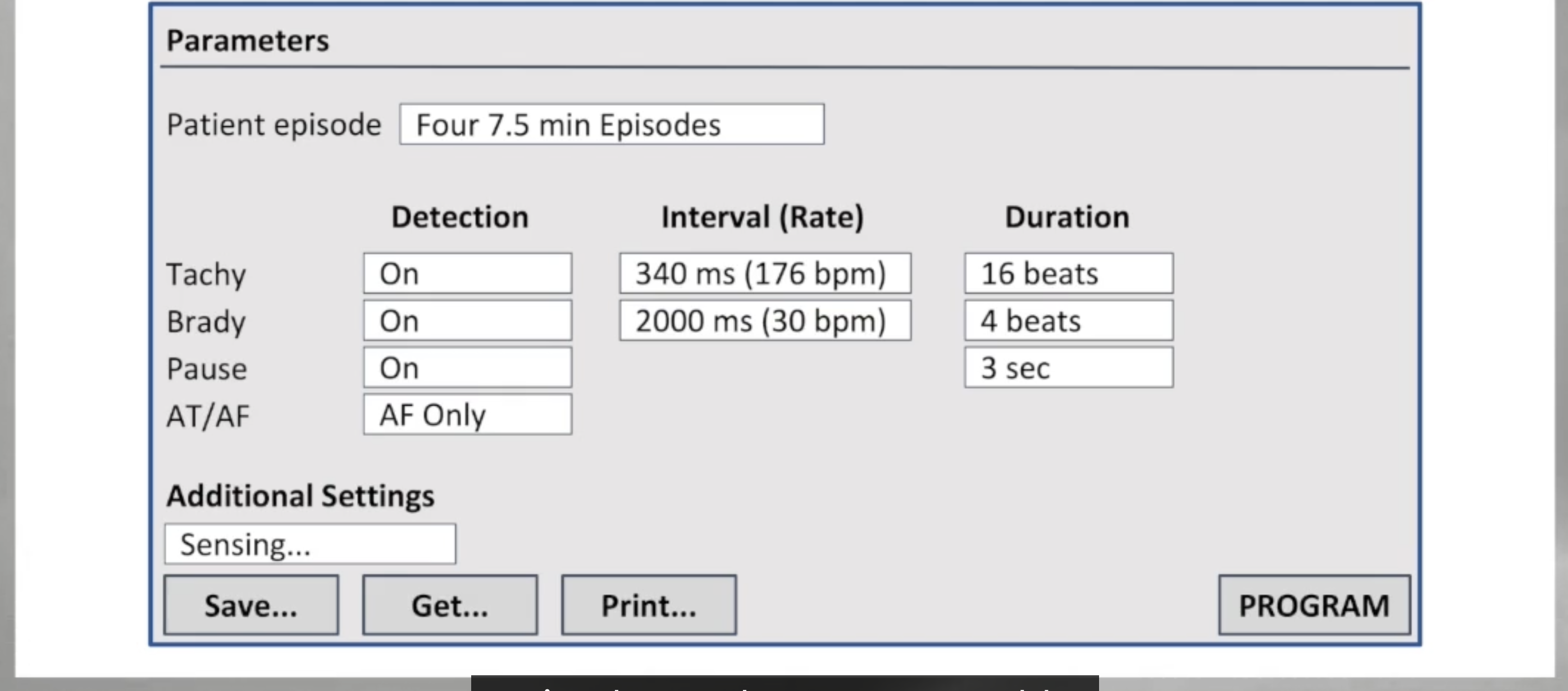
ILR Programmer Screen
Fewer parameters
Sensing/detecting only
Subcutaneous ECG
Home page:
Battery capacity
Parameters
AF burden
Episodes
Sensing test
Analyze stored episodes
Adjust alerts
AF Detection
No atrial lead: based on R-R irregularity
Compare current interval to previous intervals
Sinus rhythm: regular
AF: irregularly irregular
AT: regular or regularly irregular
Fooled by PACs, PVCs, 2nd degree HB
Difficult to assess with small atrial signals
Once AF detected and treated, turn alerts off
CIED Indication
Sinus bradycardia: must have documented symptoms
Ignore bradycardia while patient asleep
Some indications do not require symptoms:
Asystole > 3 seconds
Escape rhythm < 40 bpm
VT: may indicate for ICD