Week 10 - Disorders in Growth
 Call Kai
 Learn
Learn Practice Test
 Spaced Repetition
 Match
Match Flashcards
 Knowt Play
1/24

There's no tags or description
Looks like no tags are added yet.
Name | Mastery | Learn | Test | Matching | Spaced | Call with Kai |
|---|
No analytics yet
Send a link to your students to track their progress
25 Terms
Birth weight categories
Low birth weight - < 2,500 g (5 lb, 8 oz)
Very low birth weight - < 1,500 g (3 lb, 5 oz)
Extremely low birth weight - > 1,000 g (2 lb, 3 oz)
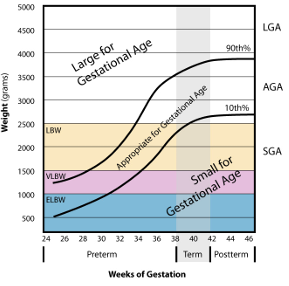
What is a premature infant?
An infant born before 38 weeks of estimated gestational age.
Barker Hypothesis (correlations)
Barker and Colleagues found an inverse correlation between the incidence of coronary heart disease and birth weight. Associations are independent of influences of adult lifestyle and occur in different populations (mostly men) levels of: SES, cigarette and alcohol use, and obesity.
Same correlation with diabetes/impaired glucose tolerance. As birth weight decreases → risk increases.
ACTUAL Barker Hypothesis
Organs and metabolic/endocrine pathways are programmed during embryonic and fetal development according to environmental factors.
This programming is long-lasting and determines the set points of physiological and metabolic responses that persist into adulthood.
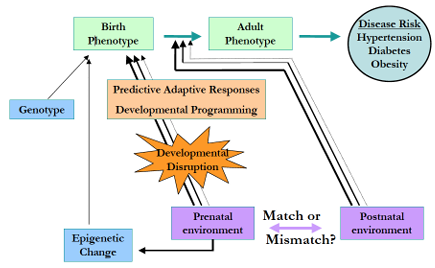
Mismatch hypothesis
Predictive adaptive responses to prenatal environment produce a birth phenotype adapted to a similar postnatal environment. Developmental programming may occur due to epigenetic alterations to the DNA. If the postnatal environment does not match the prenatal environment, the individual is maladapted and may be at increased risk of diseases later.
Animal models agree with epidemiological studies
Pregnant rats fed low protein diet, offspring born smaller but catch up in growth. Offspring have higher risk of obesity, elevated BP, and hyperinsulinemia.
Chemical exposures during pregnancy (BPA, phthalates, DES) can also increase risk of offspring obesity (environmental obesogens)
What are the possible underlying mechanisms for fetal programming?
Hypothalamic-pituitary-adrenal axis and levels of stress hormones in the fetus (glucocorticoids) and epigenetic modifications
What do genetic mutations affect for growth issues?
Pituitary hormones, or specifically pituitary transcription factors. Affect resistance/deficiency to pituitary or gonad hormones.
GH-IGF-1 Axis
Hypothalamus releases GhRH (stimulates GH), and somatostatin (inhibits GH)
Pituitary gland - releases GH
GH actions on liver, liver produces IGF-1 (Insulin-like Growth Factors 1)
IGF-1 causes bone growth, muscle development.
Ghrelin from the stomach also stimulates GH release.
Negative feedback - IGF-1 feedback to brain and decreases GH release.
Deficiency in GH-IGF-1 Axis
Short stature - treatment for GH deficiency
hGH - risks of prion infection
rGH
Excess GH secretion
Gigantism or acromegaly (after puberty)
Usually due to benign tumors on the Pituitary called Adenomas.
Health Issues Associated with Excess GH (Untreated Acromegaly)
Joint pain and arthritis, osteoporosis
High BP
Heart failure from enlarged heart
Compression of nerves leading to weakness or tingling in limbs, loss of vision, severe headaches
Increased risk of diabetes mellitus and colon cancer.
Sleep apnea
GH Resistance
Laron Syndrome - mutation in GHR or GH-induced intracellular signaling molecules.
Insensitive to growth hormone and low levels of IGF-1.
Small stature, lower risk of diabetes and cancer.
Precocious puberty
Puberty < 8 years in girls, < 9 years in boys.
Central causes traced to hypothalamus or pituitary (lesions, tumors, infections, or trauma)
Peripheral causes are linked to sex steroids from abnormal sources (adrenal or gonadal tumours, environmental hormones)
Early puberty more likely in girls with obesity.
Delayed puberty
Hypogonadism - testes or ovaries produce little or no sex hormones.
Hypogonadotropic hypogonadism - due to problem with pituitary gland or hypothalamus
Causes:
damage from surgery, injury, tumours, or infections
high doses of glucocorticoid meds
severe stress
rapid weight loss - anorexia
Kallman syndrome is an inherited form
Genetic causes of hypogonadotropic hypogonadism
Can range from GnRH neuron migration, GnRH synthesis and release, GnRH action, and Gonadotropin synthesis
Romania maternal policy
Policy banned birth control and abortion and put celibacy tax on families with less than five children. 100,000 children in Romania ended up in institutionalized care.
Policy resulted in high maternal mortality rates:
Romania had highest maternal mortality rate of any country in Europe at the time.
87% of deaths were from illegal abortions
Institutionalized children effect
Children who went to a foster home during the sensitive period up to 24 months of age fared better than those who remained in an institution when tested later for developmental quotient (DQ), IQ, and brain electrical activity.

Senescence
Aging is a complex composed of several features:
1. exponential increase in mortality with age
2. physiological changes that lead to functional decline with age
3. increased susceptibility to certain diseases with age.
Progressive deterioration of physiological function, an age-related process of loss of viability and increase in vulnerability.
Gerontology v Geriatrics
Gerontology is the study of the aging processes and individuals as they grow from middle age through later life. It includes:
- the study of physical, mental, and social changes in older adults as they age.
- investigation of changes in society due to our aging population
- application of this knowledge to policies and programs
Geriatrics is the health care of older adults including the study of health and disease in later life.
Changes in aging median in Canada
% of people 65+ years old increases over time. The population is shifting toward older ages (25% in 2061), creating major social and healthcare impacts.
Lifespan
Age at death for individuals.
Maximum lifespan
theoretical limit on length of life for a species under ideal conditions (relatively fixed)
Life Expectancy
average number of years an individual can expect to live. Very variable and depends on many many factors.
Healthy Life Expectancy
Average years of life in good health free from major disease, injury, or limitations on activity.