chemical equilibrium
 Call Kai
 Learn
Learn Practice Test
 Spaced Repetition
 Match
Match Flashcards
 Knowt Play
1/28

There's no tags or description
Looks like no tags are added yet.
Name | Mastery | Learn | Test | Matching | Spaced | Call with Kai |
|---|
No analytics yet
Send a link to your students to track their progress
29 Terms
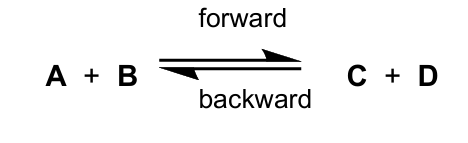
reversible reactions
reversible reactions are reactions that proceed in both forward and backward reactions
denoted using a double arrow (⇌)
in a closed system:
when A and B are reacted, they are not completely converted to C and D
reversible reactions are never complete, and a mixture of reactants and products is obtained
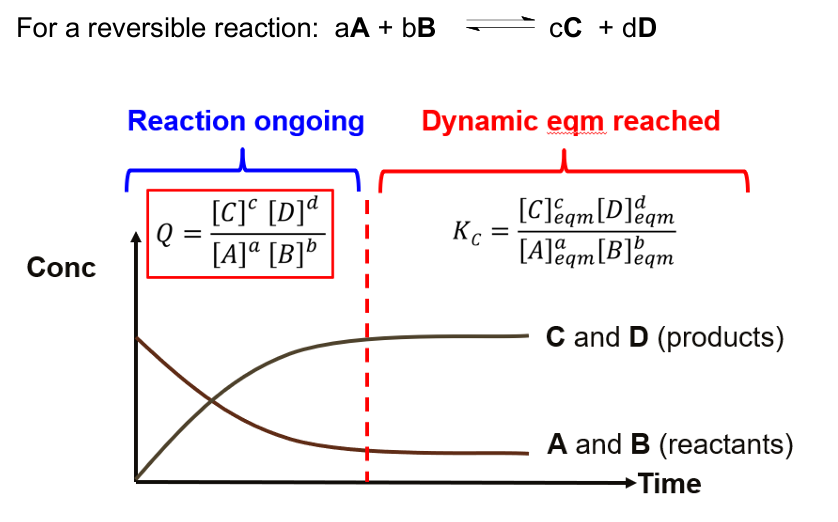
graph of concentration vs time for reversible reactions
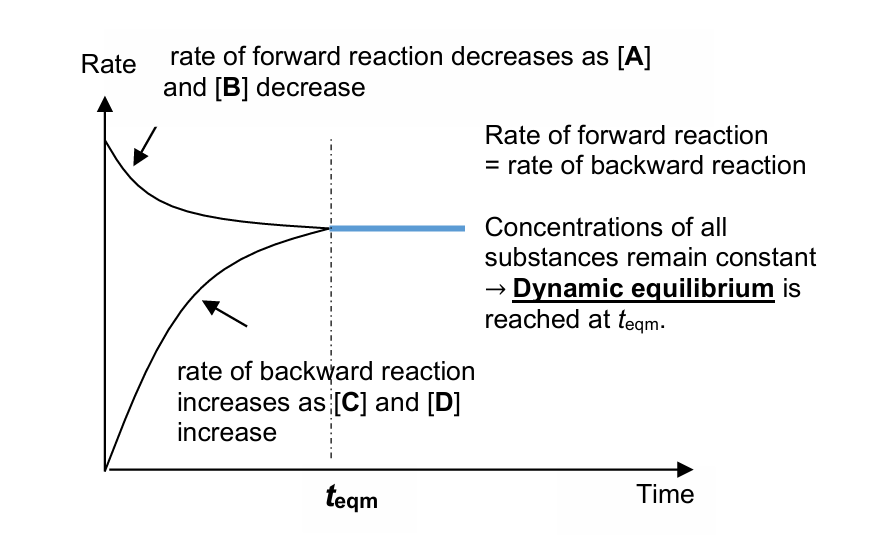
at t = 0, there is no C and D ⇒ rate of backward reaction is zero
as the reaction proceeds, [C] and [D] increases ⇒ rate of backward reaction increases + [A] and [B] decreases ⇒ rate of forward reaction decreases
after some time, a state will be reached when C and D is used up as soon as they are formed:
rate of forward reaction = rate of backward reaction
no further changes in [A], [B], [C], and [D]
the reaction has reached a state of dynamic equilibrium ⇒ substances, A & B and C & D, are still reacting together although the concentrations of reactants and products
remain constant (reaction is still proceeding)
![<ul><li><p>at t = 0, there is no C and D ⇒ rate of backward reaction is zero</p></li><li><p>as the reaction proceeds, [C] and [D] increases ⇒ rate of backward reaction increases + [A] and [B] decreases ⇒ rate of forward reaction decreases</p></li><li><p>after some time, a state will be reached when C and D is used up as soon as they are formed:</p><ul><li><p>rate of forward reaction = rate of backward reaction</p></li><li><p>no further changes in [A], [B], [C], and [D]</p></li><li><p>the reaction has reached a state of dynamic equilibrium ⇒ substances, A & B and C & D, are still reacting together although the concentrations of reactants and products<br>remain constant (reaction is still proceeding)</p></li></ul></li></ul><p></p>](https://assets.knowt.com/user-attachments/989f8552-9505-4cc8-aad0-8df320b0f5b5.png)
graph of rate against time for reversible reactions
dynamic chemical equilibrium
when a reversible reaction in a closed system reaches dynamic chemical equilibrium,
reaction continues to occur
rates of the forward and backward reactions are equal hence there is no net change in the concentrations of the reactants and products
equilibrium can only be achieved in a closed system → no loss/gain of matter to or from the surroundings but does allow the free transfer of energy
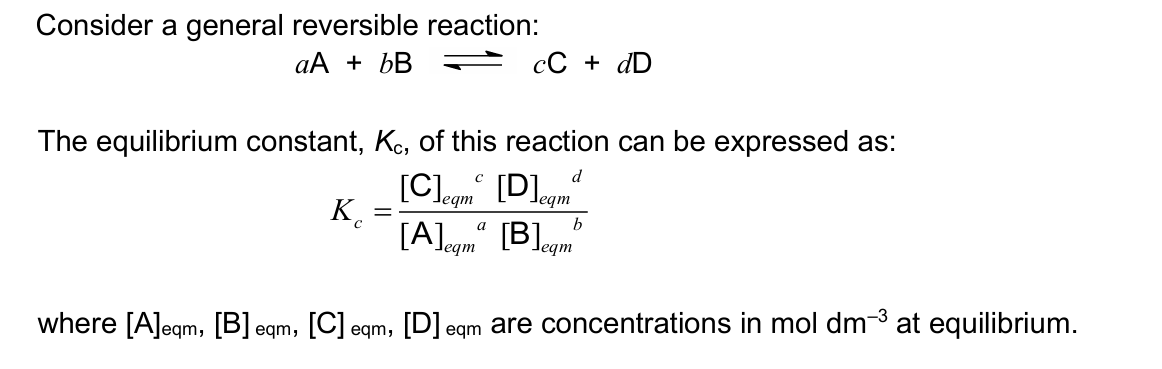
Kc → equilibrium constant (definition)
the ratio of the product of the concentrations of products raised to the appropriate powers to the product of the concentrations of reactants raised to the appropriate powers at equilibrium at a given temperature
units for Kc
may or may not have units, depending on the form of expression
units may/may not cancel out
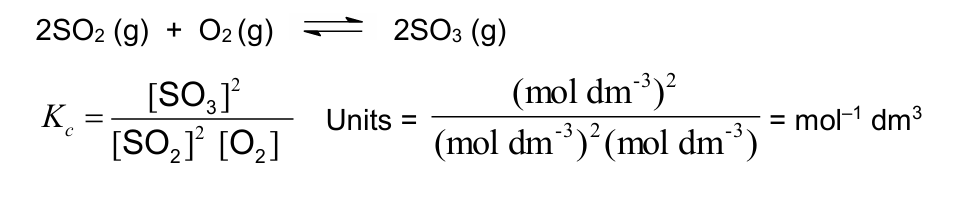
expressions for Kc
expressions do not include term for solids
in an aqueous system where water is used as a solvent, the expression does not include the concentration of water, [H2O(l)]
only included in the expression if it is specified for use in the question
in a non-aqueous system, the expression includes the concentration of water, [H2O(l)]
concentration of water is included as concentration of water in this reaction is not constant ⇒ water is not used as a solvent in this reaction but produced as a product
Kp → equilibrium constant
for reactions involving gases, the equilibrium constant can be expressed in:
Kc ⇒ if concentrations of the reactants and products are used
Kp ⇒ if partial pressures of the reactants and products are used
Kp can be only applied if the equilibrium has at least 1 gaseous species
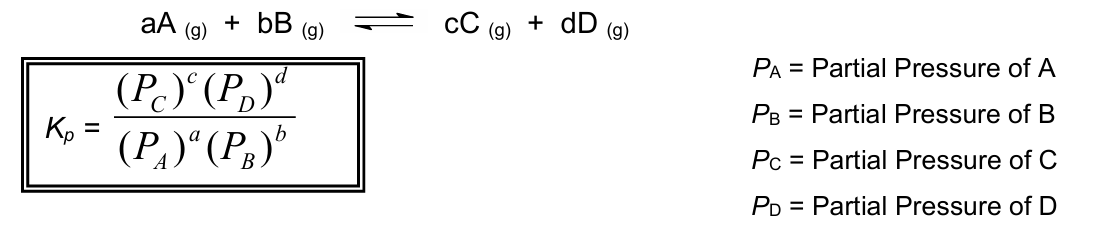
units for Kp
for pressure: Pa (Pascal), atm (atmosphere), bar
may or may not have units, depending on the form of expression
units may/may not cancel out
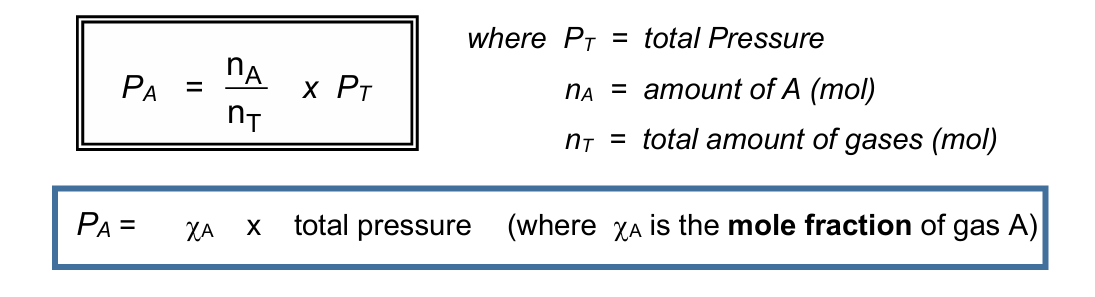
partial pressure
the pressure which the gas would exert if it alone occupies the same volume as the mixture in the container
formula for partial pressure:
Pa = (na/nT) x PT
relationship between Kc and Kp
Kp = Kc(RT)Δn
Δn: sum of the coefficients of the gaseous products in the chemical equation minus the sum of the coefficients of the gaseous reactants
Kc ∝ Kp at constant temperature
Kc = Kp only when the number of moles of gaseous reactants is equal to the number of moles of gaseous products in the equation ⇒ Δn = 0
significance of Kc and Kp
Kc measures the extent to which a reversible reaction takes place, which is the proportion of products to reactants in the equilibrium mixture, and it is independent of the initial composition of the reaction mixture
Kc > 1
reaction proceeds from left to right to a greater extent and formation of products are favoured ⇒ position of equilibrium lies to the right
when Kc > 1000 / >>> 1 ⇒ reaction “is effectively complete”
Kc < 1
reaction proceeds from right to left to a greater extent and formation of reactants are favoured ⇒ position of equilibrium lies to the left
when Kc < 0.001 / <<<1 ⇒ reaction “is negligible”
factors affecting Kc and Kp
are temperature dependent only
not affected by:
changes in concentrations of reactants and products
changes in pressure of gaseous reactions
addition of catalysts
procedure for solving equilibrium problems
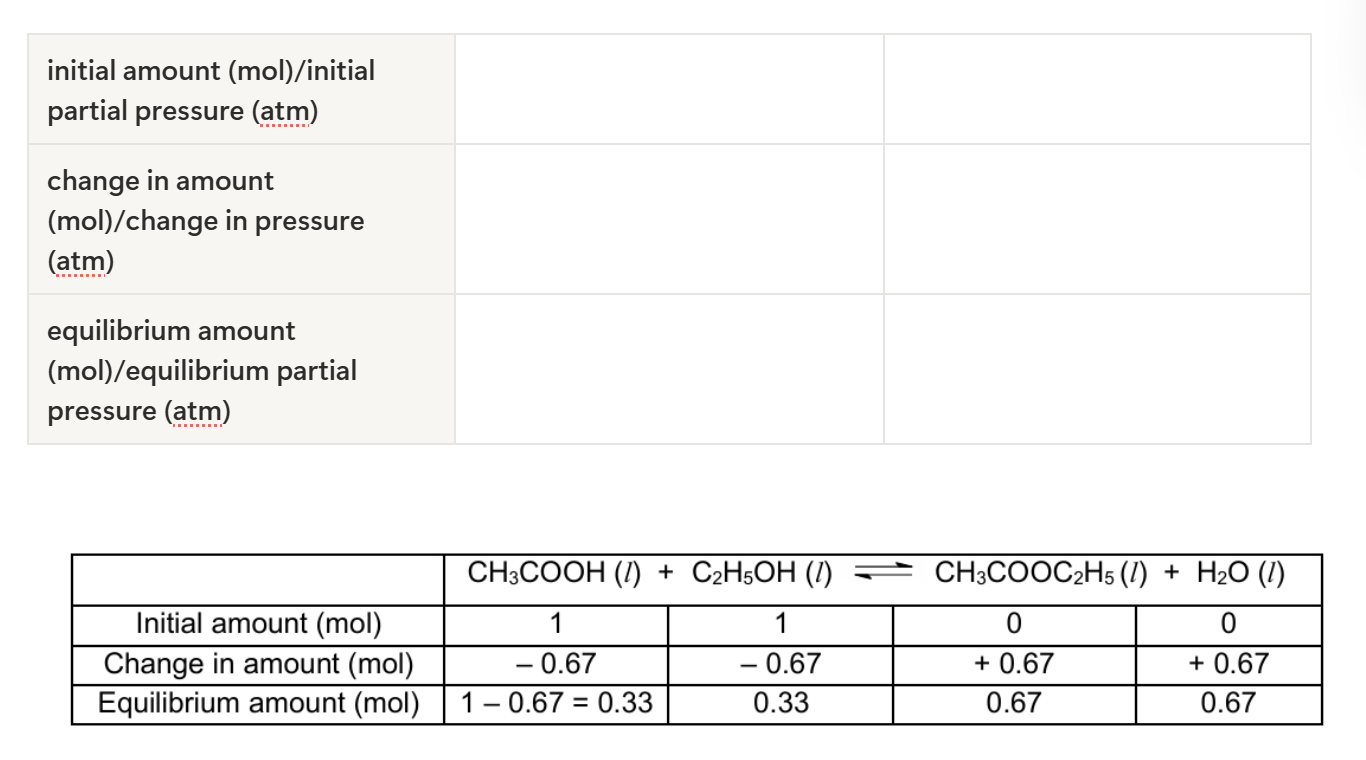
use ICE table → initial amount, change in amount and equilibrium amount
if question specifies the initial and equilibrium amount (mol) OR percentage dissociation
percentage dissociation = amount dissociated/initial amount x 100%
degree of dissociation/fraction dissociated = amount dissociated/initial amount
if question only gives values for equilibrium number of moles ⇒ no need to draw table
find equilibrium concentration by dividing by volume of vessel, substitute in values into Kc and Kp expression and solve
factors affecting equilibrium
change in concentration
change in pressure
change in temperature
addition of catalyst
limitations: not useful in predicting or explaining the changes where the disturbance impacts the system in more than one way ⇒ no conclusion can be reached
Le Chatelier’s Principle
when a system at dynamic equilibrium is subjected to a change which disturbs the equilibrium, the system will react in a way so as to counteract the effect of the change to re-establish equilibrium
change in concentration
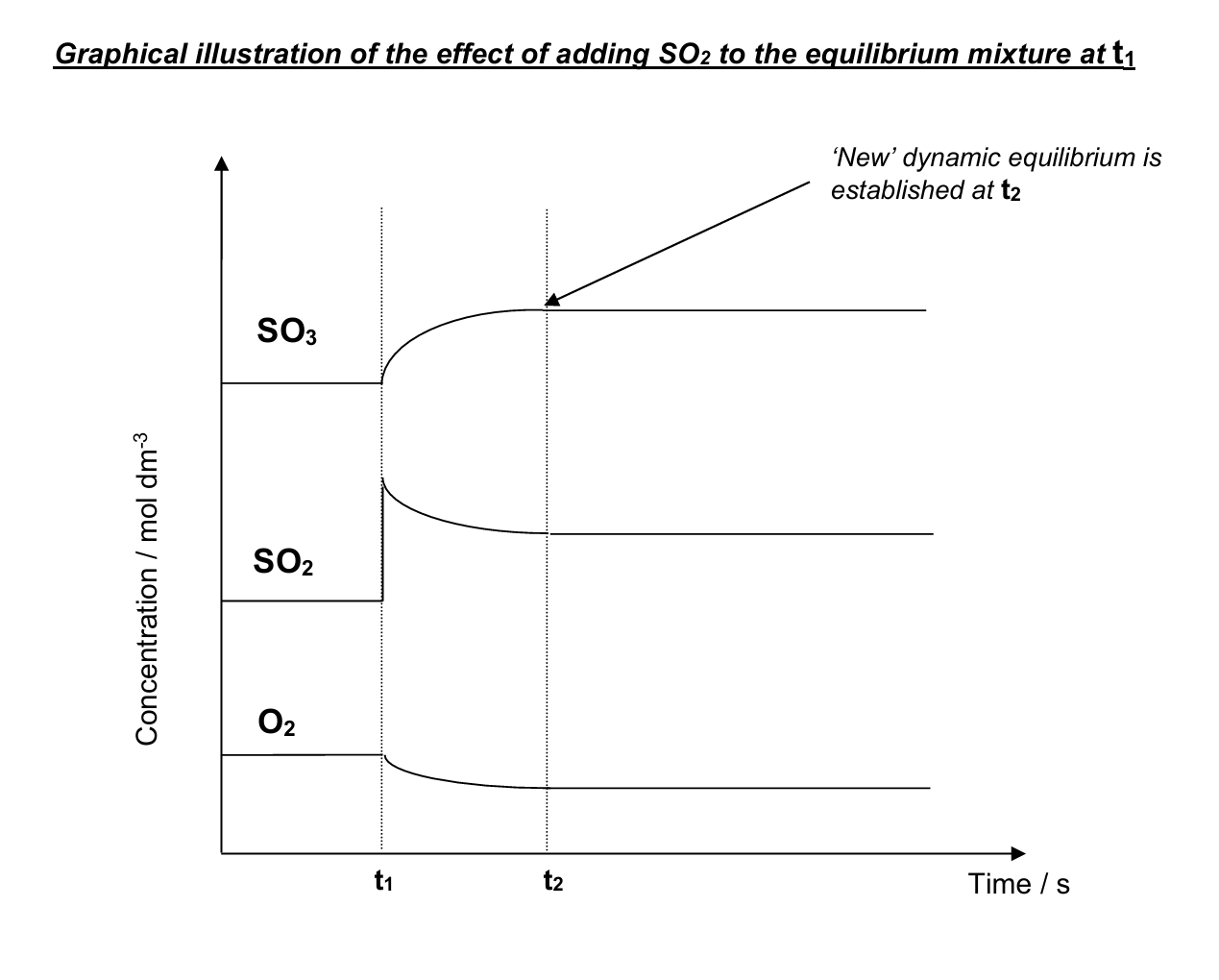
if more of 1 reactant (A) is added:
by Le Chatelier’s Principle, the equilibrium position will shift right to decrease the concentration of A
the concentration of products increases until a new equilibrium is attained
the new equilibrium will contain more products, more A, and less of the other reactant (B)
if A is removed:
by Le Chatelier’s Principle, the equilibrium position will shift left to increase the concentration of A
concentration of products decreases until a new equilibrium is attained
the new equilibrium mixture will contain less products and less A, and more of the other reactant (B)
why Kc is not affected by changes in concentration
the concentrations of reactants and products will increase/decrease to the extent that Kc is kept constant
change in pressure
pressure changes only affect gaseous reactions ⇒ negligible
effect on the volumes of solids and liquidspressure of a gas is the force exerted by the gas particles on the walls of its container → P ∝ n
for pressure changes, use number of moles instead of concentration due to a change in volume in the system
↑ n = ↑ P; ↓ n = ↓ P
if pressure is increased:
the system will try to reduce the pressure
by Le Chatelier’s Principle, the equilibrium position shifts left/right decrease the number of moles of gas, hence decreasing pressure
the new equilibrium mixture contains more/less reactant, and more/less product
if pressure is decreased:
the system will try to increase the pressure
by Le Chatelier’s Principle, the equilibrium position shifts left/right to increase the number of moles of gas, hence increasing pressure
the new equilibrium mixture contains more/less product, and more/less reactant
pressure has no effect on the equilibrium position of the composition of the equilibrium mixture when:
total number of moles of gaseous reactants = total number of moles of gaseous products
change in temperature
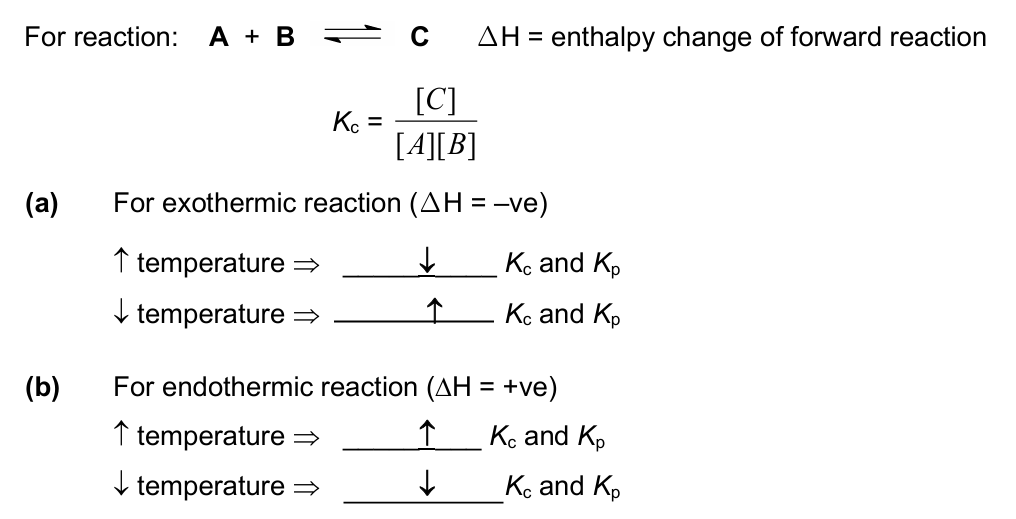
Kc and Kp are temperature dependent ⇒ values change with temperature
main concept for effect of temperature on equilibrium position
increases temperature → equilibrium position shifts towards the endothermic reaction to absorb heat
decrease temperature → equilibrium position shifts towards the exothermic reaction to release heat
forward reaction is endothermic → absorb heat
surrounding temperature increases:
the system will try to remove the heat added
by Le Chatelier’s Principle, the equilibrium position shifts right towards the endothermic reaction to absorb heat
the new equilibrium mixture contains more products, and less reactants
surrounding temperature decreases
the system will try to produce heat
by Le Chatelier’s Principle, the equilibrium position shifts left towards the exothermic reaction to release heat
the new equilibrium mixture contains less products, and more reactants
forward reaction is exothermic → release heat
surrounding temperature increases
the system will try to remove the heat added
by Le Chatelier’s Principle, the equilibrium position shifts left towards the endothermic reaction to absorb heat
the new equilibrium mixture contains less product, and more reactants
surrounding temperature decreases
the system will try to produce heat
by Le Chatelier’s Principle, the equilibrium position shifts right towards the exothermic reaction to release heat
the new equilibrium mixture contains more product, and less reactants
how does Kc vary with temperature
endothermic reaction
increase in temperature: [C] increases, [A] and [B] decreases ⇒ Kc increases
decrease in temperature: [C] decreases, [A] and [B] increases ⇒ Kc decreases
exothermic reaction
increase in temperature: [C] decreases, [A] and [B] increases ⇒ Kc decreases
decrease in temperature: [C] increases, [A] and [B] decreases ⇒ Kc increases
addition of catalyst
catalysts have no effect on Kc or Kp, the yield of the product and the equilibrium of the position (does not change the concentration of reactants)
increase the rate of forward and backward reaction to the same extent hence position of equilibrium remains unchanged
catalysts increase the rate of reaction so that dynamic equilibrium is established more quickly
with a catalyst, the rate of reaction is faster and equilibrium is reached faster, however, the yield of product remains the same
Haber process
manufacture of ammonia: N2 (g) + 3H2 (g) ⇌ 2NH3 (g), ΔH = -92 kJ mol-1
common operating conditions
high pressure of 250 atm
moderate temperature of 450°C
iron catalyst
molar ratio of N2 : H2 is 1 : 3
Le Chatelier’s Principle indicates that to increase the yield of NH3, high pressure and low temperature should be used
there is a compromise between the conflicting demands of high yield and high rate of reaction in the conditions
explain choice of pressure of 250 atm → Haber process
by Le Chatelier’s Principle, a high pressure will cause the equilibrium position to shift right to decrease the number of moles of gas to decrease pressure ⇒ yield of ammonia increases
however, too high a pressure (i.e. > 250 atm) would be too expensive to maintain as thicker pipes would need to be built to withstand the higher pressure ⇒ pressure of 250 atm is used
explain choice of moderate temperature of 450°C → haber process
by Le Chatelier’s Principle, a low temperature will cause the equilibrium position to shift right towards the exothermic reaction to release heat ⇒ yield of ammonia increases
however, too low a temperature would decrease the rate of reaction, making it not feasible industrially ⇒ moderate temperature of 450ºC is used
explain why iron catalyst is required → haber process
iron catalyst (heterogeneous catalyst) is used to increase reaction rate ⇒ does not affect the yield of ammonia
significance of Q, the reaction quotient
when a reversible reaction has not yet reached equilibrium: the reaction quotient (Q) is the ratio of the product of the concentrations of products raised to the appropriate powers to the product of the concentrations of reactants raised to the appropriate powers at a given temperature
unlike Kc, Q is not a constant value as the concentration of products and reactants are always changing, until the reaction reaches equilibrium
Kc: special Q that defines the proportion of each species in a reaction mixture at dynamic equilibrium
Q has the same expression as the equilibrium constant, K but
represents the quantity of reactants and products at any composition
if Q < Kc → not at dynamic equilibrium yet
proportion of products to reactant is less than at equilibrium
to attain dynamic equilibrium, increases the proportion of products to reactants ⇒ increase conversion of reactants to products until Q = Kc
if Q > Kc → not at dynamic equilibrium yet
proportion of products to reactant is more than at equilibrium
to attain dynamic equilibrium, decrease the proportion of products to reactants ⇒ increase conversion of products to reactants until Q = Kc
Q = Kc → system is at equilibrium
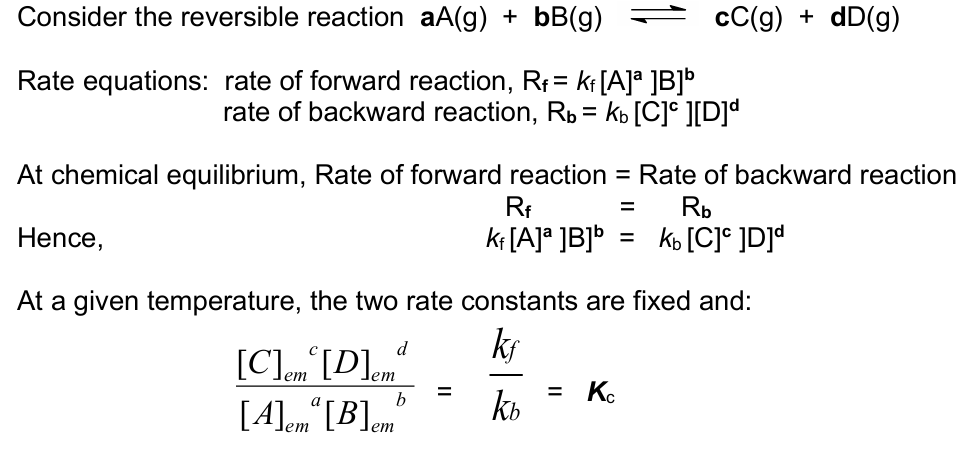
relationship between Kc and rate constants, kf and kb
Kc = kf / kb