Changing economic world
 Call Kai
 Learn
Learn Practice Test
 Spaced Repetition
 Match
Match Flashcards
 Knowt Play
1/33

Earn XP
Description and Tags
Name | Mastery | Learn | Test | Matching | Spaced | Call with Kai |
|---|
No analytics yet
Send a link to your students to track their progress
34 Terms
What does development mean?
Growth of a country in terms of economic growth, use of technology and human welfare.
As a country develops it means that standards of living and quality of life improve.
What are social factors affecting development?
women not having equal rights and are unbale to work
poor education system and low literacy rate
diseases preventing people from working
What are economic factors affecting development?
landlocked and can not benefit from trade by sea
countries are in debt and spend money on paying interest off rather than investing into the country.
global trade favours HIC’s so others don’t get as much money
What is the environmental factors affecting development?
unpredictable climate and threat to drought
poor soils for farming which leads to poor harvests
What is the political factors that affect development?
Political instability e.g. civil war, riots ext.
What is quality of life?
how good an individuals life is measured by factors like healthcare, access to free water, safety, security, freedom, right to vote, women’s rights and happiness.
What is GNI?
Gross national income:
the total value of goods and services produced in a country including money earned from different countries
economic indicator.
What is GNI per capita?
The goss national income divided by the countries population.
economic indicator
What is HDI?
Human development index:
gives a score between 0-1 based on three indicators
What are the benefits of GNI per capita.
measures quality of life rather than income
easier to collect economic data in wealthy countries
What are the limitations of GNI per capita?
average figures for each country so doesn’t show poverty if there are lots of rich people
One USD might be worth more in different countries
wealth might be owned by very few individuals
no mention of human rights or freedom
What are the benefits of HDI?
health and education can see how economic development is helping people in a country.
indicates differences of wealth in a country
social measures are better indicators for quality of life
better indications of inequalities within a country
What are the limitations of HDI?
no measure of access to food resources, which are vital for a good quality of life
some people may agree that different indicators are more important than others
doesn’t show differences between communities
What dies the demographic transition model look like?
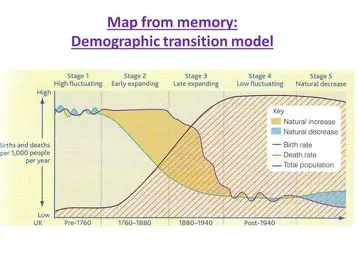
What are the physical, economic and historical causes of uneven development?
Physical:
landlocked
unpredictable climate - risk of natural hazards
disease
country is vulnerable to natural hazards - e.g. earthquakes
poor soils for harming - bad harvests
Economic:
countries in debt spend money paying interest off rather than investing into the country
poor water supplies and lack of money to invest into installing pipes and taps.
lack of investment into the education system and low literacy rates
lots of LIC’s are dependent on primary produce which is less profitable
tariff’s make trade unaffordable for LIC’s
Historical:
political instability
Define disparity.
The difference between two things
What are some types of migration?
Internal migration - people moving within the same country
Rural to urban migration - people moving to urban areas
refugee - leaving a country due to fears of safety
asylum seeker - someone wanting to PERMENANTLY move to a safter country.
What are the ways to reduce the development gap?
Industrial development
intermediate technology
fair trade
debt relief
aid
tourism
What is industrial development and how does it reduce the development gap?
Industrial development is where countries develop industrially.
It provides employment opportunities in construction, manufacturing and services.
Increased wealth leads to improvements in health and education through more taxes.
What is fair trade and how does it reduce the development gap?
Fair trade it involves paying farmers a fair price for their products.
It promotes primary industry and farmers will be able to pay more tax and get higher profits.
What are microfinance loans and how does it reduce the development gap?
Micro-finance loans offer financial support to small communities / businesses. This promotes employment and provides more economic opportunities.
What is debt relief and how does it reduce the development gap?
Debt relief is the reduction or removal of debt for LIC countries so it can easily be paid back. This means more money can be invested into the country.
What is aid and how does it reduce the development gap?
Aid is financial support towards lower income countries
This money is designed to be invested in improving quality of life and generally boosting the economy.
how does tourism reduce the development gap?
Tourism brings economic opportunities.
What is intermediate technology and how does it reduce the development gap?
Intermediate technology is simple, easy to use and maintain technology which serves locals in LIC’s
can impact quality of life.
What is emergency aid?
short term financial assistance to
What is developmental aid?
long term support given by charities/governments/organisations. e.g. Education and improvements to infrastructure.
What are common financial issues of economic development?
squatter settlements - contaminated water - disease and death
lack of infrastructure leads to less sewage pipes and poor waste management
economic growth causes air pollution as people can afford to buy cars
deforestation to make way for building sites and materials.
Define sustainable.
providing the needs of the present generation without compromising the ability of future generations to meet their own needs
What are the impacts of industry?
derelict buildings make future investments more unlikely
many service sector jobs are low skilled, low paid and part time
high job losses in deindustrialised areas causes low employment
old buildings are repurposed
the government and EU have had to focus areas of investment in areas of deindustrialisation to reduce impacts
factories closing can cause less water pollution and greater air quality
when factories close the land can be polluted with chemicals and heavy metals from industrial processes.
in areas from traditional industries like steel making, ship building and coal mining, most of the working population would have worked in these industries.
Define infrastructure
The basic physical and organisational structures and facilities. e.g. roads, schools, power supplies ext. This is needed for the operation of society.
What is the north south divide and gives examples of it.
The n/s divide is the difference in economic, social and cultural aspects between the north and south of the UK.
e.g.
the industrial revolution centred it’s growth around coal fields in Wales, Northern England and Scotland but since the 1970s many industries like steel making and ship building have declined due to high unemployment.
Compare the north and south of the UK with facts and stats.
North:
average disposable income is £13,560 per year in NE region
NE region had 7.7% unemployment
house price = £154,000
brain drain as there is less likely chance for Northerners to study in Oxford or Cambridge
life expectancy = 71.8(male) and 77.8(female)
South:
average disposable income = £20,509
SE region unemployment = 4.4%
average house prices = £305,000
pupils are 40% more likely to get top GCSE grades
male life expectancy = 83.1 and female = 84.7
How does the UK link up with the wider world?
Culture:
food like Chinese and Indian
popular films and tv either imported or exported e.g. Peppa pig
Trade links:
Heathrow is one of the biggest airports around the world
important transport between the whole of mainland Europe and beyond.