Theme 2 flashcards made from Up learn
 Call Kai
 Learn
Learn Practice Test
 Spaced Repetition
 Match
Match Flashcards
 Knowt Play
1/48

There's no tags or description
Looks like no tags are added yet.
Name | Mastery | Learn | Test | Matching | Spaced | Call with Kai |
|---|
No analytics yet
Send a link to your students to track their progress
49 Terms
Income
Income is the flow of money received by a person or economy each year.
Wealth
Wealth is the sum, or stock, of a person or economy’s assets.
What is the Circular Flow Equation
National income = national expenditure = national output
Within the Circular Flow of Income what is meant by Factor Incomes?
Money paid by firms to households in return for factors of production.
What are the different types of leakages/withdrawals from the circular flow of income?
Savings
Imports
Taxes
S I T
What are the different types of injections into the circular flow of income?
Government spending
Investment
EXports
G I X
Explain the three stages to calculating the UK’s price level.
Stage 1 - the Office of National Statistics conducts its Living Costs and Food Survey. This involves interviewing 5000 households to find the 760 most common goods and services and to find the percentage of their spending goes on each of these goods and services.
Stage 2 - the ONS conducts a price survey where they collect prices of these 760 goods from across the UK in order to find the average price of each good.
Stage 3 - a weighted average of all the prices is calculated in order to find the price level.
How to calculate a weighted average
multiply % of spending by the price of the good and add the values up for all the goods
Disinflation
Disinflation is when the inflation rate is positive but decreasing.
4 main problems with measuring inflation (and explain each)
Unusual Spending habits - the basket of goods is based on average household spending, so it may not reflect the spending patterns of all individuals.
Changes in quality - a rise in price may be caused by an improvement in quality, so the measured increase may not fully represent inflation.
Time lag - the basket of goods and its weighting are only updated periodically, so they may be out of date and not reflect current spending patterns.
Doesn’t include Mortgages - higher mortgage repayments faced by homeowners are not fully included, so the rise in the cost of living may be understated.
RPI - Retail price index
RPI includes mortgage payments whereas CPI does not, so RPI is usually higher
What are three possible benefits and three possible costs of inflation?
Benefits:
Reduces the real value of debt (borrowers pay back less in real terms as the value of money falls)
Encourages current spending (consumers may buy now rather than later because prices are rising)
May reduce real wages (if wages rise more slowly than prices, firms’ labour costs fall in real terms)
Costs:
May lead to a deflationary spiral (if inflation becomes negative, consumers delay spending, AD falls, and prices fall further)
May cause a wage-price spiral (workers demand higher wages, raising firms’ costs, which pushes inflation up further)
Creates uncertainty (firms and households find it harder to predict costs, prices and returns, so investment may fall)
Gross National Income (GNI)
Gross Domestic Product plus net income from abroad.
Purchasing Power Parity
A purchasing power parity (PPP) between two countries tells us how much of one currency is needed to purchase a basket of goods compared to another currency.
What are the two difficulties when comparing nominal GDP per capita data between countries?
Different price levels and volatile exchange rates
What are five limitations of GDP as a measure of living standards?
Population changes (a rise in GDP may not increase living standards if the population also rises, because GDP per head may stay the same or fall)
Income distribution (GDP does not show how income is shared, so living standards may not rise for everyone even if GDP increases)
Type of goods and services (GDP may rise because of more capital goods or military spending, which may not directly improve consumers’ living standards)
Underground economies (illegal or cash-in-hand work is not recorded, so GDP may underestimate actual output and income)
Subsistence economies (goods and services produced for own consumption are not measured, so GDP may underestimate living standards in poorer countries)
Working Age Population
People between the ages of 16 and 64.
Active Population
People between the ages of 16 and 64 who are actively working or actively seeking work. Also called the workforce.
Inactive Population
People between the ages of 16 and 64 who are neither actively working nor actively seeking work. This includes those who are unable to work
Unemployed
When somebody is able to work and actively seeking work but is not working
Unemployment Level
The number of people who are unemployed
Unemployment Rate
The number of unemployed people as a percentage of the economically active population
Unemployment rate = (Number of unemployed people/economically active population) x 100
Employment Rate
The number of employed people as a percentage of the working age population
Employment rate = (Number of employed people/working age population) x 100
Activity Rate
The activity rate (or participation rate) is the number of economically active people as a percentage of the working age population.
Activity Rate = (Number of Economically Active People/Working Age Population) x 100
What are the two ways of calculating unemployment in the UK?
claimant count
ILO labour force survey
ILO labour force survey
The UK uses the Labour Force Survey, a household survey run by the ONS, to measure unemployment using the ILO definition. A person is classed as unemployed if they are without a job, have actively looked for work in the last 4 weeks, and can start work in the next 2 weeks. People who have found a job and are waiting to start within the next 2 weeks are also counted as unemployed.
Claimant count
A measure of unemployment which calculates the number of people claiming unemployment benefits.
Explain the limitations of the ILO Labour Force Survey and the Claimant Count as measures of unemployment.
The Labour Force Survey asks approximately 30,000 households out of 28 million in the UK. It is therefore possible that the sample used is not representative, which means that this method can lack accuracy.
The Claimant Count does not include people who are unemployed but do not claim unemployment related benefits. This includes people who are embarrassed to claim benefits or who have partner who is a high earner. This means that it underestimates the actual level of unemployment.
Underemployment
Underemployment is when workers are employed but working fewer hours than they want to or underusing their skills.
5 Types of unemployment
Real wage (classical) unemployment (unemployment caused when wages are kept above the market equilibrium, so firms demand less labour than workers want to supply)
Cyclical (demand-deficient) unemployment (unemployment caused by a fall in AD during a downturn or recession, so firms reduce output and need fewer workers)
Structural unemployment (long-term unemployment caused by a mismatch of skills, location or job opportunities, often due to changes in the economy)
Frictional unemployment (short-term unemployment when people are moving between jobs or are temporarily searching for work)
Seasonal unemployment (unemployment caused by seasonal changes in demand, for example in tourism, agriculture or retail)
Occupational immobility
Occupational immobility means workers can’t find work because they lack the skills needed to move into new professions. This leads to structural unemployment: when unemployment is caused by a shift in industry e.g. the UK shifting from manual labour to services.
Geographical Immobility of Labour
When workers can’t move between different jobs because they can’t move to a different location
Government Bond
A method that the government uses to borrow money. They sell a bond to an investor and pay it back at a later date with interest.
Recession
Two or more consecutive quarters of negative economic growth
Potential Trend GDP
The sustainable rate of GDP growth caused by improvements in productive capacity overtime
Characteristics of a boom
High animal spirits increase consumption and investment.
High economic growth, measured by an increase in real GDP.
Demand pull inflation as the price level increases.
Low unemployment as firms demand more workers.
An improved budget as government spending decreases and tax revenue increases.
Characteristics of a recession (bust)
1. Low animal spirits decrease consumption and investment.
2. Low economic growth measured by a decrease in real GDP.
3. Low inflation or deflation as the price level decreases.
4. High unemployment as firms demand fewer workers.
5. A worsened budget as government spending increases and tax revenue decreases.
Why can economic growth conflict with the environment?
Economic growth usually means more production, transport and energy use, which can increase pollution, carbon emissions and depletion of non-renewable resources.
However, if growth is based on cleaner technology, renewable energy and greater efficiency, output can rise with less environmental damage.
Describe the trade-off between inflation and unemployment (Philips curve)
When unemployment is low, competition for workers pushes up wages. Higher wage costs increase firms’ costs, so firms raise prices. Therefore, lower unemployment may be associated with higher inflation.
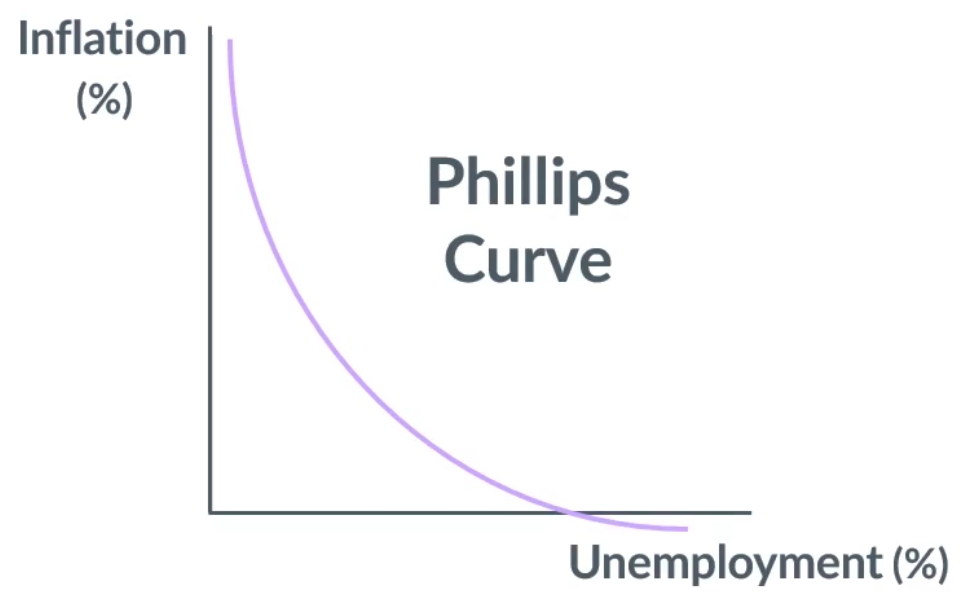
Philips curve evaluation
Because inflation may be caused by supply-side shocks rather than low unemployment, so inflation and unemployment do not always move in opposite directions. Recent UK inflation rose sharply due to wider shocks, showing the trade-off is not always reliable.
Why can expansionary fiscal policy conflict with contractionary monetary policy?
Expansionary fiscal policy increases AD, shifting AD to the right and increasing economic growth, but it may also increase the price level. Contractionary monetary policy may then be needed to reduce inflation, for example through higher interest rates. However, this reduces consumption and investment, lowering AD and slowing economic growth, so the two policies conflict
What is national wellbeing?
National wellbeing is a broader measure of living standards than GDP. It looks at how well people are doing as individuals, communities and as a nation, using both objective indicators and subjective measures of how people feel about their lives.
What are the effects of unemployment on workers?
Unemployment causes loss of income and lower living standards, and may also reduce confidence, skills and future employability if unemployment lasts a long time.
What are the effects of unemployment on firms?
Unemployment reduces demand for goods and services because households have lower incomes, so firms may face lower sales and profits.
What are the effects of unemployment on the government?
Unemployment increases government spending on benefits and reduces tax revenue, which can worsen the budget balance.
What are the effects of unemployment on society and the economy?
Unemployment means scarce labour resources are wasted, so actual output is below potential output, and it may also increase poverty, inequality and social problems.
Why are output gaps difficult to measure?
Output gaps are difficult to measure because potential output cannot be observed directly, so economists have to estimate it.
What are the multiplier formulae?
Multiplier = 1 / (1 - MPC) ;
Multiplier = 1 / MPW ;
MPW = MPS + MPT + MPM
What is quantitative easing, why is it used, and how does it work?
Quantitative easing is a monetary policy where the central bank creates new money electronically to buy financial assets, mainly government bonds. It is used to increase AD and inflation when the economy is weak and normal interest rate cuts are not enough. By buying bonds, the central bank increases their price and lowers their yield, which reduces long-term borrowing costs and encourages more borrowing, spending and investment.