topic 19 chem modern analytical techniques 2
 Call Kai
 Learn
Learn Practice Test
 Spaced Repetition
 Match
Match Flashcards
 Knowt Play
1/48

There's no tags or description
Looks like no tags are added yet.
Name | Mastery | Learn | Test | Matching | Spaced | Call with Kai |
|---|
No analytics yet
Send a link to your students to track their progress
49 Terms
describe how chromatography works to separate a mixture
- dissolve in solvent (mobile phase)
- pass though a solid eg chromatography paper (stationary phase)
identify the stationary and mobile phase in paper chromatography
stationary phase: chromatography paper
mobile phase: solvent eg water, ethanol
separation: as the solvent moves up the paper, it dissolves the components and move them up the paper. the more soluble, the more it moves.
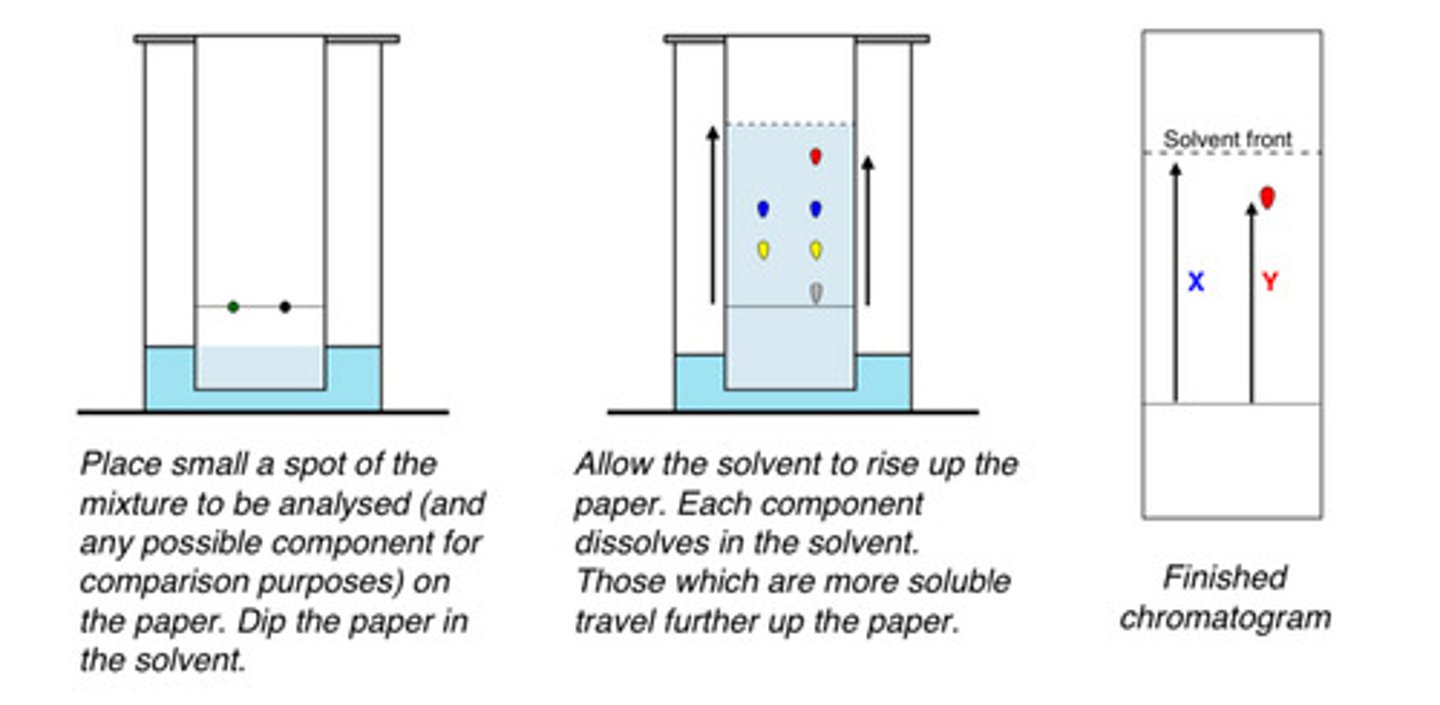
state the formula to calculate the Rf value
Rf = distance travelled by component / distance travelled by solvent
the largest value of Rf is 1
in what situation will comparison of Rf value be a problem?
- if substances have similar Rf values
- if there is no standard value to compare with
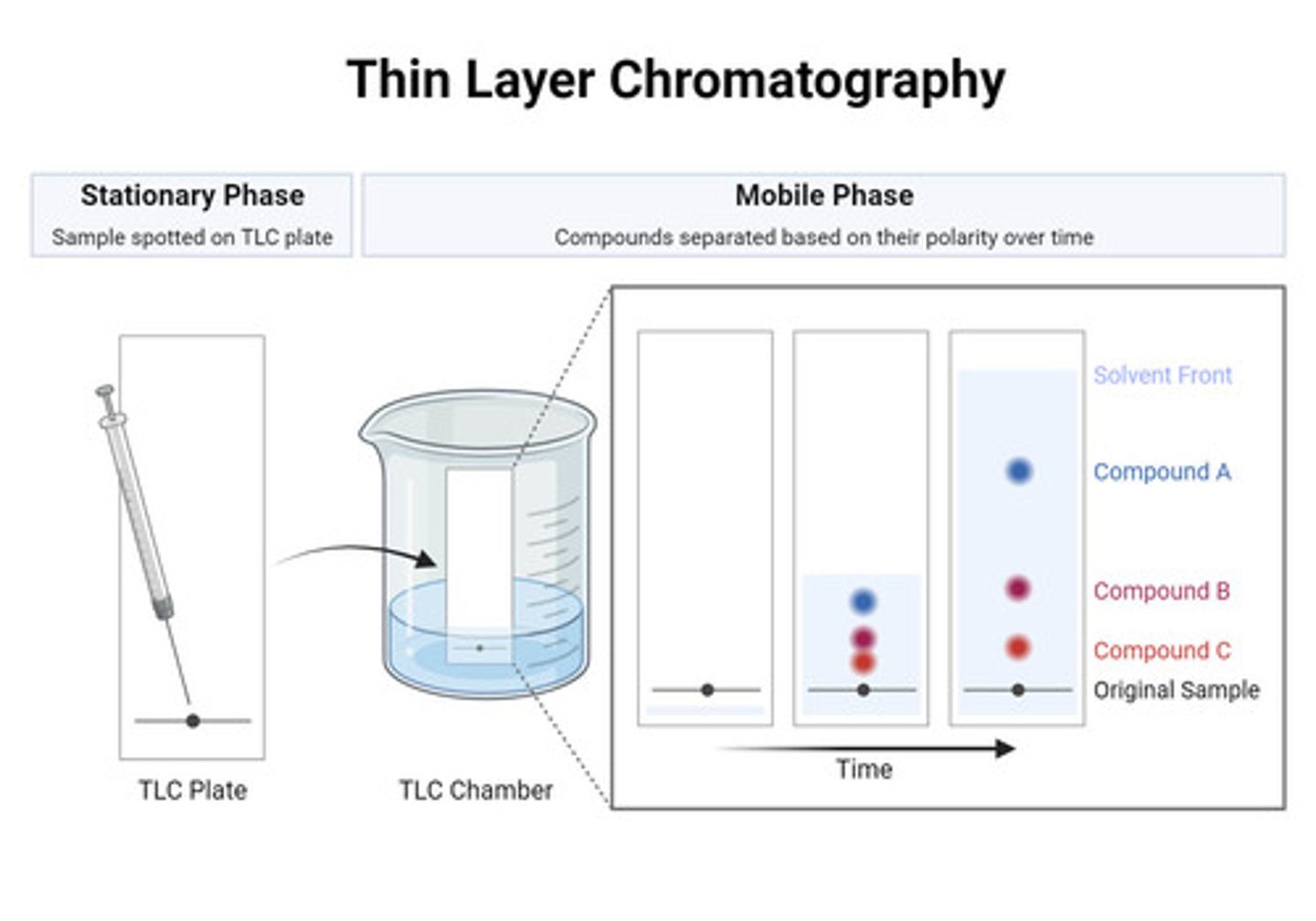
identify the stationary and mobile phase in thin layer chromatography (similar to paper chromatography)
stationary phase: silica mounted on a glass plate
mobile phase: organic solvent
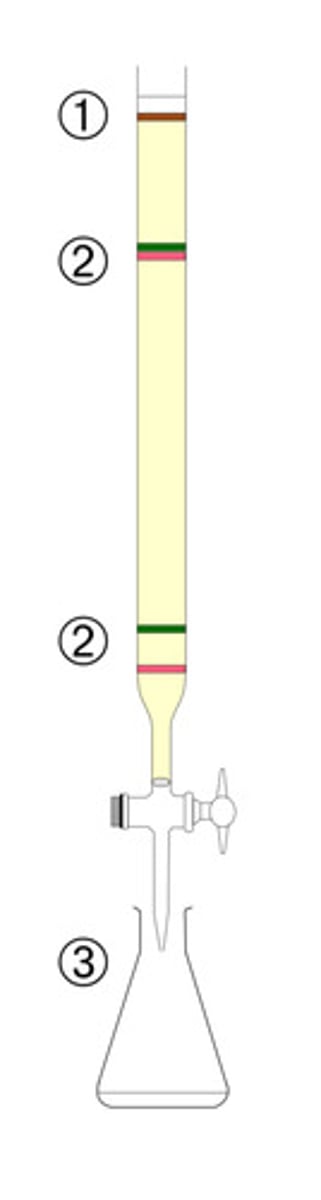
identify the stationary and mobile phase in column chromatography
stationary phase: silica
mobile phase: organic solvent
separation: components interact with the stationary phase (silica) to different extents
describe how column chromatography works
- a chromatography column is filled with solvent and silica
- drops of the mixture are placed on top of the silica
- tap is opened to allow solvent to flow out
- components travel at different rates and separate
- solvent collected at intervals with conical flask
- solvent is evaporated to obtain components
identify the stationary and mobile phase in gas liquid chromatography (GLC)
stationary phase: liquid absorbed onto an inert solid
mobile phase: inert gas (kept vaporised by oven)
used to separate vaporisable compounds
is a type of column chromatography
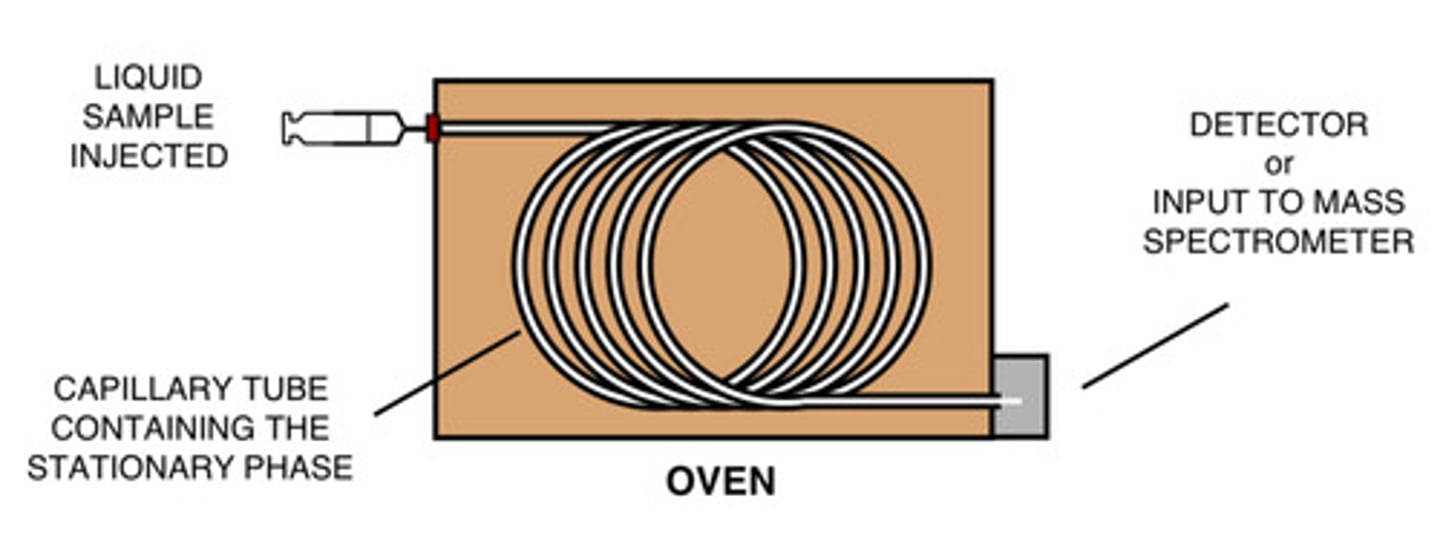
describe how gas liquid chromatography (GLC) works
- a small sample is injected onto the machine using a syringe
- the injector is contained in an oven
- the sample boils and is carried by an inert carrier gas through a column
- the column contains a liquid stationary phase (absorbed onto inert solid)
- the time a compound takes to travel through the column depends on the time spent moving with the gas (retention time)
- detention involves the destruction of the sample, which will produce a peak depending on the current produced per component
- when peak is detected, it can be sent to a mass spectrometer (GCMS)
explain how substances separate due to different retention times in column chromatography
- retention time is the time taken for a compound to travel through the column to the detector
- measured from the time the sample is injected to when it reaches its maximum peak
- this is affected by: boiling point (high = long rt) and solubility in liquid phase (greater = long rt)
identify the stationary and mobile phase in high pressure liquid chromatography (HPLC)
stationary phase: silica
mobile phase: suitable solvent
separation: components interact with the stationary phase (silica) to different extents
is a type of column chromatography
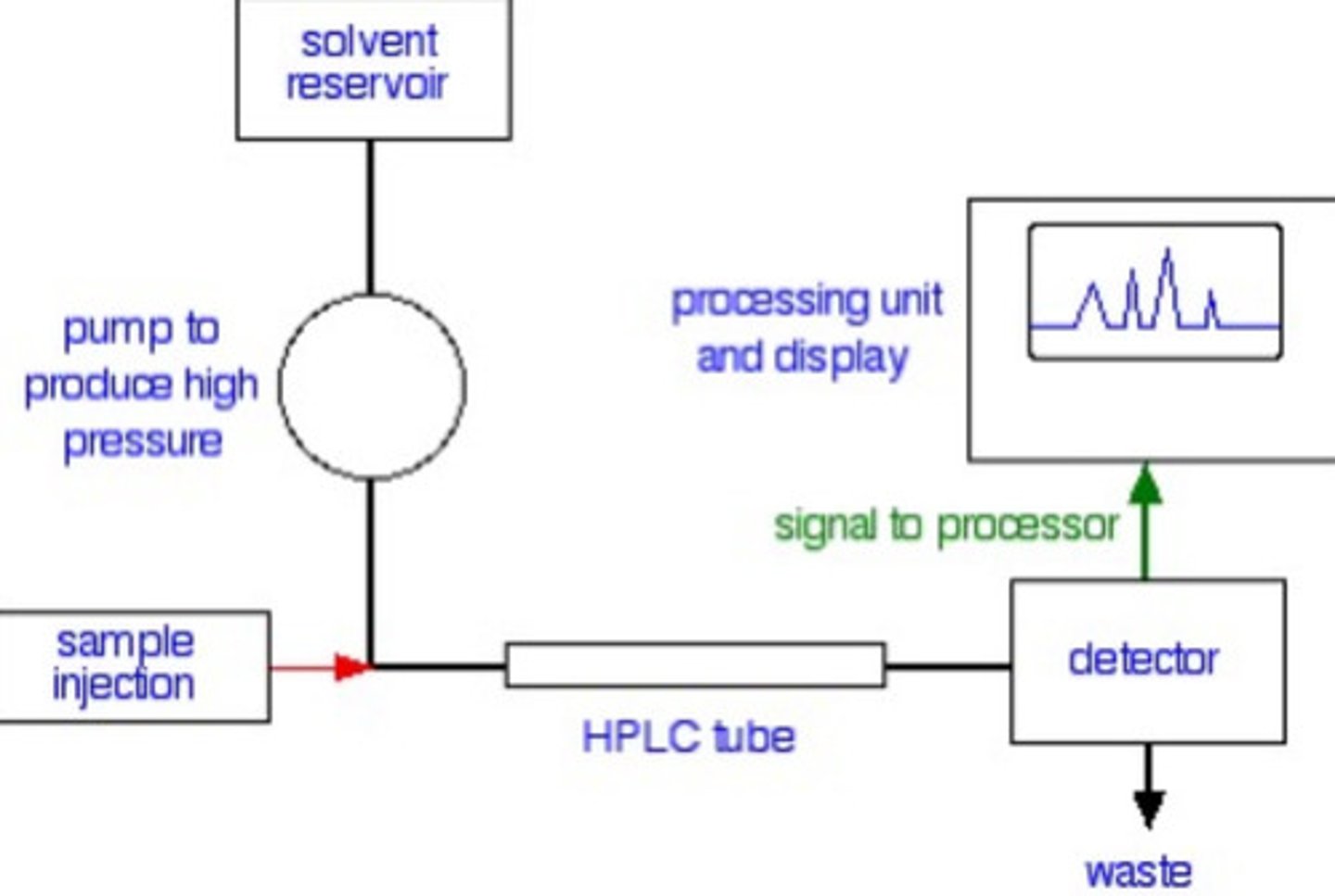
describe how high pressure liquid chromatography (HPLC) works
- a sample is injected
- the solvent and and sample is pushed through under high pressure
- different compounds have different retention time
- output can be detected by compounds absorbing UV light
- can be connected to a mass spectrometer
give 2 advantages of using HPLC
- it is fast due to the short path
- it gives better separation
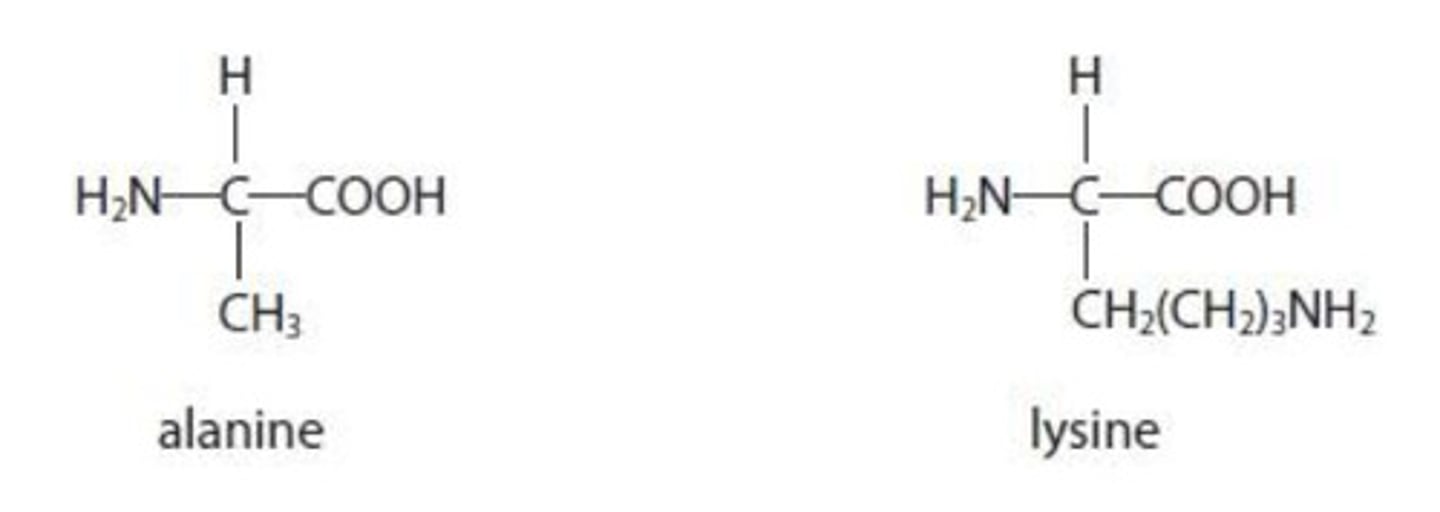
the dipeptide formed from alanine and lysine is hydrolysed under acidic conditions and the resulting mixture is analysed by column chromatography. the column uses a polar stationary phase.
explain why lysine leaves the chromatography column after alanine. (2)
- in acidic conditions, lysine has 2 positive charges whereas alanine only has 1
- so lysine has a greater attraction for the stationary phase
state why argon and nitrogen are suitable carrier gases for gas chromatography. (1)
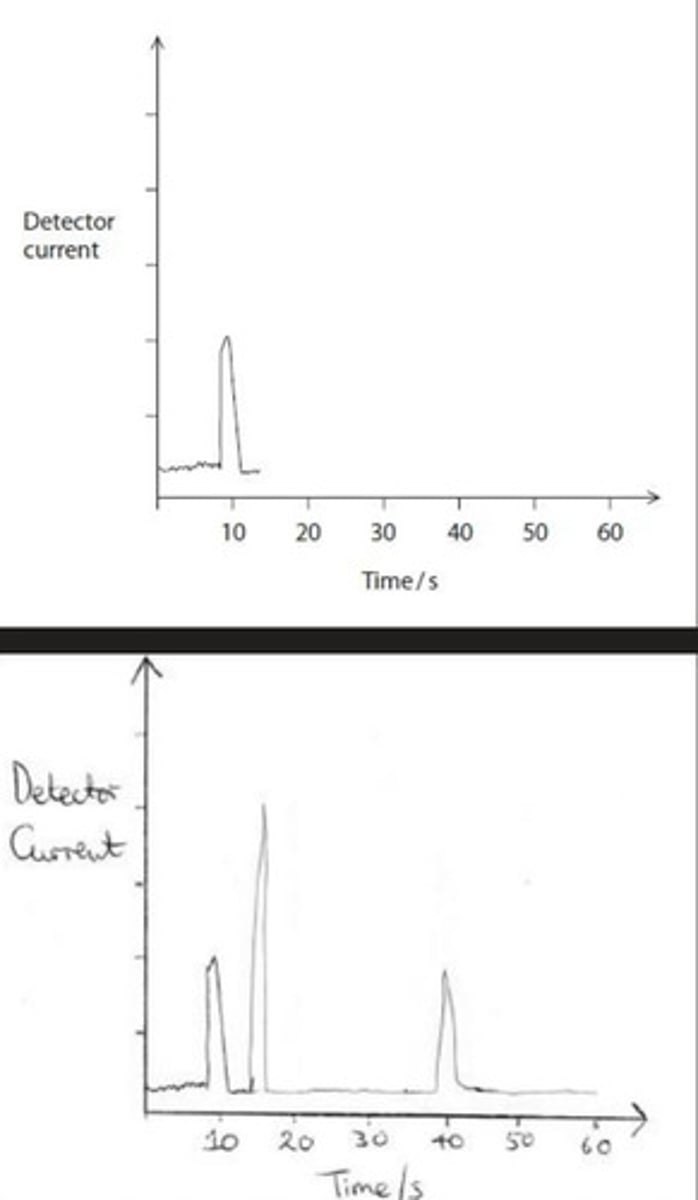
a mixture containing one part of substance X, two parts of sustenance Y and one part of substance Z was separated by gas chromatography.
substance X has a retention time of 10s, substance Y of 15s and substance Z of 40s.
complete the sketch of this chromatogram. (3)
- peak at 15s and 40s
- peak at 15s with height at 2x of peak at 10s
- peak at 40s with height the same as peak at 10s
the time taken for a compound to pass through the column in gas chromatography is called the retention time.
explain why different compounds will have different retention times in the same column, under same conditions. (2)
- retention time depends on the polarity or attraction of the components for the stationary phase
- the greater the attraction of the component for the stationary phase, the greater the retention time
- retention time also depends on the boiling temperature of the compound
- a compound with a higher boiling temperature will spend less time in the gas phase, so it will have a longer retention time
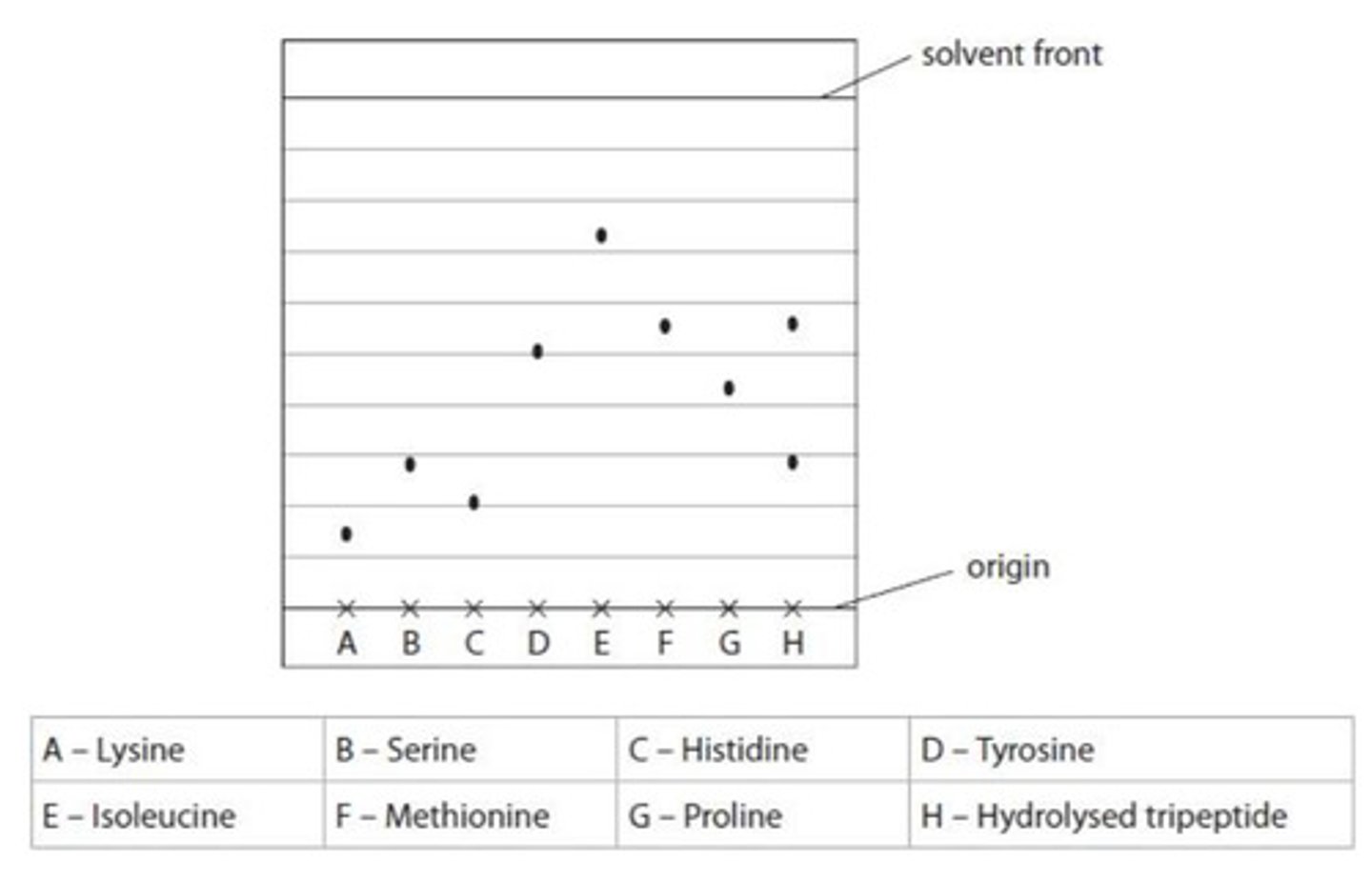
a sample of tripeptide was hydrolysed then placed on a thin layer chromatography plate. sample of possible amino acids were also placed on the TLC plate for reference.
identify the name of the 2 amino acids present in the tripeptide, giving a reason for the lack of a third spot. (3)
- serine and methionine
- either one amino acid is present twice in the tripeptide
- or another amino acid has the same Rf value as either serine or methionine
give 2 reasons why different amino acids have different Rf values. (2)
- amino acids have different solubility and adsorption to the stationary phase
- amino acids have different solubility int he mobile phase
in chromatography, a 'locating' reagent is often used when the components in a mixture is colourless.
what reagent is used to locate the amino acid spots in thin layer chromatography? (1)
ninhydrin
ninhydrin is used in thin-layer chromatography to help identification of amino acids. this is because ninhydrin
A. reacts with amino acids to form a compound which has an intense colour
B. reacts with amino acids to form compounds each of which has a characteristic colour
C. increase the separation of the amino acids on the chromatogram
D. ensures that the mobile phase maintain a nearly constant pH for all the amino acids
A
separation is achieved in gas chromatography due to the components in the mixture having different
A. interactions with the stationary phase
B. interactions with the mobile phase
C. colours
D. solubility in the solvent
A
in high performance liquid chromatography (HPLC) the stationary phase is non-polar and a polar solvent is used. which of the following would travel through the chromatography column most quickly?
A. tetrachloromethane
B. chloromethane
C. iodomethane
D. hexane
B
how do NMR spectrometers work?
- compound is put into a strong magnetic field
- radio waves passed through the compound
- compound absorbs some radio waves to change the spin direction of the nuclei of the 1-H or 13-C atoms
define the term 'chemical shift' and factors that affect it in a NMR spectrum
- refers to the the difference between the frequencies at which a compound and TMS (control) absorb in ppm
- the closer the C atom is to an electronegative atom (eg O, Cl) or a double bond (C=C), the greater the chemical shift
- since electronegativity changes the carbon bond environment
predicting different carbon environments present in a molecule using 13-C NMR
- molecules with symmetry display less chemical peaks (eg benzene)
- a carbon is in the same environment if it is bonded to the same molecules
- otherwise they are different carbon environments
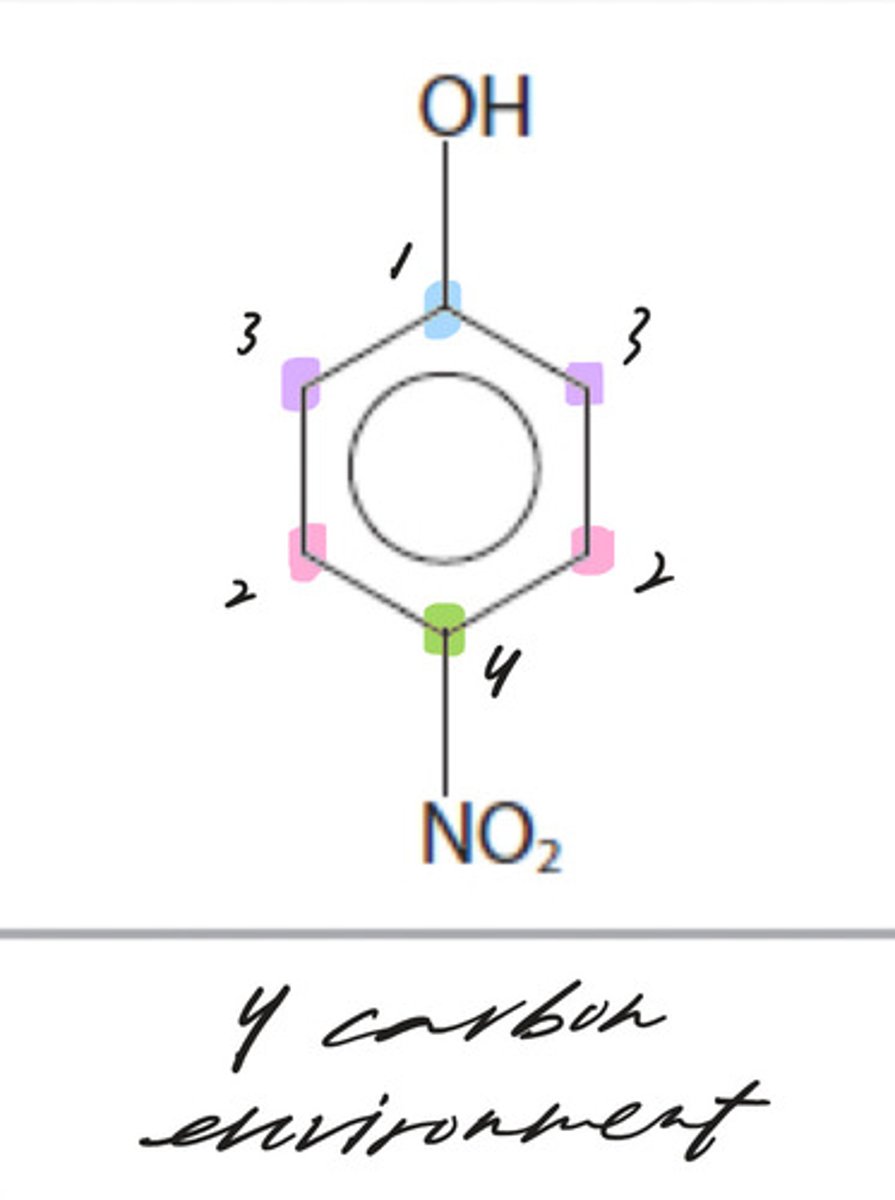
identifying carbon environments on the spectra
- each peak represents 1 carbon environment
- height of signal is irrelevant and not proportional
which part of the electromagnetic spectrum is used in NMR?
radio waves
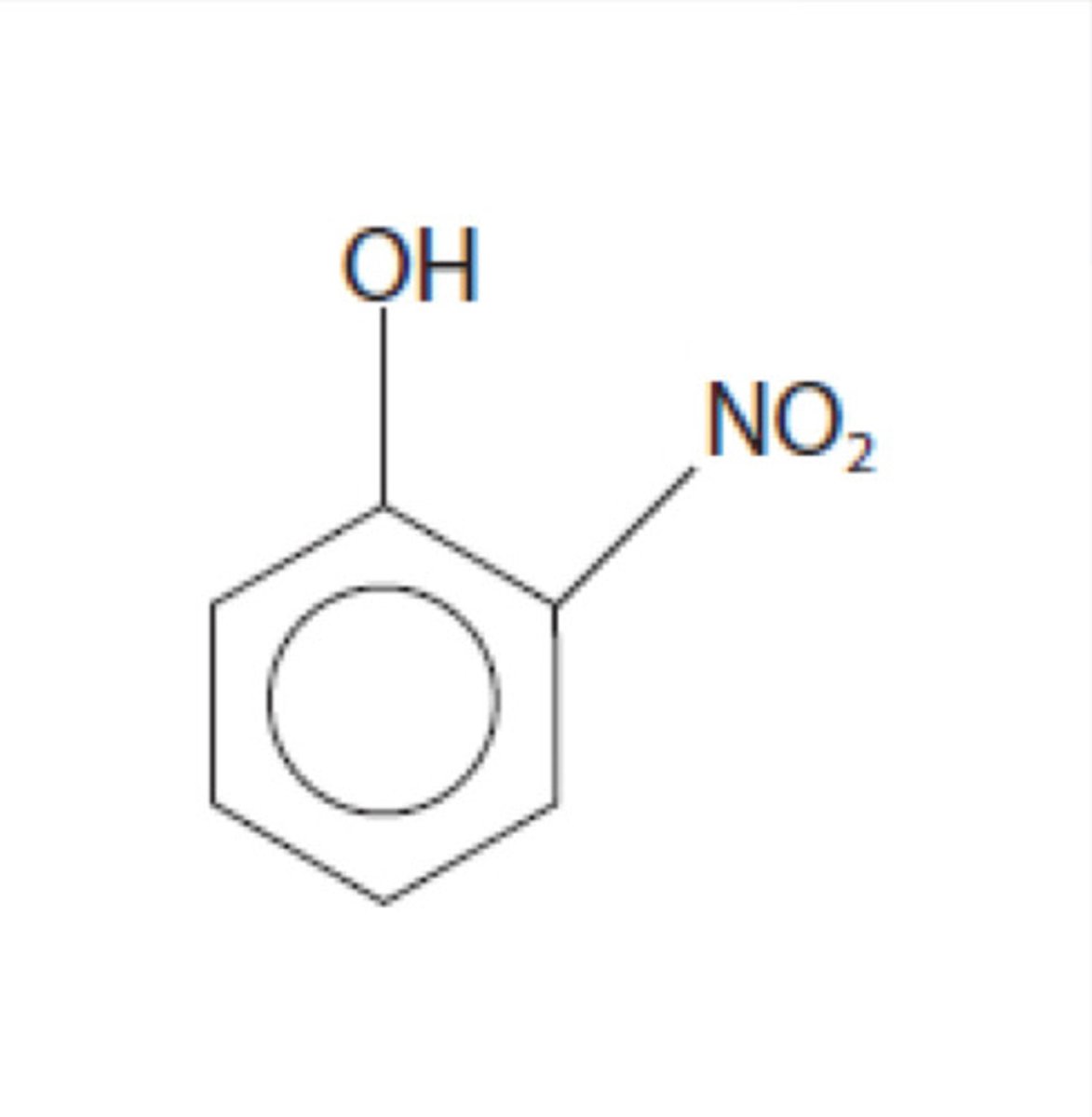
the 2 products can be distinguished using their 13-C NMR spectra. deduce the number of peaks in the compound below. (1)
6
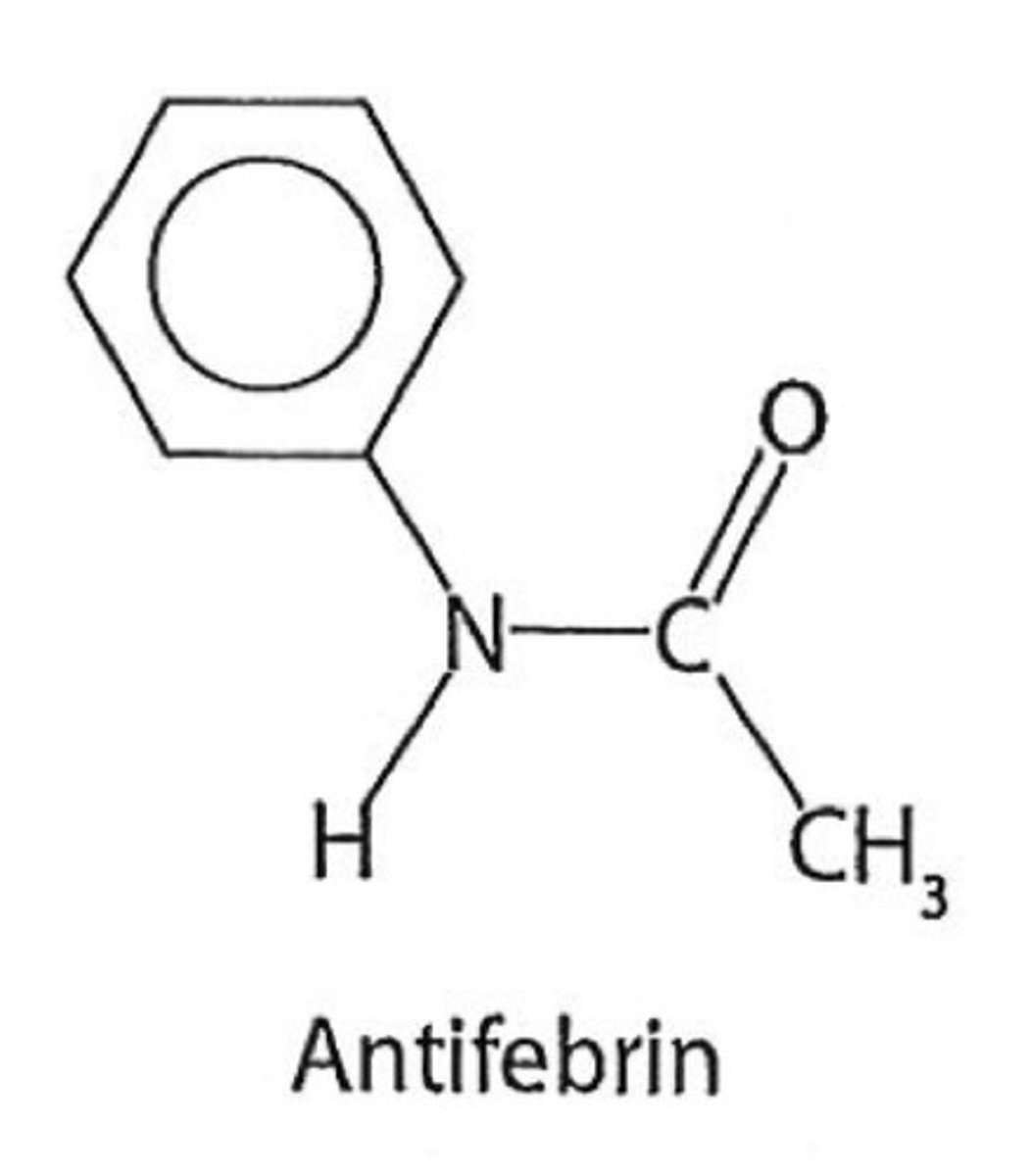
what is the number of peaks in a C-13 NMR spectrum of Antifebrin?
6
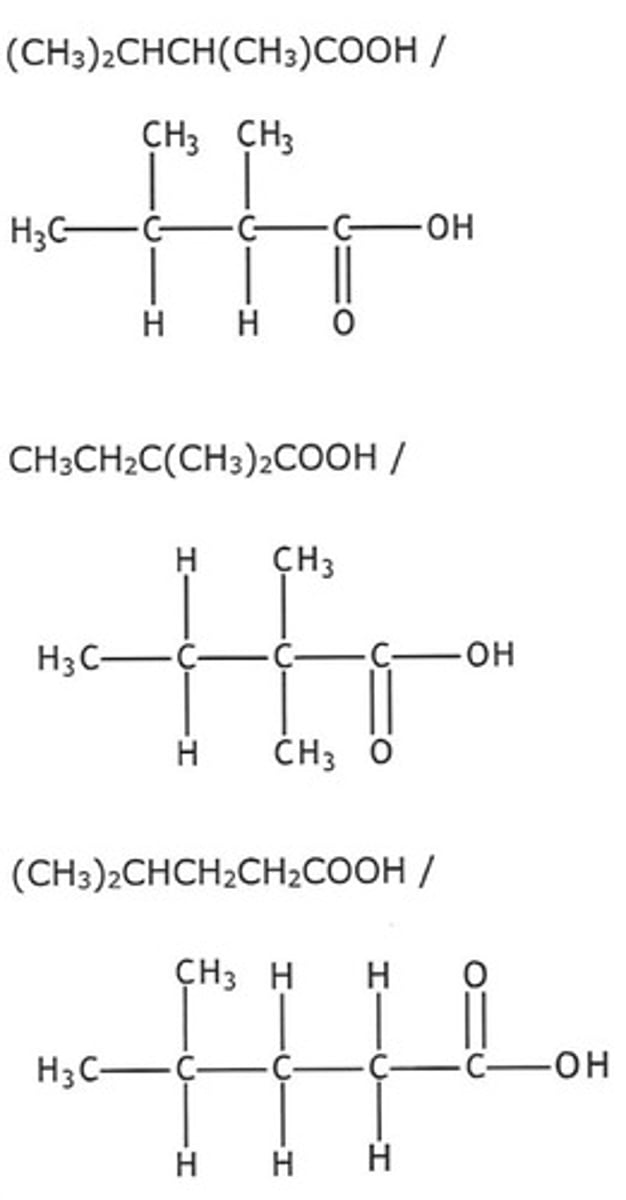
there are 3 isomers of C6H12O2 which are carboxylic acids with 5 peaks in their 13C NMR spectra. draw the structural formula for 2 of these isomers. (2)
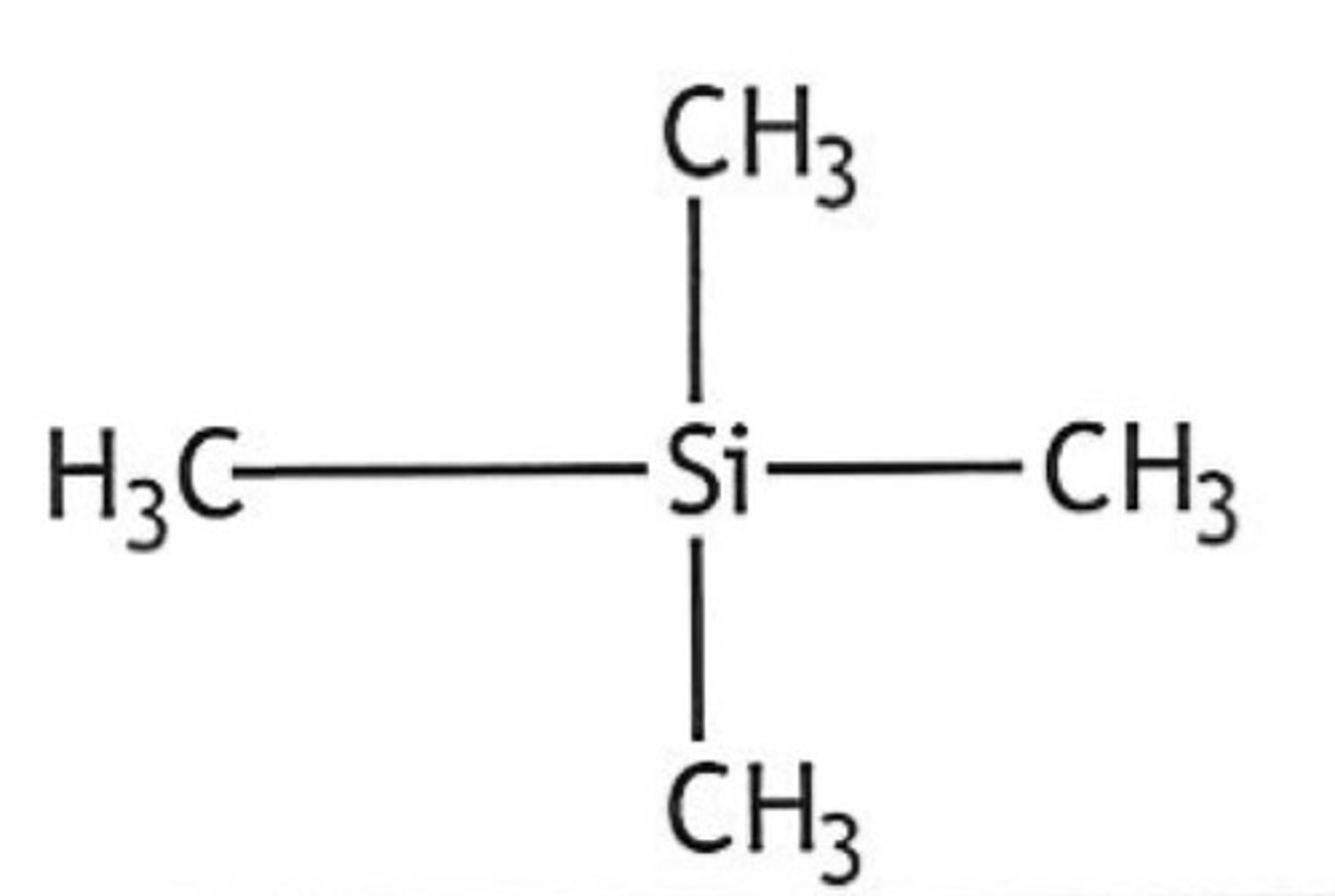
compound used for recording 1-H and 13-C NMR spectra: TMS (tetramethylsilane)
- standard state in NMR (relative to)
- contains 4 identical carbon and hydrogen environments
- peak at δ=0 ppm
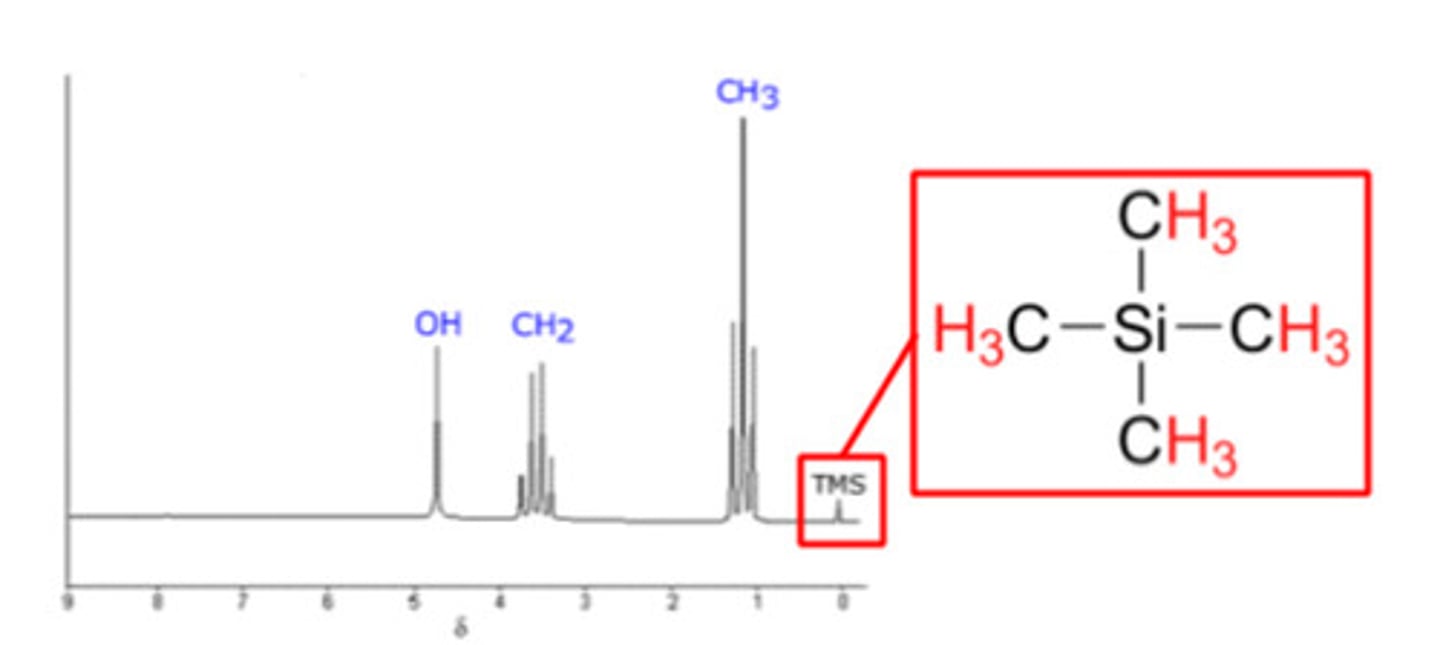
name the compound responsible for the peak at a chemical shift of 0ppm, stating its purpose. (2)
- TMS
- so that chemical shifts can be compared
TMS is an inert and non-toxic compound. state 2 other reasons why TMS is suitable for use as a standard when recording NMR spectra. (2)
- only a single peak since all H / C are in the same environments (no splitting)
- TMS peak to the right, which is out of the way of other peaks
- TMS has a low boiling temperature so it can be easily removed
- TMS gives a strong signal so only a small amount is required
there are 3 isomers of C6H12O2 which are carboxylic acids with 5 peaks in their C-13 NMR spectra.
draw the structural formula of 2 of these isomers. (2)
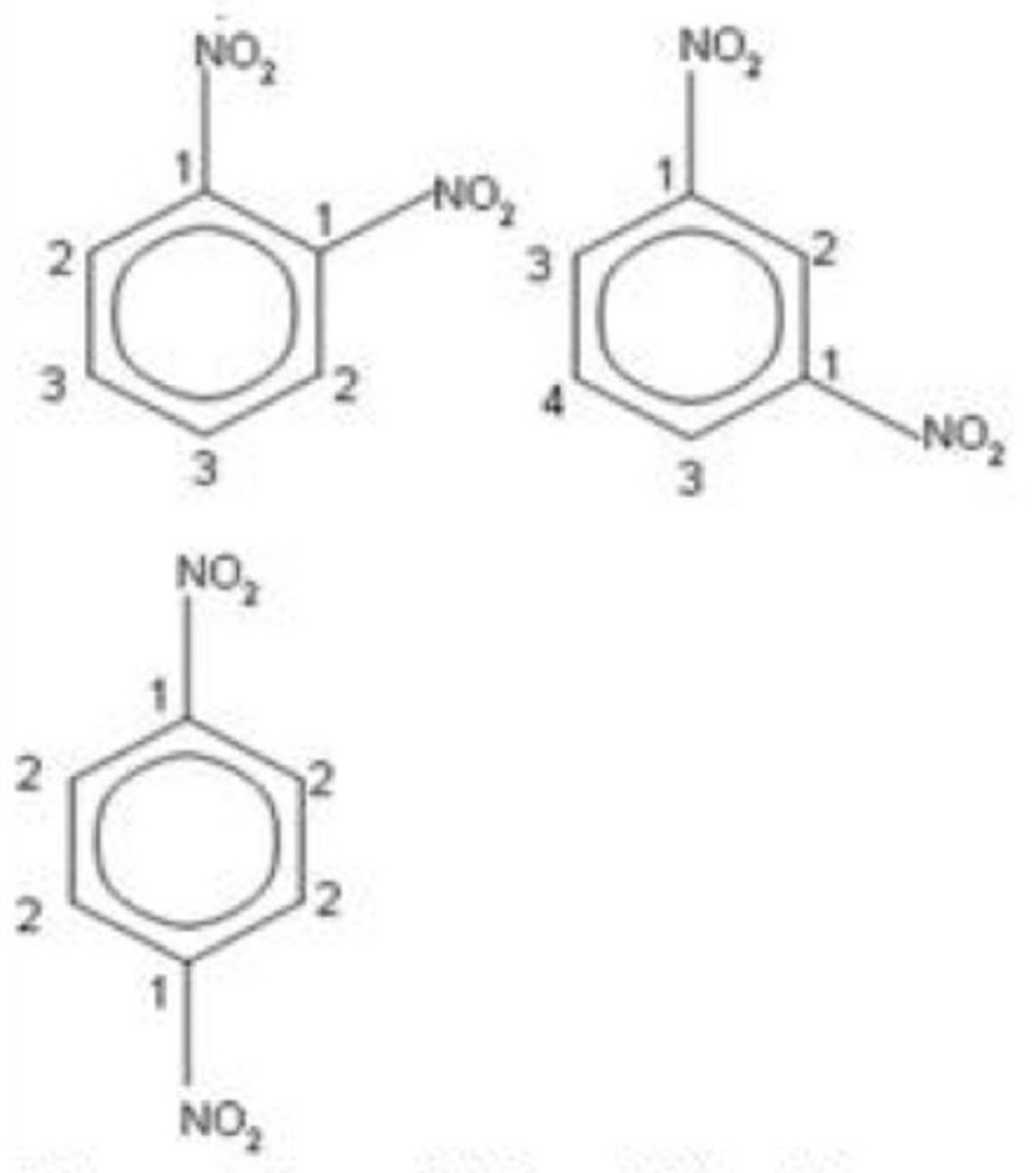
dinitrobenzene has 3 possible isomers.
the 13C NMR spectrum of the compound has 4 peaks. identify this structure by labelling the different carbon environments in all 3 possible isomers. (4)
- the compound is 1,3-dinitrobenzene
- with 4 different carbon environments
solvents for proton NMR
- cannot contain any 1H atoms
- eg CCl3, CDCl3
splitting occurs in high resolution proton HNMR.
explain what splitting is and when it occurs.
- influence of spin-spin coupling of adjacent H atoms when interacting with radiowaves
- only peaks caused by a H directly bonded to a C can split
- a peak is higher if there is more protons in the group (NOT more peaks)
give the structural formula of TMS (1)
explain what the n+1 rule is in relation to HNMR
- multiplets always split into one more than the number of H in the neighboring environment
- in a molecule of ethanol, the CH₃ group will produce 3 peaks, since it is neighboring 2 protons + 1
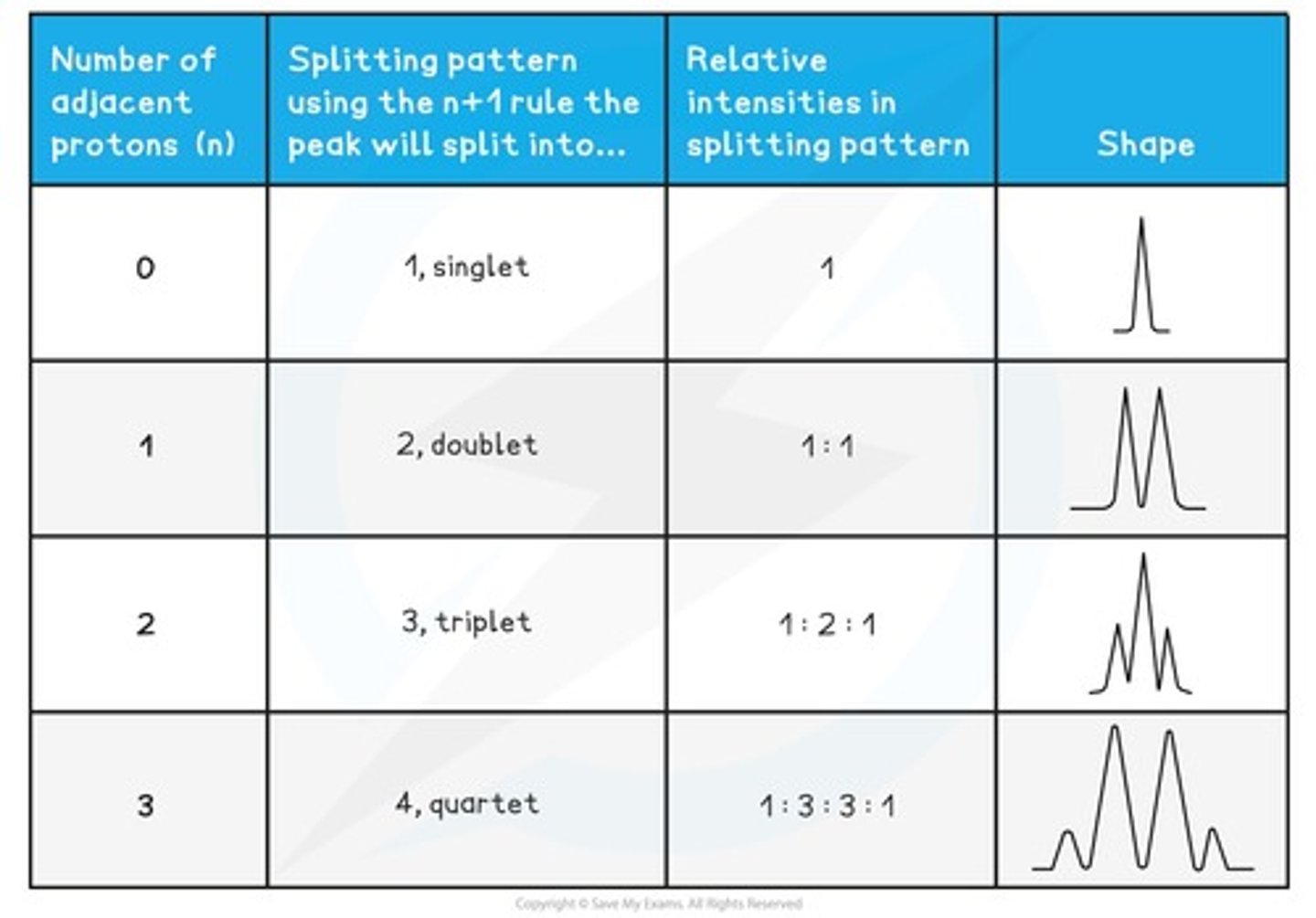
splitting pattern using the n+1 rule and the number of adjacent protons
0 adjacent proton = singlet
1 adjacent proton = doublet
2 adjacent proton = triplet
3 adjacent proton = quartet
4+ adjacent proton = multiplet
how many peaks would you expect to see in a low resolution proton NMR spectrum of the ester HCOOCH2CH2CH3?
4
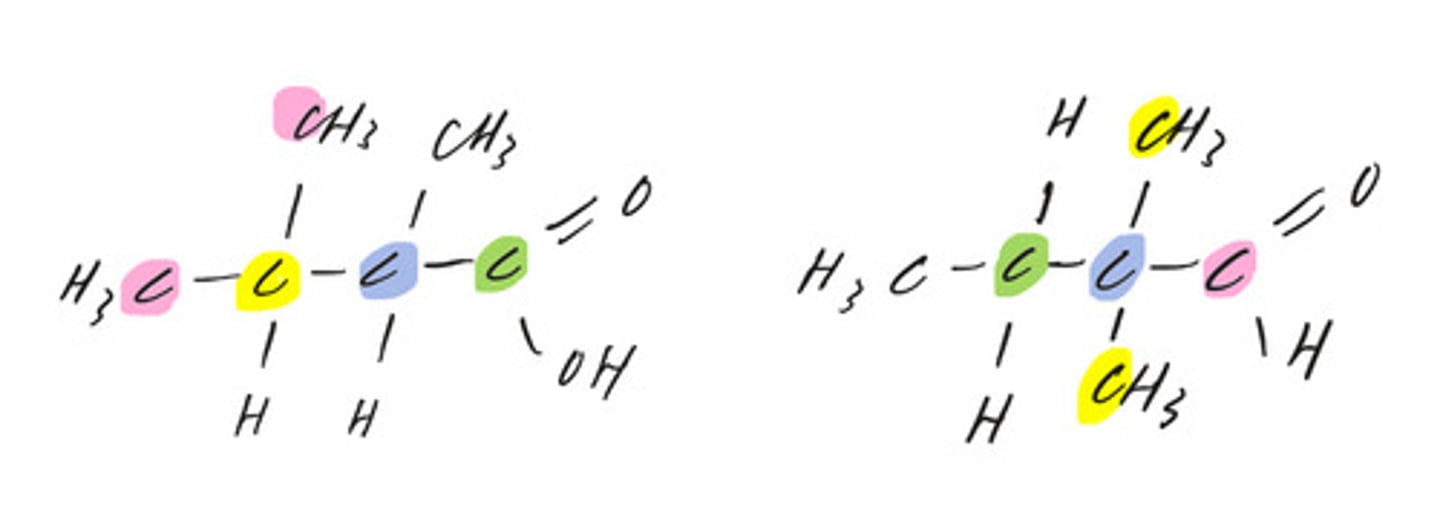
predicting different proton environments present in a molecule using 1-H NMR
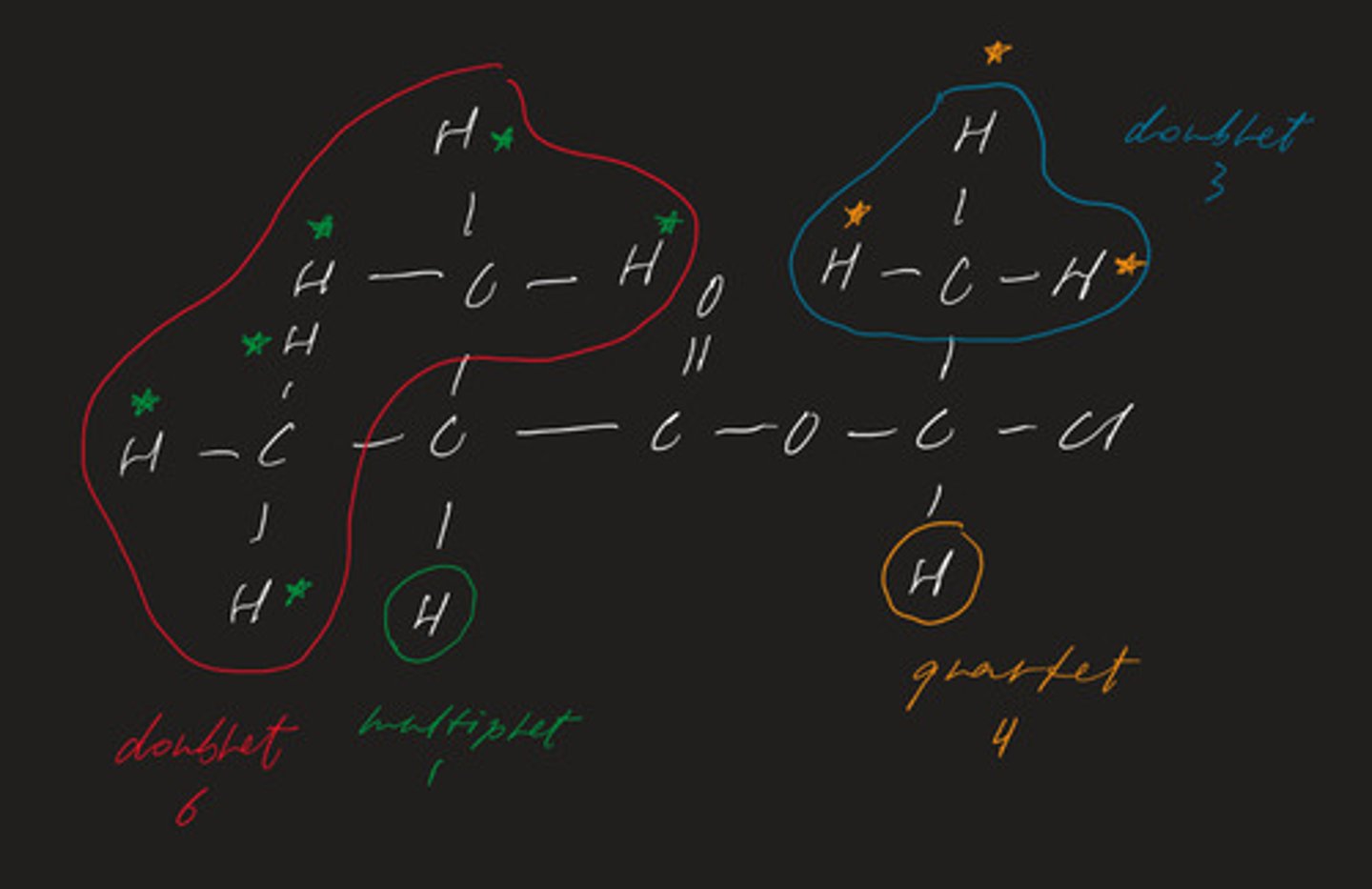
- draw out the structural formula of the compound
- eg when looking at the blue CH3 group, we look at its adjacent Cs
- if these Cs are attached to an H, we apply the n+1 rule
- in this case, the adjacent C is attached to a single H, so it is a doublet (3 — amount of proton in group)
- protons are in the same environment if they are bonded to the same molecules surrounding it
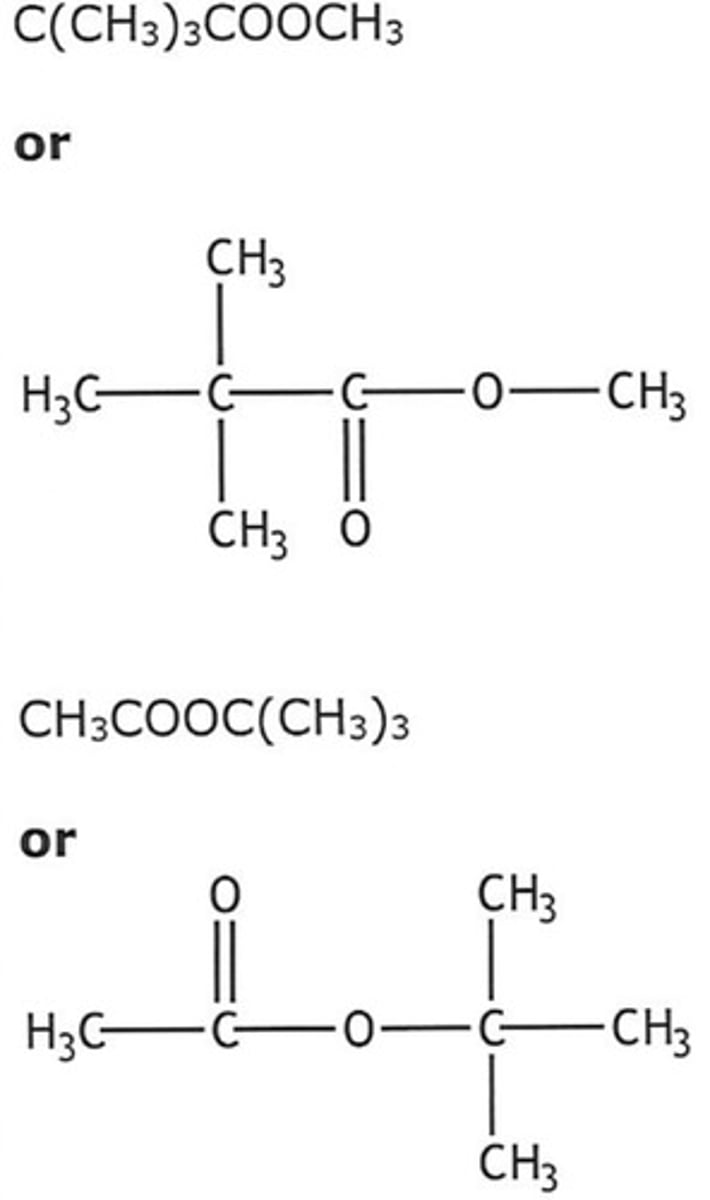
draw the structural formula of the 2 esters with formula C6H12O2 that each only have 2 peaks, both singlets, in their high resolution proton NMR spectra.
the relative peak areas are 3:1 for both esters. (2)
(2 peaks suggest only 2 proton environments so the H will be very close together, while singlet suggest that its an carbonyl)
identify the proton environment that causes a peak at 3.8ppm with a relative peak area of 3 on the diagram given. justify your answer. (3)
- identify furthest right proton environment attached to carbon
- 3 hydrogen atom in environment and is a singlet with no neighbouring hydrogen
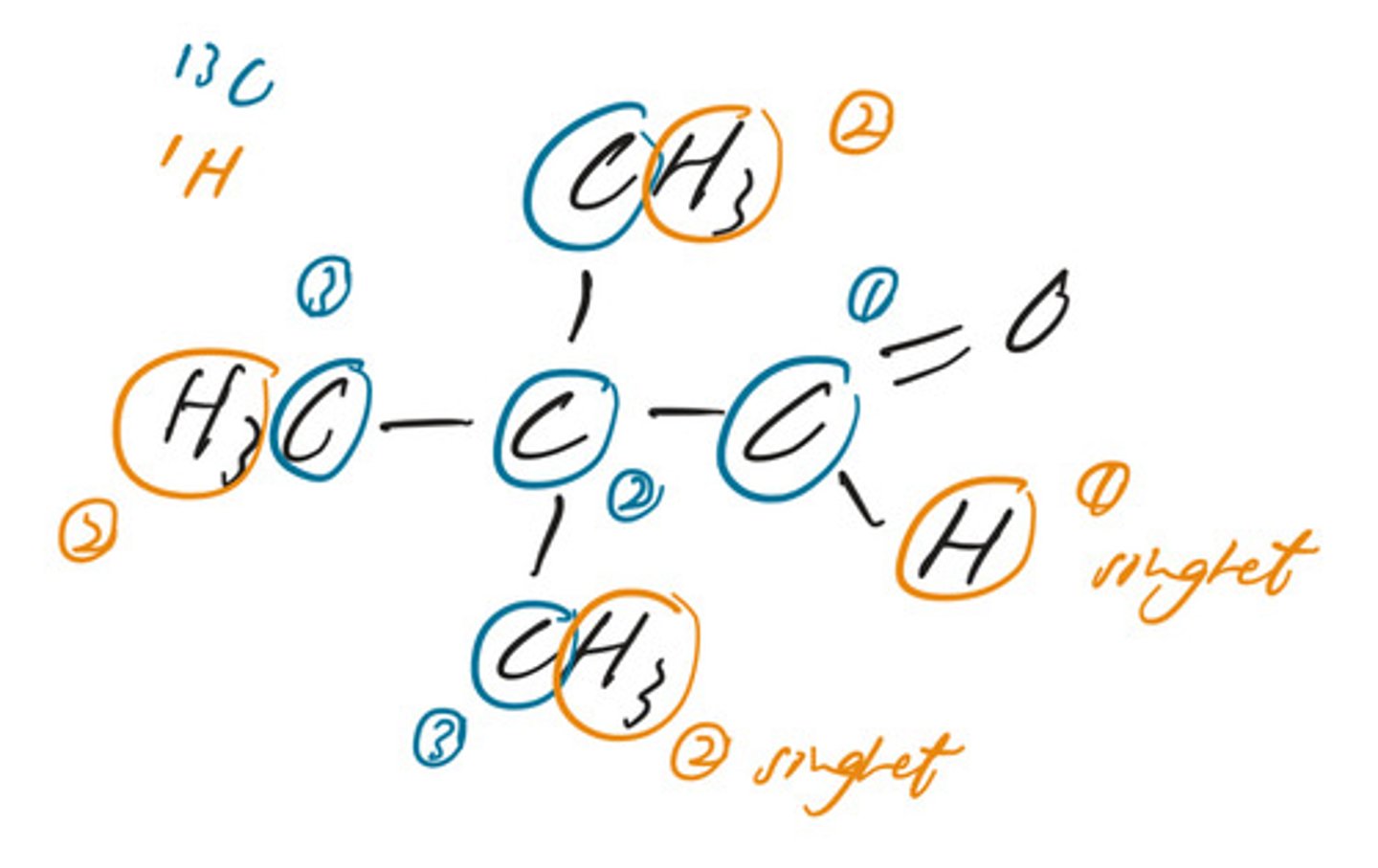
an aldehyde with molecular formula C5H10O has a 13C NMR spectrum with 3 peaks.
the high resolution 1H NMR spectrum of this aldehyde has 2 peaks and neither split.
deduce the displayed formula of the aldehyde. (4)
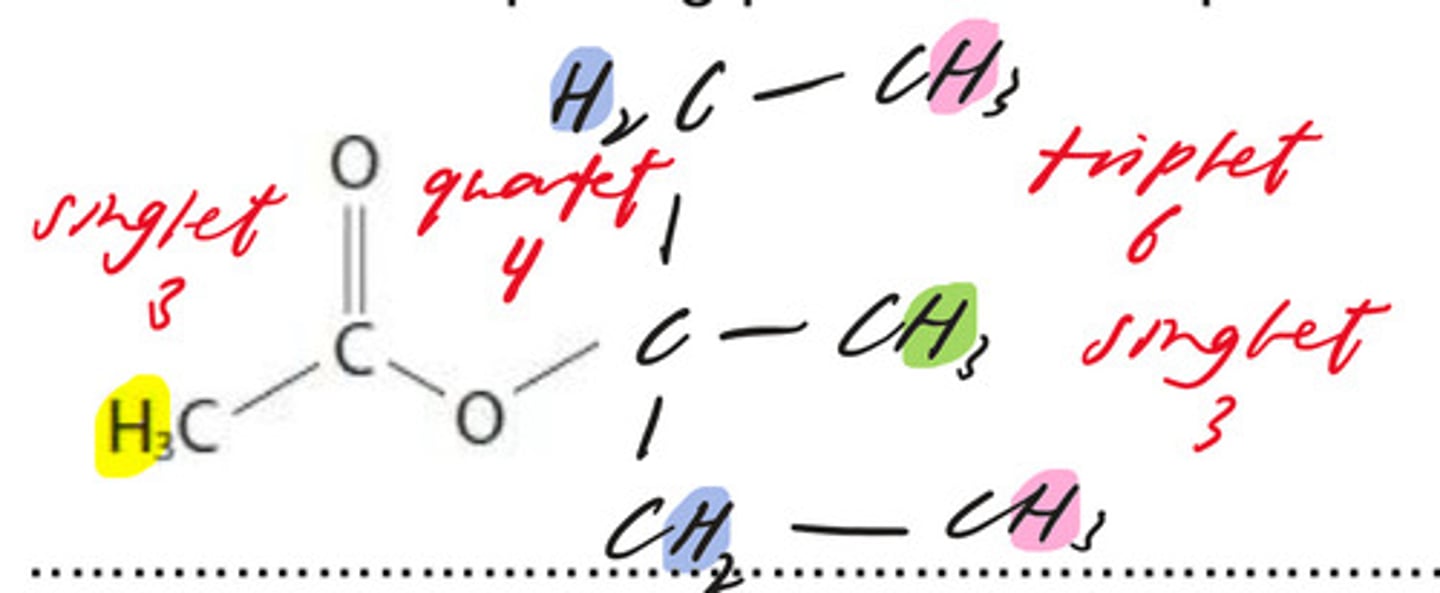
data from a high resolution 1H NMR spectrum of an ester Q is shown below:
singlet, 3 - 2.50δ
quartet, 4 - 1.56δ
singlet, 3 - 1.43δ
triplet, 6 - 0.92δ
draw the structure of Q and justify your answer by linking proton environments in your structure to the relative peak areas. (7)
compare the 1H and 13C NMR spectra of propan-1-ol and propan-2-ol.
include the number of peaks, relative peak areas and splitting patterns where appropriate.
- 3 peaks for propan-1-ol and 2 peaks for propan-2-ol
- both have a singlet peak for OH in 1H NMR
- there are 4 peaks for propan-1-ol in the relative ratio 3:2:2:1
- there are 3 peaks for propan-2-ol in the relative ratio 6:1:1
- there are 2 triplets and 1 sextet in propan-1-ol
- there are 1 doublet and 1 septet in propan-2-ol
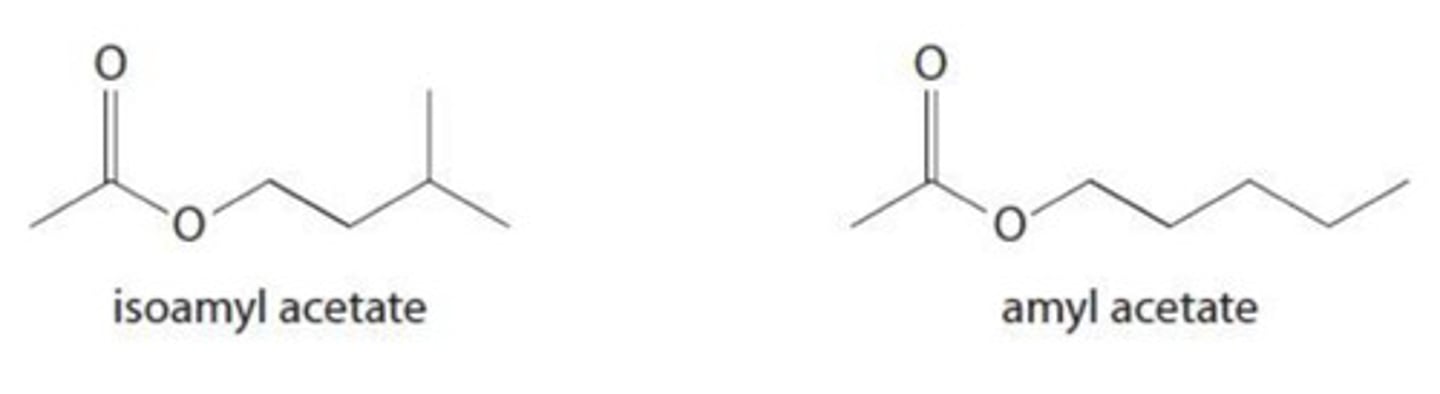
what is the number of peaks in a 13C NMR spectrum of isoamyl acetate and of amyl acetate?
6 in isoamyl acetate, 7 in amyl acetate