Quiz 9: Ch.18 - 19
 Call Kai
 Learn
Learn Practice Test
 Spaced Repetition
 Match
Match Flashcards
 Knowt Play
1/120

There's no tags or description
Looks like no tags are added yet.
Name | Mastery | Learn | Test | Matching | Spaced | Call with Kai |
|---|
No analytics yet
Send a link to your students to track their progress
121 Terms
1) Proto-oncogenes can change into oncogenes that cause cancer. Which of the following best explains the presence of these potential time bombs in eukaryotic cells?
A) Proto-oncogenes are genetic "junk."
B) Proto-oncogenes normally help regulate cell division.
C) Proto-oncogenes are mutant versions of normal genes.
D) Proto-oncogenes first arose from viral infections.
B) Proto-oncogenes normally help regulate cell division.
2) When taken up by a cell, which of the following molecules binds to a repressor so that the repressor no longer binds to an operator?
A) inducer
B) cAMP
C) corepressor
D) promoter
A) inducer
3) Which of the following is a molecule that helps to "turn off" the expression of genes in a cell?
A) inducer
B) corepressor
C) promoter
D) operator
B) corepressor
4) Which of the following functions are characteristic of general transcription factors in eukaryotes?
A) They bind to other proteins or to the TATA box.
B) They bind to sequences just after the start site of transcription.
C) They are sufficient to allow high levels of transcription.
D) They inhibit RNA polymerase binding to the promoter and begin transcribing.
A) They bind to other proteins or to the TATA box.
5) Cell differentiation always involves ________.
A) the selective loss of certain genes from the genome
B) the movement of cells
C) the production of tissue-specific proteins
D) transcription of the myoD gene
C) the production of tissue-specific proteins
6) Which of the following describes the normal function of the p53 gene product?
A) It allows cells to pass on mutations due to DNA damage.
B) It inhibits the cell cycle.
C) It causes cells to reduce expression of genes involved in DNA repair.
D) It slows down the rate of DNA replication by interfering with the binding of DNA polymerase.
B) It inhibits the cell cycle.
7) Which of the following statements correctly describes a characteristic of tumor-suppressor genes?
A) They often encode proteins that stimulate the cell cycle.
B) They encode proteins that help prevent uncontrolled cell growth.
C) They are cancer-causing genes introduced into cells by viruses.
D) They are frequently overexpressed in cancerous cells.
B) They encode proteins that help prevent uncontrolled cell growth.
8) If a researcher moves the operator to the far end of the operon, which of the following processes would likely occur when the cell is exposed to lactose?
A) The operon will never be transcribed.
B) The genes of the lac operon will be transcribed continuously.
C) The inducer will no longer bind to the repressor.
D) The repressor will no longer bind to the operator.
B) The genes of the lac operon will be transcribed continuously.
9) Which of the following characteristics of gene expression allows bacteria to quickly change protein synthesis patterns in response to environmental changes?
A) mRNA is stored for later use when it is needed later.
B) mRNA have long lifespans, allowing the bacteria to use them many times for translation.
C) Operons are activated in the presence of transcription factors.
D) mRNAs that are produced are short-lived and degraded within a few minutes of being synthesized
D) mRNAs that are produced are short-lived and degraded within a few minutes of being synthesized
10) According to the lac operon model proposed by Jacob and Monod, what is predicted to occur if the operator is removed from the operon?
A) Only lacZ would be transcribed.
B) Only lacY would be transcribed.
C) The lac operon would be transcribed continuously.
D) Genes involved in glucose metabolism would not be transcribed.
C) The lac operon would be transcribed continuously.
11) Which of the following mechanisms is commonly used to coordinate the expression of multiple, related genes in eukaryotic cells?
A) Release of each gene's individual inducing molecule must be coordinated to coordinate gene expression.
B) Environmental signals entering the cell cause the genes to rearrange into related sets.
C) Related genes are organized in operons that share a promoter that controls their expression.
D) Groups of genes that are expressed together have specific combinations of control elements.
D) Groups of genes that are expressed together have specific combinations of control elements.
12) DNA methylation and histone acetylation are examples of which of the following processes?
A) chromosomal rearrangements
B) epigenetic phenomena
C) translocation
D) genetic mutation
B) epigenetic phenomena
13) Cytoplasmic determinants are best described as having which of the following characteristics?
A) They are centromeric regions of DNA loosened for chromosomal replication by transcription factors.
B) They are tissue-specific transcription factors expressed in the early embryo.
C) They are maternal substances in the egg that influence the course of early development.
D) They are single-stranded RNA molecules capable of binding complementary sequences and altering translation.
C) They are maternal substances in the egg that influence the course of early development.
14) If a researcher moves the promoter for the lac operon to the region between the beta galactosidase (lacZ) gene and the permease (lacY) gene, which of the following results would be most likely?
A) Beta galactosidase will not be produced.
B) The operon will still transcribe the lacZ and lacY genes, but the mRNA will not be translated.
C) The three genes of the lac operon will be expressed normally.
D) RNA polymerase will no longer transcribe permease.
A) Beta galactosidase will not be produced.
15) If a mutation alters a maternal effect gene in a female Drosophila zygote, which of the following is most likely to occur?
15) ______
A) She will not develop past the early embryonic stage.
B) Only her male offspring will show the mutant phenotype.
C) Only her female offspring will show the mutant phenotype.
D) All of her offspring will show the mutant phenotype, regardless of their genotype.
D) All of her offspring will show the mutant phenotype, regardless of their genotype.
16) How does breakdown of glucose inhibit transcription of the lac operon? 16) ______
A) by inhibiting RNA polymerase from opening the strands of DNA to initiate transcription
B) by reducing the levels of intracellular cAMP
C) by strengthening the binding of the repressor to the operator
D) by weakening the binding of the repressor to the operator
B) by reducing the levels of intracellular cAMP
17) Which of the following explains why introducing the MyoD protein into a fat cell causes that cell to become a muscle cell but adding it to a neuron will have no effect? 17) ______
A) MyoD is causes positive feedback of MyoD expression in fats cells but not neurons.
B) Neurons are a differentiation step after muscle cells, they cannot go "backwards."
C) Fat cells are undifferentiated, the MyoD protein causes them to differentiate.
D) Muscle-specific gene expression requires a protein that neurons do not make.
D) Muscle-specific gene expression requires a protein that neurons do not make.
18) The product of the bicoid gene in Drosophila is responsible for determining which of the following embryonic features or structures during development? 18) ______
A) orientation of the anterior-posterior axis
B) segmentation of developing limbs
C) orientation of the left-right axis
D) orientation of the dorsal-ventral axis
A) orientation of the anterior-posterior axis
19) Which of the following characterizes BRCA1 and BRCA2 as tumor-suppressor genes? 19) ______
A) The normal genes code for estrogen receptors.
B) The mutant forms of either one of these prevent breast cancer.
C) They block penetration of breast cells by chemical carcinogens.
D) Their normal products participate in repair of DNA damage.
D) Their normal products participate in repair of DNA damage.
20) Much of the human genome does not code for proteins. Which of the following types of DNA are found in these regions of the genome? 20) ______
A) DNA that is transcribed into several kinds of small RNAs with biological function
B) DNA that consists only of histone coding sequences
C) DNA that is translated directly without being transcribed
D) DNA that serves as binding sites for reverse transcriptase
A) DNA that is transcribed into several kinds of small RNAs with biological function
21) If a mutation deactivated a regulatory gene of a repressible operon in an E. coli cell which of the following describes the most likely outcome? 21) ______
A) irreversible binding of the repressor to the operator
B) continuous transcription of the structural gene controlled by that regulator
C) complete inhibition of transcription of the structural gene controlled by that regulator
D) continuous translation of the mRNA because of alteration of its structure
B) continuous transcription of the structural gene controlled by that regulator
22) Absence of bicoid mRNA from a Drosophila egg leads to the absence of anterior larval body parts and mirror-image duplication of posterior parts. This is evidence that the product of the bicoid gene ________. 22) ______
A) normally leads to formation of head structures
B) normally leads to formation of tail structures
C) is a protein present in all head structures
D) is transcribed in the early embryo
A) normally leads to formation of head structures
23) Prokaryote's ability to regulate patterns of gene expression most likely promotes the organism's survival by ________.
A) allowing each gene to be expressed an equal number of times
B) organizing gene expression, so that genes are expressed in a given order
C) allowing an organism to adjust to changes in environmental conditions
D) allowing environmental changes to alter a prokaryote's genome
C) allowing an organism to adjust to changes in environmental conditions
24) Which of the following best explains why a neuron and a pancreatic cell isolated from the same individual contain different sets of proteins? 24) ______
A) Each cell type needs different proteins and, therefore, they break down proteins they don't need.
B) The genes in each cell type have different promoters and, therefore, they respond to different regulatory proteins.
C) The set of genes in each cell type are different, therefore, they express different proteins.
D) Each cell type contains different regulatory proteins and, therefore, they express different proteins.
D) Each cell type contains different regulatory proteins and, therefore, they express different proteins.
25) A genetic test to detect predisposition to cancer would likely examine the APC gene for involvement in which type(s) of cancer?
A) lung and prostate
B) colorectal only
C) lung only
D) lung and breast
B) colorectal only
26) A rise in extracellular glucose results in which of the following changes at the lac operon?
A) lac repressor is allosterically inactivated
B) cAMP receptor protein (CRP) detaches from the lac promoter
C) lac operator binds inducer with greater affinity
D) RNA polymerase binds the lac promoter with greater affinity
B) cAMP receptor protein (CRP) detaches from the lac promoter
27) What would occur if the repressor of an inducible operon were mutated so it could not bind the operator?
A) irreversible binding of the repressor to the promoter
B) continuous transcription of the operon's genes
C) buildup of a substrate for the pathway controlled by the operon
D) reduced transcription of the operon's genes
B) continuous transcription of the operon's genes
28) Which of the following changes in conditions results in an increase in cAMP receptor protein (CRP) mediated initiation of transcription?
A) an increase in glucose and a decrease in cAMP
B) a decrease in glucose and a decrease in the repressor
C) an increase in glucose and an increase in the repressor
D) a decrease in glucose and an increase in cAMP
D) a decrease in glucose and an increase in cAMP
29) For a repressible operon to be transcribed, which of the following conditions must occur?
A) RNA polymerase must bind to the promoter, and the repressor must be inactive.
B) RNA polymerase and active repressor must occupy the promoter.
C) RNA polymerase must bind to the promoter and a corepressor must be present.
D) RNA polymerase must bind the inducer, and the repressor must be inactive.
A) RNA polymerase must bind to the promoter, and the repressor must be inactive.
30) Under which condition do high levels of transcription of structural genes occur in an inducible operon?
A) It stops when the pathway's product is present.
B) It starts when the pathway's substrate is present.
C) It starts when the pathway's product is present.
D) It occurs continuously in the cell.
B) It starts when the pathway's substrate is present.
31) Which of the following statements about the DNA in one of your brain cells is true?
A) Each gene lies immediately adjacent to an enhancer.
B) The majority of genes are likely to be transcribed.
C) Most of the DNA codes for protein.
D) It is the same as the DNA in one of your liver cells.
D) It is the same as the DNA in one of your liver cells.
32) In colorectal cancer, several genes must be mutated for a cell to develop into a cancer cell. Which of the following kinds of genes would you expect to be mutated?
A) genes regulating cell division in colon bacteria
B) genes coding enzymes that act in the colon
C) genes involved in control of the cell cycle
D) genes that are especially susceptible to mutation
C) genes involved in control of the cell cycle
33) Which of the following describes the role typical proto-oncogenes have when they are expressed in cells that are not cancerous?
A) They inhibit differentiation.
B) They stimulate normal cell growth and division.
C) They enhance signaling from growth factor receptors.
D) They suppress tumor growth
B) They stimulate normal cell growth and division.
34) Forms of the Ras protein found in tumors usually cause which of the following events to occur?
A) cell division to cease
B) DNA replication to stop
C) decreased cell-to-cell adhesion
D) excessive cell division
D) excessive cell division
35) Assays analyzing transcriptional control of gene expression focus on which of the following characteristics?
A) size of the gene's open reading frame
B) amount of the mRNA generated
C) number of copies of the gene in the organism
D) relative level of the protein produced
B) amount of the mRNA generated
36) Which of the following results is most likely to occur if acetylation of histone tails in the chromatin of embryonic cells is increased?
A) inactivation of the selected genes
B) decreased binding of transcription factors
C) decreased chromatin condensation
D) increased chromatin condensation
C) decreased chromatin condensation
37) Which of the following describes how steroid hormones regulate gene expression?
A) They promote the degradation of specific mRNAs.
B) They bind to intracellular receptors and alter transcription of specific genes.
C) They bind to control elements in a regulatory gene and promote synthesis of that operon.
D) They activate translation of certain mRNAs.
B) They bind to intracellular receptors and alter transcription of specific genes.
38) Which of the following types of RNA is responsible for helping to re-establish methylation patterns during gamete formation?
A) piRNA
B) lncRNA
C) siRNA
D) miRNA
A) piRNA
39) A researcher introduced many copies of a double-stranded RNA into a culture of mammalian cells and used a fluorescent probe to follow it. Later she finds that the introduced strands separate into single-stranded RNAs and she hypothesizes that the molecules are acting as an miRNA. Which of the following pieces of evidence would support her claim?
A) After separating the strands she introduced shut down all translation.
B) The rate of accumulation of the polypeptide encoded by the target mRNA is reduced.
C) The amount of the RNA she introduced increases due to transcription.
D) The degradation rate of the single strand is slower than that of other cellular mRNA's.
B) The rate of accumulation of the polypeptide encoded by the target mRNA is reduced.
40) Which of the following molecules is a protein produced by a regulatory gene?
A) promoter
B) operator
C) repressor
D) operon
C) repressor
41) Muscle cells differ from nerve cells mainly because they ________.
A) contain different genes
B) use different genetic codes
C) have unique ribosomes
D) express different genes
D) express different genes
42) Which of the following predictions about the survival of a lactose intolerant E. coli cell is most likely correct?
A) The cell will survive if the environment has sufficient glucose.
B) The cell will survive if the cell has high levels of lacI expression.
C) The cell will not survive because inducible operons must be stimulated for the cell to survive.
D) The cell will not survive because E. coli require lactose as a nutrient source for life.
A) The cell will survive if the environment has sufficient glucose.
43) Mutations in which of the following genes result in transformations in the identity of entire body parts?
A) segmentation genes
B) homeotic genes
C) egg-polarity genes
D) inducers
B) homeotic genes
44) Which of the following processes destroys RNA molecules if they have a sequence complementary to an introduced double-stranded RNA?
A) RNA blocking
B) RNA obstruction
C) RNA interference
D) RNA disposal
C) RNA interference
45) Under what conditions does the trp repressor block transcription of the trp operon?
A) when the repressor is not bound to the operator
B) when the repressor binds to the inducer
C) when the repressor is not bound to RNA polymerase
D) when the repressor binds to tryptophan
D) when the repressor binds to tryptophan
46) If a particular operon encodes enzymes for making an essential amino acid and is regulated like the trp operon, then
________.
A) the amino acid inactivates the repressor
B) the repressor is active in the absence of the amino acid
C) the amino acid turns on transcription of the operon
D) the amino acid acts as a corepressor
D) the amino acid acts as a corepressor
47) The functioning of enhancers is an example of ________.
A) post-translational control that activates certain proteins
B) the stimulation of translation by initiation factors
C) transcriptional control of gene expression
D) a eukaryotic equivalent of prokaryotic promoter functioning
C) transcriptional control of gene expression
48) Which of the following conclusions is consistent with the fact that plants can be cloned from somatic cells?
A) The differentiated state is normally very unstable.
B) Differentiated cells retain all the genes of the zygote.
C) Differentiation results in the loss of non-expressed genes.
D) Differentiation does not occur in plants
B) Differentiated cells retain all the genes of the zygote.
49) Which of the following conditions is most likely to result in transcription of the lac operon?
A) There is more glucose in the cell than lactose.
B) There is glucose but no lactose in the cell.
C) The cAMP level is high and the lactose level is low.
D) The cAMP and lactose levels are both high within the cell
D) The cAMP and lactose levels are both high within the cell
50) Which of the following statements correctly describes the primary difference between enhancers and proximal control elements?
A) Enhancers are located considerable distances from the promoter; proximal control elements are close to the promoter.
B) Enhancers are transcription factors; proximal control elements are DNA sequences.
C) Enhancers improve transcription; proximal control elements inhibit transcription.
D) Enhancers are long regions of DNA; proximal control elements are shorter RNA molecules that stand in for DNA
A) Enhancers are located considerable distances from the promoter; proximal control elements are close to the promoter.
51) Which of the following statements best describes the characteristics of siRNA?
A) a double-stranded RNA that is formed by cleavage of hairpin loops in a larger precursor
B) a double-stranded RNA, one of whose strands can complement and inactivate a sequence of mRNA
C) a single-stranded RNA that can fold into cloverleaf patterns due to regions of internal complementary base pairs
D) a portion of rRNA that allows it to bind to several ribosomal proteins in forming large or small subunits
B) a double-stranded RNA, one of whose strands can complement and inactivate a sequence of mRNA
52) A mutation in E. coli results in a molecule known as a "super-repressor" because the operon is permanently repressed.
Which of the following describes the most likely effect of the mutation on the repressor protein?
A) It cannot bind to the operator.
B) It makes a repressor that binds CAP.
C) It cannot bind to the inducer.
D) It cannot make a functional repressor.
C) It cannot bind to the inducer.
53) Which of the following is the most likely phenotypes of a yeast mutant that contains histones that are resistant to
acetylation?
A) The mutant will require galactose for growth.
B) The mutant will grow rapidly.
C) The mutant will show increased levels of gene expression.
D) The mutant will show decreased levels of gene expression.
D) The mutant will show decreased levels of gene expression.
54) If a researcher moves the repressor gene (lacI) and its promoter, to a position at some several thousand base pairs away from its normal position, which of the following describes the most likely effect on the lac operon?
A) The repressor will no longer bind to the operator.
B) The lac operon will be expressed continuously.
C) The repressor will no longer bind to the inducer.
D) The lac operon will function normally.
D) The lac operon will function normally.
55) A researcher introduced many copies of a double-stranded RNA into a culture of mammalian cells and used a fluorescent probe to follow it. She found that the introduced strands separated; one strand degraded and the other single-stranded RNA remained. The remaining strand is able to do which of the following?
A) act as a template for transcription
B) activate other siRNAs in the cell
C) attach to histones in the chromatin
D) bind to complementary regions of target mRNAs
D) bind to complementary regions of target mRNAs
56) In wildtype Drosophila embryos, the bicoid mRNA is localized to the anterior end of the embryo. If bicoid mRNA was injected into the embryo's posterior end as well, which of the following developmental events would occur?
A) The embryo would show anterior structures at both ends of the embryo.
B) The embryo would grow extra wings and legs.
C) The embryo would develop normally.
D) The embryo would have altered segmentation.
A) The embryo would show anterior structures at both ends of the embryo.
57) The cAMP receptor protein (CRP) is said to be responsible for positive regulation of the lac operon because ________.
A) CRP bound to the CRP-binding site stimulates the transcription of the lac operon
B) CRP prevents binding of the repressor to the operator
C) CRP levels rise when lactose is present in the environment
D) CRP promotes the production of allolactose
A) CRP bound to the CRP-binding site stimulates the transcription of the lac operon
58) If the DNA of a mammalian promoter region experiences increased methylation on cytosine (C) which of the following results is most likely to occur?
A) decreased chromatin condensation
B) inactivation of the gene
C) higher levels of transcription of certain genes
D) activation of histone tails for enzymatic function
B) inactivation of the gene
59) Which of the following is an example of post-transcriptional control of gene expression?
A) the addition of methyl groups to cytosine bases of DNA
B) the removal of introns and alternative splicing of exons
C) gene amplification contributing to cancer
D) the binding of transcription factors to a promoter
B) the removal of introns and alternative splicing of exons
60) Which of the following molecules binds with a repressor to alter its conformation and therefore affect its function?
A) promoter
B) inducer
C) transcription factor
D) cAMP
B) inducer
61) Within a cell, the amount of protein made using a given mRNA molecule in that cell depends partly on ________.
A) the rate at which the mRNA is degraded
B) the number of introns present in the mRNA
C) the types of ribosomes present in the cytoplasm
D) the degree of DNA methylation
A) the rate at which the mRNA is degraded
62) Which of the following methods are used by eukaryotes to control gene expression but are not used by bacteria?
A) limiting access to free nucleic acids
B) control of both RNA splicing and chromatin remodeling
C) regulatory proteins binding to promoter sequences and determining polymerase used
D) organization of genes in operons
B) control of both RNA splicing and chromatin remodeling
63) A cell is considered to be differentiated if it has which of the following characteristics?
A) The cell replicates by the process of mitosis.
B) The cell produces proteins specific to a particular cell type.
C) The cell appears to be different from the surrounding cells.
D) The cell loses connections to the surrounding cells.
B) The cell produces proteins specific to a particular cell type.
64) Gene expression is often assayed by measuring the level of mRNA produced from a gene. Which of the following levels of the control of gene expression can by analyzed by this type of assay?
A) translational control
B) replication control
C) alternative splicing
D) transcriptional control
D) transcriptional control
65) Which of the following types of mutation would convert a proto-oncogene into an oncogene?
A) a mutation that greatly increases the amount of the proto-oncogene protein
B) a deletion of most of the proto-oncogene coding sequence
C) a mutation that greatly reduces the stability of a proto-oncogene mRNA
D) a mutation that blocks transcription of the proto-oncogene
A) a mutation that greatly increases the amount of the proto-oncogene protein
66) Which of the following processes is the best way to determine whether alternative splicing of a given gene occurs?
A) Compare the sequences of the given gene and a gene known to undergo alternative splicing.
B) Compare the size of the DNA within the given gene and a similar gene in a related organism.
C) Isolate the primary transcripts made from the given gene and compare the sequences.
D) Isolate mRNA from the given gene and compare the sequences.
D) Isolate mRNA from the given gene and compare the sequences.
1) Which of the following statements accurately describes the lysogenic cycle of lambda (λ) phage?
A) The phage genome is integrated in the host chromosome where it is passed on to daughter cells through binary fission.
B) The product of one prophage gene is made and it activates most of the other prophage genes.
C) The phage DNA is copied and accumulates in the cytoplasm. Then a trigger causes capsid proteins to be made and phages
are assembled.
D) The viral genes immediately turn the host cell into a lambda-producing factory. Then the host lyses.
A) The phage genome is integrated in the host chromosome where it is passed on to daughter cells through binary fission.
2) Which of the following correctly explain the effect that treating a viral infection with antibiotics has on the course of the infection?
A) The infection's length will be shorter because antibiotics activate the immune system, and this decreases the severity of the
infection.
B) The infection's length will remain the same because antibiotics have no effect on eukaryotic or virally encoded enzymes.
C) The infection's length will remain the same because viruses do not have DNA or RNA, and so antibiotics do not affect them.
D) The infection's length will be shorter because antibiotics can prevent viral entry into the cell by binding to host-receptor
proteins.
B) The infection's length will remain the same because antibiotics have no effect on eukaryotic or virally encoded enzymes.
3) In 2009, a flu pandemic was believed to have originated when viral transmission occurred from pig to human, thereby earning the designation "swine flu." Although pigs are thought to have been the host for the 2009 virus, sequences from bird, pig, and human viruses were all found within this newly identified virus. What is the most likely explanation for the presence of sequences from bird, pig, and human viruses?
A) The RNA of related viruses can reassort during viral assembly resulting in new genetic combinations.
B) The virus was descended from a common ancestor of bird, pig, and human flu viruses.
C) The infected individuals happened to be infected with all three virus types.
D) The human was likely infected with various bacterial strains that contained all three RNA viruses.
A) The RNA of related viruses can reassort during viral assembly resulting in new genetic combinations.
4) Viruses can carry out which of the following processes?
A) They can manufacture their own ATP, proteins, and nucleic acids.
B) They can use the host cell machinery to make copies of viral genomes and viral proteins.
C) They can replicate while within a host cell as well as when they are between host cells.
D) They can use the host cell as a source of energy allowing viral machinery to replicate the virus.
B) They can use the host cell machinery to make copies of viral genomes and viral proteins.
5) Which of the following methods would be best to use for distinguishing between an infectious agent that is a virus and one that is a prion?
A) Filter the substance to remove all elements smaller than what can be easily seen under a light microscope.
B) Treat the substance with enzymes that destroy all nucleic acids, and then determine whether the substance is still infectious.
C) Culture the substance on nutritive medium, away from any cells.
D) Treat the sample with proteases that digest all proteins, and then determine whether the substance is still infectious.
B) Treat the substance with enzymes that destroy all nucleic acids, and then determine whether the substance is still infectious.
6) Which of the following correctly describes a strategy that bacteria have evolved to defend against infection by phage?
A) Bacteria secrete enzymes that diffuse away from the cell and digest phage capsid proteins so the virus cannot infect the cells.
B) The lysogenic cycle allows bacteria evolve inhibitors that bind with the phage DNA they contain so their daughter cells will no longer be infected.
C) The CRISPR-Cas system allows bacteria to recognize phage strains that have previously infected that bacterial lineage and targets the phage DNA for destruction.
D) Bacteria methylate phage DNA as it enters the cell, targeting it for destruction by restriction enzymes.
C) The CRISPR-Cas system allows bacteria to recognize phage strains that have previously infected that bacterial lineage and targets the phage DNA for destruction.
7) RNA viruses require their own supply of certain enzymes because ________.
A) these enzymes penetrate host cell membranes
B) host cells rapidly destroy the viruses
C) these enzymes translate viral mRNA into proteins
D) host cells lack enzymes that can replicate the viral genome
D) host cells lack enzymes that can replicate the viral genome
8) Which of the following human diseases is caused by a virus that requires reverse transcriptase to transcribe its genome inside the host cell?
A) smallpox
B) AIDS
C) influenza
D) herpes
B) AIDS
9) Which of the following characteristics is typical of the lytic cycle of a bacteriophage?
A) Viral DNA incorporates into the host genome.
B) The host sequesters viral particles in the lysosome.
C) The host membrane ruptures, releasing many phages.
D) The viral genome replicates without destroying the host.
C) The host membrane ruptures, releasing many phages.
10) An infectious substance capable of causing disease in plants is isolated and researchers want to determine whether the substance is a bacterium or a virus. Which of the following methods will best allow them to determine the type of infectious agent they have isolated?
A) Treat the sample with proteases that digest all proteins, and then determine whether the substance is still infectious.
B) Culture the substance on nutritive medium, away from any plant cells.
C) Treat the substance with enzymes that destroy all nucleic acids, and then determine whether the substance is still
infectious.
D) Culture the substance with plant cells, and then determine whether the cells lyse.
B) Culture the substance on nutritive medium, away from any plant cells.
11) A few minutes of incubation at room temperature in the laboratory will inactivate HIV, but the flu virus is still active after incubating for several hours. What are the practical consequences of these findings?
A) This property of HIV makes it more likely to be a pandemic than the flu virus.
B) The flu virus can be transmitted more easily from person to person than HIV.
C) The flu virus is more sensitive to changes in temperature than HIV.
D) Disinfecting surfaces will have more of an effect on reducing the spread of HIV than on reducing the spread of the flu
B) The flu virus can be transmitted more easily from person to person than HIV.
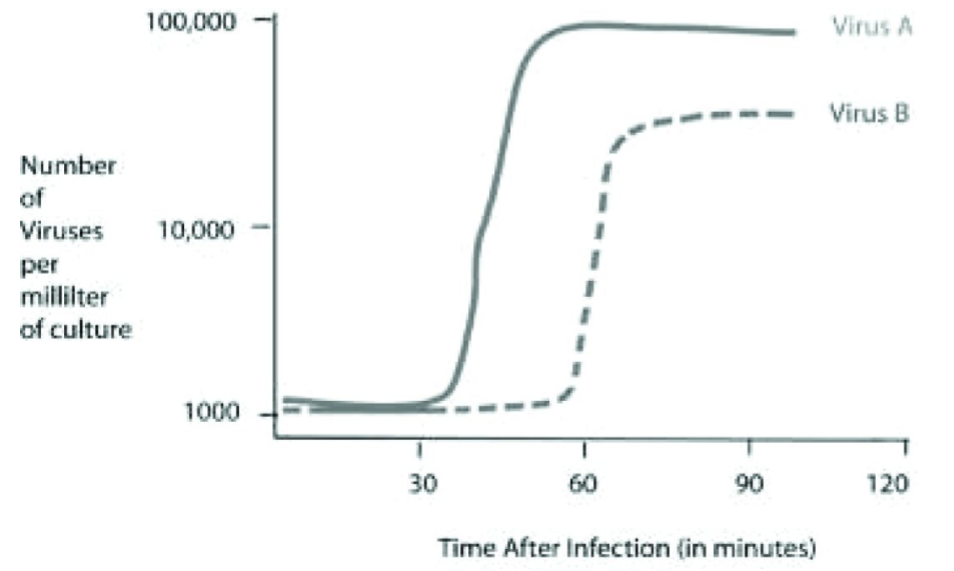
12)Cells were infected with approximately 1,000 copies of either virus A or virus B at the 0 time point. At five-minute intervals, a sample of the virus and cell mixture was removed. All intact cells were removed from the sample, and the number of viruses per milliliter of culture was determined and plotted in the graph above.
In a second experiment, 1 mL of each viral sample collected at 90 minutes post infection was mixed with new, uninfected cell cultures. Which of the following best describes these new cultures?
A) The new culture infected with virus B will plateau with approximately 50,000 viral particles per milliliter of culture.
B) The new culture infected with virus A will result in more infected cells than the new culture infected with virus B.
C) The new culture infected with virus B will have a shorter lytic cycle than seen in the original virus B culture.
D) The new culture infected with virus A will require 60 minutes before new viral particles will be released into the culture.
B) The new culture infected with virus A will result in more infected cells than the new culture infected with virus B.
13) The herpes viruses are enveloped DNA viruses that cause disease in vertebrates and in some invertebrates such as oysters. Some of the human forms are herpes simplex virus (HSV) types I and II, causing facial and genital lesions, and the varicella zoster virus (VSV), causing chicken pox and shingles. Each of these actively infects nervous tissue. Primary infections are fairly mild, but the virus is not then cleared from the host; rather, viral genomes are maintained in cells in a latent phase. The virus can later reactivate, replicate, and infect others.
Which of the following treatments would have the best chance of lowering the number of new cases of infection?
A) Educate people about ways to disinfect surfaces that came in contact with herpes simplex virus.
B) Interfere with new viral replication in preexisting cases of herpes simplex virus.
C) Vaccinate of all persons with preexisting cases of herpes simplex virus.
D) Treat herpes simplex virus lesions to shorten the breakout.
B) Interfere with new viral replication in pre-existing cases of herpes simplex virus.
14) Which of the following types of viral genomes could be copied using reverse transcriptase?
A) dsDNA
B) ssRNA
C) dsRNA
D) ssDNA
B) ssRNA
15) A bacterium is infected with an experimentally constructed bacteriophage composed of the T2 phage protein coat and T4 phage DNA. The new phages produced would have ________.
A) T4 protein and T2 DNA
B) T2 protein and T2 DNA
C) T4 protein and T4 DNA
D) T2 protein and T4 DNA
C) T4 protein and T4 DNA
16) If a viral host cell has a mutation that interferes with the addition of carbohydrates to proteins during processing in the Golgi apparatus, which of the following processes is most likely to occur?
A) The virus-encoded protease would be unable to cleave large viral proteins into smaller, functional polypeptides.
B) Viruses released by that cell would have a decreased ability to infect cells than the virus that originally infected the cell.
C) Viruses released by that cell are novel and would result in infections with higher mortality rates.
D) The virus would be unable to reproduce within the host cell
B) Viruses released by that cell would have a decreased ability to infect cells than the virus that originally infected the cell.
17) Which of the following statements correctly describes a difference between viruses and prions?
A) Viruses have protein capsids surrounding nucleic acids, whereas prions are made only of nucleic acids.
B) Viruses replicate using its host's DNA replication machinery, whereas prions replicate using host's translation machinery.
C) Viruses infect many types of cells, whereas prions infect only prokaryotic cells.
D) Viruses have genomes composed of RNA, whereas prions have genomes composed of DNA
B) Viruses replicate using its host's DNA replication machinery, whereas prions replicate using host's translation machinery.
18) Which of the following statements best supports the argument that viruses are nonliving?
A) They do not evolve.
B) They have RNA rather than DNA.
C) Their DNA does not encode proteins.
D) They do not carry out metabolic processes
D) They do not carry out metabolic processes
19) To cause a human pandemic, the H5N1 avian flu virus would have to ________.
A) become capable of human-to-human transmission
B) become much more pathogenic
C) spread to primates such as chimpanzees
D) develop into a virus with a different host range
A) become capable of human-to-human transmission
20) Poliovirus is an RNA virus of the picornavirus group, which uses its RNA as mRNA. The RNA genome has a 5′ RNA cap instead of a 5′ methyl-G cap. This is followed by a non-translated leader sequence and then a single long protein-coding region (~7,000 nucleotides) followed by a poly-A tail. Infected cells were incubated with radioactive amino acids and viral proteins were isolated. After a short incubation with radioactive amino acids only very long viral proteins were seen, while longer periods of labeling result in several short polypeptides of different lengths.
Which of the following conclusions is most consistent with the results described?
A) The RNA is first translated into a single long protein, which is then cleaved into shorter ones.
B) The RNA is translated into short polypeptides, which are then assembled into large complexes.
C) The large radioactive polypeptides are coded by the host, whereas the short ones are coded for by the virus.
D) Host cell ribosomes translate the viral coding region and poly-A tail at different times resulting in the different populations
of proteins.
A) The RNA is first translated into a single long protein, which is then cleaved into shorter ones.
21) Which of the following characteristics correctly describes retroviruses?
A) They have a single-stranded RNA that acts as a template for DNA synthesis.
B) They can only reproduce by infecting bacteria.
C) They have a single-stranded DNA that is integrated into the host cell genome.
D) They are not destroyed or deactivated by heating.
A) They have a single-stranded RNA that acts as a template for DNA synthesis.
22) What is the function of reverse transcriptase in retroviruses?
A) It translates viral RNA into proteins.
B) It converts host cell RNA into viral DNA.
C) It uses viral RNA as a template for making more viral RNA strands.
D) It uses viral RNA as a template for DNA synthesis.
D) It uses viral RNA as a template for DNA synthesis.
23) Which of the following processes can be effective in preventing the onset of viral infection in humans?
A) getting vaccinated to certain viruses
B) taking antibiotics to inhibit bacterial growth
C) taking drugs that inhibit transcription
D) taking vitamins before being exposed to various viruses
A) getting vaccinated to certain viruses
24) Which of the following best defines prions?
A) mobile segments of DNA that can disrupt host gene expression
B) circular molecules of RNA that can infect plants
C) misfolded versions of normal proteins that can cause disease
D) viral DNA that attaches itself to the host genome and causes disease
C) misfolded versions of normal proteins that can cause disease
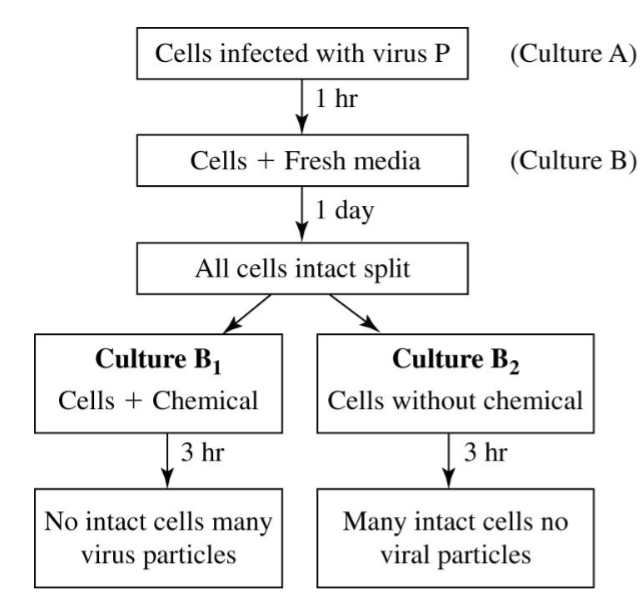
25) In an experiment to investigate an uncharacterized virus, virus P, cells were infected with virus P. After one-hour, a sample of the culture was removed and found to contain both cells and free virus particles. The cells were removed from the sample and grown in fresh media (culture B). One day later a sample of culture B was examined and found to contain only intact cells. Culture B was split into two smaller cultures. A chemical was added to culture B1 but not added to culture B2. Examination of the culture contents after 3 hours reveals B1 contains no intact cells and many virus particles while B2 contains many intact cells and no viral particles. The figure represents the steps of the experiment and the results.
Which of the following best explains the results?
A) The chemical added to culture B1 caused the cells to lyse.
B) The cells in culture B2 were resistant to infection while the cells in B1 were not.
C) Virus P is capable of both lysogenic and lytic cycles.
D) Culture B1 was contaminated and infected with virus when the chemical was added.
C) Virus P is capable of both lysogenic and lytic cycles.
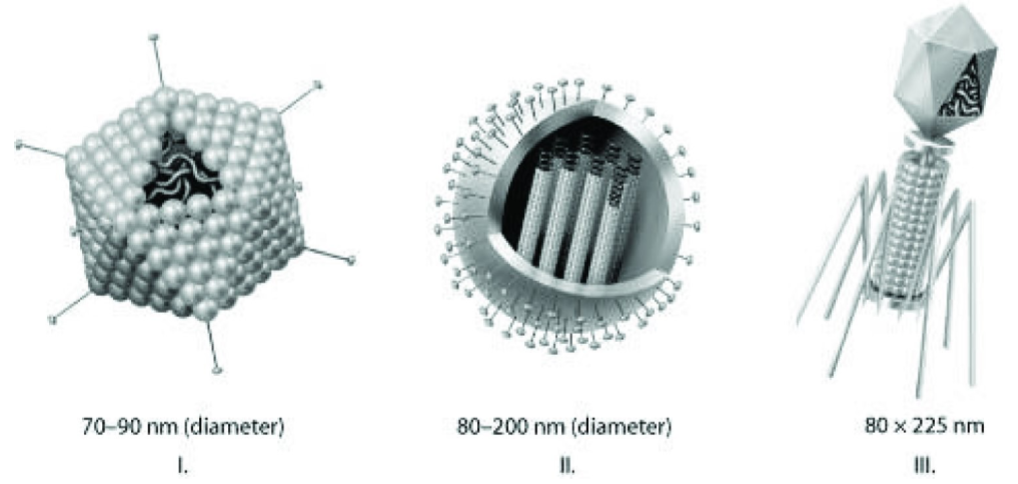
26) Which of the three types of viruses shown would you expect to have glycoproteins among its components?
A) I and II only
B) III only
C) I only
D) II and III only
B) III only
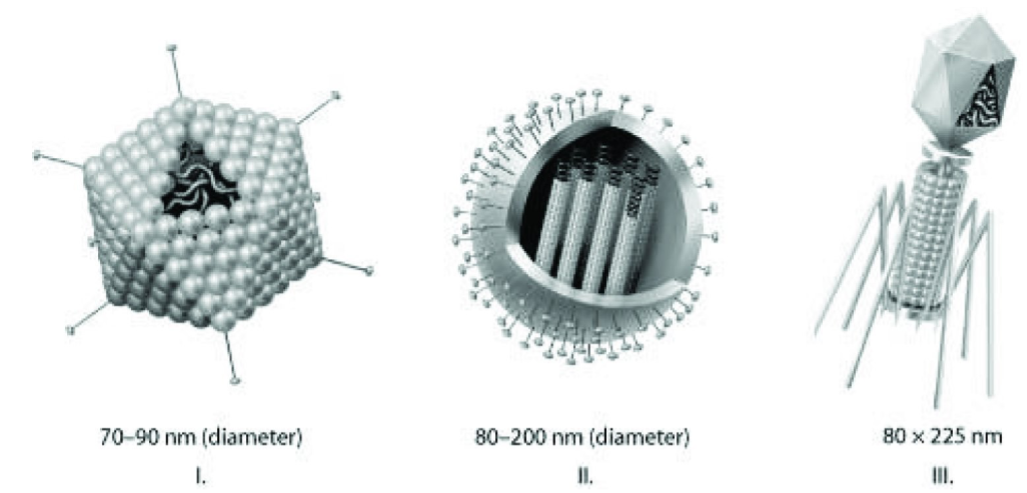
27) Which of the three types of viruses shown in the figure would you expect to include a capsid(s)?
A) I, II, and III
B) I only
C) I and II only
D) III only
A) I, II, and III
28) Which of the following descriptions correctly identifies a main structural difference between viruses with envelopes and viruses without envelopes?
A) Only viruses with envelopes have their contents enclosed by a layer containing lipids
B) Only viruses with envelopes package their genetic material by engulfing it.
C) Only viruses without envelopes interact with receptor proteins on the surface of the host cell.
D) Only viruses without envelopes can release their genetic material into the cytoplasm of the host.
A) Only viruses with envelopes have their contents enclosed by a layer containing lipids
29) Which of the following statements correctly describes a characteristic of viral infections in plants?
A) They are not spread by animals.
B) They have little effect on plant growth.
C) They can spread within a plant via plasmodesmata.
D) They can be controlled with antibiotics.
C) They can spread within a plant via plasmodesmata.
30) Which of the following statements best reflects what we know about how influenza virus moves between species?
A) An influenza virus fuses with a different type of virus (like HSV) and gains new DNA which enable the new virus to be transmitted to a wider variety of host species.
B) In an animal, such as a pig, the influenza virus is mutated and replicated in alternate arrangements so that humans who eat the pig products can be infected.
C) An influenza virus from a human epidemic or pandemic infects birds; the birds replicate mutant versions of that virus and then pass the new forms back to humans.
D) An animal, such as a pig, is infected with more than one strain of the influenza virus and the genomes reassort into new combinations that can facilitate spread to other species.
D) An animal, such as a pig, is infected with more than one strain of the influenza virus and the genomes reassort into new combinations that can facilitate spread to other species.
31) If a viral host cell has a mutation that interferes with the addition of carbohydrates to proteins during processing in the Golgi apparatus, which of the following processes is most likely to occur?
A) The viral envelope proteins would not have glycoproteins added to them and might not arrive at the host plasma membrane.
B) The viral capsid proteins would not have glycoproteins added to them and might not arrive at the host plasma membrane.
C) The virus would be unable to reproduce within the host cell.
D) The viral core proteins would not have glycoproteins added to them and might not arrive at the host plasma membrane.
A) The viral envelope proteins would not have glycoproteins added to them and might not arrive at the host plasma membrane.
32) Which of the following responses explain why the apparent high rate of mutation in RNA viruses?
A) RNA viruses can incorporate a variety of nonstandard bases.
B) RNA nucleotides are more unstable than DNA nucleotides.
C) RNA virus genome replication does not involve proofreading.
D) RNA viruses are more sensitive to mutagens.
C) RNA virus genome replication does not involve proofreading.
33) What is difference between an epidemic and a pandemic?
A) An epidemic has low mortality; a pandemic has higher mortality.
B) An epidemic is a disease; a pandemic is a treatment.
C) An epidemic is restricted to a local region; a pandemic is global.
D) An epidemic is caused by a bacterial infection; a pandemic is caused by a viral infection.
C) An epidemic is restricted to a local region; a pandemic is global.
34) Emerging viruses arise by ________.
A) mutation of existing viruses
B) the spread of existing viruses more widely within their hostspecies
C) the spread of existing viruses to new host species
D) all of the above
D) all of the above