Principles of training
 Call Kai
 Learn
Learn Practice Test
 Spaced Repetition
 Match
Match Flashcards
 Knowt Play
1/17

There's no tags or description
Looks like no tags are added yet.
Name | Mastery | Learn | Test | Matching | Spaced | Call with Kai |
|---|
No analytics yet
Send a link to your students to track their progress
18 Terms
What are the 5 principles of training?
Individuality
Specificity
Reversibility
Progressive overload
Variation
What is individuality?
Idea that not all athletes are equal
Variations in genes, metabolism, CV health can affect performance
What is specificity?
Training programmes must stress the most physiologically relevant system for the athlete to produce relevant adaptations
Must be specific to type of activity, volume of training, intensity, energy systems
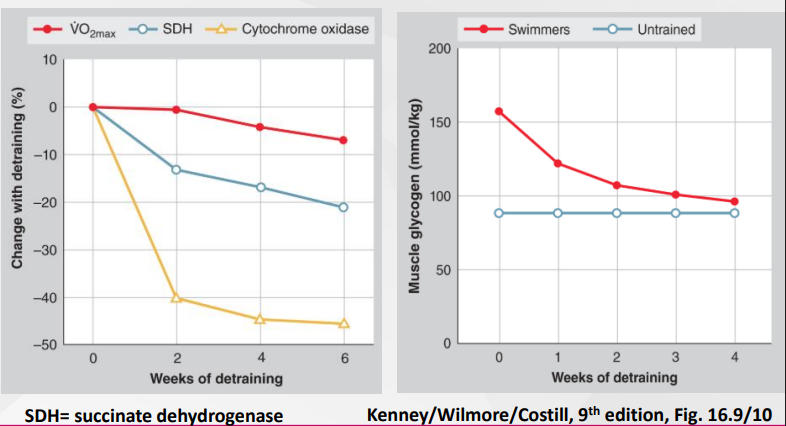
What is reversibility?
The idea that not training will reverse the adaptations caused by the exercise
What is progressive overload?
The demands on the body need to be increased to make further improvements
e.g. muscles must be overloaded beyond the normal loading level for improvement. This state is called overreaching
What is the difference between overreaching and overtraining?
Overreaching = athlete intentionally pushes their body past its normal limits, causing improvements
Overtraining = A chronic condition where excessive training and poor recovery leads to long-term performance decline
What are the symptoms of overtraining?
General fatigue
Loss of strength and weight
Loss of appetite
Sleep and emotional disturbances
Increased resting HR
Metabolic and hormonal disturbances
How can the principle of periodisation be utilised by a coach?
Change the intensity
Change the volume
Change the technique
Change of mode of exercise
What are the 3 components of periodisation?
Macrocycle = largest section of training with a clear end point (e.g. whole season)
Mesocycle = broken part of a macrocycle, often in smaller blocks (e.g. a 4 week block)
Microcycle = broken part of a mesocycle, often specific parts of training (e.g. each session within a mesocycle)
What are the benefits of periodisation?
Allows for tapering of exercise within the cycles
Avoids overtraining
Promotes overreaching
Athlete can achieve acute overload (progressive overload)
What is the equation for training volume?
Volume = Duration x FrequencyIntensity
What is the ideal relationship between intensity and volume?
• Intensity and volume are inversely related
– If volume ↑, intensity should ↓
– If intensity ↑, volume should ↓
• Intensity ↑ + volume ↑ → potential negative effects
How would an athlete periodise for an upcoming competition?
During the preparation phase, work at a low intensity and high volume
Leading upto pre-comp and competition phase, intensity will increase and volume will decrease
What type of resistance training produces greater force?
Eccentric training
How should a resistance training session be scheduled?
Multi-joint movements should occur before single joint ones (e.g. squat before hamstring curls)
Larger muscles should be done before small muscles, as the small muscles provide stability
High intensity movements before low intensity
What are the reps and intensities needed for different resistance training outcomes?
Muscle hypertrophy = 8-12 reps, slow-moderate speed, high load
Muscle power = 3-6 reps, moderate-fast speeds
Muscle endurance = 10-25 reps, light load
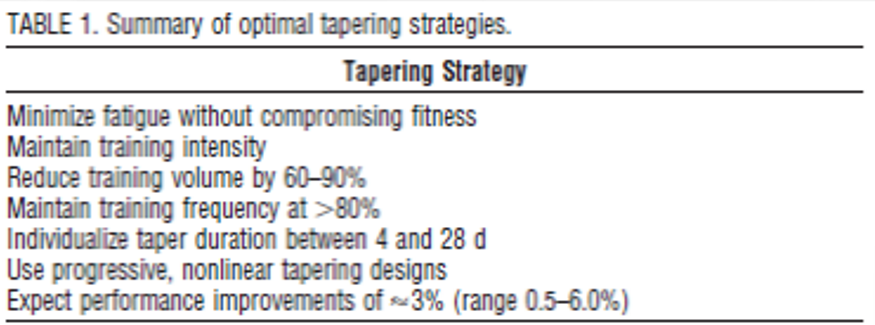
What is tapering and why?
The reduction in training volume prior to a major competition
Allows muscles to repair and replenish glycogen stores
What is the ideal tapering strategy?