BIOCH 200 Unit 2 - Nucleic Acids (Questions)
 Call Kai
 Learn
Learn Practice Test
 Spaced Repetition
 Match
Match Flashcards
 Knowt Play
1/57

There's no tags or description
Looks like no tags are added yet.
Name | Mastery | Learn | Test | Matching | Spaced | Call with Kai |
|---|
No analytics yet
Send a link to your students to track their progress
58 Terms
What are the commonly used pyrimidine bases in DNA and RNA?
Uracil, thymine, cytosine
What are the commonly used purine bases in DNA and RNA?
Adenine, guanine
Among the pyrimidines, how do you distinguish each base (what are their unique characteristics/similarities)?
All have carbonyl at C2, nitrogen at 1 and 3
Uracil: 2nd carbonyl at C4
Thymine: 2nd carbonyl at C4, methyl group at C5
Cytosine: amino group at C4, no 2nd carbonyl
Among the purines, how do you distinguish each base (what are their unique characteristics/similarities)?
All have nitrogen at at 1, 3, 7, 9 (sep by 2)
Adenine: no carbonyl, amino group at C6
Guanine: carbonyl at C6, amino group at C2
What is the relationship between resonance stabilization and hydrogen bonding capacity? Why?
Resonance stabilization reduces hydrogen bonding capacity, as lone pairs in resonance cannot accept hydrogen bonds due to not being localized
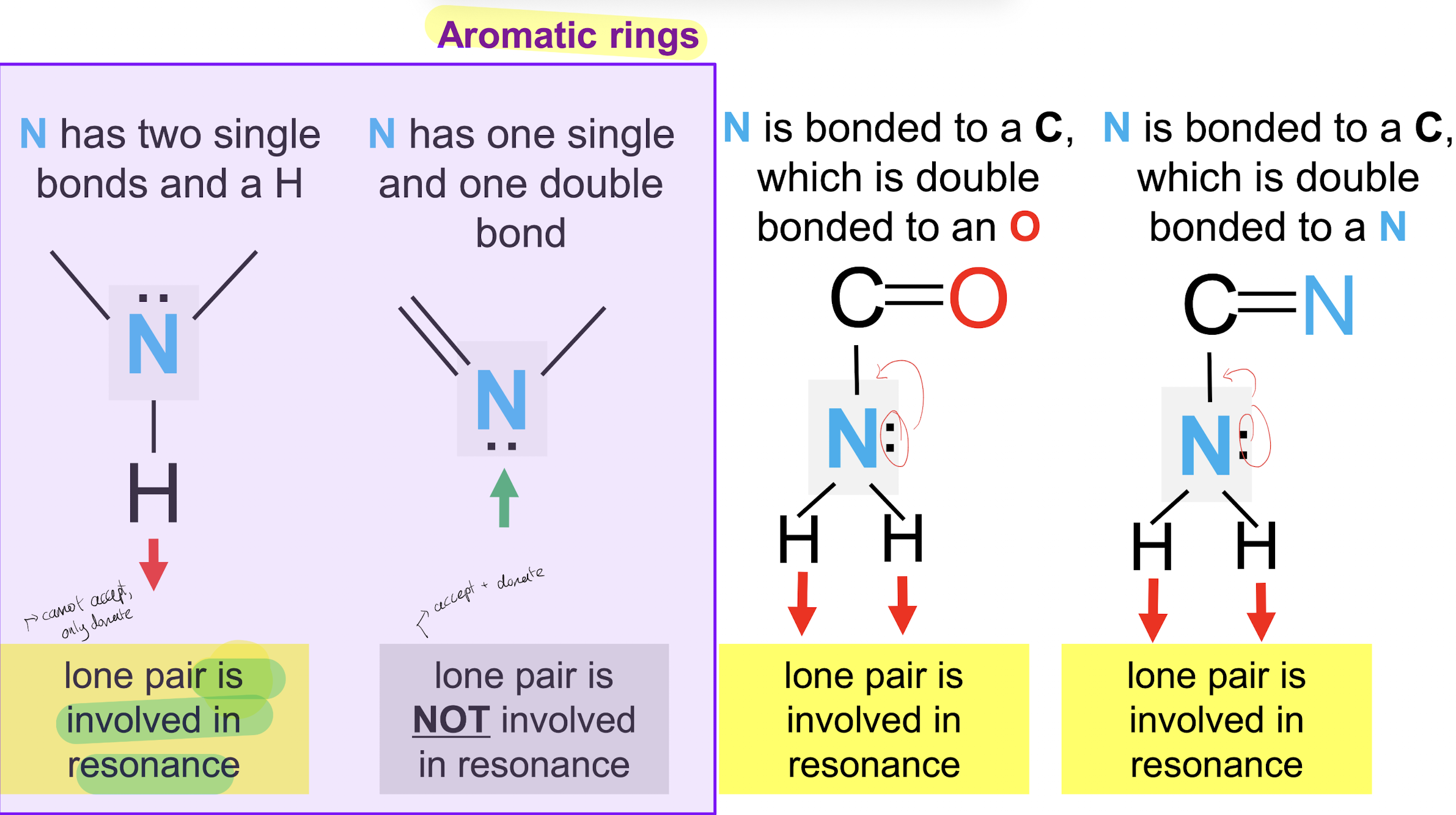
In an aromatic ring, when is a nitrogen atom with a single lone pair able to accept or donate hydrogen bonds? Outside an aromatic ring? What is the pattern?
For aromatic:
2 single bonds and an H: lone pair involved in resonance into the ring, can’t accept. Can donate hydrogen. 1 single bond and 1 double bond: lone pair not involved in resonance into the ring, is able to accept. No hydrogen to donate.
Outside aromatic:
Nitrogen connected to C double bonded to N/O is involved in resonance, can’t accept. Can donate hydrogen
If a nitrogen can donate, it can’t accept!!
RNA is a polymer of which 4 nitrogenous bases? DNA?
RNA: A, C, G, U. DNA: A, C, G, T
In common notation, how do you distinguish the numbered carbons of a ribose sugar ring from those of a nitrogenous base ring?
Carbons in sugars will have prime (‘) next to them
How is a nucleoside formed (which functional groups are involved)?
C1’ on pentose sugar loses its hydroxyl group and N1/N9 on base loses its hydrogen when sugar and base are joined
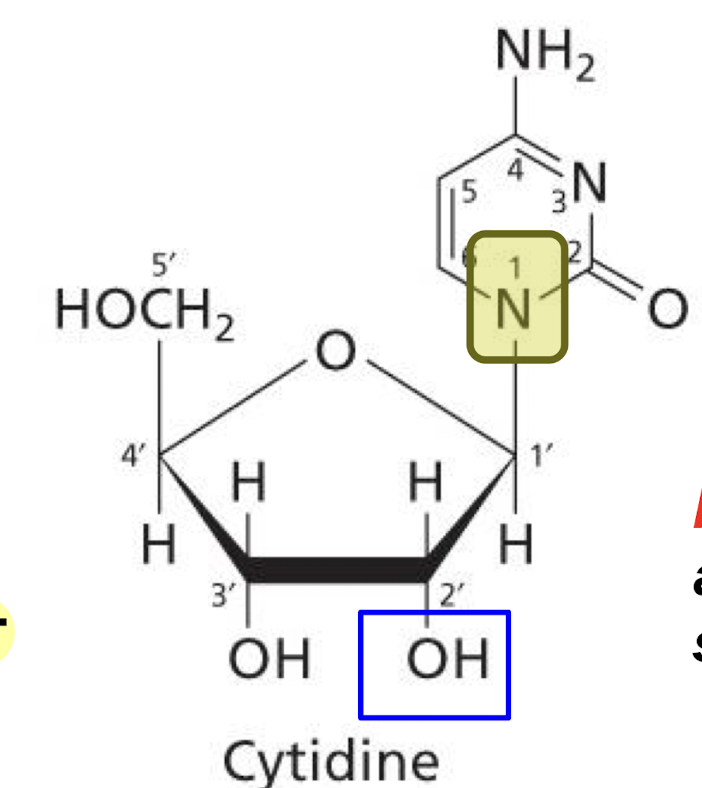
How are purine nucleosides named? Pyrimidine nucleosides?
-ine in purines becomes -osine. Keep prefix of pentose (adenine + ribose → adenosine, guanine + deoxyribose → deoxyguanosine)
All pyrimidines end in -idine. Keep prefix of pentose (cytosine + ribose → cytidine, thymine + deoxyribose → deoxythimidine, uracil + ribose → uridine
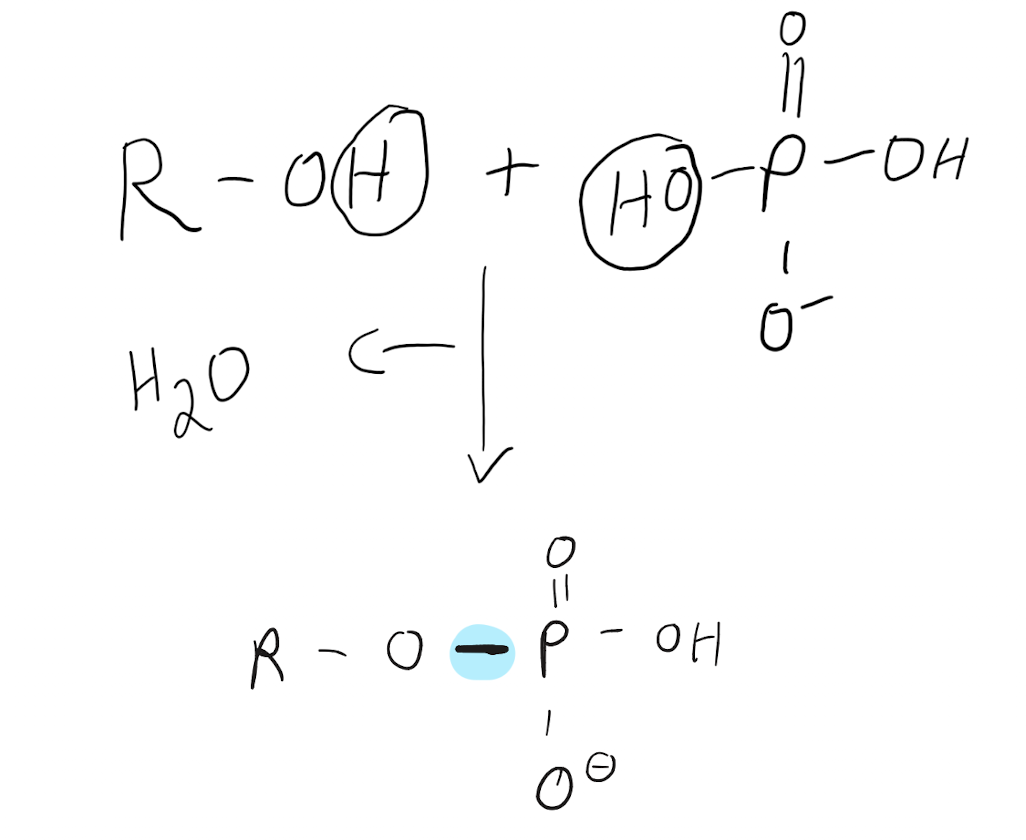
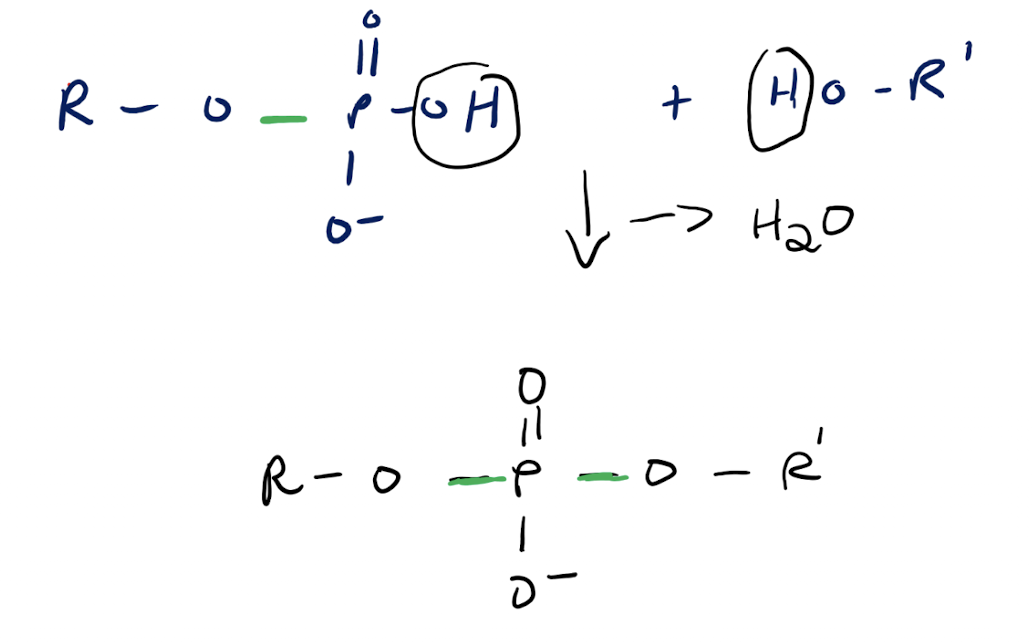
Describe how an phosphoester linkage is formed, including reactions and groups.
A hydroxyl is removed from the phosphate group and a hydrogen is removed from a hydroxyl group (from R group) in a dehydration reaction, precipitating a water molecule. The oxygen attached to the R group bonds with the central phosphorus atom, forming the C-O-P phosphoester linkage
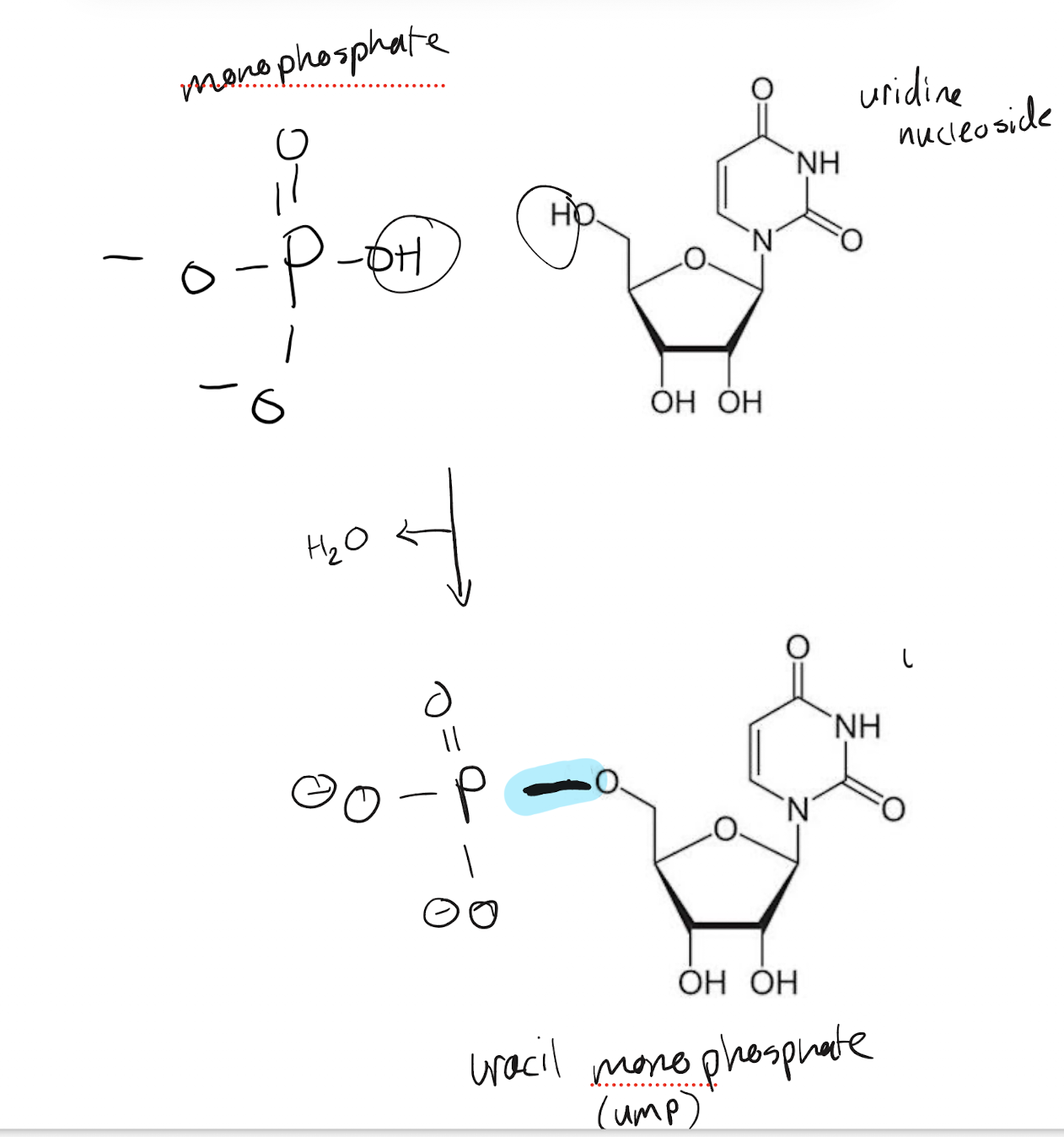
In nucleotides, where on the nitrogenous base does the pentose sugar attach? Where on the sugar does the phosphate(s) attach?
Sugar attaches to N1 in pyrimidines and N9 in purines. Phosphates attach to C5’ OH group
From a nucleoside, how are phosphates attached to form a nucleotide?
A hydroxyl is removed from the leading phosphate group and a hydrogen is removed from a hydroxyl group (from sugar) in a dehydration reaction, precipitating a water molecule. The oxygen attached to the R group bonds with the central phosphorus atom, forming the C-O-P phosphoester linkage
How are nucleotides named?
Use the nucleoside name, then depending on the number of phosphates add (prefix)phosphate after it
Ex. adenine + ribose + 3 phosphates = adenosine triphosphate, cytosine + deoxyribose + 2 phosphates = deoxycytidine diphosphate, uracil + ribose + 1 phosphate = uridine monophosphate
Describe how a phosphodiester linkage is formed, including reactions and groups.
A hydroxyl is removed from a phosphoester and a hydrogen is removed from a hydroxyl group (from R group) in a dehydration reaction, precipitating a water molecule. The oxygen attached to the R group bonds with the central phosphorus atom, forming the C-O-P-O-C phosphodiester linkage
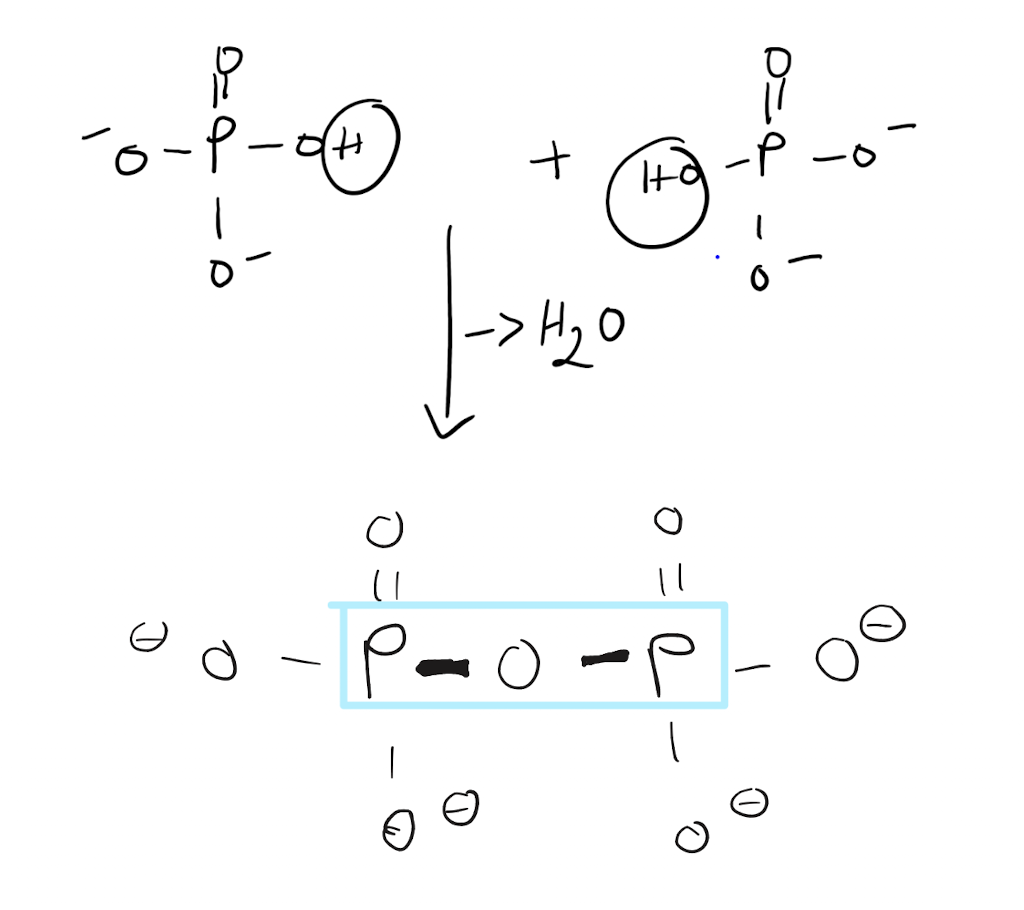
Describe how a phosphoanhydride linkage is formed, including reactions and groups.
A hydroxyl is removed from a phosphate group and a hydrogen is removed from the hydroxyl group on the other phosphate in a dehydration reaction, precipitating a water molecule. The oxygen attached to the 2nd phosphate group bonds with the phosphorus atom of the other phosphate group, forming the P-O-P phosphoanhydride linkage
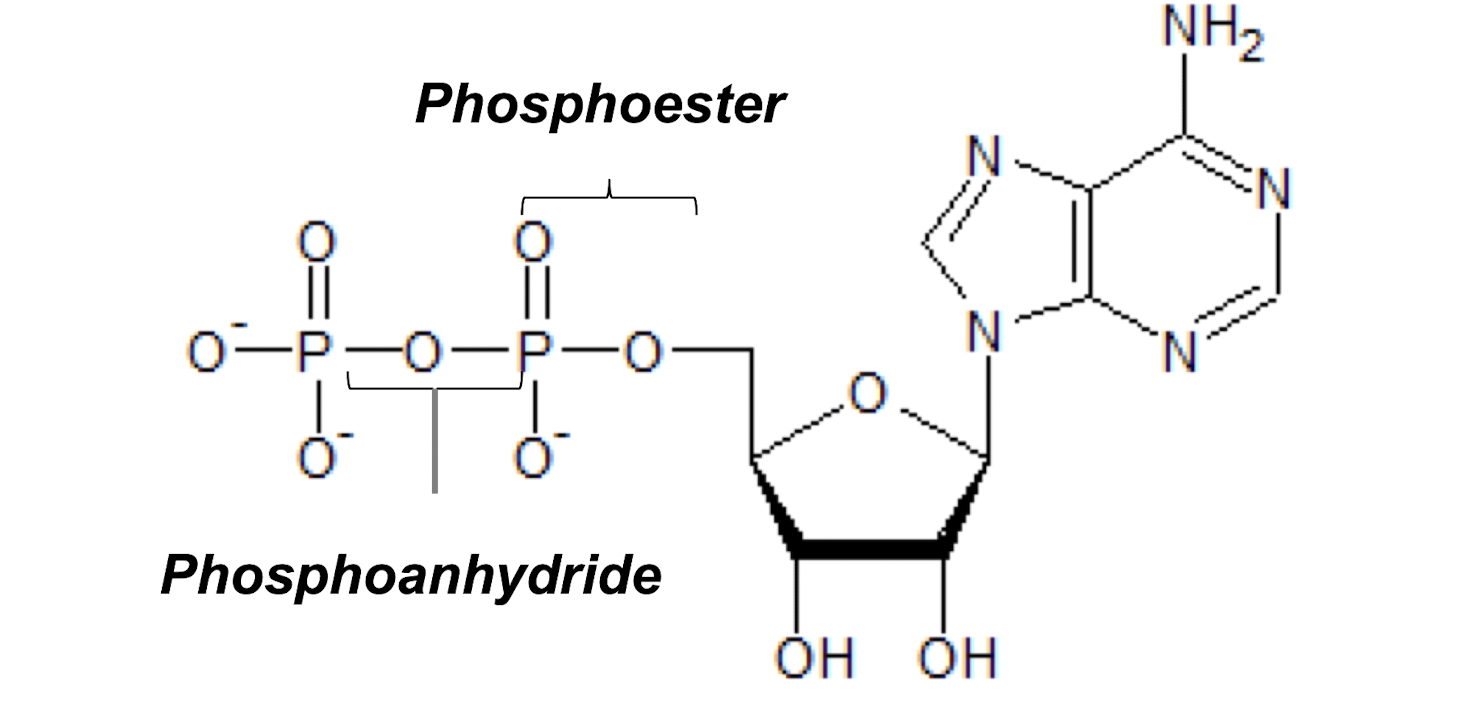
The linkage between the first phosphate group and the pentose sugar in a nucleic acid is ___. The linkage between each subsequence phosphate group is ___.
Phosphoester, phosphoanhydride
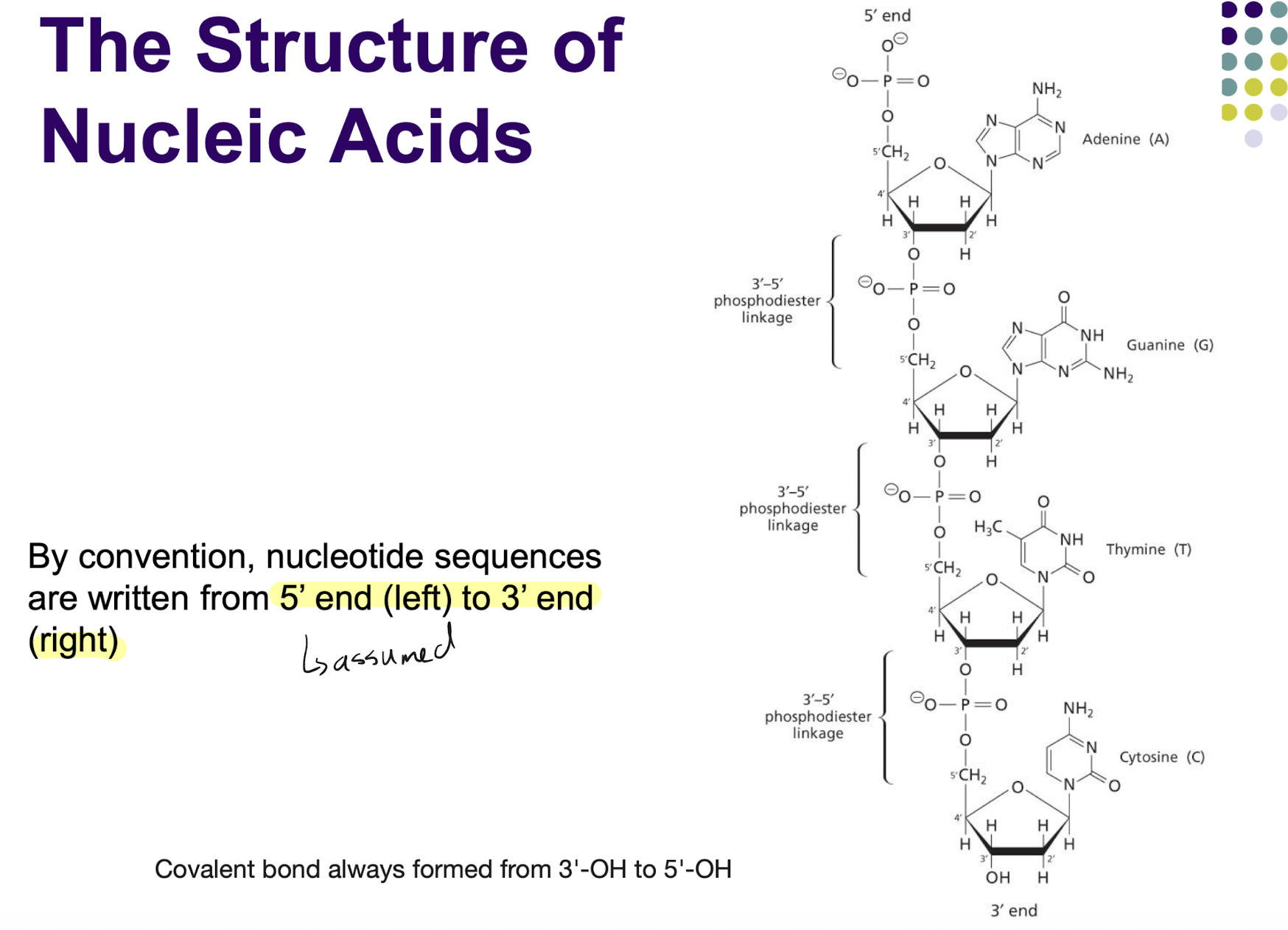
How do you distinguish the 5’ end of a nucleic acid? 3’?
At the 5’ end, the 5’ carbon on the pentose sugar is not linked to another nucleotide and is thus not involved in a phosphodiester bond. There will be a free 5’ phosphate group not connected to other molecules
At the 3’ end, the 3’ carbon on the pentose sugar is not linked to another nucleotide and is thus not involved in a phosphodiester bond. There will be a free 3’ OH group not connected to other molecules
How does the backbone in RNA differ from that of DNA in terms of structure and bonding capacity?
Each nucleotide residue in RNA has a free 2’ OH group that DNA residues do not have, which gives it the capacity to form 3 more H-bonds per residue than DNA
From which end of the nucleic acid is a chain of nucleotides extended? What functional group makes this possible?
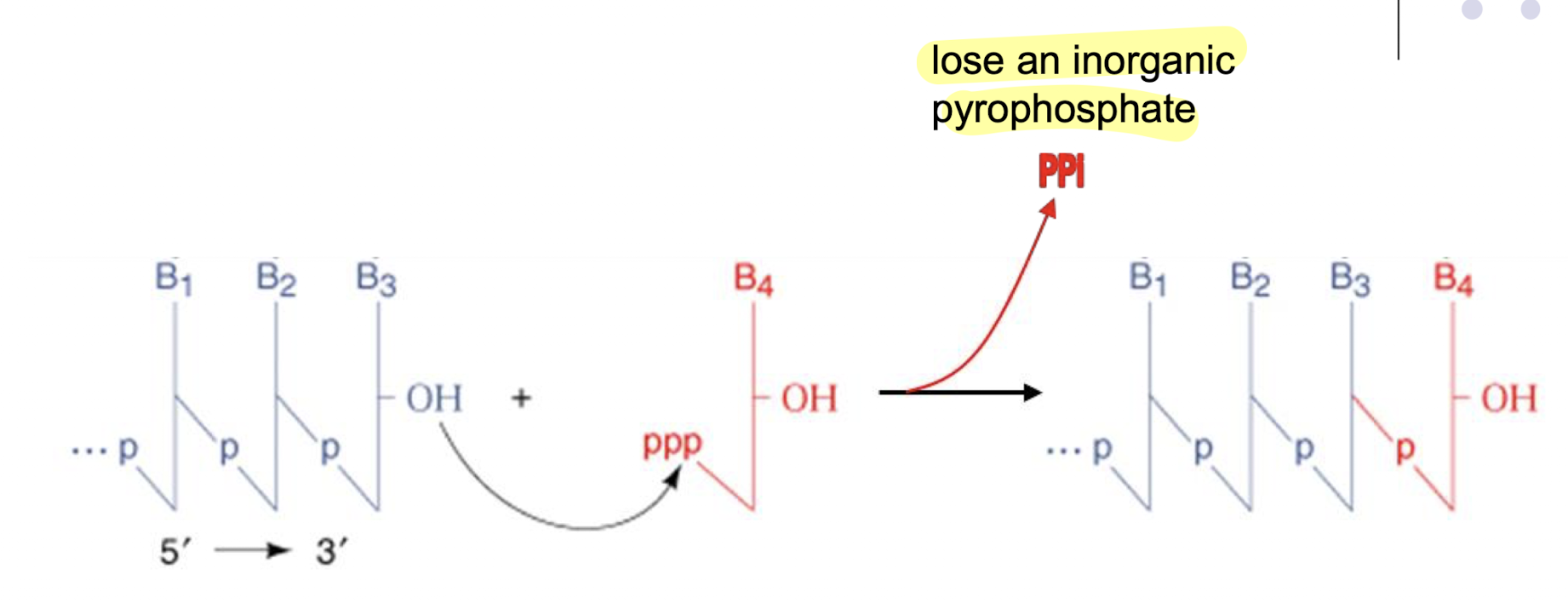
Extend chain from 3’ end with OH group, as joining nucleotides needs the lone pair on oxygen to form a new phosphodiester bond to next nucleotide’s 5’ carbon
Explain how nucleotides (NTPs) are connected to one another to form a nucleic acid.
The nucleotide on the 3’ end of the nucleic acid will have an OH group, which donates its lone pair to an adjacent connecting NTP. This causes the NTP to lose 2 phosphates to become an NTP residue, forming a phosphodiester bond that ensures the 3’ end always has a free OH.
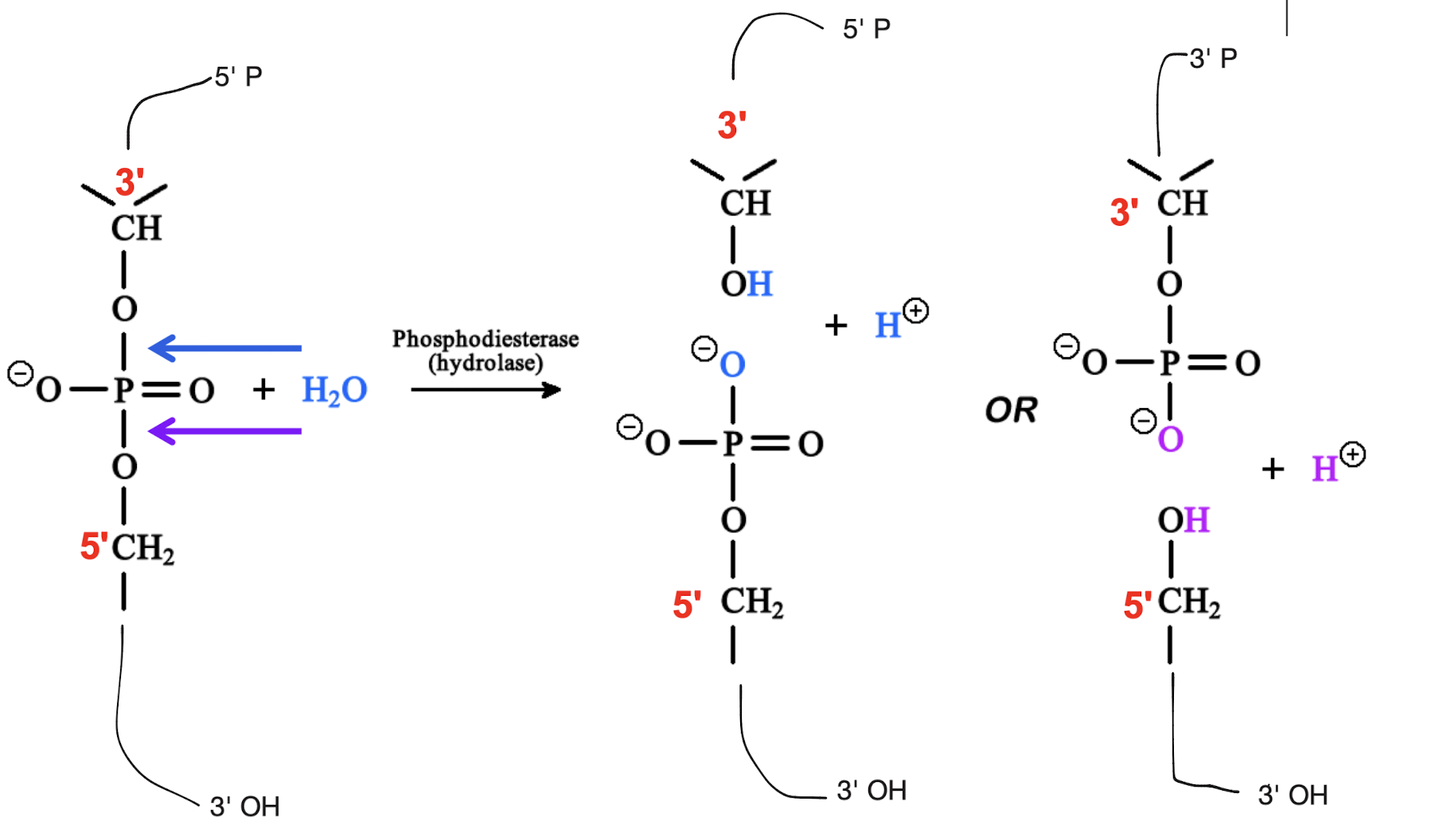
Explain how enzymatic hydrolysis of a phosphodiester bond occurs. Which ends (on the nucleic acid and on the bond) does this commonly occur on and why?
Recall: phosphodiester bonds made 3’ to 5’ (opposite end direction to the nucleic acid). The bond is broken most commonly at the 3’ end of the phosphodiester bond (P-O bond closest to 5’ on nucleic acid), as this leads to the formation of regular ended nucleotides (5’ end of nucleotide has phosphate, 3’ has OH)
Hydrolysis of the 5’ end of the phosphodiester bond (P-O bond closest to 3’ on nucleic acid) is less common because it leads to unusual ends (3’ phosphate, 5’ OH), but it still occurs occasionally
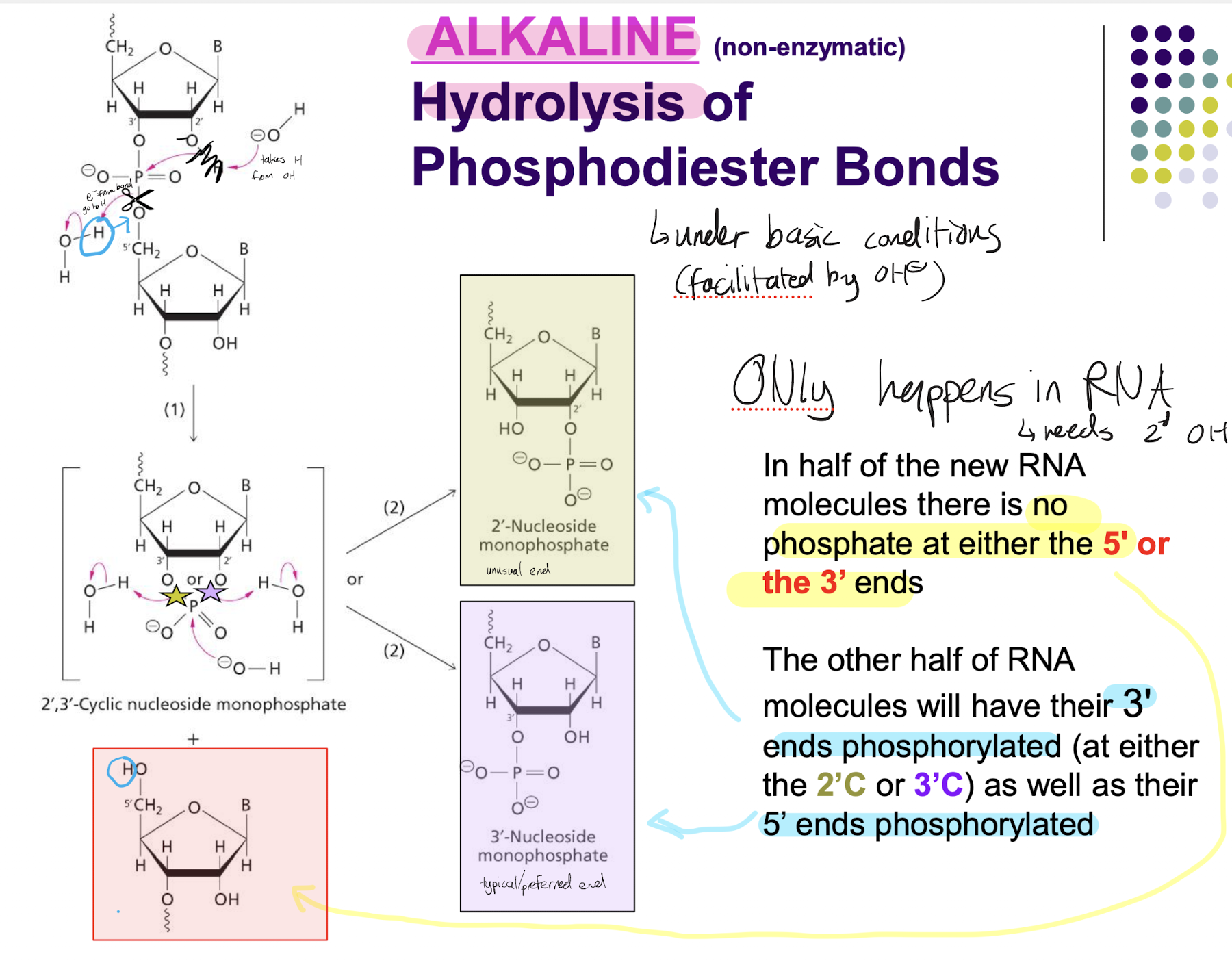
Explain how alkaline hydrolysis of a phosphodiester bond occurs. Which ends (on the nucleic acid and on the bond) does this commonly occur on and why?
The negatively charged free-floating hydroxyl donates its electrons to bond with the H from the 2’ hydroxyl group on the RNA, taking the H from the OH. The newly formed water molecule accepts electrons from the phosphodiester bond to cleave it.
After passing through an intermediate, half of the newly formed RNA molecule chains will have no phosphate at either end (phosphates removed from what was previously 5’ end, and 3’ end will only have OH) or forms a nucleoside (if not part of a chain).
The other half of the RNA molecules will have both their 3’ and 5’ ends phosphorylated (take the phosphates from the other half onto what is now the 3’ end, already have phosphates at their 5’ end). Because the RNA intermediate had free oxygen on both the 2’ and 3’ C, the new phosphorylated RNA can have their 3’ end phosphorylated at either 2’C or 3’C. (Nucleoside bisphosphate if not part of a chain)
Why is DNA not susceptible to alkaline hydrolysis?
Lacks 2’ OH group needed for hydroxide ion to initiate bond cleavage
How would you name a molecule missing a hydroxyl group at more than one carbon (ex. 2’C, 3’C)?
Include carbon markings of missing OH groups and name (#’ #’) dideoxynucleoside phosphate (ex. 2’ 3’ dideoxynucleoside)
Which OH group on nucleic acids does the phosphate chain usually attach to? How should this be notated if it is unusual?
5’ OH. Must note which carbon’s OH group the phosphates are attached to if unusual (ex. adenosine 3’ monophosphate)
Describe the properties of the nitrogenous bases in the following categories: cyclicality, aromaticity, shape (planar/nonplanar), solubility in water, polarity of groups, H-bond capacity.
Heterocyclic, aromatic, mostly planar, poorly soluble in water, mainly hydrophobic with polar groups, able to H-bond easily
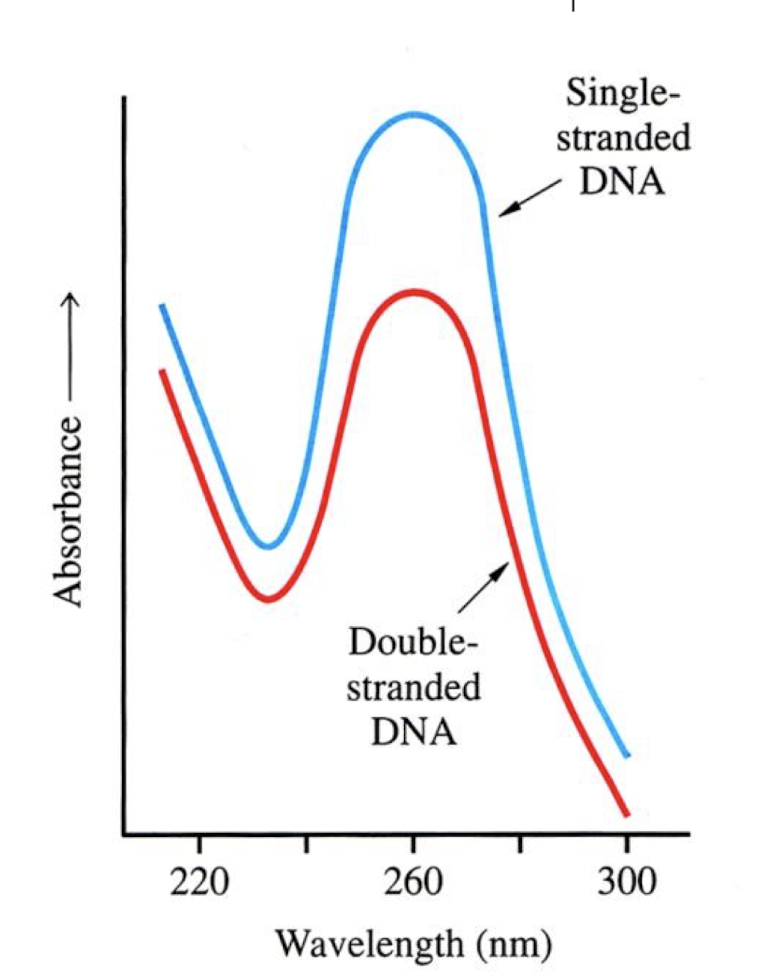
Why are nucleic acids able to absorb UV light? What wavelength is its absorbance max? Protein (a common contaminant) has its absorbance max at where?
Electrons are delocalized in nitrogenous bases, allowing nucleic acids to absorb UV light. Max: 260 nm. Protein: max at 280 nm
(ssDNA/dsDNA) absorbs UV better (more absorbance). Why? Rank A260nm of free nucleotides, ssDNA, and dsDNA.
ssDNA: in dsDNA nitrogenous bases are stacked and H-bonded together, shielding them from absorbing the light, while ssDNA is not shielded or blocked. Free nucleotides > ssDNA > dsDNA
In a DNA standard curve, A260nm is used to measure ___, while A260/A280 ratio is used to measure ___. What is an expected ratio for pure DNA, and how would it change if the sample is contaminated?
Concentration of nucleic acids in solution, purity of the sample. Pure DNA ratio: 1.8 - 1.95, ratio would decrease if contaminated as A280 (conc of protein) would increase
For H-bonds to form within biochemical macromolecules (ex. N-H with O), they must be (shielded from/in contact with) water. Why?
Shielded from, water has a high capacity to form H-bonds and thus will H-bond with the molecules, preventing them from H-bonding with themselves.
When macromolecules H-bond to one another, how does this affect their polarity?
Less polar
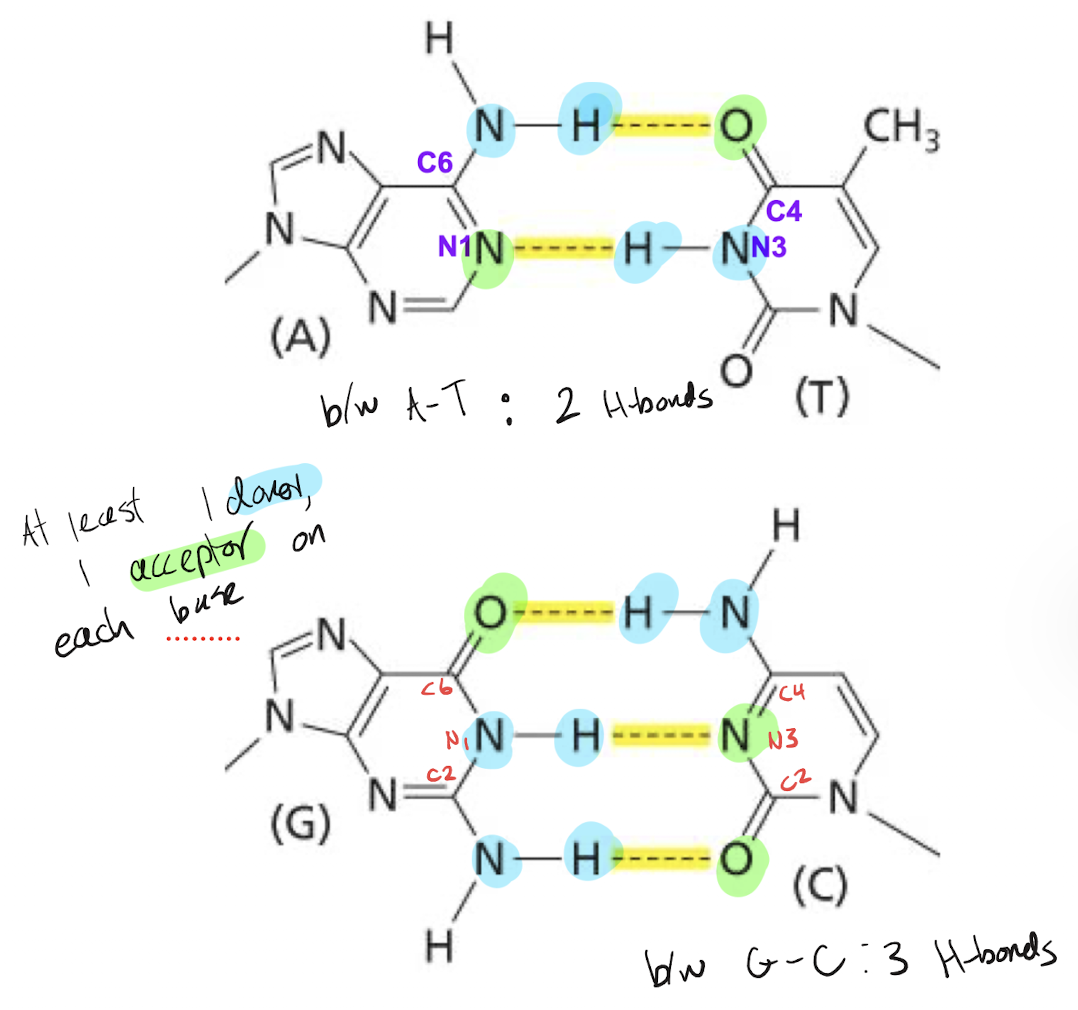
How many hydrogen bonds are formed between the A/T pair? C/G? Describe the H-bonds formed using numbered carbons.
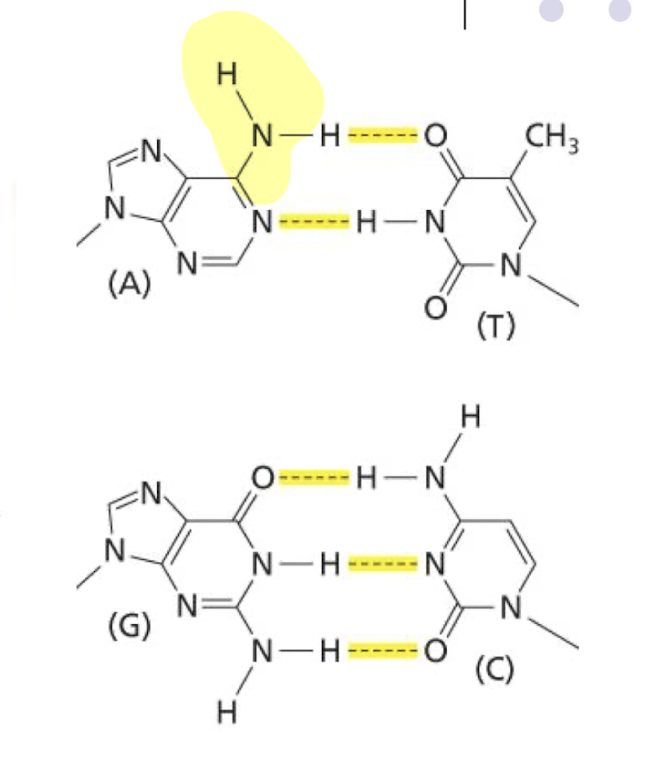
A-T: 2 bonds (A C6 -- T C4, A N1 -- T N3)
C-G: 3 bonds (G C6 -- C C4, G N1 -- C N3, G C2 -- C C2)
What are the 3 forms of DNA? Describe them in terms of structure.
All double stranded antiparallel
A form: right-handed helix, dehydrated, smaller than B form
B form: right-handed helix
Z form: left-handed helix
The stabilizing force in primary DNA structure is ___. The stabilizing forces in secondary DNA structure are ___ and ___, with the major force being ___.
Phosphodiester bonds. Base stacking/hydrophobic interactions, hydrogen bonds. Base stacking interactions
DNA has a (hydrophobic/hydrophilic) core, which is made up of the (backbone/bases). DNA has a (hydrophobic/hydrophilic) exterior, which is made up of the (backbone/bases).
Hydrophobic, bases. Hydrophilic, backbone (ribose and phosphates)
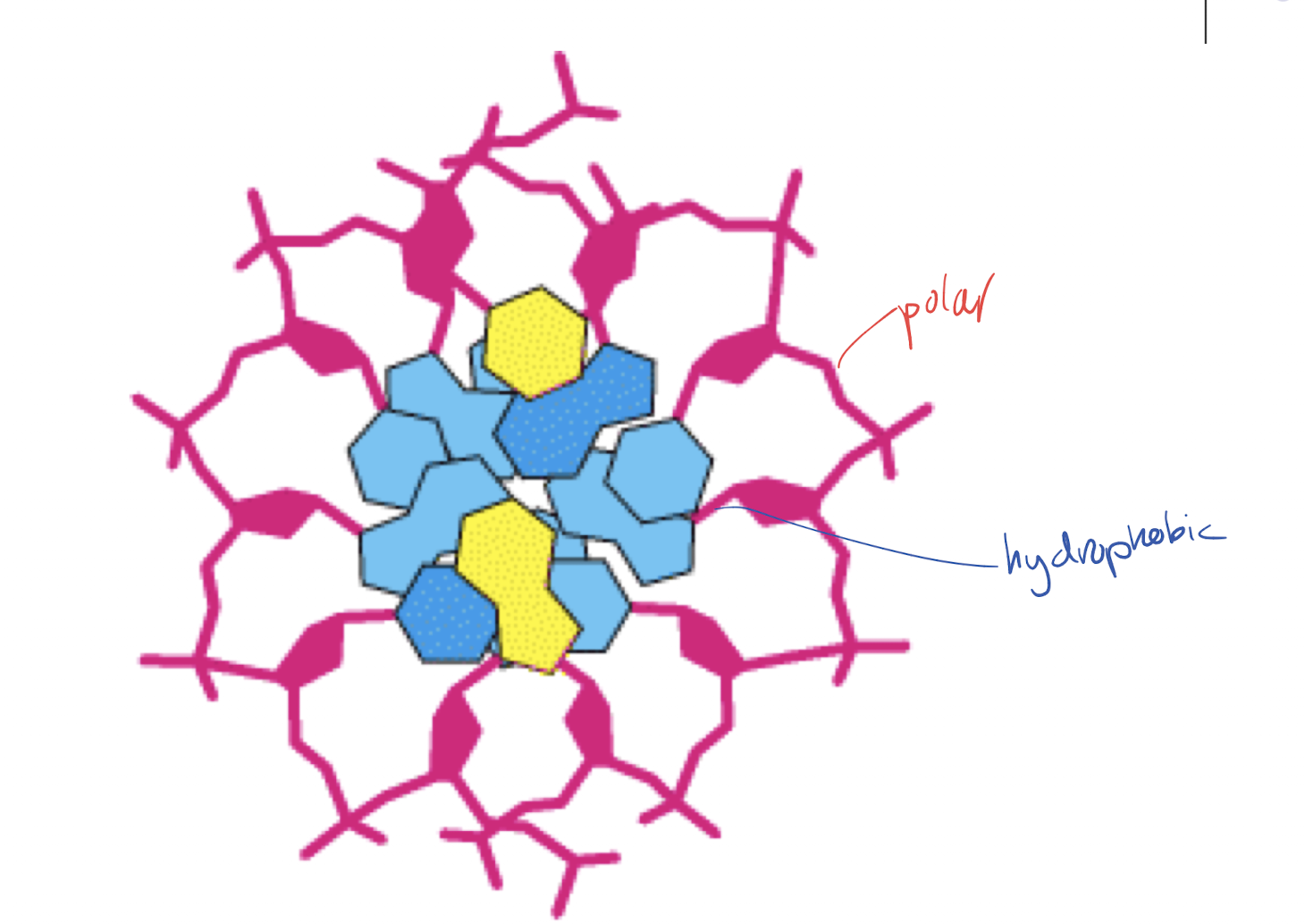
Why are the nitrogenous bases in DNA excluded from water?
So that they can H-bond with each other, stabilizes the H-bonds
Why do nucleic acids have directionality?
Ends are geometrically distinct from one another: 5’ end contains phosphate vs 3’ end contains OH
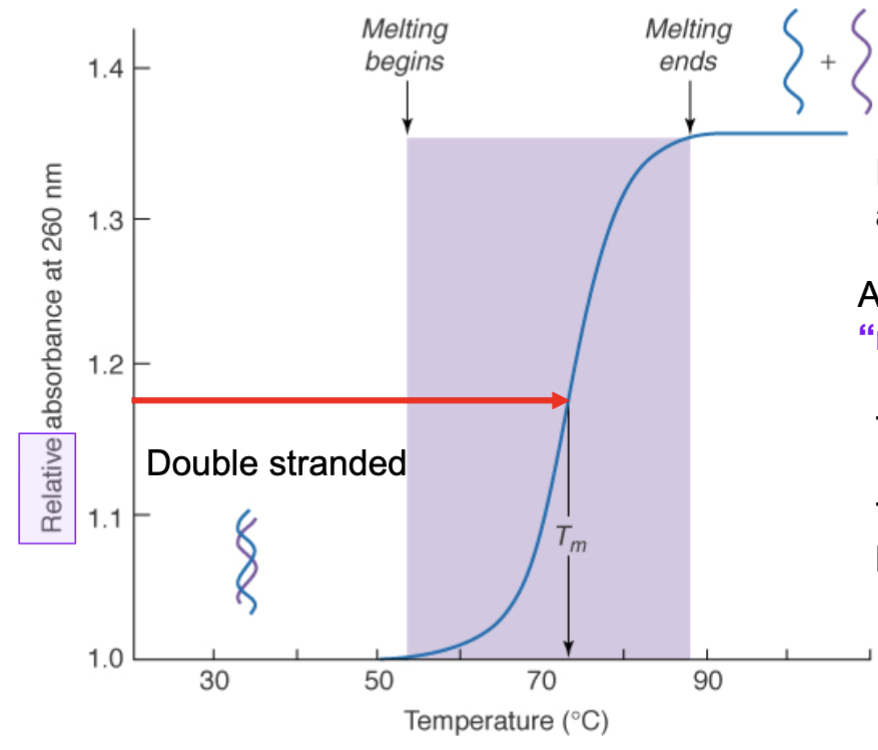
Describe a DNA melting curve. Why does this trend occur?
At a temp less than ~50, the relative absorption does not change (curve remains at 0) as the temperature is not high enough to denature the DNA. Once it passes this temperature, the relative absorption slowly begins to rise and then rapidly spikes until it reaches a plateau as the temperature becomes high enough to denature the dsDNA to ssDNA, which absorbs better. At the plateau, the curve remains the same as the temperature continues to increase because the DNA has completely denatured at this point and is all ssDNA (no more to denature, no change in absorbace)
The driving force of the curve’s trend is the rate/amount at which dsDNA is denatured into ssDNA
Describe a DNA absorbance curve (ss + ds). Why does this trend occur?
There is an absorbance maximum at 260 nm. The line for ssDNA peaks higher than ds as it absorbs UV light better
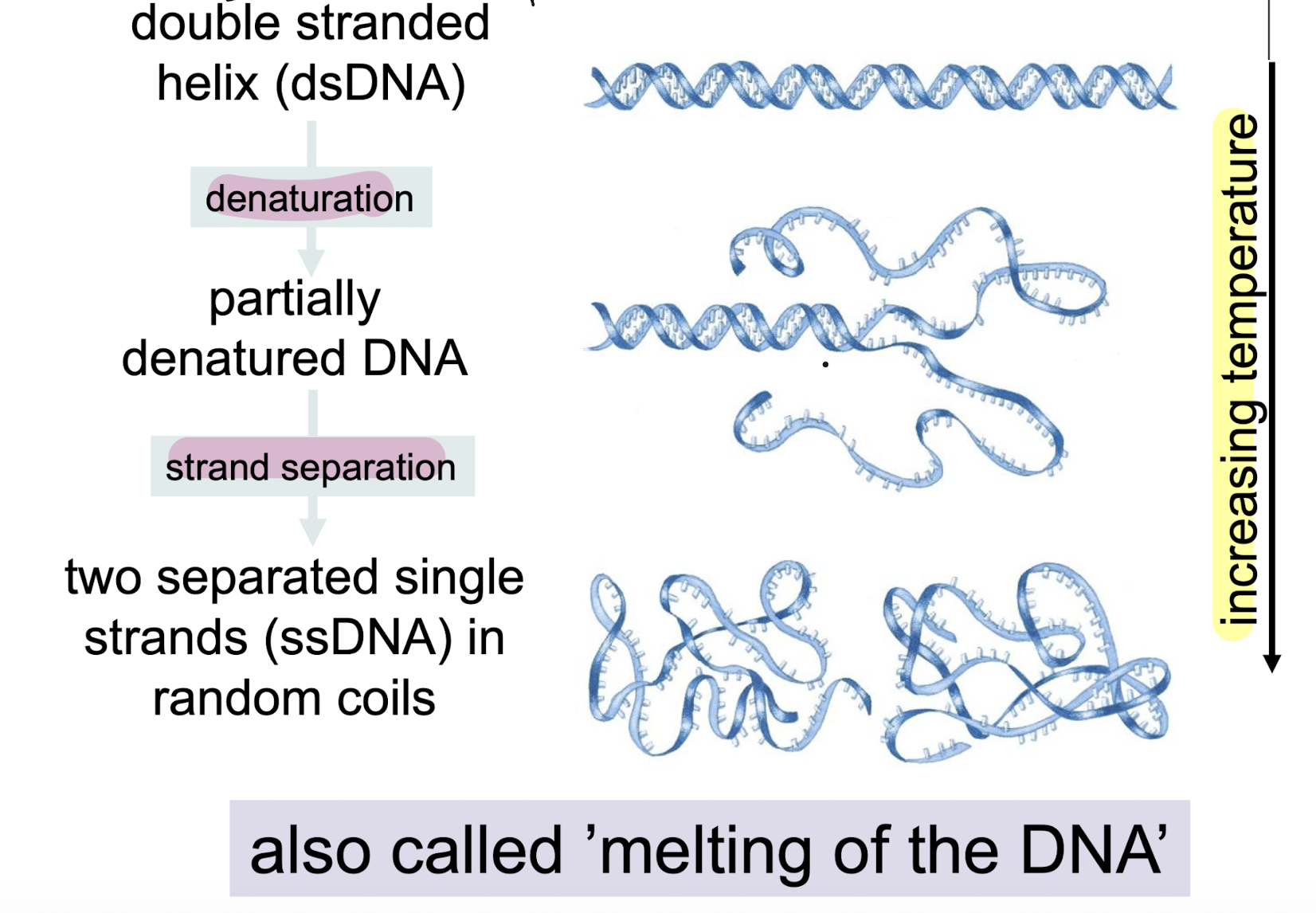
Explain the process of DNA double helix denaturation, including driving forces and DNA states.
Double stranded DNA undergoes denaturation with sufficient temperature, transforming it to partially denatured DNA (some ss, some ds)
As temperature increases and all non-covalent bonds are denatured, the DNA undergoes strand separation, transforming it to two separated ssDNA coils
Explain the process of DNA double helix renaturation, including driving forces and DNA states.
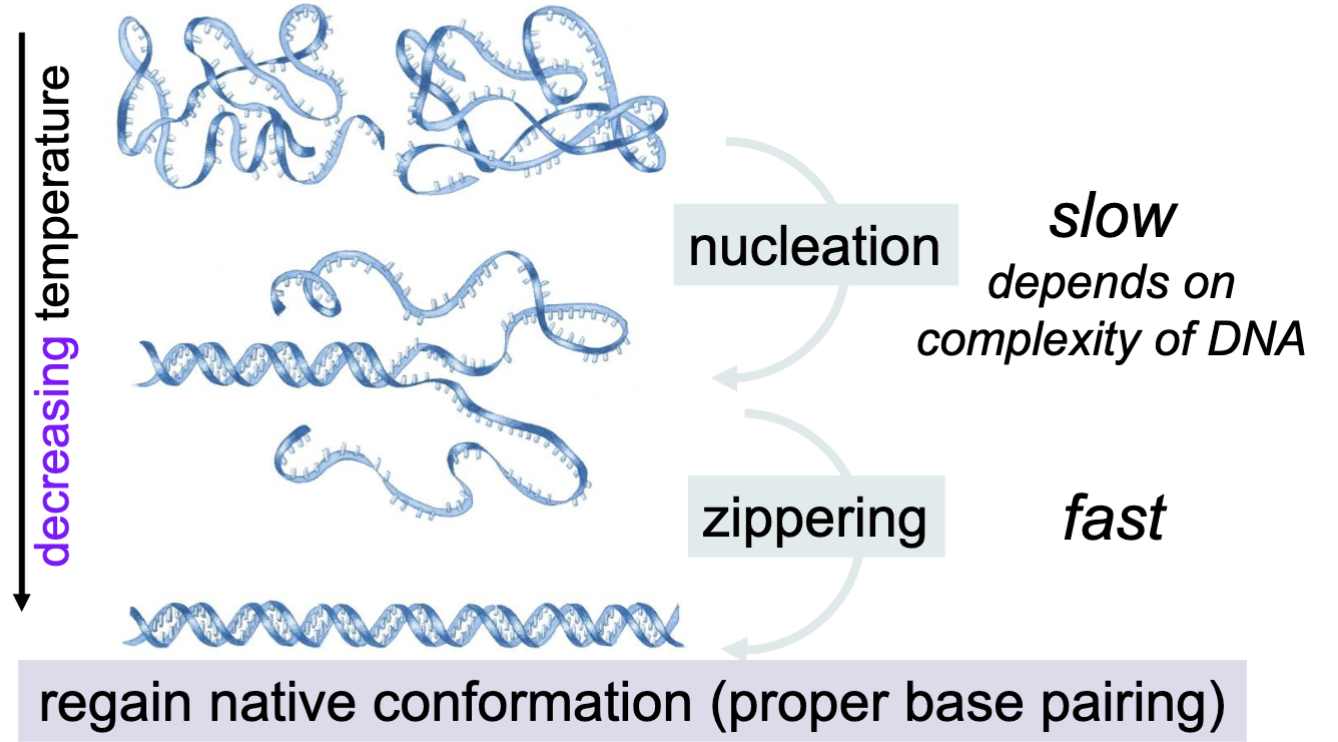
As temperature decreases, the coils of ssDNA undergo nucleation, which partially renatures the DNA (some ss, some ds) in a slow process
Complex (genomic) DNA is unable to undergo nucleation
As temperature continues to decrease, the nucleated ssDNA is able to very quickly undergo zippering of its bases, allowing the DNA to renature completely to its native conformation
What value describes the index of thermal stability of a nucleic acid? What does it depend on?
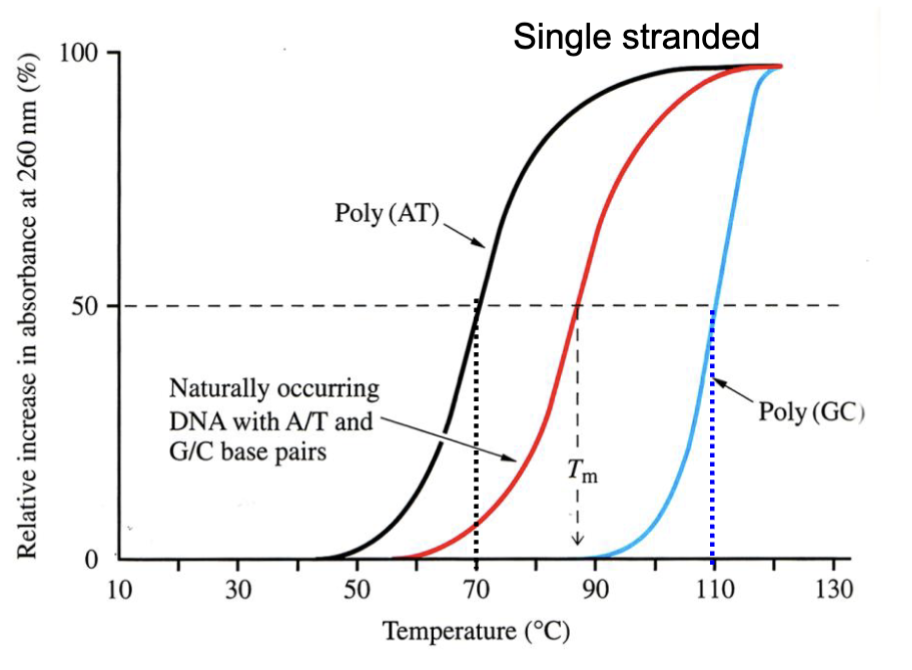
Tm (more heat needed = more stable); base number, base composition and sequence, solvent conditions (salt and pH)
Describe a DNA melting curve with Poly(AT), naturally occurring DNA, and Poly(GC). Why does this trend occur?
The AT curve is farthest to the left, natural is in the middle, and GC curve is farthest to the left. Poly(AT) is the least thermally stable and poly (GC) is the most, and so natural DNA with an equal mix of both falls in between. The Tm is higher in poly (GC).
Why does a higher GC content in DNA mean more thermal stability? What are the major and minor contributors?
GC pairs have higher base stacking interactions due to greater surface area, which is the major contributor to why high GC content DNA has elevated Tm. A minor contributor is that GC pairs have 3 h-bonds while AT pairs have 2
Regions of DNA that denature readily (ori, transcription initiation bubbles) are (GC/AT) rich. Why?
AT. Less thermally stable, will denature easier than GC
At equilibrium, how does a protonated acid (HA) behave depending on pH? What about its deprotonated form (H+ + A-)?
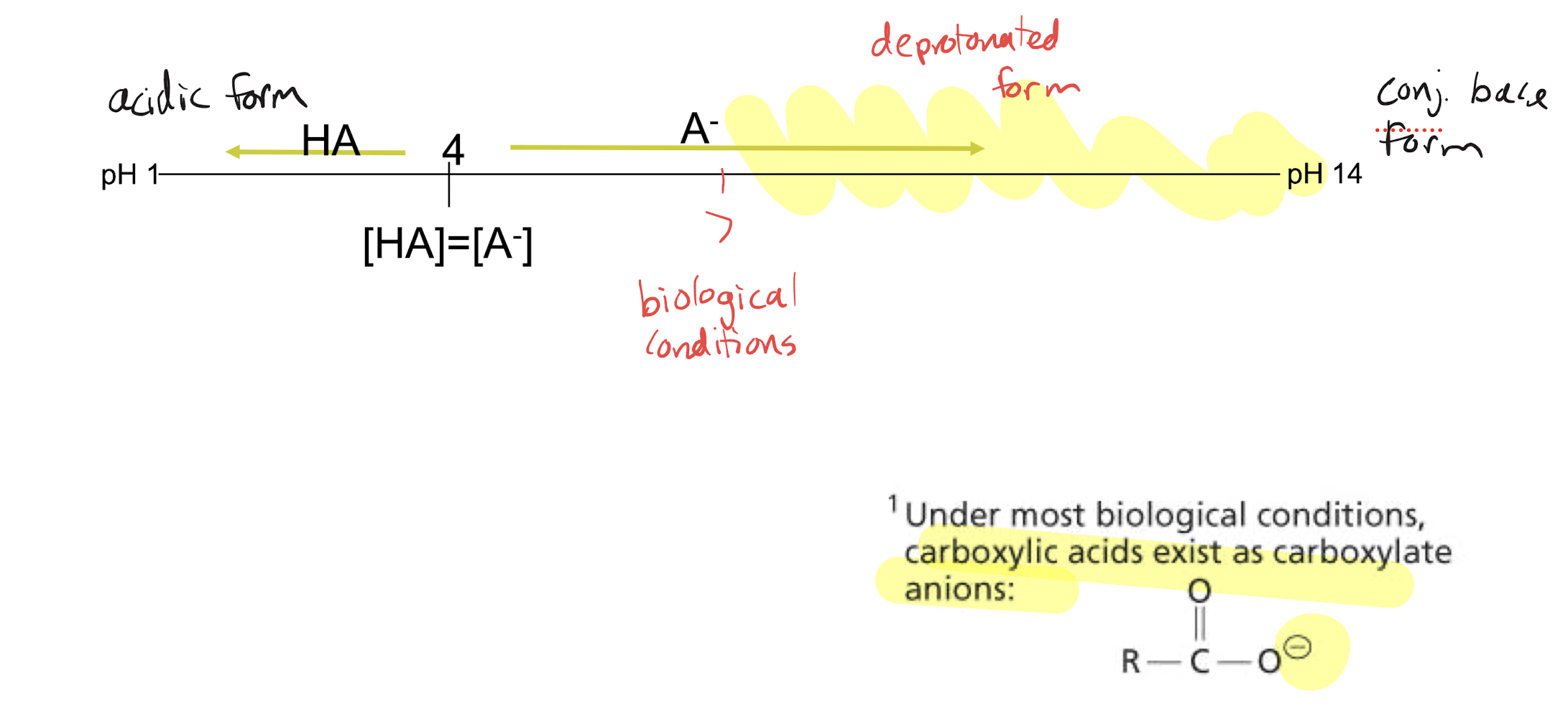
At low pH, there is an abundance of H+ in solution, making it difficult for the HA to further donate its H+, but it is easy for the conjugate base to pick up H+. Thus, more HA forms and the equilibrium shifts left.
At high pH, there is a low amount of H+ in solution, making it favourable for the protonated acid to donate its H+ and unfavourable for the conjugate base to pick up H+. Thus, more A- forms and the equilibirum shifts right.
At pH below the pKa, an acid exists predominantly as (protonated/deprotonated) form. At pH above the pKa, an acid exists predominantly at (protonated/deprotonated) form. At pH equal to the pKa, an acid exists at (protonated/deprotonated) form.
Protonated, deprotonated, exactly half dissocated (half acid half conj base)
A carboxylic acid group has a pKa of ___ (acidic/basic). Thus compared to biological conditions, it mainly exists in its (protonated/deprotonated) form.
2/4, acidic. Deprotonated form
An amino group has a pKa of ___ (acidic/basic). Thus compared to biological conditions, it mainly exists in its (protonated/deprotonated) form.
9.5, basic. Protonated form
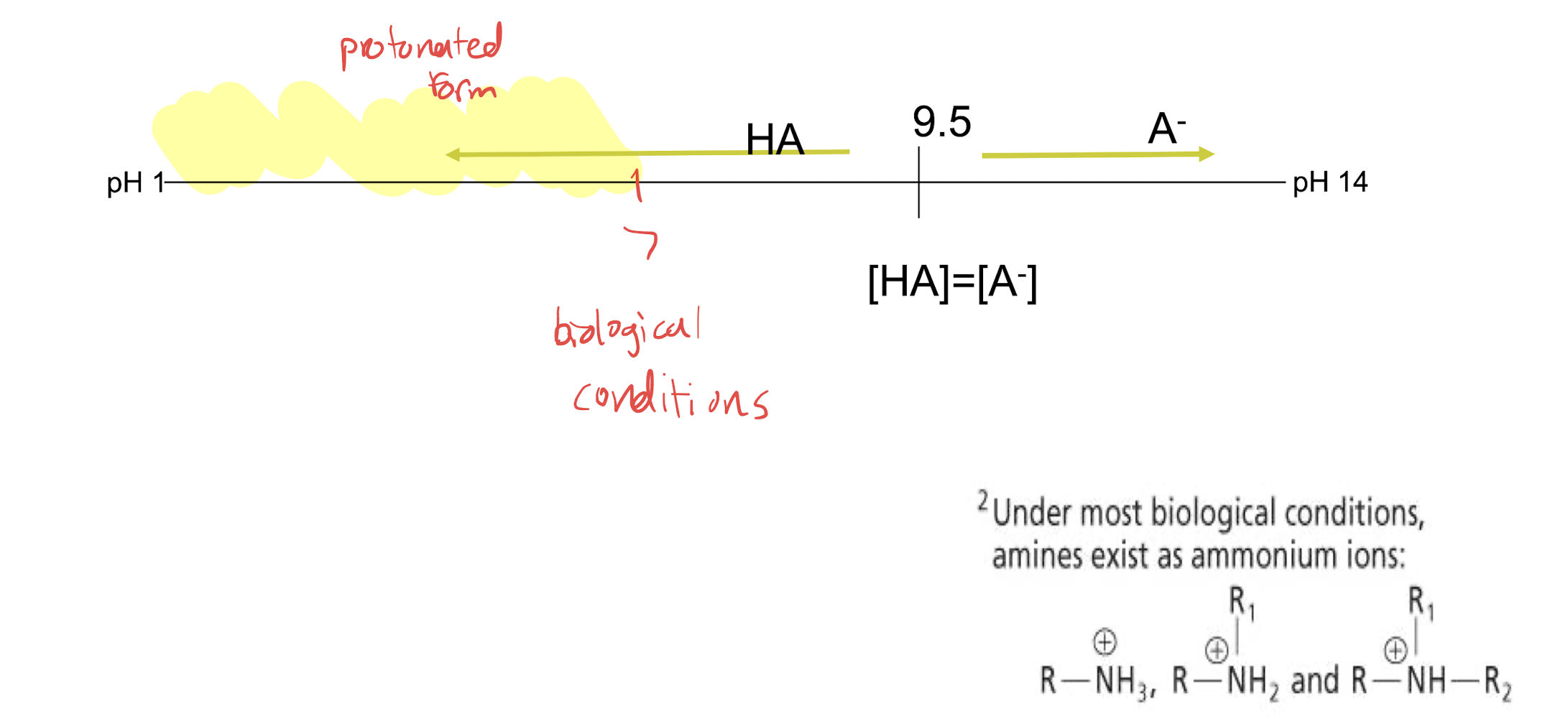
pKa of functional groups with acidic protons (change/stay the same) when part of a molecule. Why?
Change, protonating/deprotonating the molecule in order for it to form bonds with a molecule will change its pKa
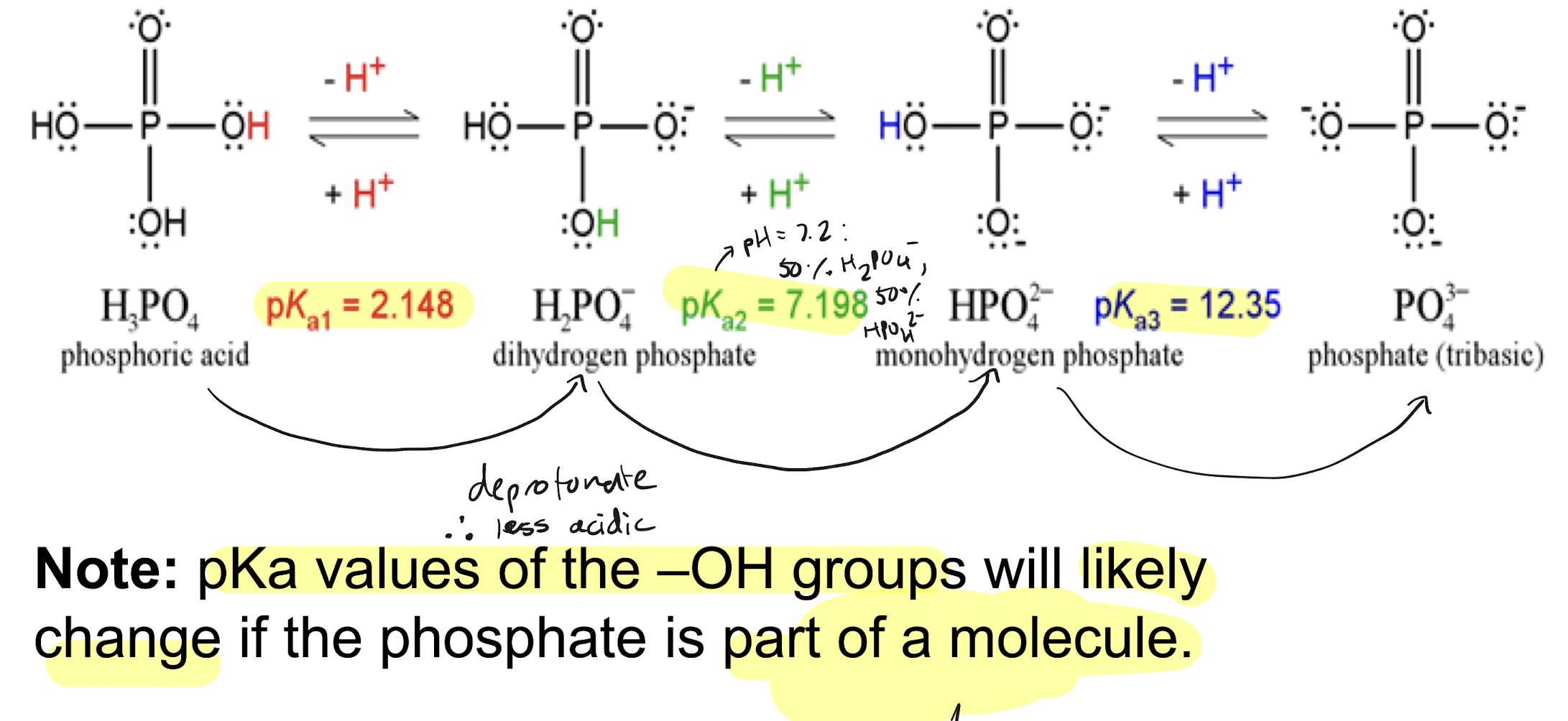
Compared to biological conditions, a phosphate mainly exists in its (protonated/deprotonated) form. What about in acidic conditions with low pH?
Fully deprotonated. Gain protons as pH decreases, up to 2 at max in a molecule
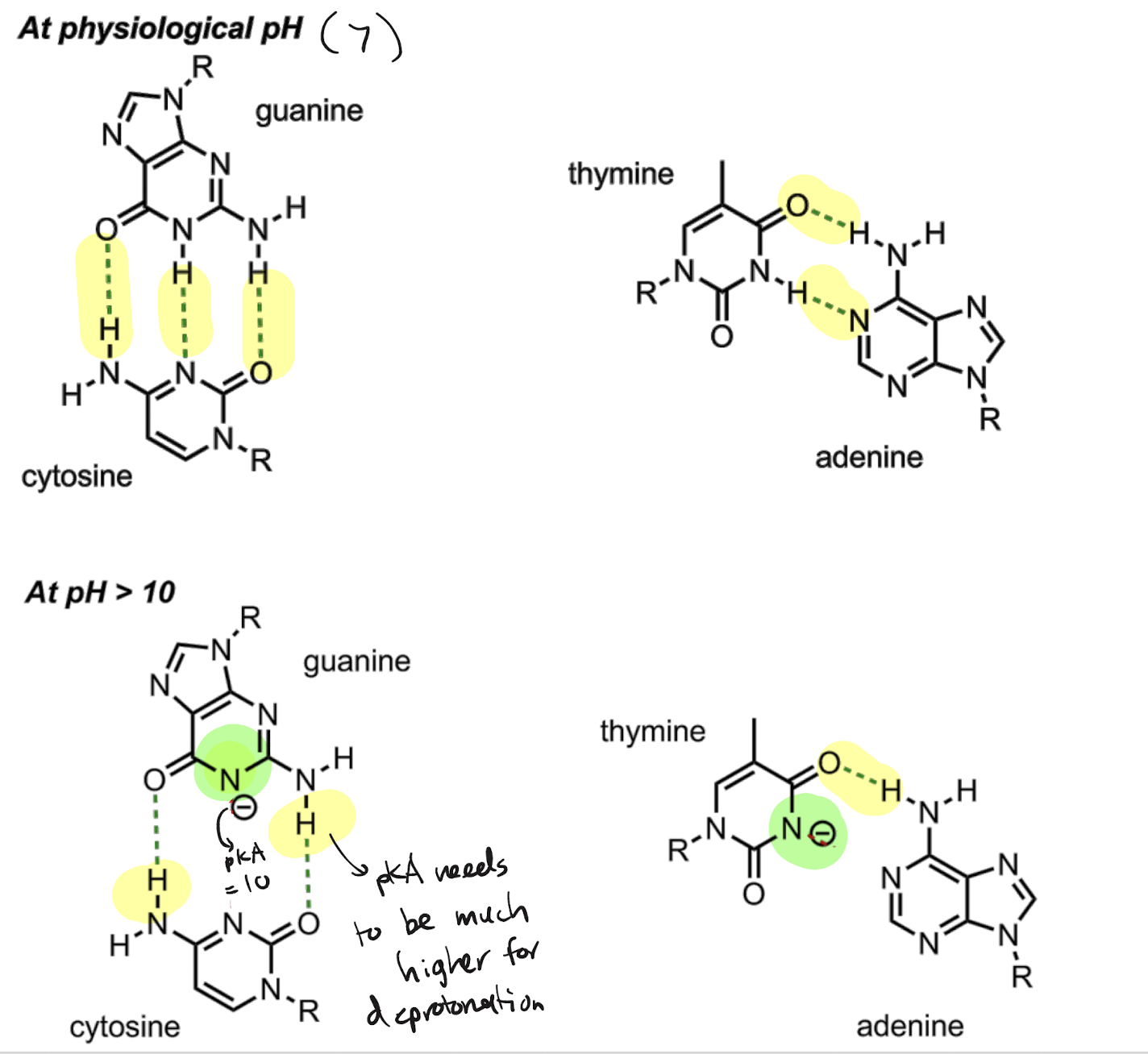
How does a basic pH affect Tm?
At a pH>10, certain groups on DNA bases are deprotonated, hindering their ability to H-bond with each other. Thus there is slightly less shielding and a lower temperature is needed, leading to lower Tm
How does changing salt concentration affect Tm?
Salt ions shields/stabilize negative charges on the polar phosphate-sugar backbone of DNA. Low salt concentration destabilizes the double helix, decreasing Tm. High salt concentration means a stabilized double helix, increasing Tm.
What are the necessary conditions to denature DNA? (Think: what lowers Tm or allows denaturation)
Increased temperature, basic/high pH, decreased salt
What are the necessary conditions to hybridize DNA? (Think: what raises Tm or allows renaturation)
Decreased temperature, neutral pH, increased salt
Structurally, how is RNA different from and similar to DNA?
RNA has many forms while DNA has one. Adenine pairs with uracil in RNA instead of with thymine. RNA is often single stranded instead of double stranded. Only participates in intrastrand base pairing instead of both intra and inter
Stabilized by H-bonds and base stacking interactions like DNA
Can RNA form a double stranded helix, similar to DNA? Can it undergo melting? Compare this to DNA.
Yes, through intrastrand pairing, complementary RNA can form a double stranded helix with itself, but the structure is different from that of the B-DNA helix due to its 2’ OH group. It can undergo melting, but the curve will be higher than DNA because the 2’ hydroxyl group in RNA leads to more H-bonds, more base stacking and thus slightly higher thermal stability.