role of cabinet
 Call Kai
 Learn
Learn Practice Test
 Spaced Repetition
 Match
Match Flashcards
 Knowt Play
1/20

There's no tags or description
Looks like no tags are added yet.
Name | Mastery | Learn | Test | Matching | Spaced | Call with Kai |
|---|
No analytics yet
Send a link to your students to track their progress
21 Terms
The real executive
The ‘real’ executive, also known as the political executive:
•who forms government in Australia,
•forms the Cabinet,
•runs the country between elections,
•implements policy,
•proposes statute laws,
•heads the public service and other agencies.
The real executive is the ‘engine room of government’
Ministers
Definition
A minister is a member of the executive arm of government and a member of Cabinet. Ministers have responsibility for a particular area of government activity called a ‘portfolio’ such as healthcare, education, or foreign affairs.
•Due to the responsible parliamentary system that operates in Australia, Ministers must be members of parliament (as outlined in s.64)
•Although typically from the House of Representatives, can be chosen from the Senate.
•The Ministers of State Act 1952 also governs the appointment of Ministers. This Act states that there can be no more than 42 Ministers, and up to 12 of these may be Assistant Ministers.
ministry
Definition
The Ministry is the entire collection of ministers in an executive government and the PM. It is comprised of an inner ministry of senior ministers and outer ministry of less important ministers (junior) and assistant ministers.
•The Ministry is composed of all the Ministers regardless of rank.
•Only senior Ministers hold permanent Cabinet rank.
•Since 1956, as the size and complexity of government has grown, the Cabinet split into Junior and Senior Ministers in outer and inner ministry respectively.
•Junior Ministers – Part of outer ministry. e.g. Minister for Housing and Minister for Aged Care and Senior Australians
•Senior Ministers – Part of inner ministry e.g. Minister for Defence and Minister for Foreign Affairs.
Roles of minister
to manage a portfolio - this means they are ultimately reponsible for a departments of the public service
responsible for annual budget of their department
implementing government policy and legislation in their dept
•to participate and debate in secret Cabinet meetings
•Plan political strategy of govt., deal with crises & help maintain the narrative of the government.
•Publicly support Govt decisions (even if they disagree with them) – ‘govt speaking with one voice’
•Initiate or introduce legislation / bills to parliament prepared by their department.
•Answer questions during Question Time in parliament relating to their portfolio.
•Explain policy changes of their department to the public through media.
•Appoint senior public servants
Example ministers appointing senior public servants
•On the 14 July 2023 the Treasurer, Jim Chalmers MP, appointed Michele Bullock as the new Governor of the Reserve Bank of Australia for a seven-year term commencing 18 September 2023.
•She is the first female Governor of the Reserve Bank and succeeds Phillip Lowe.
Cabinet
A committee of the executive comprising of the PM and senior ministers. Governed entirely by convention and has no legal or constitutional authority. Despite this, it is the most powerful institution in the system of government.
Cabinet is the ‘engine room’ of government.
The Cabinet Handbook defines Cabinet as…
“The council of senior ministers who are empowered by the Government to take binding decisions on its behalf”
Role of cabinet
•Develop and communicate the narrative of government – vision & priorities
•Develop and implement policies – across different departments from election promises to emerging issues (e.g. COVID)
•Allocate resources and produce annual budgets – by estimating costs of running depts. And implementing policies.
•Coordinate the machinery of govt. (the public service) – large departments and statutory agencies responsible for approx. 25% of Australia’s economic activity
•Act as an information exchange – prioritise information coming to Cabinet from public service, parliamentary committee reports, govt. inquiries, court decisions, international affairs.
•Respond to crises – such as natural disasters, threats to national security or international emergencies (e.g. 2008 Global Financial Crises, 2020 Bushfires, COVID-19)
Westminister conventions: cabinet secrecy
Deliberations and discussions of cabinet should be lept secret and held out of public view. It allows for robust and frank discussions within cabinet and allows for cabinet to reach a single position to present as a united government.
Westminister conventions: Cabinet solidarity
Cabinet presents as a united government. All minsters are bound to publically support the Cabinet’s position on all issues. If a Minister cannot publically support Cabinet they are required by convention to resign.
Cabinet decisions influence
•Consensus – all ministers agree on position
•Compromise – negotiate and give and take until decision reached
•Majority
•PM authority – ‘captain’s call’ imposing their decision
•Party room pressure – pressure from governing party’s MPs on senior ministers or leader
Cabinet secrecy in theory
secret, reaches decisions through secret debate and argument, meet each week, binds the clerical staff, must speach as one government and therefore secrecy allows ministers to argue in a venue free of community and media judgement
allowd for them to come to its best decisions, prevent embarassment of disunity
public cabinet meetings would destroy the perception of government unity
Cabinet secrecy: In practice
•Disciplined political parties are a central feature of our modern political & legal system
•Organised political parties always form government in Australia & impose discipline on their members.
•Therefore, Cabinet conventions are not as essential as in 18th Century England & are no longer strictly enforced
•Cabinet leaks are frequent & almost always go unpunished…
•Conventions still provide a framework of ‘expectations’ of the government
•A leaky Cabinet signifies to the Australian public that the government is divided & often result in the fall of government
(e.g. Turnbull and Abbott governments)
Cabinet solidarity in theory
•Cabinet solidarity requires all ministers to publicly agree with a Cabinet decision even if they disagree with it
•Ministers not present when a decision is made by Cabinet must still publicly support it
•The government speaks with one voice – solidarity creates government unity
•A Minister who is unable to support a Cabinet decision is obliged by Westminster convention to resign & join the backbenches of parliament
•Due to deeply held moral, ethical or religious conviction – or because it would go directly against wishes of electorate and undermine representation function of MP.
Cabinet solidarity in practice
•Very rare for a Minister to resign due to Cabinet solidarity,
•More typically because of personal or political scandals or no longer supporting the leader
•However, notable examples include Stewart West (1983) – who resigned from Minister for Immigration and Ethnic Affairs as he could not support cabinet decision to support uranium mining.
•Recent e.g. - In 2015 Barnaby Joyce publicly disagreed with the Abbott governments development of the Shenhua Coal Mine in the Liverpool Plains, but was not required to resign and was not sacked.
•Showing how WM Conventions are flexible and non-binding…
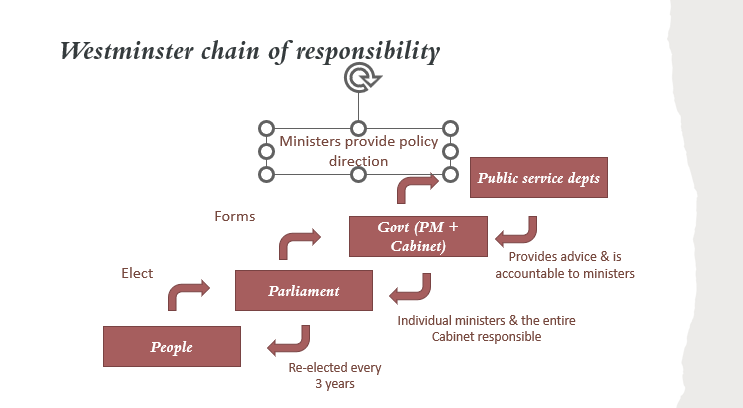
Westminster chain of responsibility
A convention of responsible parliament that specifies that parliament is accountable to the people through regular elections…
that executive government is collectively accountable to the parliament…
and that ministers are responsible for the actions of the public servants in their departments.
Factors affecting the functioning of the cabinet
•The Prime Minister
•Relationship between Ministers and parties in Coalition
•Timing
•Types of decision needed
PM affecting cabinet
can be less inclusive such as abbott and morrison not allowing for input
Relationship between ministers
Cabinet may be collegial and consensual or divided by rivalry
TIMING
•A new government may struggle with decision making because they lack experience in government,
•While a mature government may make decisions easily and a long-term government may lack vigour and/or new ideas.
Lib PM John Howard (1996-2007) - Australia's second-longest-serving Prime Minister. A strong and stable government characterised the later Howard Cabinets. Many years in office had refined Cabinet processes, and the relationship between ministers was mostly settled and constructive
Nature of the decision
Some Cabinet decisions are deliberative with much time and discussion devoted to them.
Others may be crisis responses and made quickly with limited time or resources / information as basis.
EXAMPLES:
The Morrison Government’s response to the 2020 COVID-19 was seen as quick and constructive.
Morriosn and cabinet
Formation after leadership spill - PM Morrison coming to power after leadership spill making Cabinet prone to instability. PM made Josh Frydenberg treasurer and Peter Dutton Minister for Home Affairs – appease other potential rivals and reward allies – increases Cabinet Unity.
COVID – justified suspension of cabinet meetings during pandemic where Ministers and PM made their own individual decisions without consultation of the other ministers/Cabinet. A few key ministers lived at The Lodge in a ‘bubble’ to make key decisions. Lack of Cabinet Solidarity.
Cabinet Leak – Minister from Cabinet leaked that Morrison rolled over proposals around the Religious Discrimination Act in 2022
Morrison Secret Ministry – lack of transparency and honesty / openness within Cabinet evidenced by Morrison appointing himself to 5 secret ministries & making decision on Gas Project Pep-11 against advice of Minister of Energy & Resources – breaking with long standing WM Conventions
Albo and cabinet
•No Cabinet Leaks to date - Lack of cabinet leaks to date evidence of cabinet unity & solidarity as well as cabinet secrecy WM conventions – evidencing an effective working relationship.
•Individual Cabinet Ministers in media spotlight - about issues within their portfolio (not just the PM) – e.g. Penny Wong Minister for Foreign Affairs and Treasurer Jim Chalmers interacting with the public and media a lot on legislation and decisions impacting them.
•PM Albanese calling back Cabinet before Parliament - resumed for 2024 to Canberra before parliament resumed to discuss specifically the cost of living crisis and they made decision over stage 3 tax cuts. – showing collaboration and input not just a captains call.
•Albanese avoiding Captain’s Calls – Approach seems that PM avoiding ‘Captain’s Calls’ within in Cabinet which enhances functioning of Cabinet and PM relationship.
•Without more specific examples – Albanese Cabinet suggests a consultative and collective decision-making process within and a functioning relationship between PM and Cabinet.