pre-ap biology unit 6 vocab
 Call Kai
 Learn
Learn Practice Test
 Spaced Repetition
 Match
Match Flashcards
 Knowt Play
1/14

There's no tags or description
Looks like no tags are added yet.
Name | Mastery | Learn | Test | Matching | Spaced | Call with Kai |
|---|
No analytics yet
Send a link to your students to track their progress
15 Terms
natural selection
organisms with certain inherited characteristics are more likely to survive and reproduce
artificial selection
breeding organisms with specific traits in order to make more organisms with those traits
speciation
development of a new species
isolation
when something separates a species
adaptation
a characteristic that is helpful to survive and reproduce in a specific environment
homologous structures
structures that are similar due to common ancestry, they do NOT always have a common function
analogous structures
structures with similar function that do NOT have common ancestors or a common structure
coevolution
two or more organisms evolve together (usually some sort of relationship, not necessarily genetically related)
divergent evolution
accumulation of differences between populations which can lead to speciation (can be due to isolation/separation of two populations, migration, etc)
convergent evolution
UNRELATED organisms independently evolve similarities when adapting to similar environments/climates. (ex: possums and kangaroos both have pouches)
biogeography
the study of the geographic distribution of organisms
genetic drift
change in the allele frequency of a population due to chance rather than natural selection
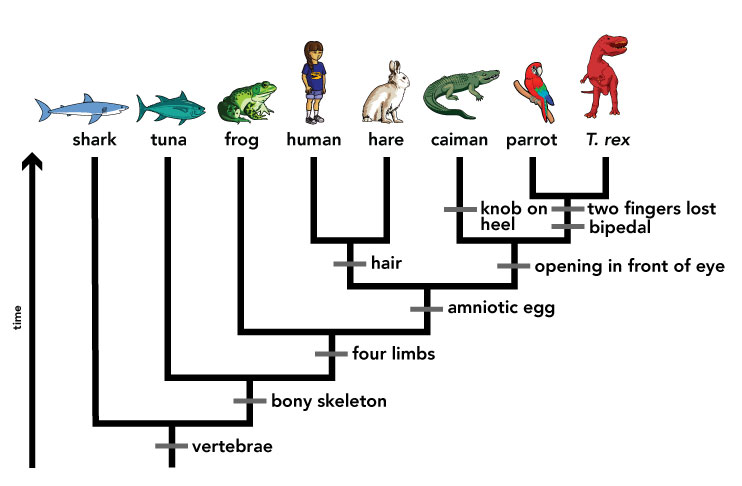
cladogram
diagram that shows the evolutionary relationships among a group of organisms
species
a group of similar organisms that are able to breed and reproduce fertile offspring
classification
the process of grouping things based on their similarities