BIOCH 200 Unit 8 - Oxidative Phosphorylation (Questions)
 Call Kai
 Learn
Learn Practice Test
 Spaced Repetition
 Match
Match Flashcards
 Knowt Play
1/23

There's no tags or description
Looks like no tags are added yet.
Name | Mastery | Learn | Test | Matching | Spaced | Call with Kai |
|---|
No analytics yet
Send a link to your students to track their progress
24 Terms
Oxidative phosphorylation occurs in ___.
Inner mitochondrial matrix
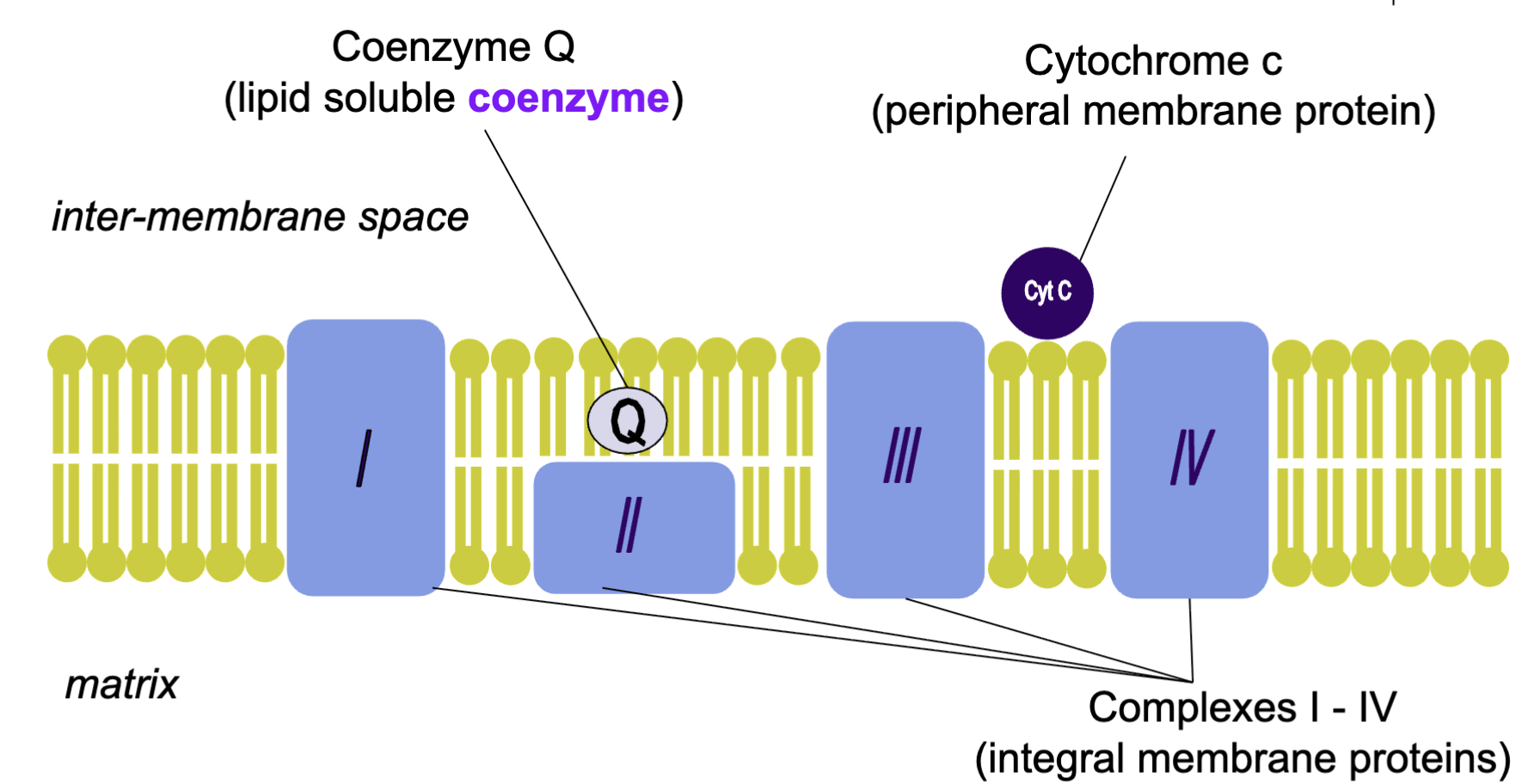
Describe the anatomy of the ETC, including mobile groups and their destination and location of complexes.
In order, complexes I, II, III, and IV are spaced within the inner mitochondrial membrane. Coenzyme Q moves between complexes I II and III (between 1 and 3, “on top” of 2), while cytochrome Q moves between III and IV. The mobile electron carriers are not embedded within the membrane. Other cofactors (Fe-S clusters, Cu2+, cytochrome heme groups, FMN/FAD) carry electrons within the complexes.
Which cofactors of the ETC are able to accept electrons directly? Which ones can’t? Classify them.
Directly: cytochrome heme groups, Cu2+ ions, Fe-S clusters
Via a hydrogen atom donating to flavin base: FMN, FAD
Via a hydrogen atom donating to quinone base: Coenzyme Q
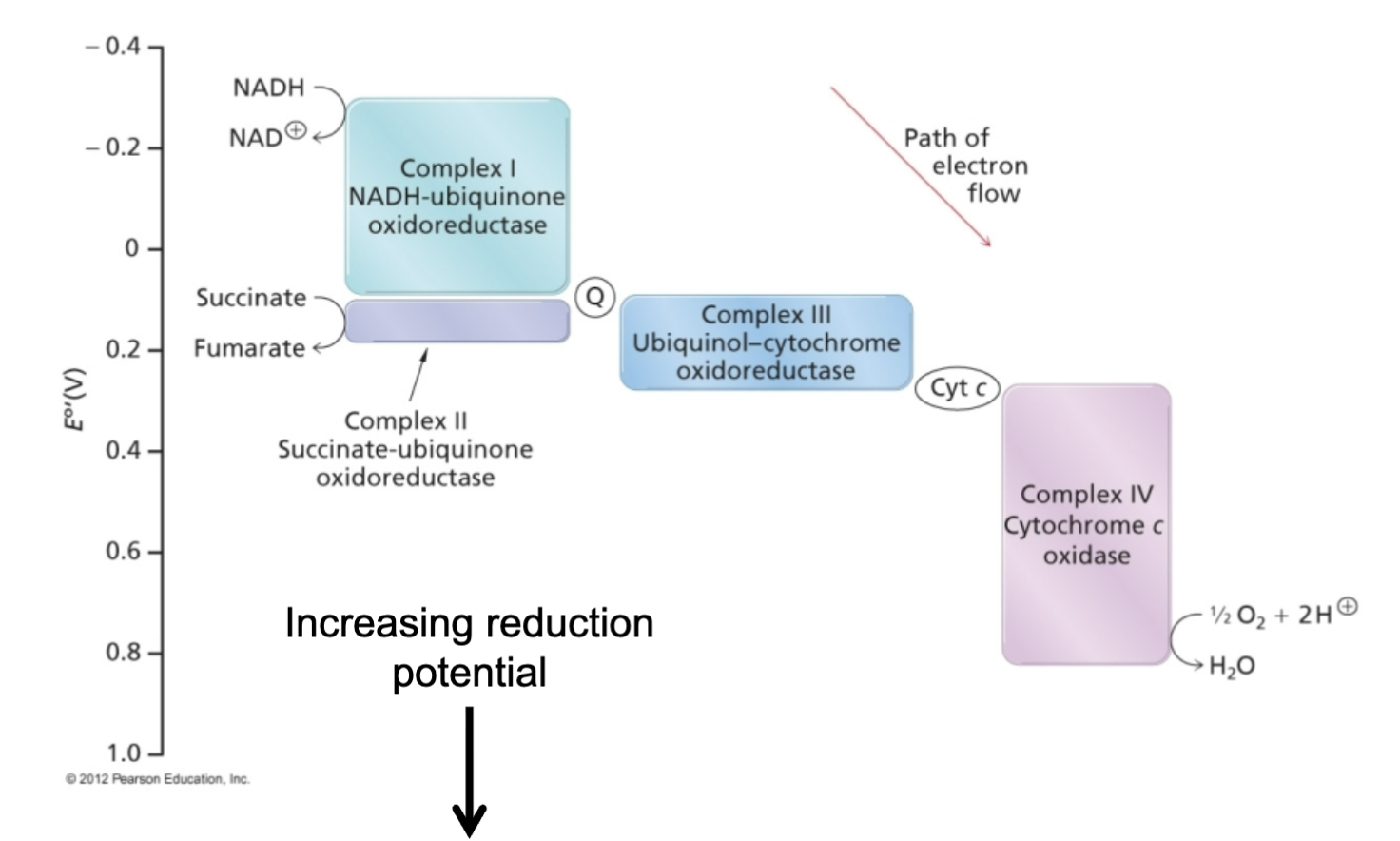
How do electrons move spontaneously through the electron chain in one direction?
Electrons move from molecules with low reduction potential (low affinity for electrons) to molecules with high reduction potential (high affinity for electrons). The terminal electron acceptor (O2) has the highest reduction potential, thus found at the end of the ETC and indirectly tugs on electrons to move them forward. Cofactors are ranked in increase order by reduction potential from complex I to complex IV.
NADH has the lowest reduction potential and thus always donates. O2 has the highest and thus always accepts. Q has a higher reduction potential than any cofactors in complex I and complex II and thus accepts from these two complexes as a co-substrate.
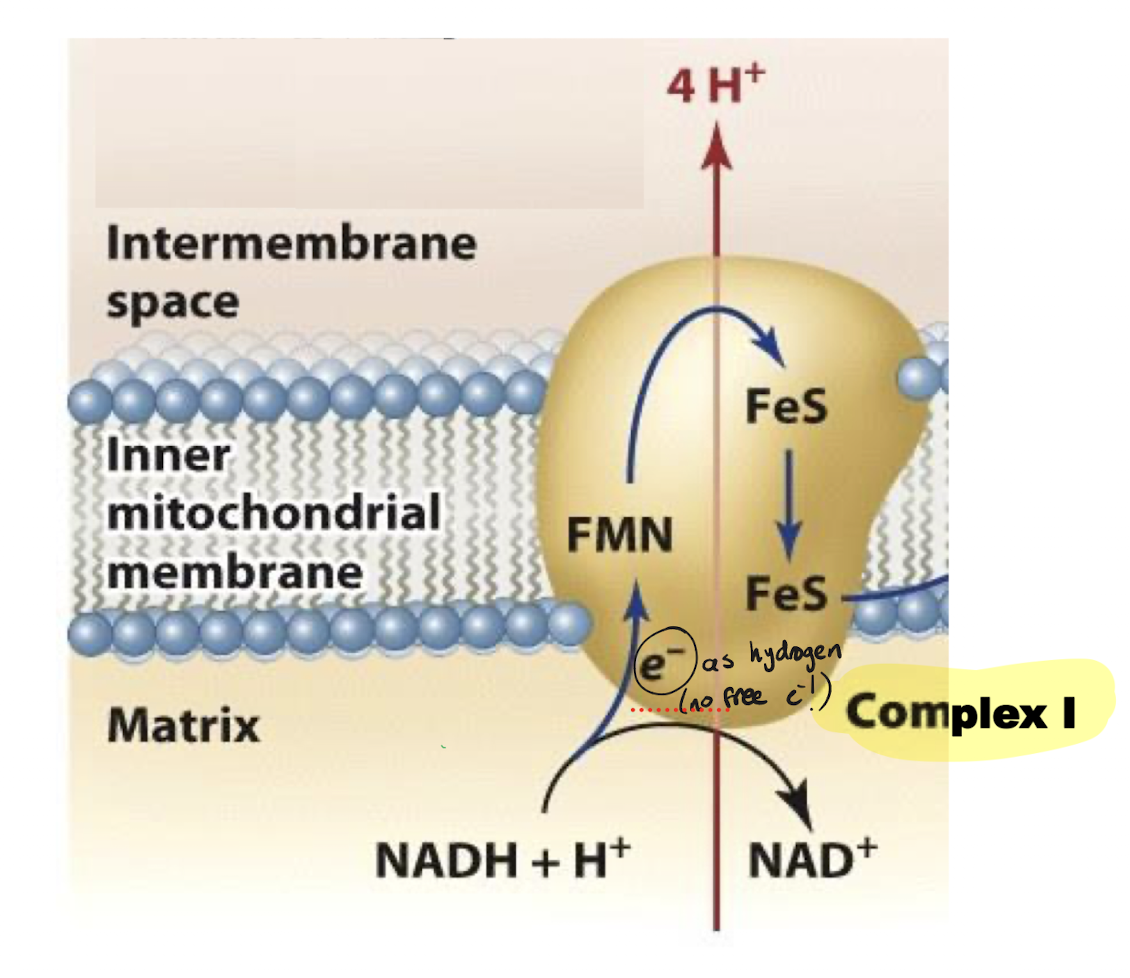
Explain how movement of electrons across the ETC begins at complex I, including all important cofactor groups and powered protons.
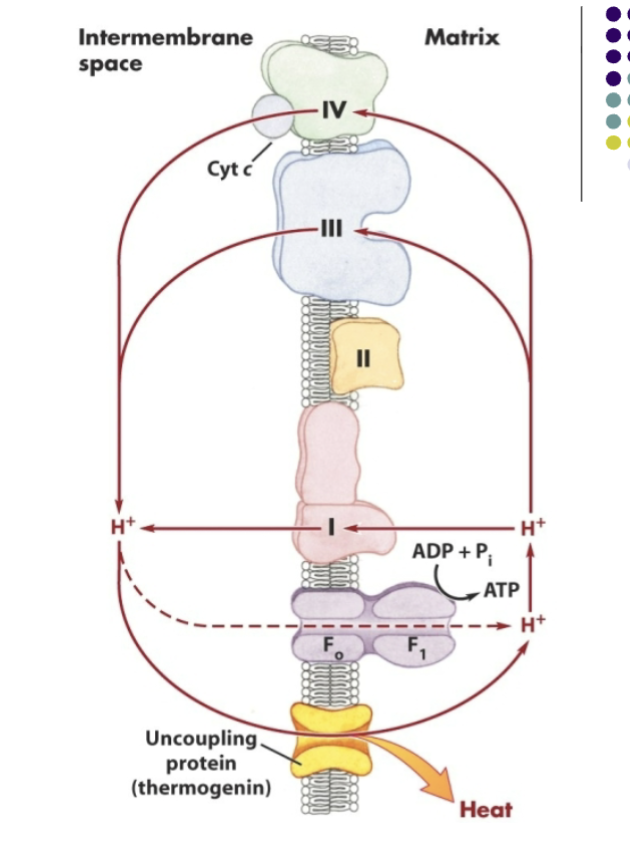
From the mitochondrial matrix, NADH (reduced form) donates its 2 electrons as two hydrogen atoms to FMN found within complex I, becoming oxidized to NAD+. Iron-sulfur clusters then pick up this electron from FMN in order to ferry it to the next complex. The movement of electrons to cofactors with more reduction potential is favourable and releases energy, powering complex I to undergo a conformational change in order to pump 4 protons against its gradient into the inter-membrane space.
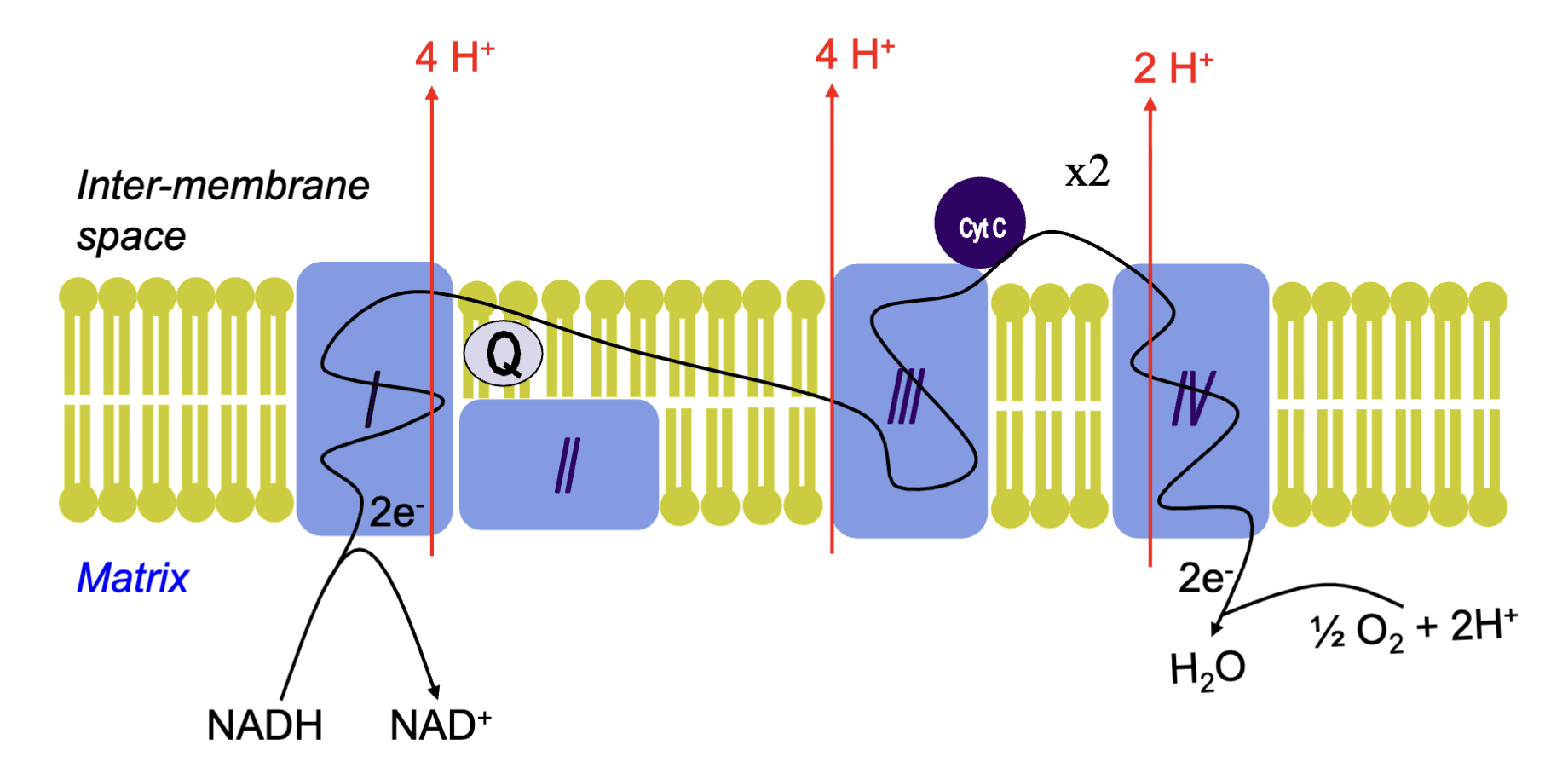
Explain the complete pathway of electrons from NADH across the ETC, starting from the primary electron donation to the terminal electron acceptor. Include amount of H+ pumped and all cofactor groups.
NADH donates its electrons to complex 1, which undergoes passage via FMN and iron sulfur clusters and then exits complex 1 to be passed to Coenzyme Q. This releases energy to pump 4 protons across the inner mitochondrial membrane via a conformational change of complex I.
The electrons passed to Q are then further passed to complex III. This releases energy to pump 4 protons across the inner mitochondrial membrane via a conformational change of complex III.
From complex III, cytochrome C receives the electrons and passes them to complex IV. This releases energy to pump 2 protons across the inner mitochondrial membrane via a conformational change of complex III.
The electrons are finally accepted by O2 at the end of the chain, which combined with protons to form H2O.
Each NADH is associated with the pumping of ___ protons across the inner mitochondrial membrane. Where does each come from?
10: 4 in complex I, 4 in complex III, 2 in complex IV
Describe the proton electrochemical gradient created by the ETC, including pH and charges on either side of the inner mitochondrial membrane. Which direction is the proton motive force?
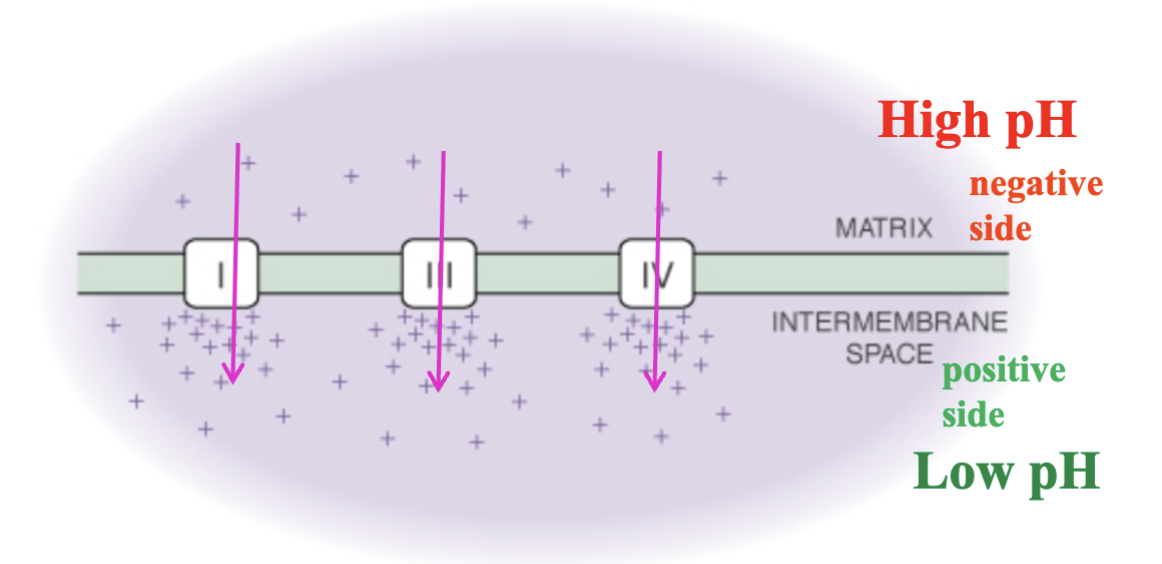
Protons are pumped from within the matrix to outside, maintaining a high concentration in the intermembrane space and a low concentration in the matrix. Thus, on the matrix side, there is high pH and negative charge. On the intermembrane side, there is low pH and positive charge.
The motive force is into the matrix, and energy is released in doing so.
If complexes do not pump protons, is electron transport possible? Explain.
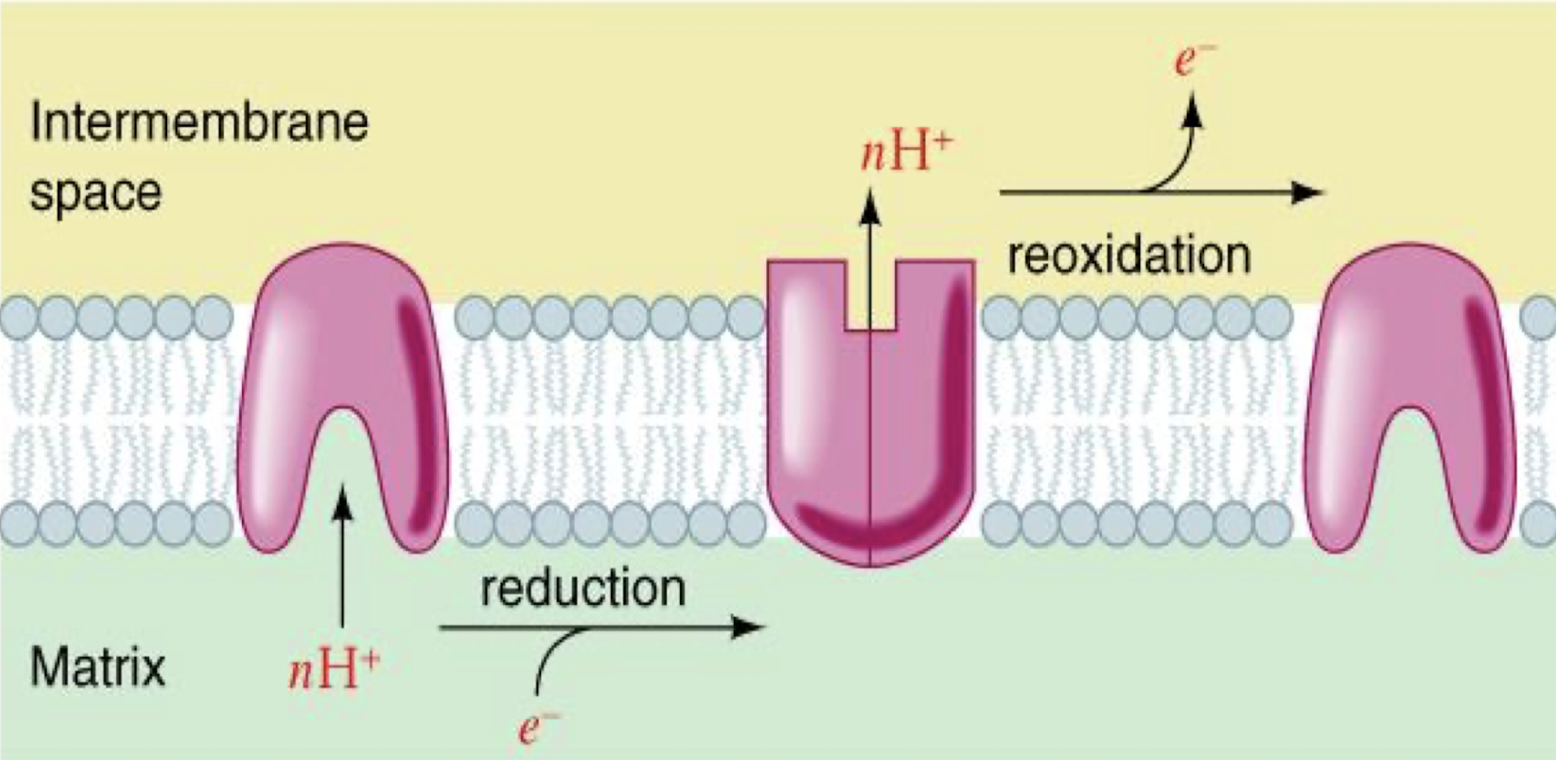
No, if you cannot pump protons across the inner mitochondrial matrix, you cannot move electrons through the ETC.
Pumping of protons = conformational change, which carries protons across the matrix and also carries electrons! Movement is not possible unless the conformational changes are occurring (protons are being pumped)
Describe the process by which protons in the membrane allow for the production of ATP at ATP synthase, including domains, reactants/products, and amounts needed.
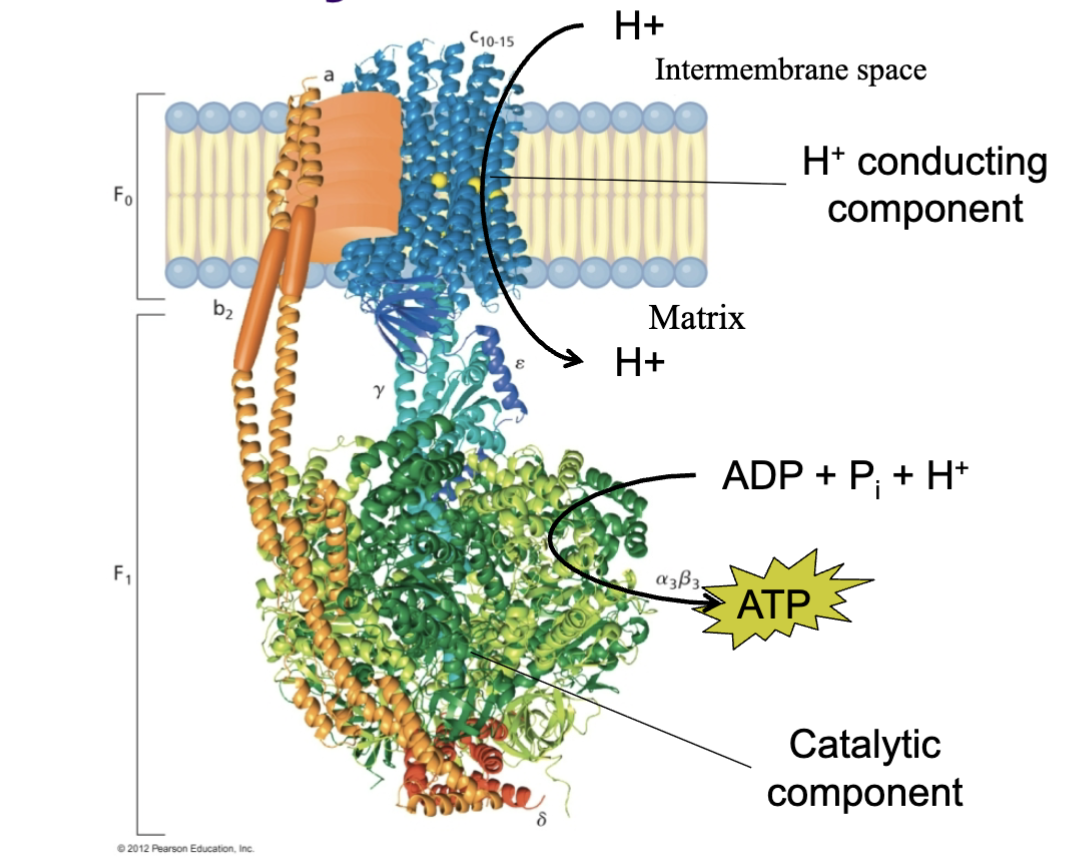
Protons first enter the transmembrane domain (F0) of ATP synthase, diffusing into the matrix down their concentration gradient. This releases energy that allows F1 to undergo a conformational change, catalyzing the synthesis of ATP from ADP, an inorganic phosphate, and protons. Approximately 3 H+ are needed per ATP synthesized via ATP synthase.
How many protons are required in total for ATP synthesis via oxidative phosphorylation?
3 needed for ATP synthase, 1 needed for Pi-H+ symporter in order to import inorganic phosphate. Total of 4
Explain the energy conversions that occur in order for ATP to be synthesized from the proton gradient created by the ETC.
The potential energy of the proton gradient is converted into mechanical energy that is used to power a conformational change in the catalytic domain of ATP synthase. This mechanical energy is then converted to chemical energy found within the phosphanhydride bonds of ATP.
Explain how movement of electrons across the ETC begins at complex II, including all important cofactor groups and powered protons.
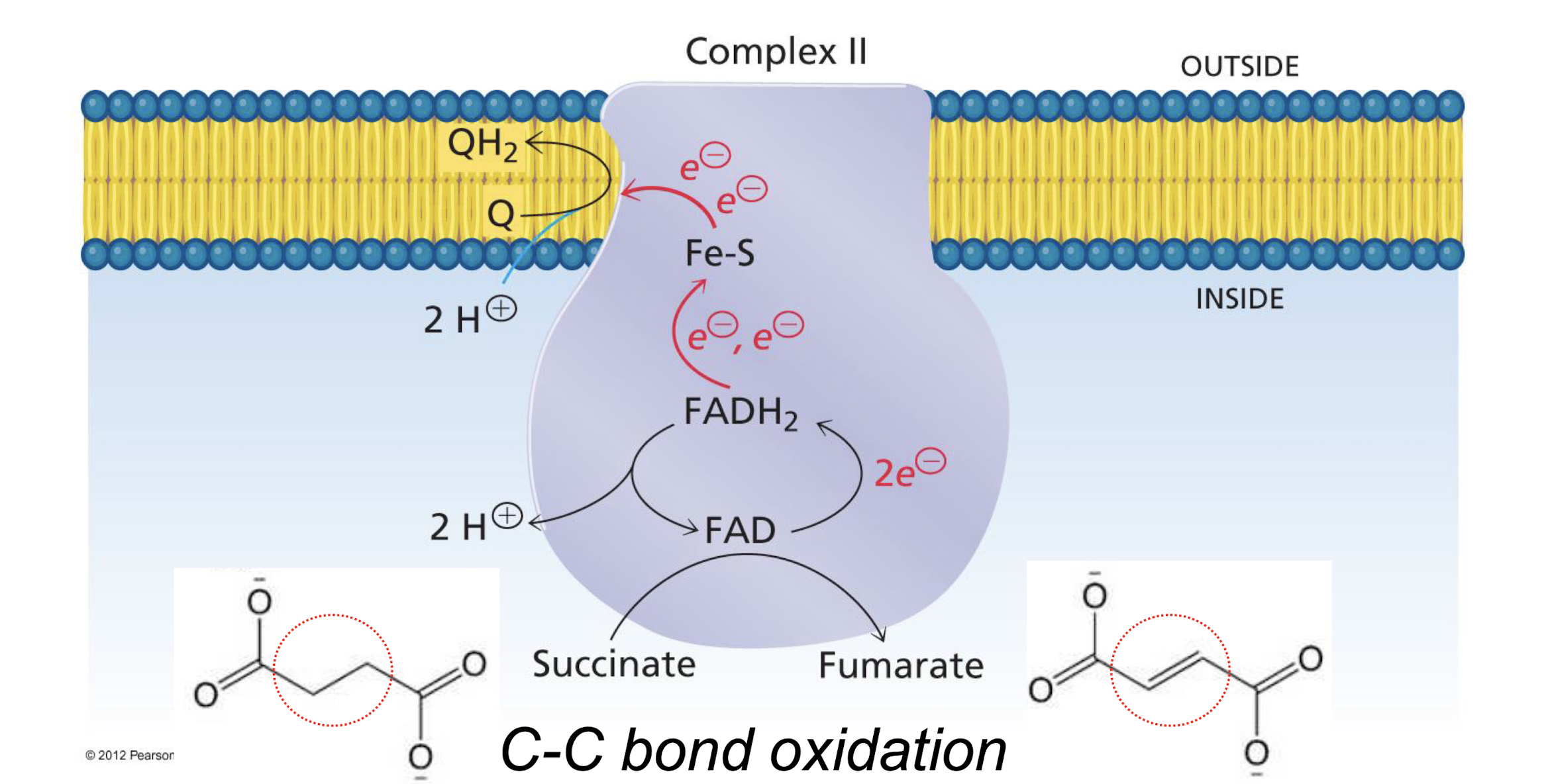
Complex II contains FAD as a prosthetic group, which catalyzes the oxidation of succinate to fumarate (citric acid cycle). 2 electrons from the succinate breakdown are picked up by the FAD, reducing it to FADH2. Iron-sulfur clusters in complex II take the electrons from FAD and pass them to coenzyme Q at the membrane. Electrons do not move across the membrane at complex II.
Explain the complete pathway of electrons from FADH2 across the ETC, starting from the primary electron donation to the terminal electron acceptor. Include amount of H+ pumped and all cofactor groups.
FADH2 donates its 2 electrons to complex II, which undergoes passage via FAD and iron sulfur clusters and then exits complex II to be passed to Coenzyme Q without crossing the membrane. The energy released is not used to pump protons in complex II (saved for ATP synthesis and passing to Q)
The electrons passed to Q are then further passed to complex III. This releases energy to pump 4 protons across the inner mitochondrial membrane via a conformational change of complex III.
From complex III, cytochrome C receives the electrons and passes them to complex IV. This releases energy to pump 2 protons across the inner mitochondrial membrane via a conformational change of complex III.
The electrons are finally accepted by O2 at the end of the chain, which combined with protons to form H2O.
Why don’t electrons from FADH2 donate to complex I instead of complex II?
Reduction potential of FAD is greater than any cofactor in complex I, so it is unfavourable to move backwards
Each FADH2 is associated with the pumping of ___ protons across the inner mitochondrial membrane. Where does each come from?
6: 4 in complex III, 2 in complex IV
Compare the energy produced (as ATP) from complex I compared to complex II. Why?
Complex I produces more ATP (more energy): each NADH from complex I pumps 10 protons while FADH2 from complex II only pumps 6. More protons = more ATP created
How are oxidation and phosphorylation in oxidative phosphorylation linked?
Oxidation creates a proton gradient, which is used to provide enough energy for phosphorylation to occur. They are coupled reactions: oxidation pushes phosphorylation forward. Oxidation produces a gradient, ATP synthesis uses the gradient
What determines the rates of electron transport/oxygen consumption in oxidative phosphorylation? Explain.
Magnitude of the proton electrochemical gradient due to ATP synthase
Small gradient = gradient is being consumed by ATP synthase = more pumping of protons needed at ETC to create gradient → speed up electron transport (pumping protons = moving electrons)
Large gradient = gradient is not being consumed by ATP synthesis = less pumping of protons needed at ETC to conserve energy instead of creating unneeded gradient → (less conformational changes = less moved electrons) slow down electron transport
Ultimately, rate of ATP synthesis determines gradient, which determines electron transport and oxygen consumption
What is the effect of increased concentration of ADP in the matrix on: proton gradient, rate of electron transport/oxygen consumption, concentration of NADH and FADH2?
More ADP = more ATP produced by ATP synthase, higher ATP synthase activity.
Proton gradient decreases (is consumed by ATP synthase), electron transport and oxygen consumption increase (require more pumping of protons and thus faster electron transport), concentration of electron carriers decreases (carriers are being oxidized more due to increased rate of electron transport)
What is the effect of decreased concentration of ADP in the matrix on: proton gradient, rate of electron transport/oxygen consumption, concentration of NADH and FADH2?
Less ADP = less ATP produced by ATP synthase, lower ATP synthase activity.
Proton gradient increases (is not used as much by ATP synthase), electron transport and oxygen consumption decrease (less pumping of protons and thus slower electron transport), concentration of electron carriers increases (carriers are being oxidized less due to decreased rate of electron transport)
The P/O ratio of NADH is ___, and the P/O ratio of FADH2 is ___. Which is better at generating ATP?
~2.5, ~1.5. NADH
How are mammals able to use uncoupling to generate heat in the winter?
In brown fat, oxidative phosphorylation can be uncoupled. An uncoupling protein is able to consume the proton gradient created by oxidation so that the rate of phosphorylation decreases, and thus the proton gradient will no longer be used for ATP synthesis but for heat
What are the effects of uncoupling and inhibition on oxygen consumption and ATP synthesis respectively?
Uncoupling: proton gradient is still being used, just for a different purpose. ATP synthesis plateaus, oxygen consumption
Inhibitor: stops the process entirely. ATP synthesis and oxygen consumption plateau