RP7: B
 Call Kai
 Learn
Learn Practice Test
 Spaced Repetition
 Match
Match Flashcards
 Knowt Play
1/7

Earn XP
Description and Tags
Measuring the rate of reaction by a continuous monitoring method.
Name | Mastery | Learn | Test | Matching | Spaced | Call with Kai |
|---|
No analytics yet
Send a link to your students to track their progress
8 Terms
Give the balanced symbol equation for the reaction between magnesium and hydrochloric acid.
Mg (s) + 2HCl (aq) → MgCl2 (aq) + H2 (g)
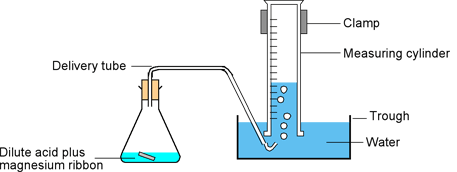
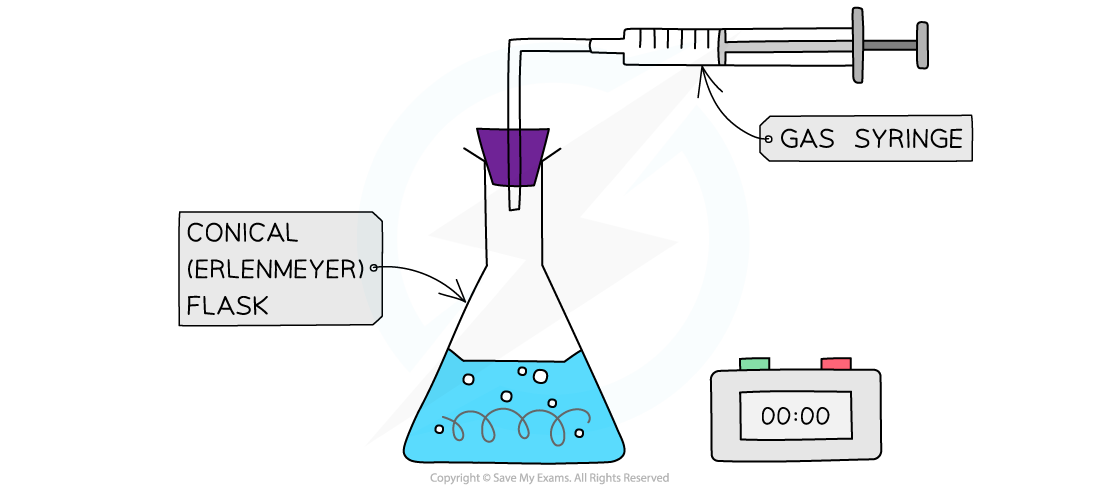
Draw and label two possible setups for this investigation.
How can you alter the concentration of hydrochloric acid?
Add varying amounts of distilled water to hydrochloric acid.
How long should you record the volume of gas produced and and what time intervals?
For 3 minutes, every 20 seconds.
How will increasing the hydrochloric acid concentration likely impact the overall volume of hydrogen gas produced?
No overall effect on the volume of hydrogen gas produced, this is because acid is in excess and the volume of hydrogen gas produced depends on the amount of magnesium at that point.
Why does using the water trough apparatus work for hydrogen but not for carbon dioxide?
Hydrogen gas is insoluble in water so all of it will collect as a gas in the inverted measuring cylinder whereas carbon dioxide gas dissolves in water meaning less gas will collect in the inverted measuring cylinder.
Give and explain two possible sources of errors in this investigation.
Not putting the bung in the conical flask quick enough after starting the reaction (some hydrogen gas may escape from the conical flask into the atmosphere).
Not starting the stopclock immediately after starting the reaction.
What method can you use to overcome the issue with getting the bung in the conical flask in time?
Place one of the reactants inside the conical flask in an inverted test tube so that it doesn’t escape into the rest of the conical flask, leave the other reactant free in the conical flask. Place the bung on the conical flask and shake it to knock over the test tube and spill the reactant in it so that the reactants meet and react.