Macro Economics: Important Topics
 Call Kai
 Learn
Learn Practice Test
 Spaced Repetition
 Match
Match Flashcards
 Knowt Play
1/83

There's no tags or description
Looks like no tags are added yet.
Name | Mastery | Learn | Test | Matching | Spaced | Call with Kai |
|---|
No analytics yet
Send a link to your students to track their progress
84 Terms
What are the main macroeconomic objectives?
TIGERS
Trade - balanced
Inflation - low and stable
Growth - high, strong, sustained
Employment - low unemployment
Redistribution of wealth - fair
Stability
What are the 4 types of unemployment?
Seasonal
Frictional
Structural
Cyclical (demand deficient)
What is seasonal unemployment?
Caused by time of year variation in demand (tourism, agriculture, construction)
What is frictional unemployment?
Short term unemployment as people move between jobs.
Usually low and inevitable
What is structural unemployment?
Caused by long term changes in the structure of the economy - workers’ skills or location no longer match available jobs
Geographical mobility of workers (solved by investment into infrastructure)
Occupational mobility of workers (solved by investment into education)
What is cyclical (demand deficient) unemployment?
Caused by a fall in AD during a recession
As AD is lower, levels of employment also decrease as less output is needed, so firms can reduce their production costs by laying off workers
What demand side (demand for labour) factors can affect levels of unemployment?
Anything that affects AD (C + I + G + (X-M))
Place in the economic cycle
What supply side (supply of labour) factors can affect levels of unemployment?
Skills of workers
Geographic mobility of workers
Labour market flexibility
How can global events affect UK employment?
Recessions: reduce export demand > reduce UK jobs in exporting industries
Migration: affects labour supply
Global price shocks: affect production costs and purchasing power > employment affected
Definition of inflation
A sustained rise in the general price level
Definition of deflation
A sustained fall in the general price level (negative inflation)
Definition of disinflation
A fall in the rate of inflation
Prices are still rising, just more slowly
What are the 2 causes of inflation?
Demand pull inflation
Cost push inflation
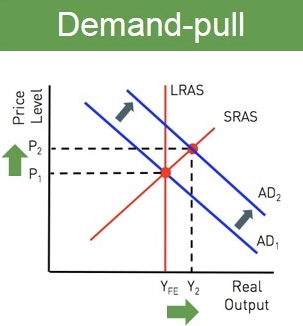
What is demand pull inflation?
AD rises faster then AS can expand, which pulls up prices
When AD increases (booming economy, increased consumer confidence, surge in government spending, etc.), sellers raise prices as buyers are competing with each other to secure the goods > price level rises
How do you draw demand pull inflation?
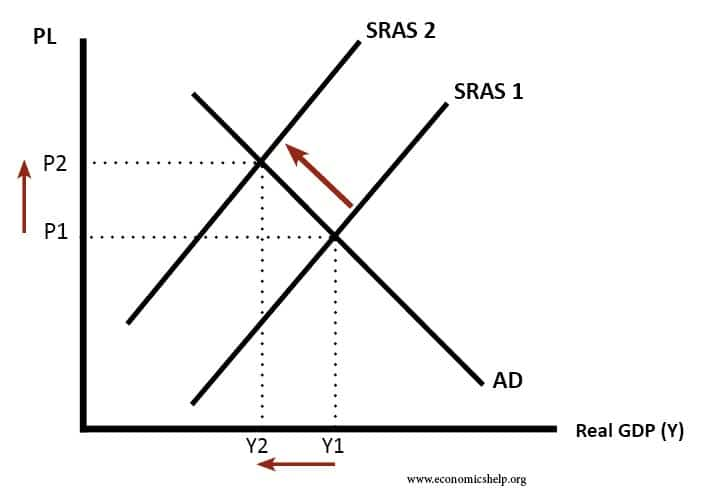
What is cost push inflation?
Rising costs of production shift SRAS to the left.
When costs of production increase (through higher costs for raw materials, energy, wages, etc.), businesses must pay more to make their products. To protect their profit margins, companies ‘push’ these extra costs onto consumers in the form of higher prices > price level increases
How do you draw cost push inflation?
What are examples of imported inflation?
Rising world commodity prices (oil, food, gas) raise UK production costs and consumer prices
A falling exchange rate makes imports more expensive > imported inflation
Inflation in major trading partners feeds through into UK import prices
What are the effects of high inflation?
Erodes purchasing power - especially of those on fixed incomes
Reduces real value of savings (hurts savers, helps borrowers)
Damages international competitiveness (if UK inflation is higher then abroad)
Creates uncertainty - firms delay investment (lowers AD)
Menu costs (firms have to keep changing prices > costs money to change prices)
Shoe leather costs (people spend time making trips to the bank to avoid holding onto money during inflation > wastes time which could've been used productively)
What are the effects of deflation?
Consumers delay purchases expecting lower future prices > falling AD
Real value of debt rises > hurts borrowers (Including government)
Firms cut production and employment as revenues fall
Real wages may rise (if money wages are sticky - slow to adjust to changing economic conditions) causing unemployment
What is the structure of the Balance of Payments on the Current Account?
Trade in goods (visible trade) - exports vs imports of physical goods
Trade in services (invisible trade) - financial services, tourism, education, etc.
Primary income (income earned from a FoP) - interest, profits, and dividends earned on overseas investments
Secondary income (one way payments) - transfers such as foreign aid, EU contributions, remittances
What does a current account deficit mean?
Outflows exceed inflows on the structure (goods, services, primary / secondary income)
Means there is a net outflow of money into the circular flow of income
What does a current account surplus mean?
Inflows (money from EXPORTS) exceed outflows (money spent on IMPORTS) on the structure (goods, services, primary / secondary income)
Means there is a net inflow of money into the circular flow of income
What are the determinants of the current account balance?
Productivity - higher productivity > more competitive exports
Relative inflation rates > high domestic inflation worsens competitiveness (exports suffer)
Exchange rate - SPICED worsens the balance (X-M decreases) and WIDEC makes the balance better (X-M increases)
Economic activity in other countries - strong foreign growth boosts UK exports (betters balance)
Domestic economic activity - strong UK growth raises imports (worsens balance)
Explain the relationship between growth and inflation if the economy is in a negative output gap
When an economy grows, AD tends to rise. If there’s lots of spare capacity (negative output gap = high unemployment + idle factories): firms can easily expand output by hiring unemployed workers and switching on unused machinery > output rises sharply, prices barely move > little inflation + lots of growth > no conflict of policies
Explain the relationship between growth and inflation if the economy is in a positive output gap
When an economy grows, AD tends to rise. If the economy is near full capacity (positive output gap = close to / above LRAS): firms struggle to find extra workers, raw materials run short, etc. To combat this, firms offer higher wages / pay more for scarce materials, and these higher costs are passed on as higher prices > demand pull inflation.
Output increases slightly + prices rise a lot > sharp conflict
Explain the relationship between growth and inflation from a Keynesian perspective
Keynesian view: The trade-off depends entirely on where you are on the Keynesian LRAS curve:
On the horizontal section → AD can rise with NO inflation. The trade-off doesn't exist.
On the upward-sloping section → growth comes with some inflation, but the trade-off is gentle.
On the vertical section → further AD growth produces only inflation.
Implication: Keynesians argue expansionary policies are appropriate as long as the economy is below full capacity. Worrying about inflation when unemployment is high is misguided.
Explain the macroeconomic conflict between growth and the current account
During periods of economic growth, consumers have high levels of spending. In the UK, consumers have a high marginal propensity to import > more spending on imports > worsens the current account deficit.
This is different for export led growth countries (their exports will rise > current account surplus)
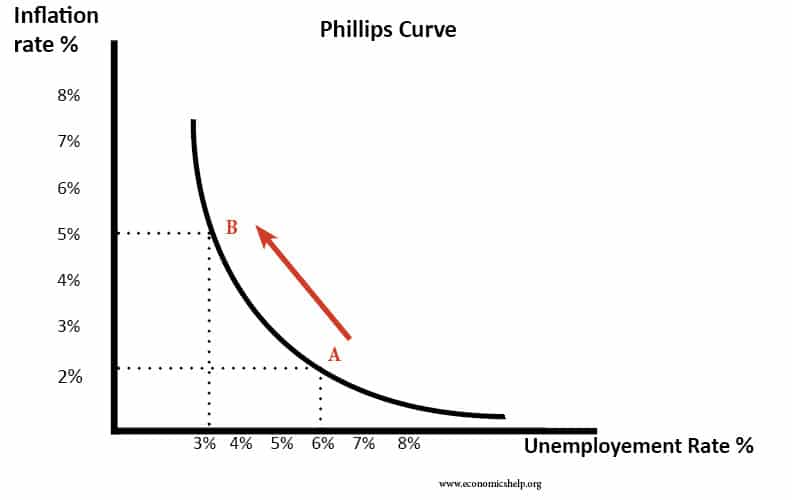
Explain the macroeconomic conflict between unemployment and inflation
When unemployment is low: workers are scarce, and firms must compete for them by offering higher wages = higher costs = passed on as higher prices AND higher household incomes (due to higher wages - boosts AD) = higher inflation
When unemployment is high: there are lots of workers, so firms don’t have to offer higher wages = wage growth is weak, cost push pressure is low, and demand pull pressure is also low (due to lower wages) = lower inflation
How can you represent the conflict between unemployment and inflation with a diagram?
What is monetary policy?
Action by the central bank (Bank Of England) to influence interest rates, the supply of money and credit, and the exchange rate
What is the UK’s main objective when considering expansionary / contractionary monetary policy?
Achieve the governments CPI inflation target of 2%, while supporting growth and employment
What are the 2 tools of monetary policy?
Bank Rate
Quantitative Easing (QE)
What is expansionary and contractionary monetary policy?
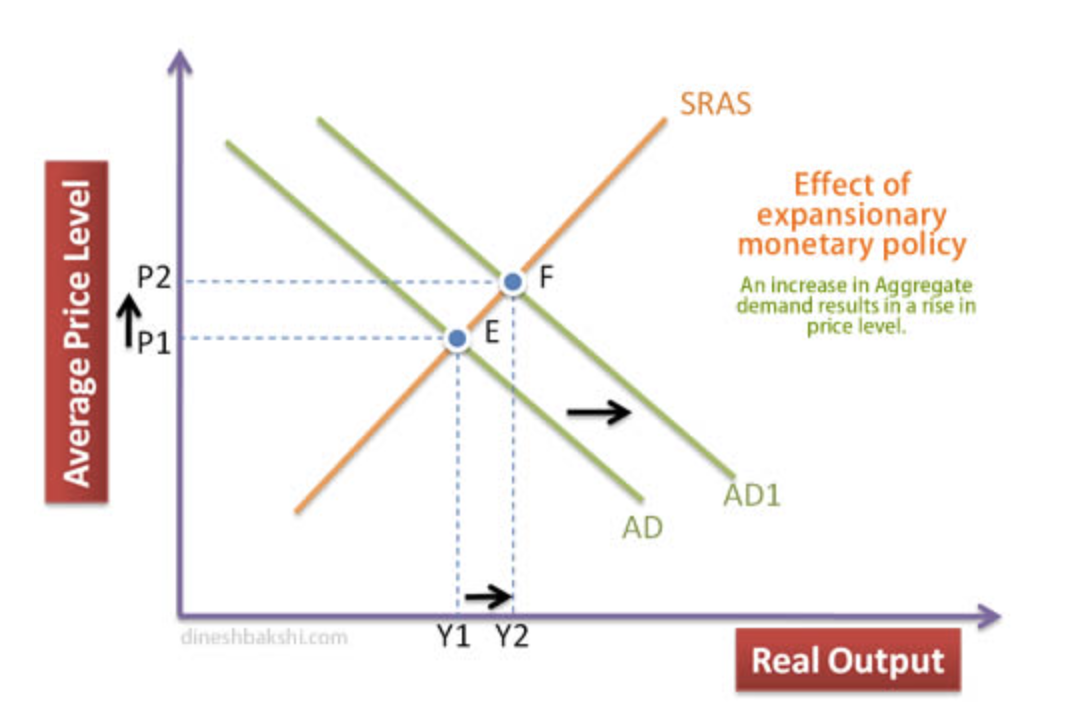
Expansionary: policy to boost AD
Contractionary: policy to reduce AD
How can the bank rate be used as a tool of expansionary monetary policy?
Bank rate is cut: results in these:
Borrowing becomes cheaper = encourages households to spend more (increased C) and for firms to borrow and invest more (increased I)
Lower return on savings = less people will save and more people will spend (increased C)
Exchange rate depreciates: £ weakens = exports become cheaper for foreign buyers and imports become more expensive = X-M increases
These all boost AD > AD shifts right > real GDP rises > unemployment falls, but inflationary pressure rises
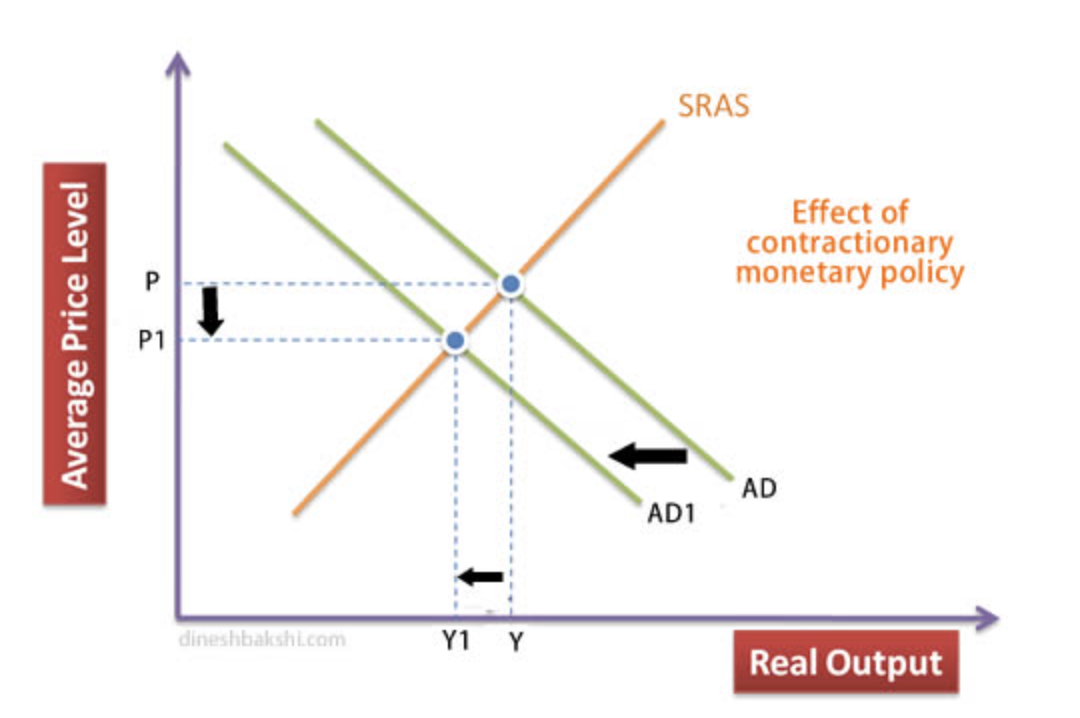
How can the bank rate be used as a tool of contractionary monetary policy?
Bank rate rises: results in these:
Borrowing becomes more expensive = discourages households to spend more (decreased C) and for firms to borrow and invest less (decreased I)
Higher return on savings = more people will save and less people will spend (decreased C)
Exchange rate appreciates: £ strengthens = exports become more expensive for foreign buyers and imports become cheaper = X-M decreases
These all reduce AD > AD shifts left > real GDP lowers > brings inflation down, but also results in slower growth and rising unemployment
In what situation is QE used?
When the bank rate has been cut to (or near) 0 - can’t go any lower, but the economy still needs more stimulus
How does QE work?
The Bank of England electronically creates new money and uses it to buy financial assets - mainly UK government bonds from commercial banks and financial institutions
What are the impacts of QE (expansionary monetary policy)?
Pushes down long term interest rates: when the bank buy lots of government bonds, bond prices rise = bond yields (interest rates) fall = borrowing across the economy becomes cheaper = increased C and I
Buying bonds from commercial banks and institutions means that they increase their money reserves = can lend more to households and firms = increased C and I
Weaker exchange rate: flooding the economy with new money tends to weaken the £ = boosts exports, weakens imports = increases X-M
How can QE (called Quantitative Tightening - QT) be reversed?
Example of contractionary monetary policy
The Bank sells the bonds back into the market, which has the opposite effect of QE:
Pushes up long term interest rates
Drains money from the economy
Strengthens the exchange rate
Who sets the Bank Rate in the UK?
The Bank of England’s Monetary Policy Committee (MPC)
What factors are considered by the MPC when setting bank rate?
Unemployment rate: high > consumer spending is likely to fall > MPC will drop interest rates to encourage spending
Savings rate: lot of saving = consumers not spending much = interest rates may fall
Consumer spending: high level of spending could mean inflationary pressure on the price level = MPC to increase interest rates
High commodity prices: high price of oil could lead to cost push inflation (as the UK is a net importer of oil) = push the MPC to increase interest rates
Exchange rate: weak £ = average price level increases = exports cheaper (more competitive) and imports more expensive = increase in X-M = MPC may increase the interest rate
What does SPICED mean?
Strong pound = imports cheap = exports dear = X-M decreases > current account deficit worsens
Opposite: WIDEC: Weak pound = imports dear = exports cheap = X-M increases > current account deficit improved
What are the drawbacks of expansionary monetary policy (cutting bank rate / QE)?
Time lags: Monetary policy takes 12-18 months to have its full effect on the economy → by the time a rate cut is fully felt, the economic situation may have changed → the policy may end up stimulating the economy when stimulus is no longer needed
Confidence problem: Cutting interest rates only works if households and firms actually want to borrow → in a deep recession, people may be too pessimistic about job security and future incomes to take on new loans, even at very low rates → similarly, firms won't invest if they don't expect demand to recover, no matter how cheap borrowing is → banks may also be reluctant to lend if they're worried about defaults → AD doesn't rise as much as expected → policy fails to deliver the intended boost to growth and employment
Worsening inequality: Cutting rates and using QE pushes up asset prices like shares and housing → this benefits wealthier households who own these assets, while poorer households without assets see no direct benefit → at the same time, rising house prices make housing less affordable for first-time buyers → long run inequality
What are the drawbacks of contractionary monetary policy (raising bank rate / QT)?
Slower growth and higher unemployment: higher bank rate = borrowing more expensive = households cut back on C, and firms cut back on I = AD shifts left = real GDP grows more slowly / falls = firms respond to weaker demand by reducing output and making workers redundant = cyclical unemployment increases
Asset (mortgage) shocks: after bank rate is increased, mortgage prices can rise steeply after renewal = reduces homeowners disposable income = cut back on other spending (lower C) = reduces AD + hurts younger mortgage holders harder
Ineffective against cost push inflation: contractionary monetary policy can only lower demand in an economy, this means accepting a recession to bring inflation down indirectly, which can lead to unnecessary economic damage
Can lead to crowding out
How can QT lead to crowding out?
Leads to crowding out: The Bank of England sells government bonds back into the market (or stops reinvesting) → the supply of bonds available to private investors increases → with more bonds chasing the same pool of investors, bond prices fall → bond yields (interest rates) rise to attract buyers → this pushes up borrowing costs throughout the economy because gilt yields are the benchmark for other interest rates → firms find investment projects less profitable → private investment falls
In what situations would you use expansionary monetary policy?
Used when the economy is too weak - AD needs boosting
Recession / negative growth
High / rising cyclical unemployment
Inflation below target (or risk of deflation)
Major demand side shocks
Strong exchange rate hurting exports
In what situations would you use contractionary monetary policy?
Used when the economy is overheating - aim is to cool down spending
Inflation above target
Economy operating above capacity (positive output gap)
Currency too weak / imported inflation
What is fiscal policy?
The use of government spending, taxation, and the budget balance to influence the economy
It can have both macroeconomic and microeconomic functions
What are the instruments of fiscal policy?
Government spending
Taxation
What are the 2 ways fiscal policy can be used to influence AD?
Expansionary fiscal policy: aims to increase AD
Contractionary fiscal policy: aims to decrease AD
How does expansionary fiscal policy work?
Used when AD is too low - typically in a recession
↑ G (gov. spending) and/or ↓ T (taxes)
The government increases spending (e.g. on infrastructure, healthcare, public sector wages) → G is a component of AD, so AD shifts right → firms experience higher demand for their goods and services → they respond by raising output, which increases real GDP → to produce more, firms hire additional workers → cyclical unemployment falls → workers earning new wages spend a proportion of that income, generating further rounds of spending (the multiplier effect) → so the final rise in real GDP is larger than the initial rise in government spending → economic growth is boosted and unemployment falls
The government cuts income tax → households have more disposable income → they spend a proportion of this extra income (depending on their marginal propensity to consume) → consumption (C) rises → AD shifts right → firms see higher demand and increase output → real GDP rises and firms hire more workers → unemployment falls → again, the multiplier amplifies the effect as new wages get spent and recirculate through the economy
What are the benefits to using expansionary fiscal policy from a Keynesian perspective?
Keynesian view: In a recession (on the horizontal section), expansionary fiscal policy is highly effective - output rises with little inflation. The multiplier is large because:
Unemployed resources are taken up
No crowding out (low interest rates, plenty of slack)
Confidence effects amplify the impact
How does contractionary fiscal policy work?
Used when AD is too high - when the economy is overheating in a positive output gap
↓ G (govt. spending) and/or ↑ T (taxes)
The government cuts spending (e.g. on welfare, public services, infrastructure projects) → G falls, which is a direct component of AD → AD shifts left → firms experience lower demand for their goods and services → they respond by reducing output → real GDP grows more slowly or falls → firms need fewer workers, so they reduce hiring or make redundancies → unemployment rises → with weaker demand, firms have less power to raise prices and workers have less power to demand wage rises → inflationary pressure falls
The government raises income tax → households have less disposable income → consumption (C) falls → AD shifts left → firms see weaker demand and cut output → real GDP slows → firms reduce hiring → unemployment rises → weaker demand and a weaker labour market reduce wage and price pressures → inflation eases
How can fiscal policy be used to influence AS?
Government spending on education and training: workers develop better skills and knowledge → labour productivity rises (output per worker increases) → at the same time, structural unemployment falls as workers gain skills matching available jobs → LRAS shifts right
Government spending on infrastructure: reduces business costs (faster transport, better connectivity) and improves the efficiency with which goods and services can be produced → firms can operate more productively → LRAS shifts right
Government spending on healthcare: a healthier population → workers take fewer sick days, work more productively, and stay in the workforce longer → labour supply expands and productivity rises → LRAS shifts right
Cuts in income tax: lower marginal income tax rates → workers keep more of each additional £ they earn → stronger incentive to work more hours, take promotions, enter the workforce, or move into higher-paying jobs → labour supply expands → LRAS shifts right
All are the opposite for contractionary fiscal policy
What is the difference between direct and indirect taxes?
Direct: taxes imposed directly onto income / wealth + paid directly to the government. Example: income tax, national insurance, inheritance tax
Indirect: taxes imposed on spending + makes costs of production higher. Example: VAT, alcohol / tobacco duty
What are the 2 types of indirect taxes?
Ad valorem: taxes that are a percentage
Specific: taxes that are a set tax per unit
What is a progressive tax?
A tax in which the average rate of tax increases as income increases
Example: UK income tax - as incomes raise higher, the rate of tax also increases higher
What is a proportional (flat) tax?
A tax in which the average rate of tax is constant, regardless of income
What is a regressive tax?
A tax in which the average rate of tax decreases as income increases
Example: VAT - standard rate is 20% - VAT takes more from a lower income consumer compared to a higher income consumer for the same product
What is the budget balance?
The difference between government revenue (mainly tax) and government spending in a single year
Budget surplus: revenue > spending
Budget deficit: spending > revenue
Balanced budget: spending = revenue
What is national debt?
The total amount the government owes - the accumulated stock of all past borrowing that hasn’t been repaid yet
What is the relationship between the budget balance and national debt?
If the budget balance is in a deficit, national debt will get larger
> Each year's budget deficit must be financed by borrowing (usually by issuing government bonds, called "gilts" in the UK). That borrowing adds to the national debt
How does the budget balance and national debt link to expansionary fiscal policy?
Expansionary fiscal policy (↑G or ↓T) → worsens the budget balance → adds to the national debt
A government wanting to boost AD through expansionary fiscal policy must consider:
Each year of deficit adds to the national debt
A larger debt means higher interest payments in future years
Higher debt may erode market confidence → push up borrowing costs → make further borrowing more expensive
How does the budget balance and national debt link to contractionary fiscal policy?
If national debt rises to a level seen as unsustainable, governments often feel pressured to use contractionary fiscal policy (cutting G, raising T) to stabilise or reduce debt. This is sometimes called "fiscal consolidation" or austerity
The problem: contractionary fiscal policy → ↓G or ↑T reduces AD → real GDP grows more slowly or falls → firms hire fewer workers → unemployment rises → the economy may enter a recession → and ironically, in a recession, tax revenue falls automatically (fewer people earning, less spending, lower profits) while welfare spending rises automatically (more unemployment claims) → so the deficit may not fall as much as expected, or may even widen → debt continues to rise → the policy partly defeats itself
What are the downsides of expansionary fiscal policy?
Worsens the budget deficit and adds to national debt: The government increases spending or cuts taxes → the gap between government spending and tax revenue widens → the budget deficit grows → this must be financed by extra borrowing → national debt rises → in future years, debt interest payments grow, squeezing other public spending → markets and credit rating agencies may worry about debt sustainability → borrowing costs may rise → and the government has less fiscal flexibility to respond to future shocks
Risk of demand pull inflation: expansionary fiscal policy boosts AD → if the economy is already near full capacity (small or no negative output gap), the rise in AD pushes the economy onto the steep part of SRAS → firms can't easily expand output, so they raise prices instead → demand-pull inflation accelerates → the Bank of England may respond by raising interest rates to control inflation → this offsets the fiscal stimulus and may even cause a recession → so the policy creates an inflation cost and triggers a contractionary monetary response
Crowding out of private investment: To finance the deficit, the government issues large amounts of bonds → bond markets must absorb this extra supply → bond yields (interest rates) tend to rise to attract buyers → higher interest rates make borrowing more expensive for private firms → firms cut back on investment projects → private sector investment falls
What are the downsides of contractionary fiscal policy?
Slower growth and rising unemployment: The government cuts spending or raises taxes → G falls and/or households' disposable income falls → consumption and government spending components of AD decline → AD shifts left → firms experience weaker demand for their products → they respond by cutting output → real GDP grows more slowly or contracts → firms reduce hiring or make workers redundant → cyclical unemployment rises → and through the multiplier effect, the loss of income spreads through the economy
Can shift LRAS to the left: If cuts fall on productive spending - infrastructure, education, training, R&D, healthcare — then short-run deficit reduction comes at a long-run cost → underinvestment in infrastructure raises business costs over time → underfunded education weakens future workforce skills → underfunded healthcare leads to more long-term sickness and lower workforce participation → all of these shift LRAS to the left (or slow its rightward growth)
Distributional unfairness: Spending cuts and tax rises hit different groups unevenly → welfare cuts disproportionately hurt the poorest households → cuts to public services hit those who rely on them most (often lower-income, elderly, disabled) → VAT and other indirect tax rises are regressive (take a bigger share from lower incomes) → income tax rises hit middle-earners hardest → this generates political opposition, protests, and electoral backlash → governments may be forced to reverse the policy before it has fully worked
What are automatic stabilisers?
Features of the tax and benefits system that automatically dampen fluctuations in the economic cycle, without any deliberate government action being needed
How do the 2 main automatic stabilisers work (tax system / welfare benefits)?
Tax system in a recession: People lose jobs, incomes fall, profits decline → tax revenue falls automatically (without any policy change) → households and firms keep more of what they earn relative to where they would be in a balanced budget → this supports their spending → AD falls by less than it otherwise would
Tax system in a boom: Incomes rise, profits grow → tax revenue rises automatically → particularly with progressive income tax, people move into higher tax brackets → more of the extra income is taxed away → this dampens the rise in disposable income and slows the growth of AD
Welfare benefits in a recession: Unemployment rises → more people claim unemployment-related benefits (Universal Credit in the UK) → government spending on welfare rises automatically → this provides income to those who have lost jobs → they continue spending on essentials → AD is supported
Welfare benefits in a boom: Unemployment falls → fewer people claim benefits → government welfare spending falls automatically → this dampens the growth of disposable income across the economy
What are supply side policies?
Government measures designed to increase the productive capacity of the economy by shifting LRAS to the right
They aim to improve the quantity, quality, and efficiency of the factors of production
What are the 2 types of supply side policies?
Market based policies:
Believe the market is best at allocating resources
Focus on reducing government's role and improving incentives
Examples: tax cuts, deregulation, privatisation, welfare reform, labour market flexibility
Interventionist policies:
Believe the government must actively invest in productive capacity
Focus on improving the quantity and quality of inputs
Examples: education and training spending, infrastructure investment, R&D funding, industrial policy
How does privatisation work?
Market based policy
The government transfers state-owned enterprises to the private sector (selling off shares or assets) → these firms now face competition and the profit motive → they have stronger incentives to cut waste, improve efficiency, and innovate → productivity rises → firms become more responsive to consumer demand → LRAS shifts right
Downside: privatised firms may become monopolies (eg. Thames Water / RailTrack in 1990s)
How does deregulation work?
Market based policy
The government removes rules and red tape on business activities → firms face lower compliance costs → barriers to entry fall → new firms can enter markets more easily → competition increases → existing firms become more efficient to survive → innovation rises → LRAS shifts right
Downside: can have negative externalities - some regulations exist for important reasons (worker safety, environmental standards, etc.)
How do cuts in income tax work?
Market based policy
Lower income tax → workers keep more of each extra £ → stronger incentive to work more, take promotions, enter workforce → labour supply expands → LRAS shifts right
How does education and training work?
Interventionist policy
The government spends more on schools, universities, apprenticeships, and adult skills programmes → workers gain better skills, qualifications, and knowledge → labour productivity rises (each worker produces more output per hour) → at the same time, fewer workers are unemployed due to skills mismatches → structural and frictional unemployment fall → labour supply effectively expands as more people become employable → LRAS shifts right
Downside: very long time lag - investment in education takes 20+ years to lead to an increase in productivity
How does investment in infrastructure work?
Interventionist policy
The government invests in transport (roads, railways, ports, airports), digital infrastructure (broadband, 5G), and energy networks → businesses can move goods, people, and information more efficiently → business costs fall → productivity rises → firms become more competitive both domestically and internationally → also makes deprived regions more economically viable → LRAS shifts right
Downside: very expensive + long time to build
How does healthcare spending work?
The government spends more on the NHS, preventive care, and mental health services → the workforce becomes healthier → fewer sick days, less long-term illness, more people able to work → labour productivity rises and labour supply expands → LRAS shifts right
Downside: opportunity cost + time lags
What is the Keynesian perspective on supply side policies?
Keynesian view: Supply-side policies matter for long-run growth, but they're not always the priority:
If the economy is on the horizontal section, supply-side policies expand capacity that isn't being used
More demand is needed first to use existing capacity
Demand-management may need to come BEFORE supply-side reforms
Implication: In a deep recession, building more roads or training more workers won't help if there's no demand for the goods and services they'd produce. Demand creates its own use of supply.
How would you represent expansionary monetary policy on a diagram?
How would you represent contractionary monetary policy on a diagram?
How would you represent expansionary fiscal policy on a diagram?
Either shifts AD out right OR pushes LRAS out (if invested)
How would you represent contractionary fiscal policy on a diagram?
Either shifts AD left OR shifts LRAS left (if invested)
How would you represent supply side policies on a diagram?
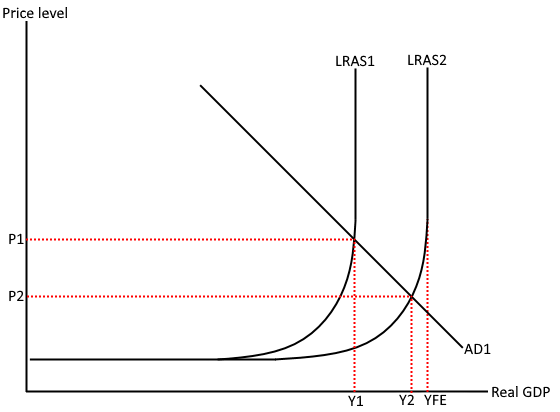
Comparisons between the 3 policies
Policy | Monetary policy | Fiscal policy | Supply-side policies |
|---|---|---|---|
What it targets | AD (via finance) | AD directly; can affect AS | LRAS |
Diagram | AD shifts | AD shifts (and LRAS if invested) | LRAS shifts |
Speed of implementation | Very fast | Slow | Very slow |
Speed of effect | 12-18 months | Fast direct effect; full effect 12-18 months | Years to decades |
Controlled by | Independent BoE | Elected government | Elected government |
Reversibility | Easy | Hard | Mixed |
Effect on budget | Indirect | Direct | Direct (worsens) |
Effect on debt | Indirect | Major | Variable |
Distributional effects | Blunt, often regressive | Highly targetable | Variable by type |
Inflation control | Primary tool | Supports monetary | Long-run only |
Growth (short run) | Effective | Very effective | Limited |
Growth (long run) | Indirect | Possible if invested | Very effective |
Cyclical unemployment | Effective | Very effective | Limited |
Structural unemployment | Limited | Effective if targeted | Very effective |
Exchange rate effect | Strong direct | Ambiguous | Long-run indirect |
Best for | Demand-side shocks, inflation | Recessions, targeted support | Long-run capacity, structural problems |
Key limitation | Zero lower bound, time lags | Political constraints, debt | Time lags, cost |
Side effects | Asset price inflation, inequality | Crowding out, debt accumulation | Inequality (market-based) |