PubPob pt.3 - Theories/Types and Models of Policy making process
 Call Kai
 Learn
Learn Practice Test
 Spaced Repetition
 Match
Match Flashcards
 Knowt Play
1/25

There's no tags or description
Looks like no tags are added yet.
Name | Mastery | Learn | Test | Matching | Spaced | Call with Kai |
|---|
No analytics yet
Send a link to your students to track their progress
26 Terms
Every mode has an underlying theory that provides an explanation of how the policy process. T or F?
TRUE
Enumerate the theories/models of policymaking
Institutional model
Rational comprehensive model
Group model
Elitist model
Incremental model
Streams model
It is the 'yardstick of wisdom' in policy-making. This approach emphasizes that policy-making is making a choice among policy alternatives on rational grounds.
This model is "to choose the one best option". Robert Haveman observes that a rational policy is one, which is designed to maximise "net value achievement".
Rationality
Rational Model in Policymaking
In this model, the activities of individuals and groups are generally directed towards government institutions such as, the legislature, executive, judiciary and bureaucracy. Public policy is formulated implemented government and enforced by institutions.
Institutional Model
1. The government gives legal authority to policies. Public policy is the outcome of certain decisions and is characterized using legal sanctions. It is regarded as a legal obligation, which commands the obedience of people.
2. The application of public policy is limited. Only public policies extend to all citizens in the state.
3. Public policies does not involve coercion. It is applied to the acts of government in backing up its decisions. A policy conveys the idea of 3 capacity for imposing penalties, through coercion of a kind usually reserved to the government itself
TRUE
FALSE - Universal
FALSE - it does involve coercion
In this model, policy-makers will break the complexity of problems into small and understandable parts; choose the one option, that is, best and satisfactory; and avoid unnecessary uncertainty.
Rational Model
He notes, "although individuals are intendedly rational, their rationality is bounded by limited cognitive and emotional capacities,
Herbert Simon
Rational Decision-making Model
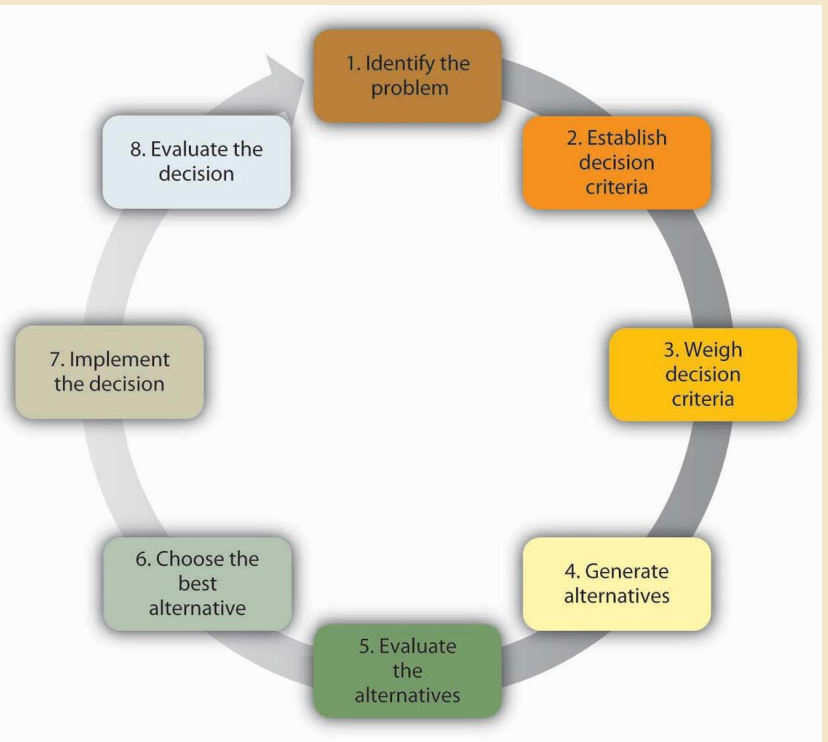
While decision makers can get off track during any of these steps, research shows that searching for alternatives in the ______ step can be the most challenging and often leads to ______ . In fact, one researcher found that no alternative generation occurred in 85% of the decisions he studied (Nutt, 1994). Conversely, successful managers know what they want at the outset of the decision-making process, set objectives for others to respond to, carry out an unrestricted search for solutions, get key people to participate, and avoid using their power to push their perspective
Fourth step — Failure
The availability of too much information can lead to _______, in which more and more time is spent on gathering information and thinking about it, but no decisions actually get made.
Analysis Paralysis
Herbert Simon observed that while the rational decision-making model may be a helpful device in aiding decision makers when working through problems, it doesn’t represent how decisions are frequently made within organizations. In fact, Simon argued that it didn’t even come close. T or F?
TRUE
…dominant research streams on _____ effectiveness in decision-making conceptualize _____ inadequately, because _____ is considered either detrimental or as a form of analysis. Current findings in general _____ research show that _____ is a holistic form of information processing that is distinct from analysis and can be superior in some cases. This only refers to one term.
Intuition
This model recognizes the limitations of our decision-making processes. According to this model, individuals knowingly limit their options to a manageable set and choose the first acceptable alternative without conducting an exhaustive search for alternatives. We are not inclined to find out all the necessary information that would be required to make a rational decision, because of cognitive and temporal limitations. This causes us to make choices that are satisfactory rather than optimal.
Bounded-rationality model of decision-making
An important part of the bounded rationality approach is the tendency to ______ (a term coined by Herbert Simon from satisfy and suffice), which refers to accepting the first alternative that meets your minimum criteria.
Satisfice
With this model, policy flows downward from the elite to the mass. Society is divided into those who have power and those who do not. Elites share values that differentiate them from the mass. Implications of this model are that the responsibility for the state of things rests with the elites, including the welfare of the mass. There is always agreement on constitutional government, democratic procedures, majority rule, freedom of speech and of the press, freedom to form political parties and run for office, equality of opportunity, private property, individual initiative and reward, and the legitimacy of free enterprise and capitalism. The masses cannot be relied on to support these values consistently, thus the elite must support them.
Elitist Model
T or F: Policies may change incrementally but the elites are liberalist and will change the basic system.
FALSE: Conservatists that are resistant to change
In this model, individuals with common interests band together to press their demands (formal or informally) on government. The ______ is the bridge between the individual and the government. ______ are important in politics only when they act as part of or on behalf of group interests. This policy is formed as a result of forces and pressures from influential groups. Pressure groups are informally co-opted into the policy making process. Regulatory agencies are captured by those they are supposed to regulate. No one group is dominant all the time on all issues.
Group Model
Group; Individuals
Group model is also called ______, as in physics. Influence is determined by numbers, wealth, and organizational strength, leadership, access to decision makers and internal cohesion. Policy makers respond to group pressure by bargaining, negotiating, and compromising among competing demands
Equilibrium Theory
This policy model relies on features of incremental decision-making such as: satisfying, organizational drift, bounded rationality, and limited cognition, among others. Such policies are often called "muddling through" & represent a conservative tendency: new policies are only slightly different from old policies.
Incremental Model
Incremental approach involves trial and error method. It is superior to a “demanding attempt at superhuman comprehensiveness”. Human beings rarely act to maximize all their values; on the contrary they act to satisfy particular demands.
They seldom search for the “one and two ways” but instead search to find “a way that will work”. This search usually begins with familiar– that is, with policy options close to contemporary policies.
TRUE
FALSE - Futile attempt
FALSE - One best way
TRUE
When existing policies have _____ which discourage innovation, incrementalism is an easier approach than rationalism, and the policies are more politically expedient because they don't necessitate any radical redistribution of values. Such models necessarily struggle to, improve the acceptability of public policy.
Sunk costs
Kingdon (1984) suggests that policy change comes about when three streams—problems, politics, and policies—connect. Kingdon’s model shows that while the three factor model may be operating independently of one another, all three need to come together in order for a policy to emerge
Streams Model
This focuses the public's and policy-makers' attention on a particular problem, defines the problem, and calls for a new policy approach.
This is where alternatives are considered, and decisions are made.
This is where the government agenda is formed: the list of issues or problems to be resolved by government.
All of these in a stream produces a ______.
Problem stream
Policy stream
Politics stream
Windows of Opportunity
Who agreed on the question: do policies determine politics?
Theodore Lowi
Do policies determine politics?
The emphasis given by Lowi to the linkage between the mentioned policy mechanisms and policy arenas characterized by a certain degree of conflict or consensus was inspired by a certain approach: Lowi was interested in “the choices about how to apply the power of the state and not primarily on what goals the sate should pursue”
This led to a microanalysis of how public power has been applied coming to the result that this could be done in different ways and that policy choices are possible—namely between the mentioned policy mechanisms or types.
In other words, because perceptions of policy outcomes are relevant, strategic policy makers—in a position to influence those perceptions— can increase the likelihood of a direct influence on the policy process.
This is the perception of what a policy is about can be influenced—and by this the policy process is also affected. For example, regional policy aiming at equalizing or at least balancing regional and social disparities is apparently redistributive. However, to calm down controversies resulting from the redistributive effects of this policy, emphasis can also be placed on related measures that are of general benefit. The development of the infrastructure, for instance, can improve the accessibility of regions, in relation to the exchange of products (the market) or the mobility of people (for the workforce as well as for tourists)
Issue Relabeling