Ketone Bodies

0.0(0)
Studied by 0 people
call kaiCall Kai
learnLearn
examPractice Test
spaced repetitionSpaced Repetition
heart puzzleMatch
flashcardsFlashcards
GameKnowt Play
Card Sorting

1/11

encourage image

There's no tags or description

Looks like no tags are added yet.

Last updated 4:06 AM on 4/12/26
Name
Mastery
Learn
Test
Matching
Spaced
Call with Kai

No analytics yet

Send a link to your students to track their progress

12 Terms
1
New cards
term image
knowt flashcard image
2
New cards
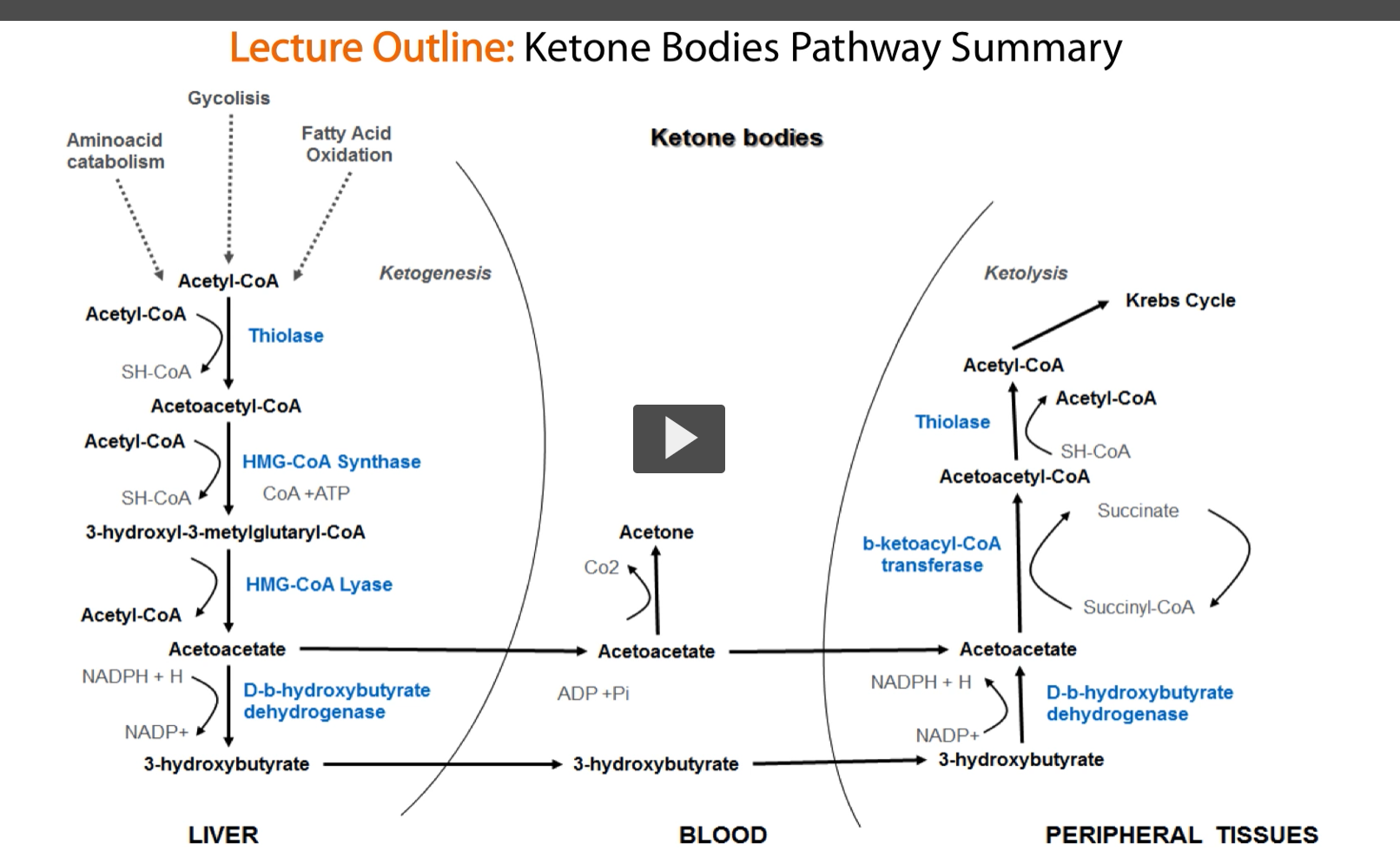
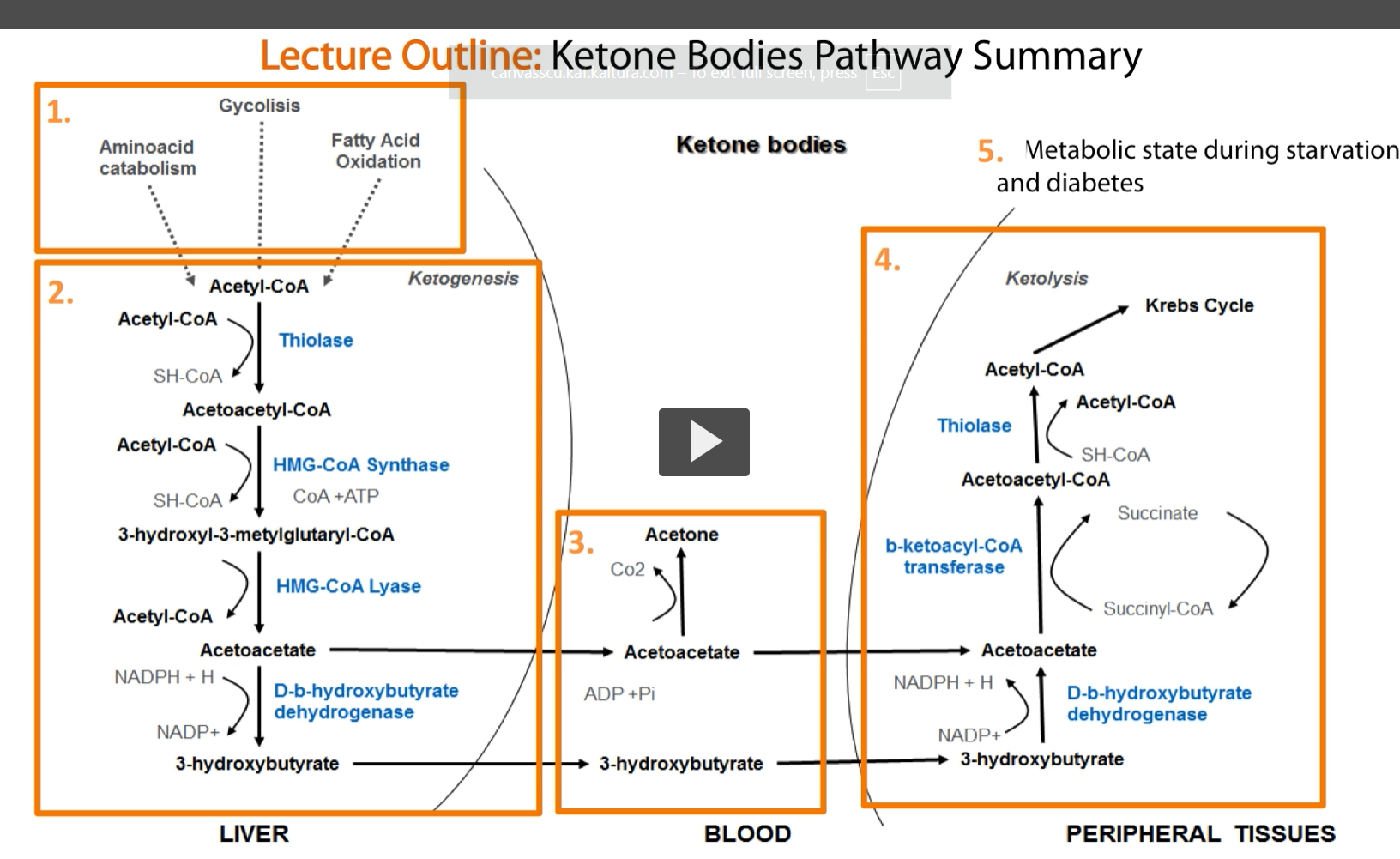
<p>This is the Outline of the pathway for keto-body formation and usage.</p><p>we are going to use this throughout the lecture to organize our thoughts.</p>

This is the Outline of the pathway for keto-body formation and usage.

we are going to use this throughout the lecture to organize our thoughts.

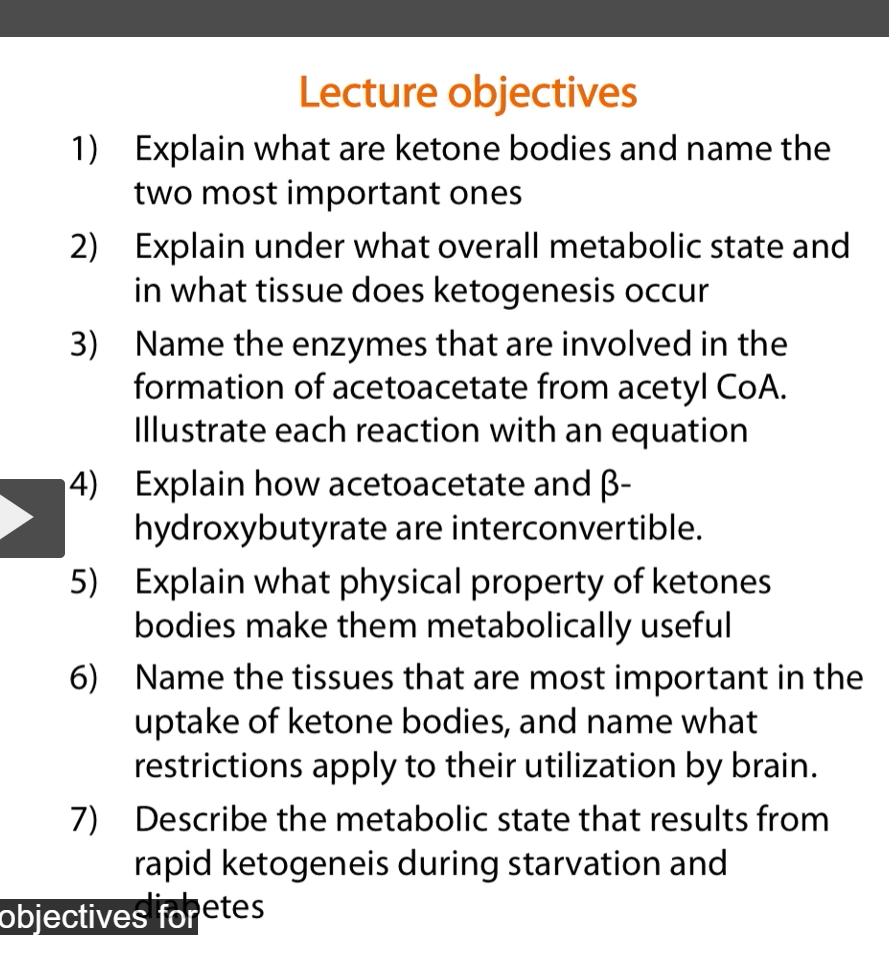
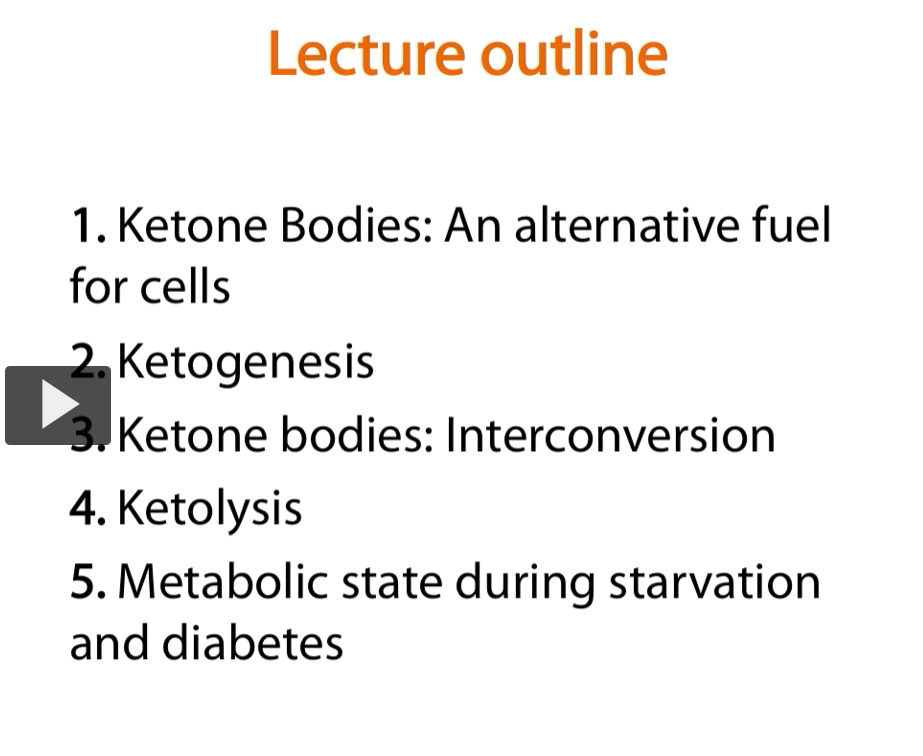
The lecture is going to be divided into 5 subsections.
<p>The lecture is going to be divided into 5 subsections.</p>
3
New cards
term image

Etymology (helps memory)

  • Ketone → from German ā€œKetonā€ (related to acetone)

  • Acetoacetate

    • ā€œAcetoā€ = acetyl group

    • ā€œacetateā€ = derived from acetic acid

  • β-hydroxybutyrate

    • ā€œhydroxyā€ = OH group

    • ā€œbutyrateā€ = 4-carbon chain (butyric acid = butter acid)

  • Acetone

    • simplest ketone (volatile)

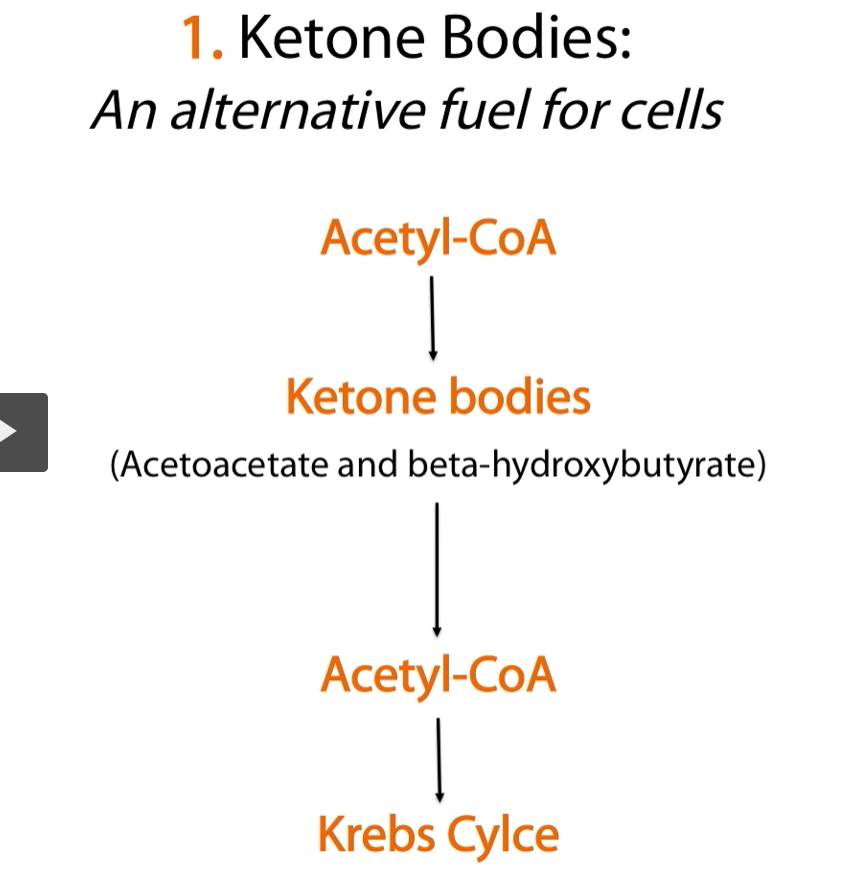
Ketone bodies = alternative fuel molecules made by the liver when glucose is low

ketone bodies are an alternative fuel for cells.

  1. acetyl-CoA is transformed into ketone bodies.

  2. ketone bodies are converted back into acetyl-CoA

  3. acetyl-CoA is able to go back into the Kreb’s Cycle.
<p><u>Etymology (helps memory)</u></p><ul><li><p><strong>Ketone</strong> → from German <em>ā€œKetonā€</em> (related to acetone)</p></li><li><p><strong>Acetoacetate</strong></p><ul><li><p>ā€œAcetoā€ = acetyl group</p></li><li><p>ā€œacetateā€ = derived from acetic acid</p></li></ul></li><li><p><strong>β-hydroxybutyrate</strong></p><ul><li><p>ā€œhydroxyā€ = OH group</p></li><li><p>ā€œbutyrateā€ = 4-carbon chain (<em>butyric acid = butter acid</em>)</p></li></ul></li><li><p><strong>Acetone</strong></p><ul><li><p>simplest ketone (volatile)</p></li></ul></li></ul><p>Ketone bodies = alternative fuel molecules made by the liver when glucose is low</p><p><strong>ketone bodies </strong>are an <strong>alternative fuel </strong>for <strong>cells</strong>.</p><ol><li><p><strong>acetyl-CoA</strong> is <strong>transformed</strong> into <strong>ketone bodies</strong>.</p></li><li><p><strong>ketone bodies</strong> are <strong>converted back </strong>into <strong>acetyl-CoA</strong></p></li><li><p><strong>acetyl-CoA</strong> is able to go <strong>back </strong>into the <strong>Kreb’s Cycle</strong>.</p></li></ol><p></p>
4
New cards
<p><strong>Ketone bodies</strong> have <strong>several properties </strong>that make them a <strong>perfect ideal alternative fuel</strong> for the <strong>cells</strong> when <strong>there is no glucose available</strong> (during <strong>fasting</strong> metabolic states).</p><p><u>Important Properties</u></p><ol><li><p>water soluble</p></li><li><p>freely transported in blood</p></li><li><p>produced by the liver</p></li><li><p>used in the proportion of the concentration they have in the blood</p></li><li><p>Ketone bodies serve as energy sources for most tissues during <strong>carbohydrate deprivation</strong></p></li></ol><p></p>

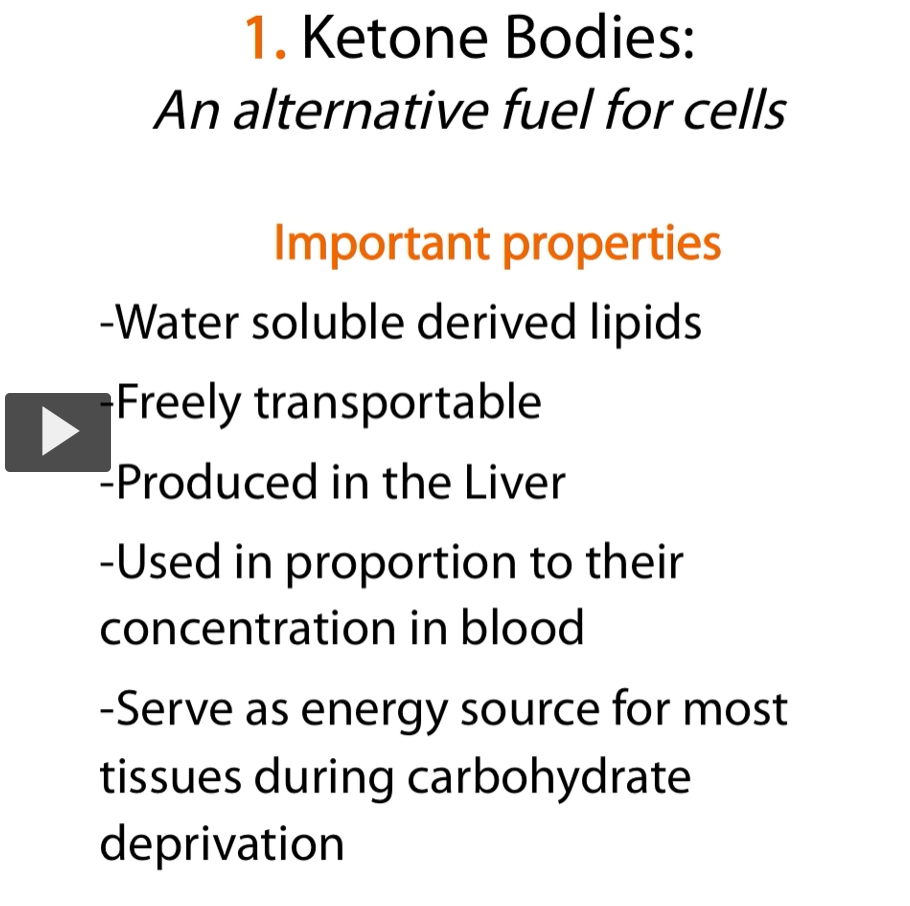
Ketone bodies have several properties that make them a perfect ideal alternative fuel for the cells when there is no glucose available (during fasting metabolic states).

Important Properties

  1. water soluble

  2. freely transported in blood

  3. produced by the liver

  4. used in the proportion of the concentration they have in the blood

  5. Ketone bodies serve as energy sources for most tissues during carbohydrate deprivation

During Starvation

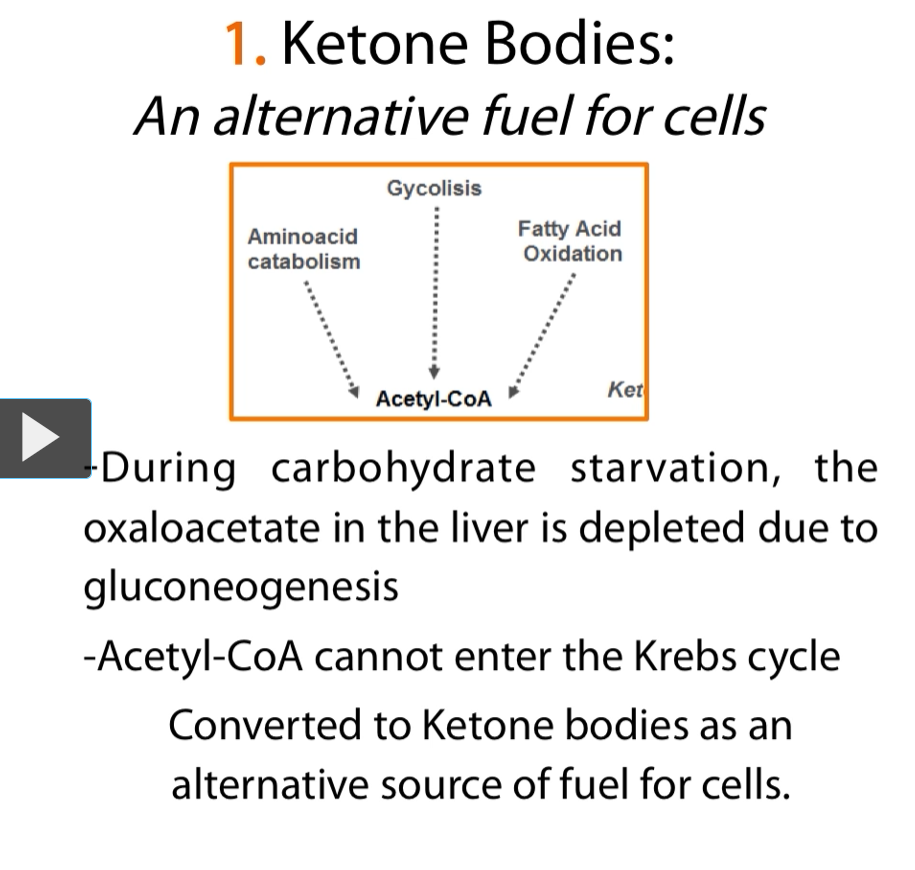
Acetyl-CoA comes from 3 places:

  1. Amino Acid Catabolism (protein catabolism)

  2. Glycolysis (carbohydrate catabolism)

  3. Fatty Acid Oxidation (fatty acid catabolism)

All three of these lead to the production of Acetyl-CoA

During carbohydrate starvation, the liver is flooded with acetyl-CoA from the amino acid catabolism, from glycolysis, from fatty acid oxidation.

However, during the starvation (no glucose coming in) the oxaloacetate in the liver depleted due to gluconeogenesis. (gluconeogenesis uses oxaloacetate, OAA: ā€œentry ticketā€ for acetyl-CoA into Krebs cycle. Problem: Oxaloacetate gets used up, LOW OAA)

5. Meanwhile… fat is being burned like crazy

  • Fat → fatty acids

  • Fatty acids → β-oxidation → lots of acetyl-CoA

6. Acetyl-CoA tries to enter Krebs cycle…

But:

  • No OAA = no entry

  • Krebs cycle slows down

Think: Acetyl-CoA + OAA → citrate (this step is blocked)

7. So acetyl-CoA builds up

Now the liver is like: I have too much acetyl-CoA and nowhere to put it.

8. Solution: convert to ketone bodies

Liver turns excess acetyl-CoA into:

  • Acetoacetate

  • β-hydroxybutyrate

  • Acetone

9. Send ketones to the body

  • Brain uses ketone bodies

  • Muscles use ketone bodies

This saves glucose

Therefore, Acetyl-CoA cannot enter into the Kreb’s cycle and therefore is converted into ketone bodies.
<p><u>During Starvation</u></p><p><strong>Acetyl-CoA</strong> comes from<strong> 3 places:</strong></p><ol><li><p>Amino Acid Catabolism (protein catabolism)</p></li><li><p>Glycolysis (carbohydrate catabolism)</p></li><li><p>Fatty Acid Oxidation (fatty acid catabolism)</p></li></ol><p><strong>All three </strong>of these <strong>lead</strong> to the <strong>production of Acetyl-CoA</strong></p><p><strong>During</strong> <strong>carbohydrate starvation</strong>, the <strong>liver </strong>is <strong>flooded </strong>with <strong>acetyl-CoA</strong> from the <strong>amino acid catabolism, </strong>from <strong>glycolysis, </strong>from <strong>fatty acid oxidation</strong>.</p><p>However, during the <strong>starvation</strong> (no glucose coming in) the<strong> oxaloacetate</strong> in the <strong>liver depleted</strong> due to <strong>gluconeogenesis</strong>. (gluconeogenesis uses oxaloacetate, OAA: ā€œentry ticketā€ for acetyl-CoA into Krebs cycle. Problem: Oxaloacetate gets used up, <strong>LOW OAA</strong>)</p><p>5. Meanwhile… fat is being burned like crazy</p><ul><li><p>Fat → fatty acids</p></li><li><p>Fatty acids → <strong>β-oxidation → lots of acetyl-CoA</strong></p></li></ul><p>6. Acetyl-CoA tries to enter Krebs cycle…</p><p>But:</p><ul><li><p><strong>No OAA</strong> = no entry</p></li><li><p>Krebs cycle slows down</p></li></ul><p>Think: <strong>Acetyl-CoA + OAA → citrate (this step is blocked)</strong></p><p>7. So acetyl-CoA builds up</p><p>Now the liver is like: <strong>I have too much acetyl-CoA</strong> and<strong> nowhere to put it.</strong></p><p>8. Solution: convert to <strong>ketone bodies</strong></p><p>Liver turns excess acetyl-CoA into:</p><ul><li><p>Acetoacetate</p></li><li><p>β-hydroxybutyrate</p></li><li><p>Acetone</p></li></ul><p>9. Send ketones to the body</p><ul><li><p><strong>Brain uses ketone bodies</strong></p></li><li><p><strong>Muscles use ketone bodies</strong></p></li></ul><p>This <strong>saves glucose</strong></p><p>Therefore, <strong>Acetyl-CoA</strong> cannot enter<strong> into the Kreb’s cycle </strong>and therefore is converted into <strong>ketone bodies.</strong></p>
5
New cards
<p><u>What is Ketogenesis</u>?<br><strong>Ketogenesis</strong> is the <strong>production of Ketone bodies</strong> and it <strong>occurs strictly in the liver.</strong></p><p>Here we have the overall diagram but we are going to break it down one by one.</p><ol><li><p><u>During Starvation</u></p><p>Acetyl-CoA comes from 3 places:</p><ol><li><p>amino acid catabolism (protein catabolism)</p></li><li><p>Glycolysis (carbohydrate catabolism)</p></li><li><p>Fatty Acid Oxidation (fatty acid catabolism)</p></li></ol><p>all three of these lead to the production of <strong>Acetyl-CoA</strong></p></li><li><p><strong>2 acetyl-CoA</strong> → 1 <strong>Aceto-Acetyl-CoA</strong> (thiolase enzyme)</p></li></ol><p>If there is a <strong>large amount of acetyl-CoA</strong>, the cell begins to <strong>condense</strong> 2-carbon units together.</p><p>Think of acetyl-CoA as many loose 2-carbon pieces.<br>The <strong>first logical step</strong> is to <strong>join two of them</strong> into a <strong>4-carbon intermediate.</strong></p><p>Why is thiolase used? ā€œThioā€ Sulfur, it takes the SH-CoA off of Acetyl-CoA</p><p>Thiolase is an enzyme that can work in reversible carbon-carbon bond formation/cleavage involving acetyl-CoA units.</p><p>So the reasoning is: ā€œWe have excess 2-carbon acetyl groups. Let’s combine two of them to begin building a ketone body precursor.</p><ol start="3"><li><p><strong>Aceto-acetyl-CoA</strong> +<strong> another acetyl-CoA</strong> →<strong> HMG-CoA</strong></p></li></ol><p><strong>Enzyme: HMG-CoA synthase</strong></p><p>Reaction idea:</p><p>Acetoacetyl-CoA + acetyl-CoA → HMG-CoA<br>(3-hydroxy-3-methylglutaryl-CoA)</p><p>Why add another acetyl-CoA?</p><p>Now the pathway is building a larger intermediate that can be <strong>rearranged and split</strong> into the<strong> first true ketone body.</strong></p><p>This step takes the 4-carbon acetoacetyl-CoA and adds one more 2-carbon unit, producing a <strong>6-carbon intermediate</strong>.</p><p>Why is HMG-CoA important?</p><p><strong>HMG-CoA </strong>is the <strong>committed ketogenesis intermediate</strong> in <strong>liver mitochondria.</strong></p><p>This step is basically: ā€œLet’s convert excess acetyl-CoA into a specialized molecule designed to be split into ketone bodies.ā€</p><p>Clinical/high-yield note</p><p><strong>HMG-CoA synthase</strong> is the <strong>key regulated enzyme of ketogenesis.</strong></p><p></p>

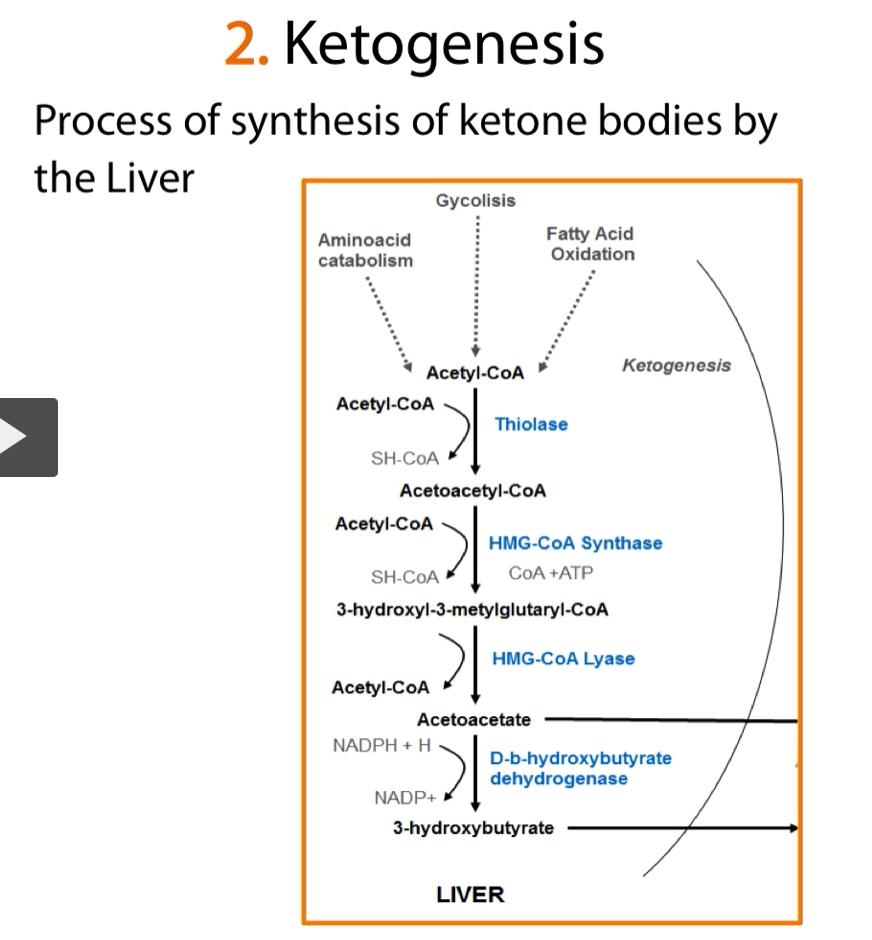
What is Ketogenesis?
Ketogenesis is the production of Ketone bodies and it occurs strictly in the liver.

Here we have the overall diagram but we are going to break it down one by one.

  1. During Starvation

    Acetyl-CoA comes from 3 places:

    1. amino acid catabolism (protein catabolism)

    2. Glycolysis (carbohydrate catabolism)

    3. Fatty Acid Oxidation (fatty acid catabolism)

    all three of these lead to the production of Acetyl-CoA

  2. 2 acetyl-CoA → 1 Aceto-Acetyl-CoA (thiolase enzyme)

If there is a large amount of acetyl-CoA, the cell begins to condense 2-carbon units together.

Think of acetyl-CoA as many loose 2-carbon pieces.
The first logical step is to join two of them into a 4-carbon intermediate.

Why is thiolase used? ā€œThioā€ Sulfur, it takes the SH-CoA off of Acetyl-CoA

Thiolase is an enzyme that can work in reversible carbon-carbon bond formation/cleavage involving acetyl-CoA units.

So the reasoning is: ā€œWe have excess 2-carbon acetyl groups. Let’s combine two of them to begin building a ketone body precursor.

  1. Aceto-acetyl-CoA + another acetyl-CoA → HMG-CoA

Enzyme: HMG-CoA synthase

Reaction idea:

Acetoacetyl-CoA + acetyl-CoA → HMG-CoA
(3-hydroxy-3-methylglutaryl-CoA)

Why add another acetyl-CoA?

Now the pathway is building a larger intermediate that can be rearranged and split into the first true ketone body.

This step takes the 4-carbon acetoacetyl-CoA and adds one more 2-carbon unit, producing a 6-carbon intermediate.

Why is HMG-CoA important?

HMG-CoA is the committed ketogenesis intermediate in liver mitochondria.

This step is basically: ā€œLet’s convert excess acetyl-CoA into a specialized molecule designed to be split into ketone bodies.ā€

Clinical/high-yield note

HMG-CoA synthase is the key regulated enzyme of ketogenesis.

Again, here is a different type of diagram for you to have the chemical structures of the compounds that go into this ketone body formation.
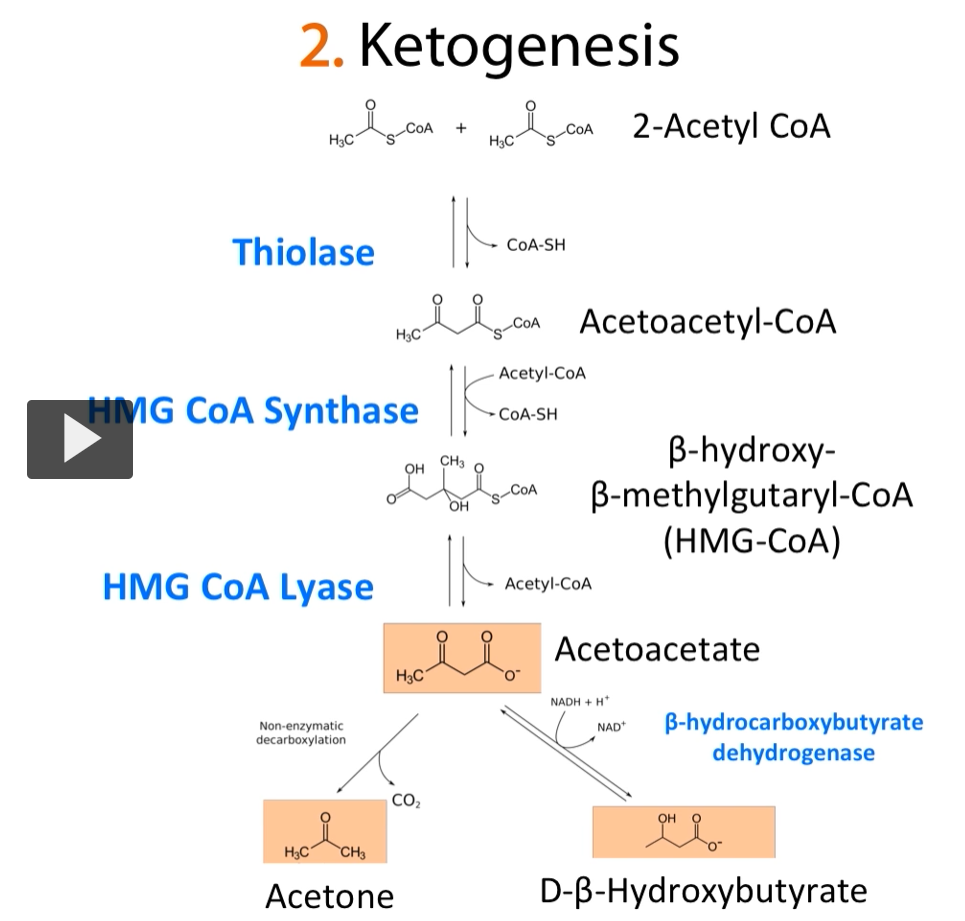
<p>Again, here is a <strong>different type of diagram</strong> for you to have the <strong>chemical structures </strong>of the <strong>compounds </strong>that go into this <strong>ketone body formation.</strong></p>
6
New cards
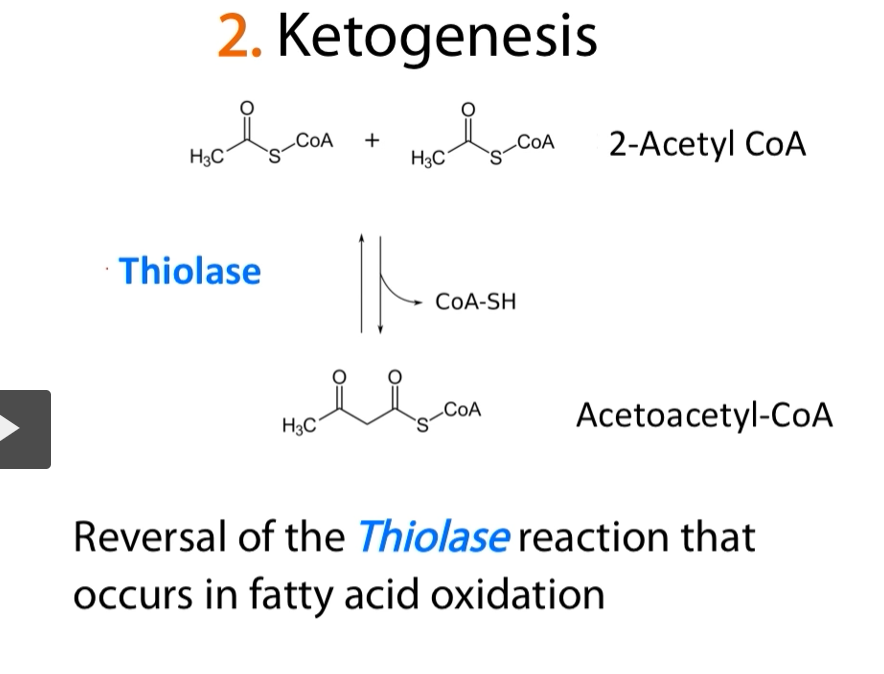
<p><u>thiolase (I think this is step 1 of ketone body formation)?</u></p><ol><li><p><strong>2 acetyl-CoA</strong> → 1 <strong>Aceto-Acetyl-CoA</strong> (thiolase enzyme)</p></li></ol><p><strong>Thiolase</strong> takes <strong>2-Acetyl-CoA </strong>and <strong>converts them </strong>and <strong>combines them </strong>to form <strong>aceto-acetyl-CoA</strong>.</p><p>This is a <strong>reversible reaction</strong>.</p>

thiolase (I think this is step 1 of ketone body formation)?

  1. 2 acetyl-CoA → 1 Aceto-Acetyl-CoA (thiolase enzyme)

Thiolase takes 2-Acetyl-CoA and converts them and combines them to form aceto-acetyl-CoA.

This is a reversible reaction.

(step 2)

The next step in ketogenesis is carried out by the HMG-CoA synthase

it takes the aceto-acetyl-CoA, binds it to another molecule of acetyl-CoA to form HMG-CoA.

-step 2 is the rate limiting step of Ketogenesis and this only present in significant quantities in the liver, therefore, the liver is the only organ that can produce these ketone bodies.
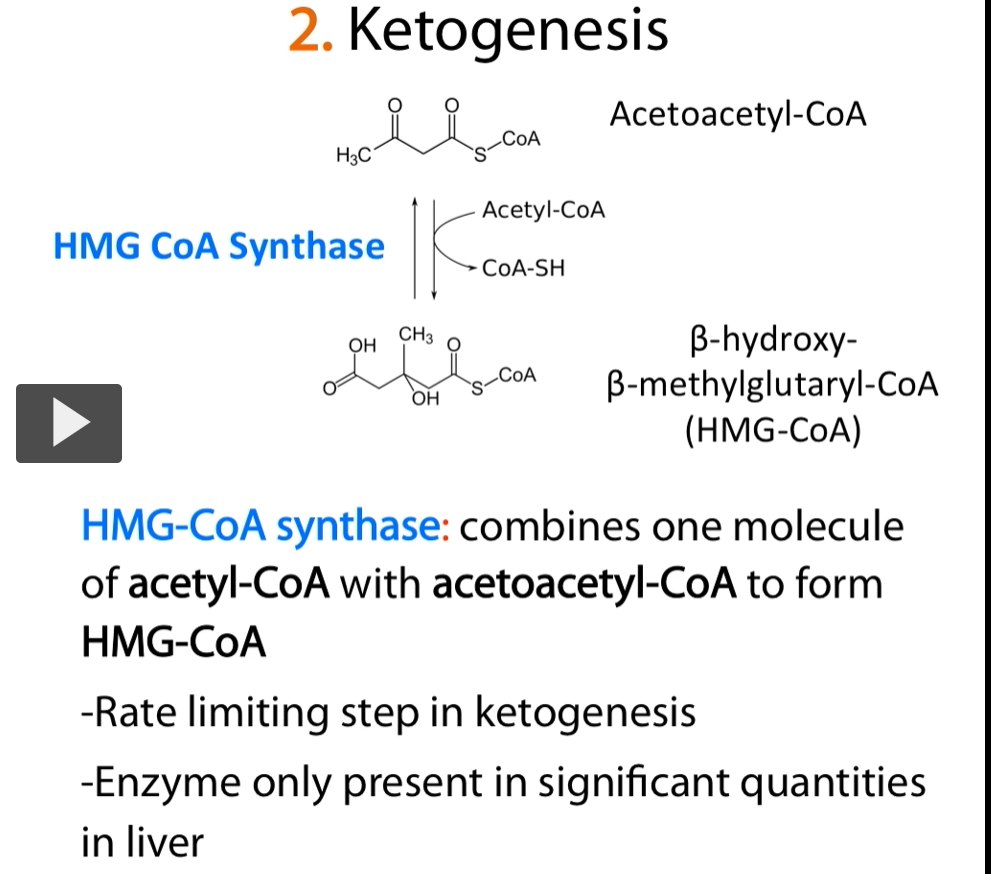
<p><u>(step 2)</u></p><p>The next step in <strong>ketogenesis </strong>is <strong>carried out</strong> by the <strong>HMG-CoA synthase</strong></p><p>it takes the <strong>aceto-acetyl-CoA</strong>, binds it to <strong>another molecule of acetyl-CoA</strong> to form <strong>HMG-CoA</strong>.</p><p><strong>-step 2</strong> is the <strong>rate limiting step of Ketogenesis</strong> and this <strong>only present </strong>in <strong>significant quantities in the liver</strong>, therefore, the<strong> liver </strong>is the <strong>only organ </strong>that can <strong>produce these ketone bodies</strong>.</p>
7
New cards
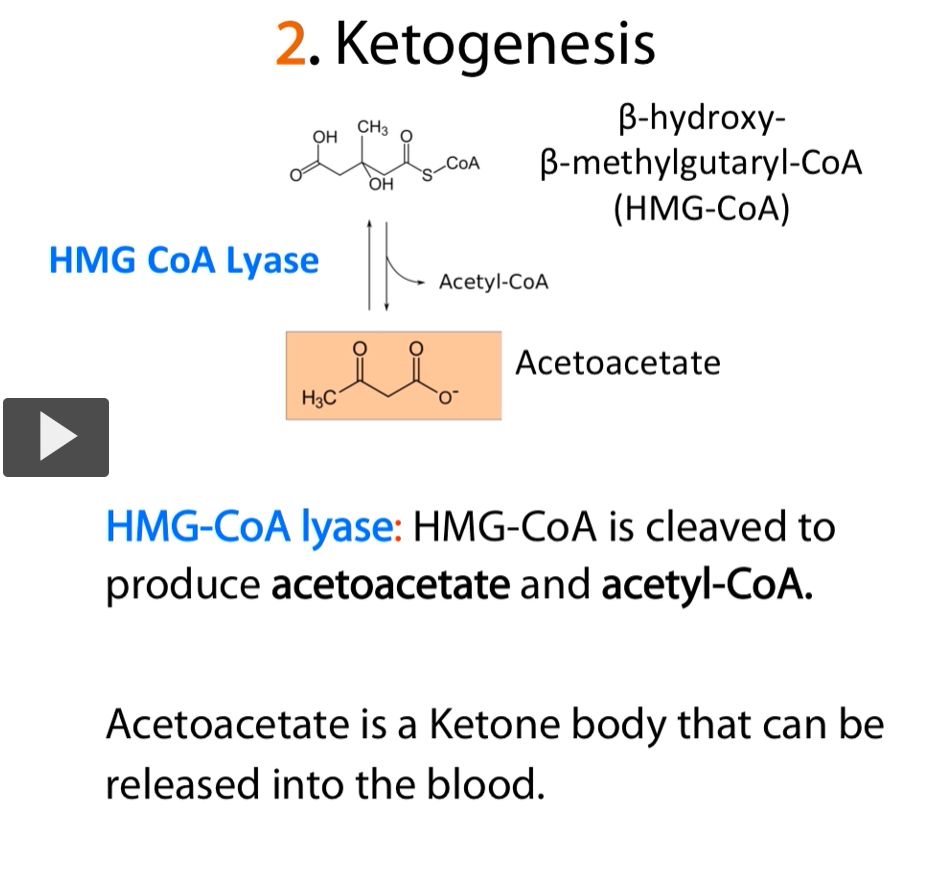
<p><u>Next step (step 3)</u></p><p>The next step takes the <strong>HMG-CoA</strong> and converts it into <strong>aceto-acetate.</strong> This is done by the enzyme called <strong>HMG-CoA lyase.</strong></p><p>Lyase = enzyme that breaks a bond WITHOUT using water or ATP</p><p>The <strong>aceto-acetate</strong> is the <strong>first ketone body </strong>that is <strong>produced by the liver</strong> and <strong>can already be exported</strong> into the <strong>bloodstream </strong>for the usage by <strong>peripheral tissues</strong>.</p>

Next step (step 3)

The next step takes the HMG-CoA and converts it into aceto-acetate. This is done by the enzyme called HMG-CoA lyase.

Lyase = enzyme that breaks a bond WITHOUT using water or ATP

The aceto-acetate is the first ketone body that is produced by the liver and can already be exported into the bloodstream for the usage by peripheral tissues.

Ketone Bodies Interconversion

Aceto-Acetate (first ketone body produced) however, can be converted into another ketone body and into acetone, and we will see how that happens in the next slide.
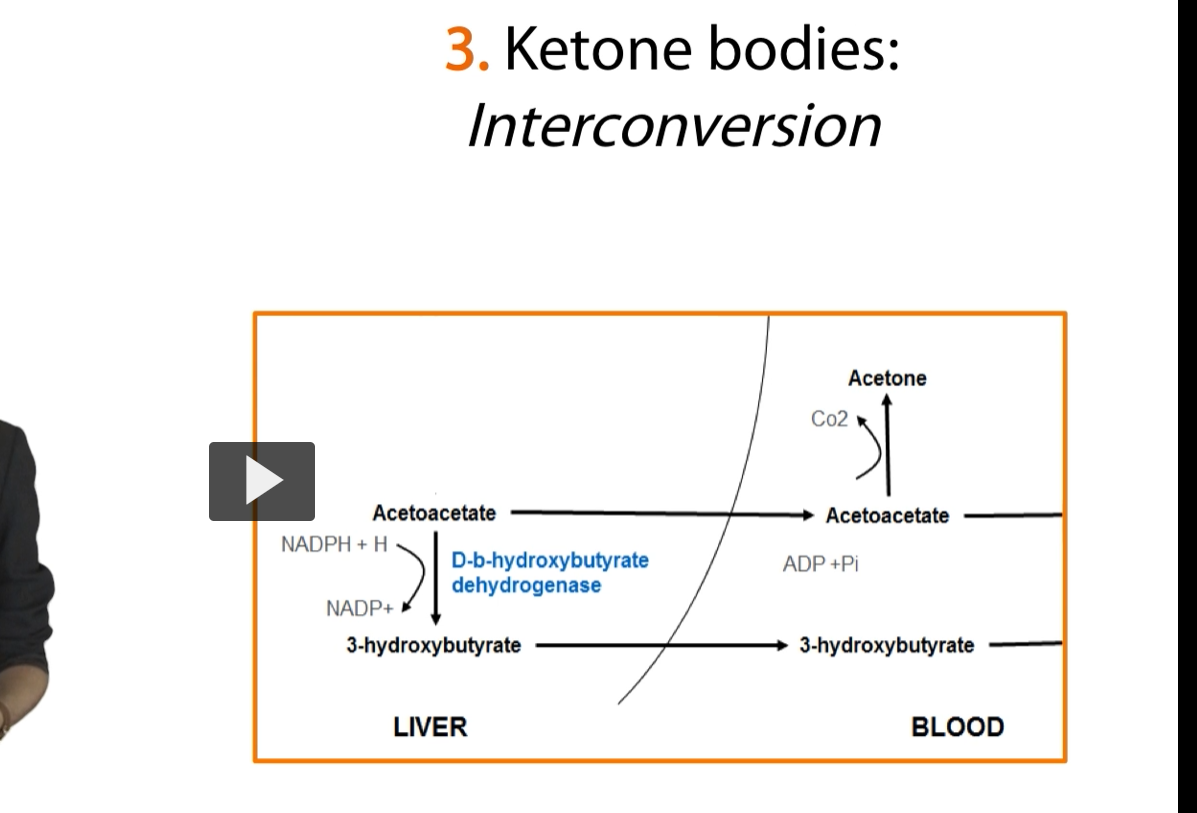
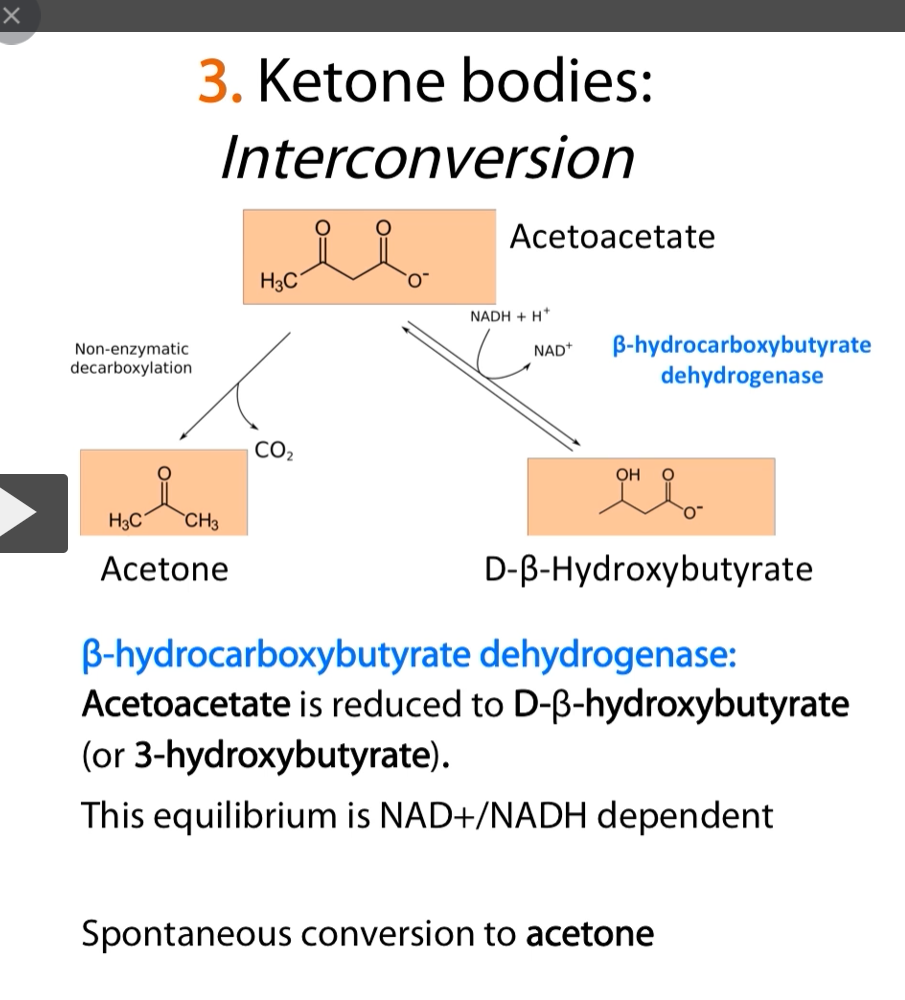
<p><u>Ketone Bodies Interconversion</u></p><p><strong>Aceto-Acetate </strong>(first ketone body produced) however, can be converted into <strong>another ketone body</strong> and into <strong>acetone</strong>, and we will see how that happens in the next slide.</p>
8
New cards
<p><u>Aceto-acetate into acetone</u></p><p><strong>Aceto-acetate</strong> can be <strong>converted </strong>into<strong> D-B-hydroxybutyrate </strong>and into <strong>acetone</strong> by <strong>B-hydrocarboxybutarate dehydrogenase .</strong></p><p><strong>B-hydrocarboxybutarate dehydrogenase</strong></p><p>-makes <strong>D-B-hydroxybutyrate</strong></p><p><strong>-dehydrogenates NADH</strong></p><p>The <strong>equilibrium</strong> between <strong>aceto-acetate</strong> and <strong>D-B-hydroxybutyrate </strong>is <strong>determined by </strong>the <strong>NAD+/NADH equilibrium</strong> in the cell. </p><p><strong>NAD<u>H</u> drives reduction → makes β-hydroxybutyrate</strong><br><strong>NAD⁺ drives oxidation → makes acetoacetate</strong></p><p><u>Aceto-acetate released into blood</u></p><p><strong>Acetone</strong> is formed <strong>spontaneously </strong>and it’s a <strong>molecule </strong>that is formed through the <strong>breathe </strong>of the <strong>patient</strong>.</p><p><strong>Acetoacetate </strong>is <strong>unstable</strong> because it is a<strong> β-keto acid</strong>, and at <strong>physiological conditions</strong> it can <strong>spontaneously decarboxylate</strong> to <strong>form acetone.</strong></p><p><strong>COā‚‚ is released</strong> in this<strong> reaction </strong>and is <strong>transported in the blood to the lungs</strong>, where it is <strong>exhaled.</strong></p><p><strong>Acetone</strong> is also<strong> exhaled</strong>, because it is is <strong>volatile </strong>and <strong>cannot be used for energy</strong>, so it is <strong>released into the bloodstream</strong> and <strong>excreted</strong> through the <strong>lungs</strong>, causing a <strong>characteristic fruity breath.</strong></p>

Aceto-acetate into acetone

Aceto-acetate can be converted into D-B-hydroxybutyrate and into acetone by B-hydrocarboxybutarate dehydrogenase .

B-hydrocarboxybutarate dehydrogenase

-makes D-B-hydroxybutyrate

-dehydrogenates NADH

The equilibrium between aceto-acetate and D-B-hydroxybutyrate is determined by the NAD+/NADH equilibrium in the cell.

NADH drives reduction → makes β-hydroxybutyrate
NAD⁺ drives oxidation → makes acetoacetate

Aceto-acetate released into blood

Acetone is formed spontaneously and it’s a molecule that is formed through the breathe of the patient.

Acetoacetate is unstable because it is a β-keto acid, and at physiological conditions it can spontaneously decarboxylate to form acetone.

COā‚‚ is released in this reaction and is transported in the blood to the lungs, where it is exhaled.

Acetone is also exhaled, because it is is volatile and cannot be used for energy, so it is released into the bloodstream and excreted through the lungs, causing a characteristic fruity breath.

Ketolysis

Next is ketolysis. (peripheral tissues metabolizing ketone bodies, turning them BACK into acetyl-CoA)

  1. The ketone bodies have been produced in the liver

  2. The ketone bodies have been exported into the bloodstream

  3. The peripheral tissues (skeletal muscles, renal cortex of the kidney, and brain) can use those ketone bodies as an alternative source of energy

The main tissues that use ketone bodies are skeletal muscles, renal cortex, and the brain (if the brain really needs to).
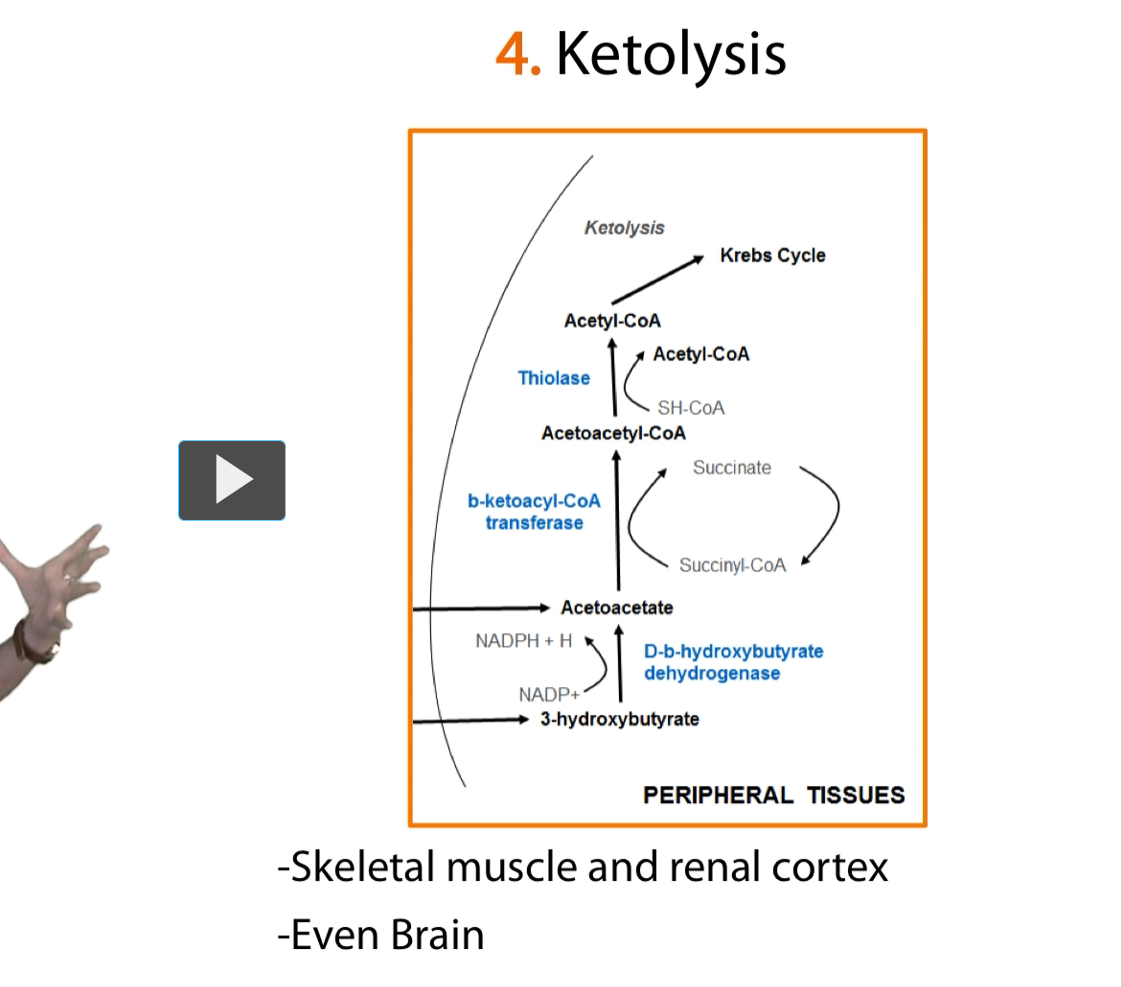
<p><u>Ketolysis</u></p><p>Next is <strong>ketolysis</strong>. (peripheral tissues metabolizing ketone bodies, turning them BACK into acetyl-CoA)</p><ol><li><p>The<strong> ketone bodies</strong> have been<strong> produced </strong>in the <strong>liver</strong></p></li><li><p>The <strong>ketone bodies</strong> have been<strong> exported</strong> into the<strong> bloodstream</strong></p></li><li><p>The <strong>peripheral tissues (skeletal muscles, renal cortex of the kidney, </strong>and <strong>brain</strong>) can <strong>use those ketone bodies</strong> as an <strong>alternative source of energy</strong></p></li></ol><p>The main tissues that use ketone bodies are <strong>skeletal muscles</strong>, <strong>renal cortex</strong>, and the <strong>brain</strong> (if the brain really needs to).</p>
9
New cards
<p><u>Ketolysis continued</u></p><p>This process is depicted here. depending on what ketone body enters the cell, if it’s <strong>3-hydrobutarate</strong> or<strong> aceto-acetate</strong> that have to be <strong>interconverted</strong> as we saw in the previous slide.</p><ol start="2"><li><p>Then the <strong>aceto-acetate</strong> has to be <strong>converted </strong>into <strong>acetoacetyl-CoA </strong>(though the enzyme <strong>Succinyl-CoA acetoacetate</strong> CoA transferase) and it’s <strong>helped</strong> by the <strong>Succinyl-CoA molecule</strong>.</p></li></ol><p><span><strong>Succinyl-CoA ketolysis</strong> is </span><mark data-color="rgba(0, 0, 0, 0)" style="background-color: rgba(0, 0, 0, 0); color: inherit;">a crucial metabolic pathway in peripheral tissues (brain, kidney, muscle) that </mark><strong><mark data-color="rgba(0, 0, 0, 0)" style="background-color: rgba(0, 0, 0, 0); color: inherit;">converts ketone bodies (acetoacetate)</mark></strong><mark data-color="rgba(0, 0, 0, 0)" style="background-color: rgba(0, 0, 0, 0); color: inherit;"> back into </mark><strong><mark data-color="rgba(0, 0, 0, 0)" style="background-color: rgba(0, 0, 0, 0); color: inherit;">acetyl-CoA</mark></strong><mark data-color="rgba(0, 0, 0, 0)" style="background-color: rgba(0, 0, 0, 0); color: inherit;"> for ATP energy production, using </mark><strong><mark data-color="rgba(0, 0, 0, 0)" style="background-color: rgba(0, 0, 0, 0); color: inherit;">succinyl-CoA</mark></strong><mark data-color="rgba(0, 0, 0, 0)" style="background-color: rgba(0, 0, 0, 0); color: inherit;"> as a </mark><strong><mark data-color="rgba(0, 0, 0, 0)" style="background-color: rgba(0, 0, 0, 0); color: inherit;">CoA donor</mark></strong><span><strong>.</strong></span></p><ol start="2"><li><p><strong>acetoacetyl-CoA </strong>gets <strong>converted </strong>into <strong>2 molecules</strong> of <strong>acetyl-CoA</strong> through <strong>thiolase</strong></p></li><li><p><strong>2 acetyl-CoA </strong>goes into the <strong>Kreb’s Cycle</strong> in the <strong>mitochondria</strong> of the peripheral tissues</p></li></ol><p>-Therefore, <strong>organs</strong> and<strong> cells</strong> that <strong>don’t have mitochondria</strong> <strong>cannot do the kreb’s cycle </strong>and therefore <strong>cannot</strong> <strong>use ketone bodies</strong> as a<strong> source of energy</strong>. </p>

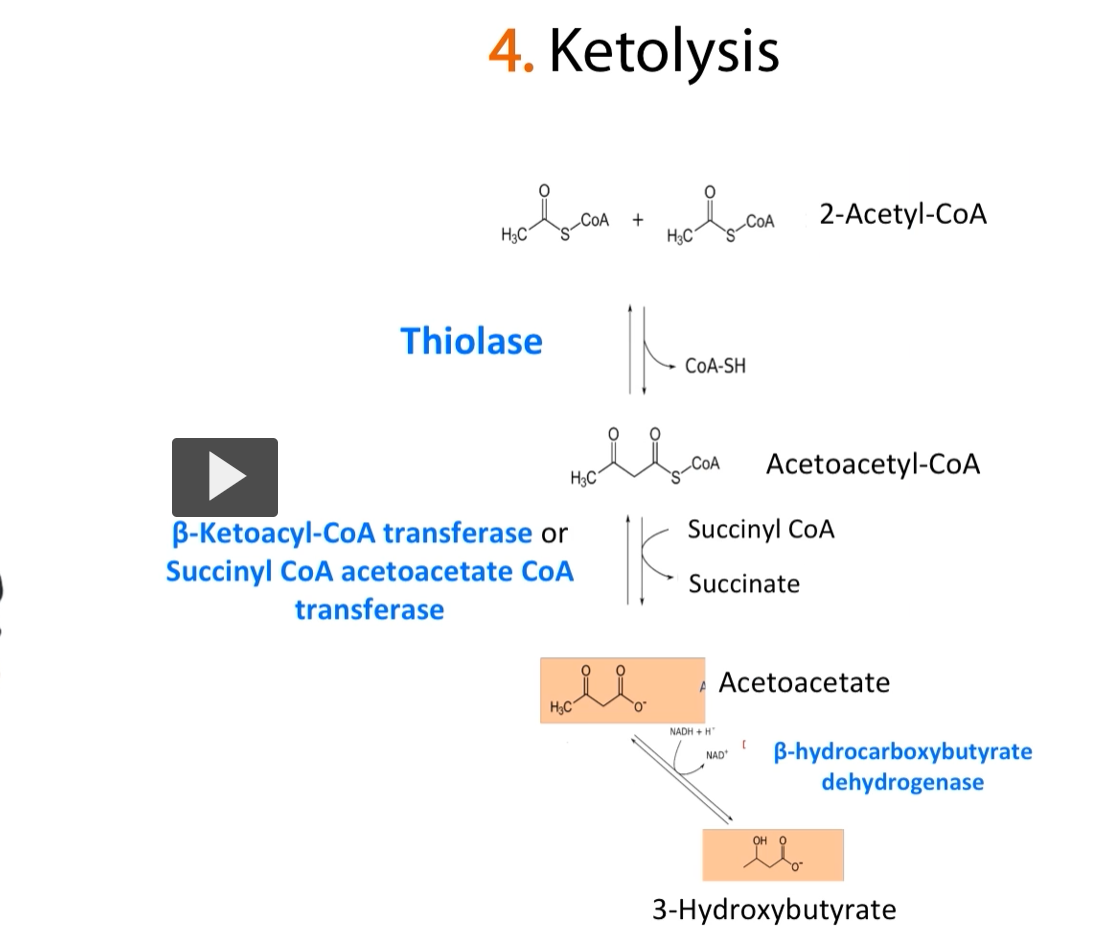
Ketolysis continued

This process is depicted here. depending on what ketone body enters the cell, if it’s 3-hydrobutarate or aceto-acetate that have to be interconverted as we saw in the previous slide.

  1. Then the aceto-acetate has to be converted into acetoacetyl-CoA (though the enzyme Succinyl-CoA acetoacetate CoA transferase) and it’s helped by the Succinyl-CoA molecule.

Succinyl-CoA ketolysis is a crucial metabolic pathway in peripheral tissues (brain, kidney, muscle) that converts ketone bodies (acetoacetate) back into acetyl-CoA for ATP energy production, using succinyl-CoA as a CoA donor.

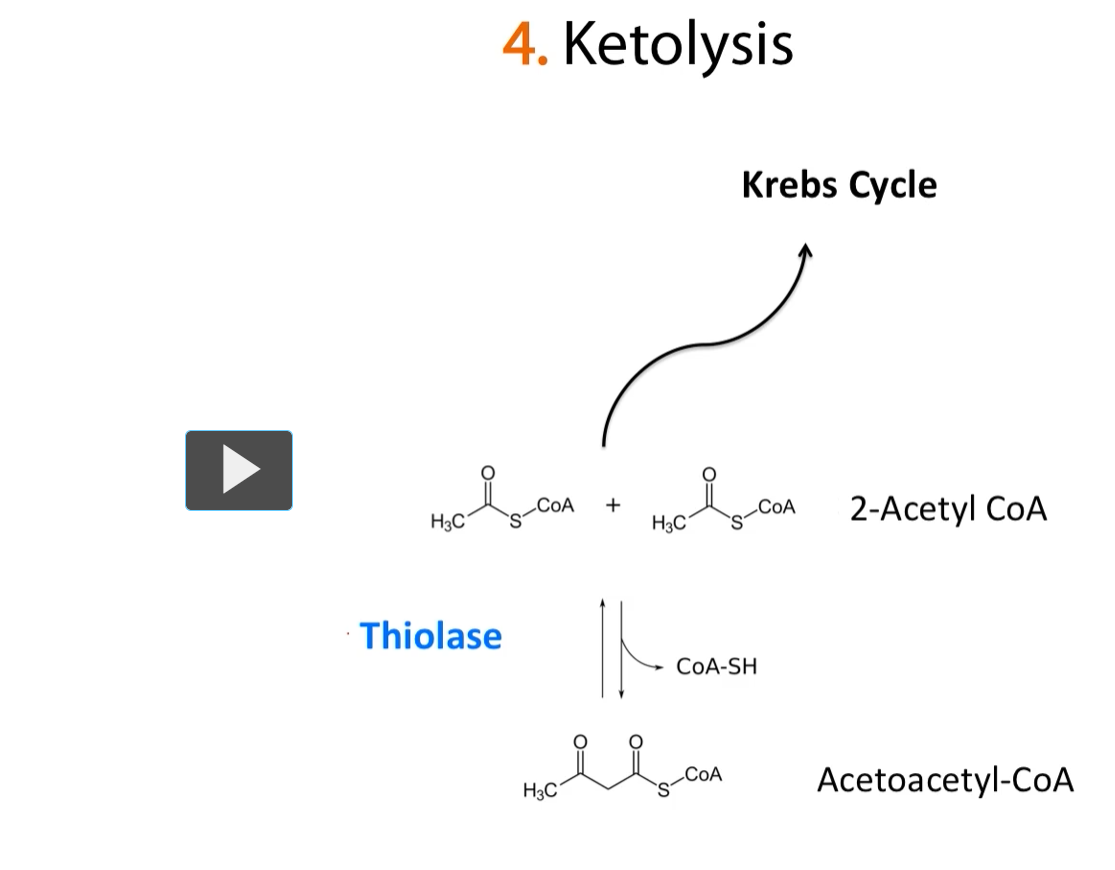
  1. acetoacetyl-CoA gets converted into 2 molecules of acetyl-CoA through thiolase

  2. 2 acetyl-CoA goes into the Kreb’s Cycle in the mitochondria of the peripheral tissues

-Therefore, organs and cells that don’t have mitochondria cannot do the kreb’s cycle and therefore cannot use ketone bodies as a source of energy.

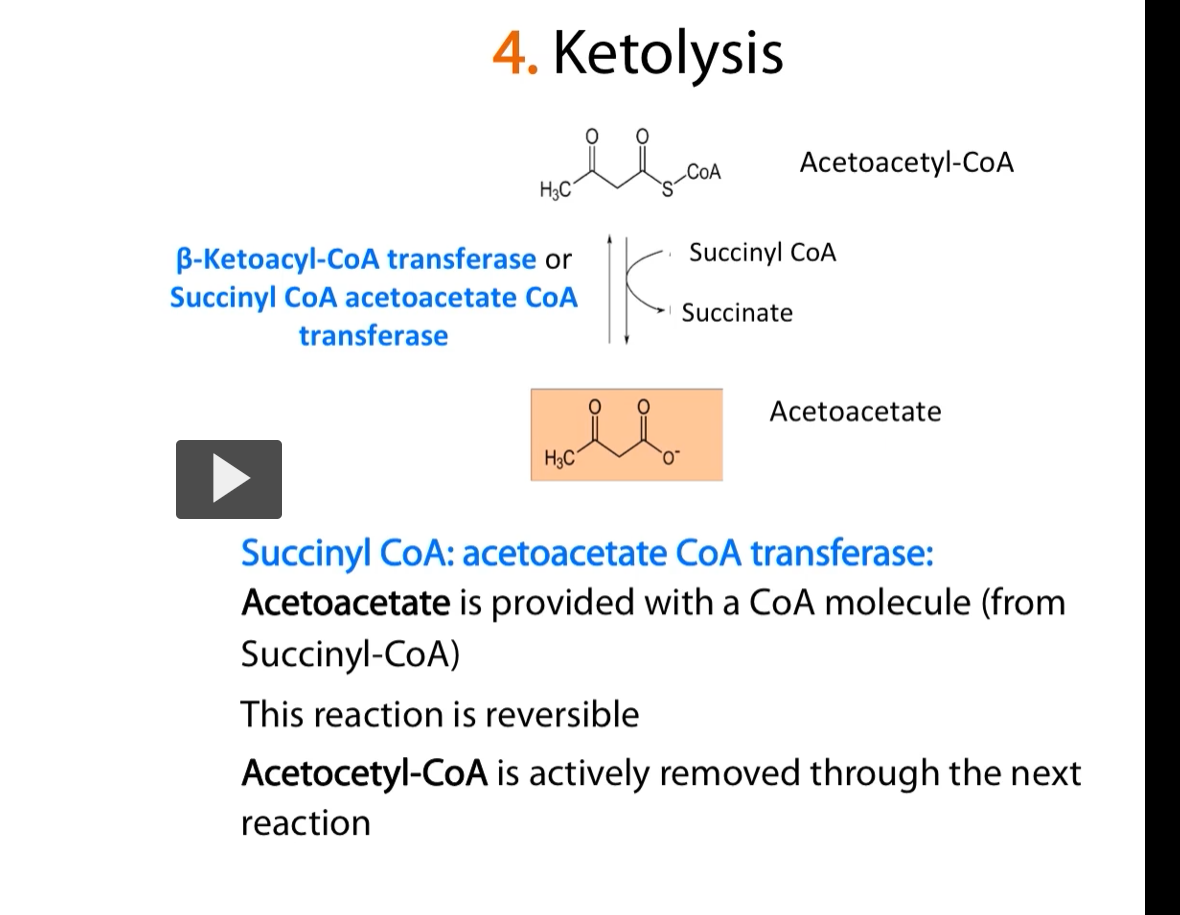
Just to break it down into smaller steps, here is the conversion of acetoacetate into 3-hydroxybutarate

-this was the first reaction on the bottom of the last slide.
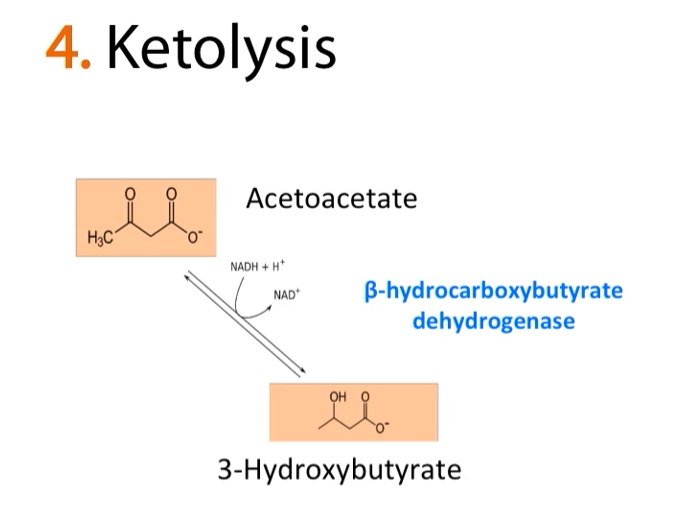
<p>Just to break it down into smaller steps, here is the conversion of <strong>acetoacetate</strong> into <strong>3-hydroxybutarate</strong></p><p>-this was the first reaction on the bottom of the last slide.</p>
10
New cards
<p>Here is the conversion from <strong>aceto-acetyl-CoA </strong>to <strong>aceto-acetate</strong>, and this is a <strong>reversible reaction.</strong></p><p>But the good thing about this reaction in the cells is the <strong>aceto-acetyl-CoA </strong>is <strong>actively removed </strong>to the next reaction <strong>very quickly</strong>.</p>

Here is the conversion from aceto-acetyl-CoA to aceto-acetate, and this is a reversible reaction.

But the good thing about this reaction in the cells is the aceto-acetyl-CoA is actively removed to the next reaction very quickly.

question

the correct answer is C) in most cells in the mitochondria for the Kreb’s cycle

-this is a Kreb’s cycle enzyme
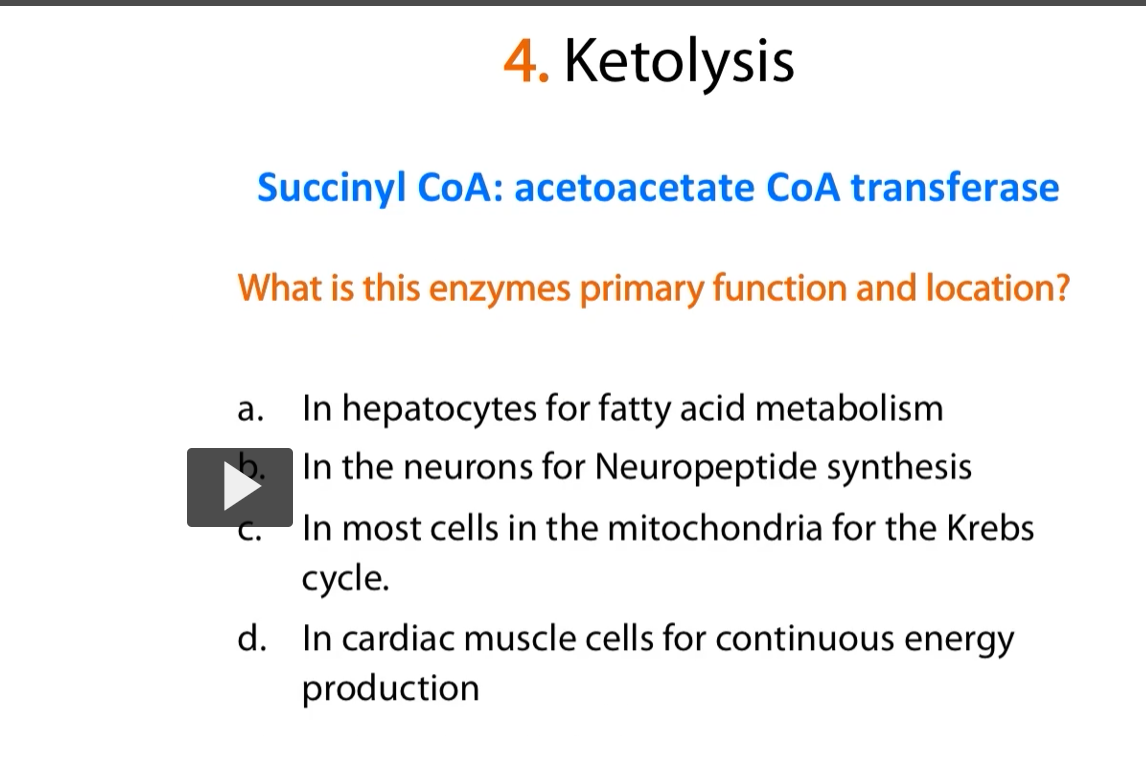
<p><u>question</u></p><p>the correct answer is C) in most cells in the mitochondria for the Kreb’s cycle </p><p>-this is a Kreb’s cycle enzyme </p>
11
New cards
<p>after the aceto-acetyl-CoA is converted into the two molecules of acetyl-CoA  through the enzyme thiolase, these acetyl-CoAs can then go into the Kreb’s Cycle for energy production. </p>

after the aceto-acetyl-CoA is converted into the two molecules of acetyl-CoA through the enzyme thiolase, these acetyl-CoAs can then go into the Kreb’s Cycle for energy production.

question

name two types of cells that cannot use ketone bodies as an energy source:

  1. red blood cells (because they don’t have mitochondria)

  2. hepatocytes (because they don’t have the succinyl-coa-acetoacetate CoA transferase enzyme)
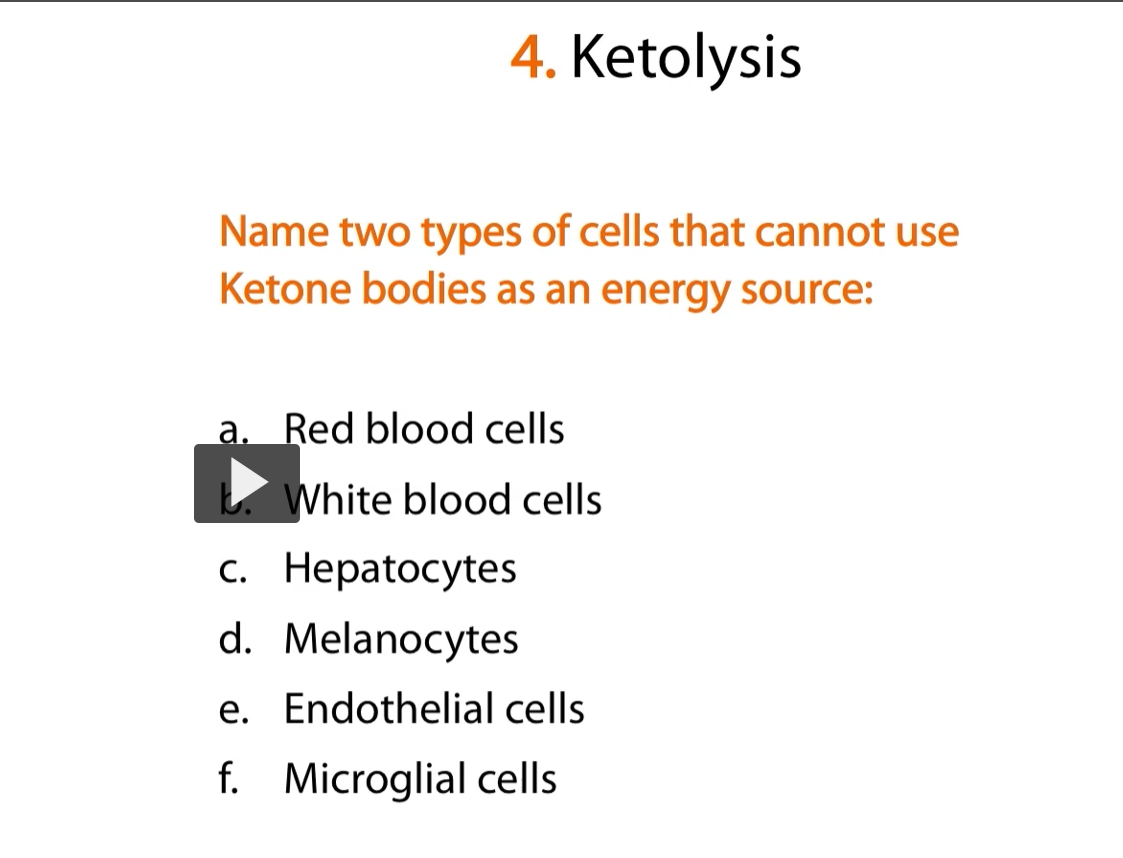
<p><u>question</u></p><p>name two types of cells that <strong>cannot </strong>use <strong>ketone bodies</strong> as an <strong>energy source</strong>: </p><ol><li><p><strong>red blood cells </strong>(because they don’t have mitochondria)</p></li><li><p> <strong>hepatocytes </strong>(because they don’t have the succinyl-coa-acetoacetate CoA transferase enzyme)</p></li></ol><p></p>
12
New cards
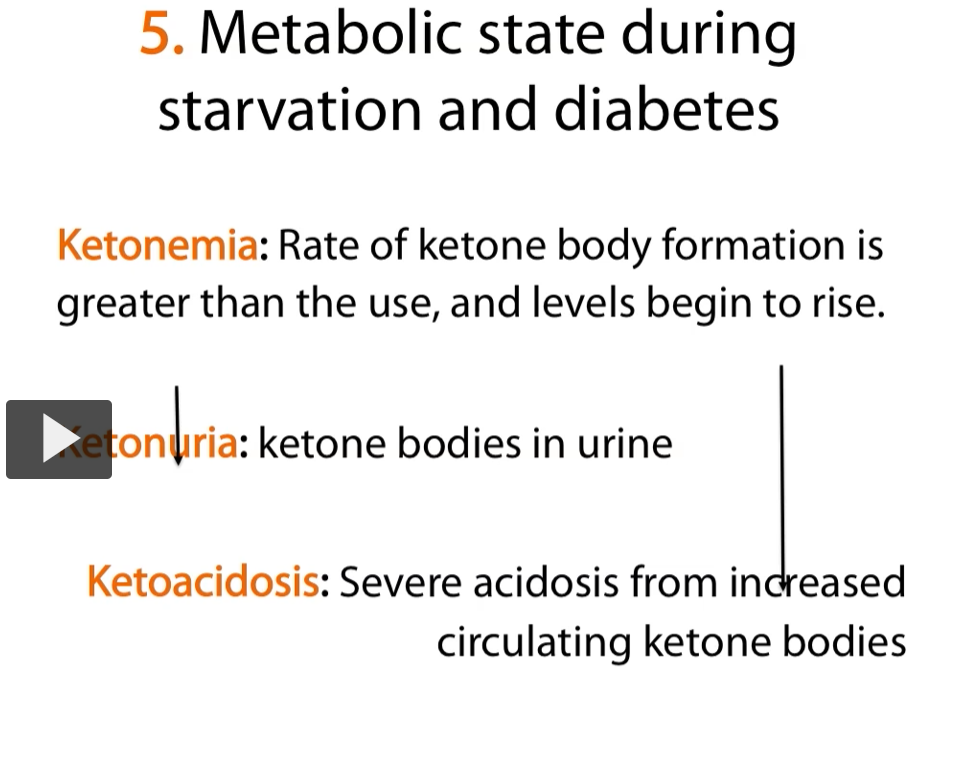
<p><u>metabolic state during starvation and diabetes</u></p><p>very important in disease processes, it’s important for you to know these three concepts. </p><ol><li><p>Ketonemia: the rate of ketone body formation is greater than the use, therefore the levels begin to rise. </p></li><li><p>ketonuria: ketone bodies are found in urine.</p></li><li><p>Ketoacidosis: severe acidosis in the blood of the patient due to increased circulating bodies. </p></li></ol><p></p>

metabolic state during starvation and diabetes

very important in disease processes, it’s important for you to know these three concepts.

  1. Ketonemia: the rate of ketone body formation is greater than the use, therefore the levels begin to rise.

  2. ketonuria: ketone bodies are found in urine.

  3. Ketoacidosis: severe acidosis in the blood of the patient due to increased circulating bodies.

untreated diabetes

during uncontrolled diabetes or prolonged states of fasting what happens is decrease in insulin and an increase in glucagon and there is an increase of fatty acid synthesis in plasma, and so the hepatic output of ketone bodies is increased and therefore the patient suffers from ketoacidosis.

-this is something that you need to be aware of for untreated diabetes.
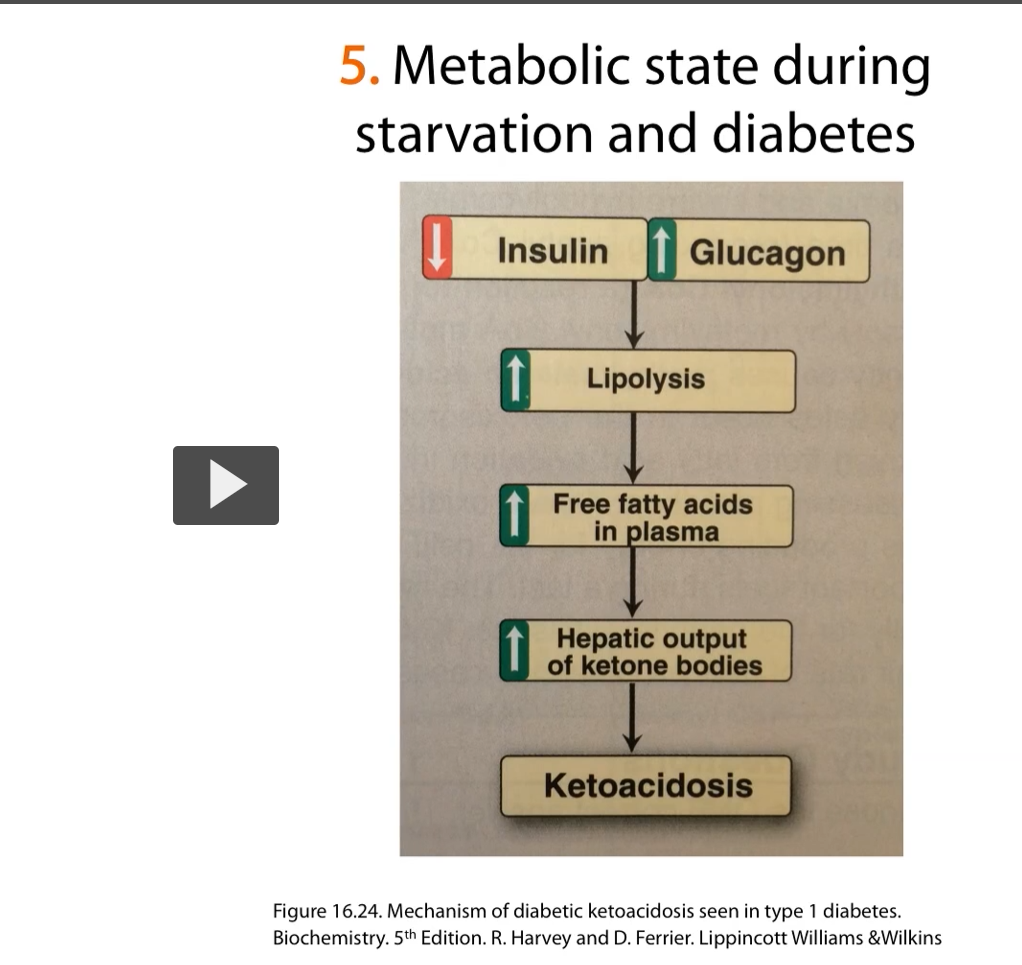
<p><u>untreated diabetes</u></p><p>during <strong>uncontrolled diabetes </strong>or <strong>prolonged states of fasting</strong> what happens is <strong>decrease in insulin</strong> and an <strong>increase </strong>in <strong>glucagon</strong> and there is an <strong>increase</strong> of <strong>fatty acid synthesis </strong>in <strong>plasma</strong>, and so the <strong>hepatic output </strong>of <strong>ketone bodies </strong>is <strong>increased</strong> and therefore the <strong>patient suffers from ketoacidosis</strong>. </p><p>-this is something that you need to be aware of for <strong>untreated diabetes</strong>. </p>