Introduction to molecular microbiological techniques (EXAM 2)
 Call Kai
 Learn
Learn Practice Test
 Spaced Repetition
 Match
Match Flashcards
 Knowt Play
1/64

There's no tags or description
Looks like no tags are added yet.
Name | Mastery | Learn | Test | Matching | Spaced | Call with Kai |
|---|
No analytics yet
Send a link to your students to track their progress
65 Terms
Central dogma
DNA -transcription→ RNA -translation→ Proteins
Genetic material
Carries information that code for all necessary components and reactions of life
DNA is in
Bacteria and higher organisms
DNA or RNA is in
Viruses
Replicon
Any DNA molecule that can replicate as a discrete genetic unit
chromsome; plasmids;viral nucleic acids
Gene
Segment of DNA molecule that in code for a particular protein or RNA
Gene expression
Process by which information encoded in a gene is converted into a protein or RNA
Genotype
The complete set of genetics determinants of an organism
Phenotype
All the observable characteristics of an organism
Protein
Built from a repertoire of 20 amino acids
Proteins fold into complex structure
Secondary, tertiary and quaternary
Protein functions
Structural, enyzmes, signaling, attachment, transport
DNA
Deoxyribose nucleic acid, double helix, A-T G-C, polymer of deoxyribose nucleotides linked by phosphodiester bonds
DNA sense/coding strand
The strand that carry genes that are translatable
What are codons and how many?
Codons are the three letter coding system and some sequences act as signals such as promoters, terminators, start codon and stop codon. 64 codons
Antisense/template DNA strand
Used as RNA template, RNA polymerase reads
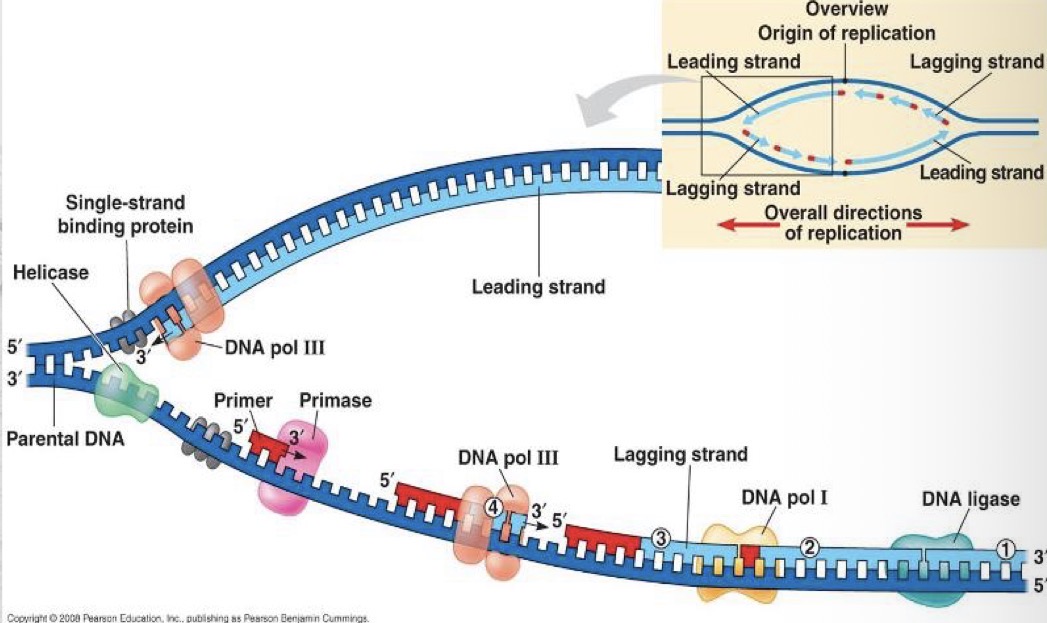
DNA replication fork
Y-shaped active region where the double helix of DNA unwinds to allow enzymes to create complementary copies of the genetic code
RNA
Ribose nucleic acid, a polymer of ribose nucleotides linked by phosphodiester bonds, single stranded, A-U G-C
Types of RNA
Messenger RNA, ribosomal RNA, transfer RNA
Gene expression (protein synthesis)
Two steps: transcription, translation
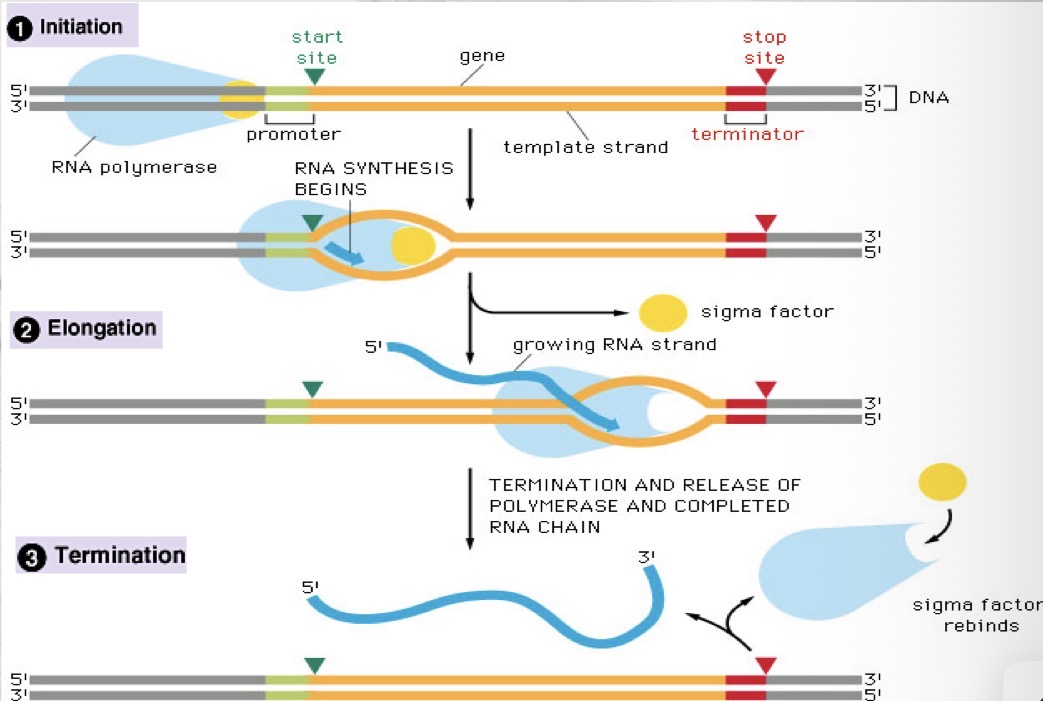
Transcription
initiation
elongation
termination
The mRNA has now a similar sequence to the coding strand with U instead of T
Initiation (transcription)
RNA polymerase II detects a promoter sequence (gene beginning), DNA unwinds, strands separate, and transcription commences
Termination (transcription)
MRNA synthesis ends at the terminator sequences
Termination (transcription)
MRNA synthesis ends at the terminator sequences
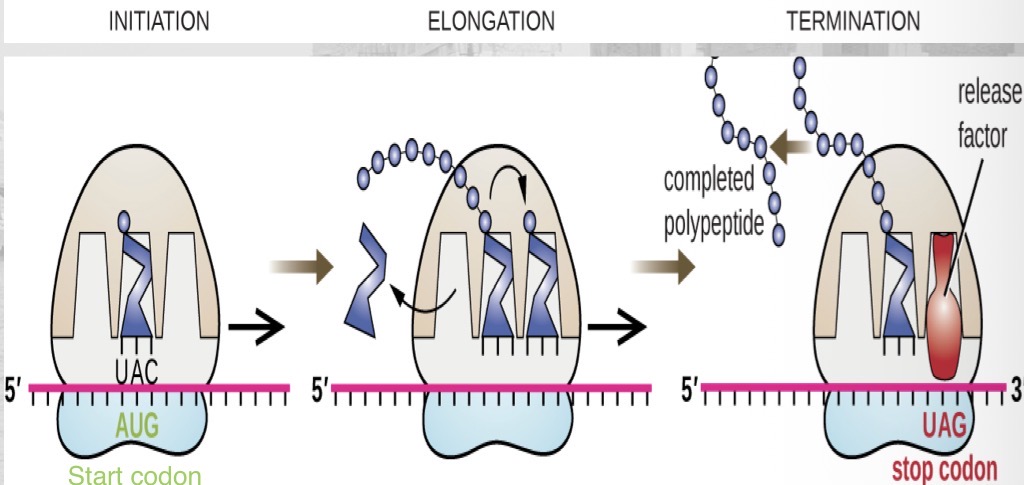
Translation
initiation
elongation
termination
Initiation (translation)
Translation complex forms (ribosome+mRNA); start codon (AUG) detected and tRNA brings the corresponding amino acids (methionine)
Elongation (translation)
Codons read one by one and the corresponding amino acids brought by tRNA and added to the polypeptide
Termination (translation)
Stop codon detected (UAA, UAG or UGA), translation complex dissociates and polypeptide released
Mutations
Permanent change in the nucleotide sequence of DNA
Cause of mutations
Spontaneous (mistakes during replications - 1 in 10^9 bases added)
Chemicals (mutagens)
Radiation (UV, X-rays, etc)
Types of mutation
Point mutations - change in single nucleotides
Segment mutations - deletions, replacements, inversions and insertions
Consequences of Mutations
No effect (silent mutations)
Altered protein
Gene inactivation (harmful effects - death)
New characteristics
Gene exchange
Genetic material can be transferred from one bacterium to another by one of 4 methods: transformation, transduction. Conjugation, transposition
Transformation
Uptake of DNA directly from the environment (DNA fragments from lysed cells)
Transduction
Transfer of DNA through a bacteriophage
Conjugation
Transfer of DNA (usually plasmid) through bacterial mating
Transposition
Movement of DNA sequences “jumping” from one DNA molecule to another in the same cell
Recombination
DNA transferred to a bacterial cell by transformation or transduction integrates into chromosomal DNA
What are the steps of viral replication?
Absorption, penetration, uncoating, transcription/translation, replication, assembly, release
What are the products of viral mRNA?
Structural proteins, enzymes, effects on host cell
What is a class I virus?
Double stranded DNA (dsDNA)
Uses host polymerase → mRNA
What is a class II virus?
Single stranded DNA (ssDNA)
Converted to dsDNA by host polymerase then transcribed into mRNA
What is a class III virus?
Double-stranded RNA (dsRNA)
Requires viral RNA polymerase to make mRNA
What is a class IV virus?
Positive-sense RNA
Genome can function directly as mRNA
Can be translated immediately
What is a class V virus?
Negative-sense RNA
Must use viral polymerase to make =mRNA first
What is a class VI virus?
Retrovirus (+RNA)
Uses reverse transcriptase
RNA → DNA → mRNA
Nucleic acid extraction purpose
Obtain pure DNA/RNA for further lab analysis, (PCR or sequencing)
What are the contaminants that need to be removed?
Proteins, carbohydrates, lipids, other nucleic acids
Methods (cell lysis)
Detergents (SDS), enzymes (lysozymes - gram +), sonication, mechanical disruption (bead beating for gram + and fungi)
Chloroform/phenol method
pH will tell you if you are extracting DNA and RNA together or just RNA
Put RNAase if you dont want RNA in the mix or other enzymes to isolate nucleic acids
Why add ethanol?
To recover DNA from aqueous layer
Chloroform pH basic/neutral
DNA and RNA
Methods (remove proteins/carbs)
Precipitation - chloroform/phenol (pH critical), salting out
Digestions (proteinase K - eliminate proteins)
Methods (remove proteins/carbs)
Precipitation - chloroform/phenol (pH critical), salting out
Digestions (proteinase K - eliminate proteins)
Methods (recovering nucleic acids)
Selectively binding to what you want
Precipitation (ethanol or isopropanol)
Solid phase ( binding to silica mini-column)
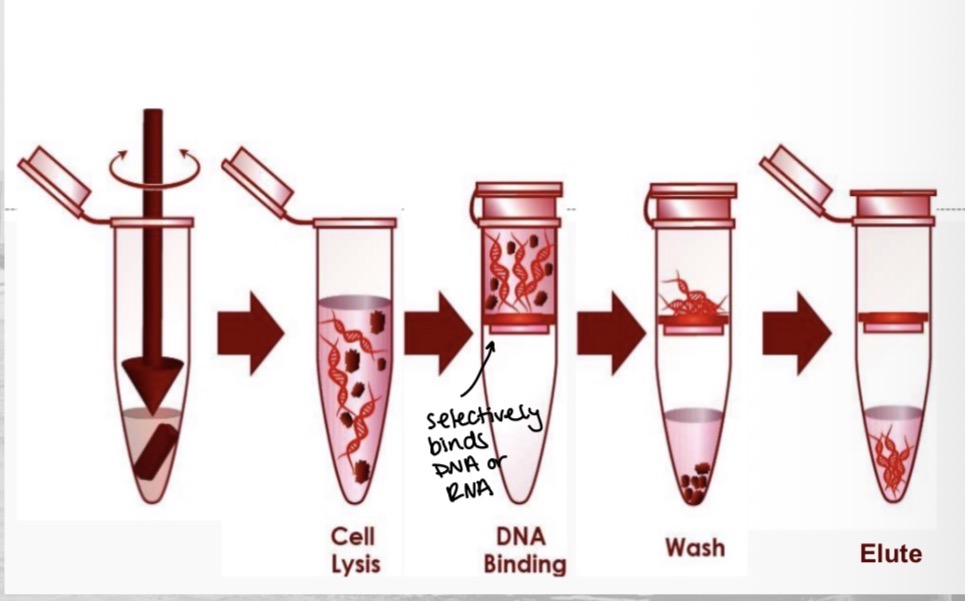
Spin column method
What does you use for extraction of RNA
RNAse free reagent and disposables
(Treatment either DEPC) followed by autoclavation
Nucleic acid quantification
Spectrophotometric, fluorescence dyes
Spectrophotometric
Quantity: A260
Quality: A260/A280; A260/A230
Tells us quality and quantity
Fluorecnence dyes
Qubit assays - only quantity
Electrophoresis
Movement of compounds (proteins & nucleic acids) by electricity
Electrophoresis purpose
Separation of proteins or nucleic acids in a mix based on: molecular weight, charge, shape/size; negative → positive
Slab electrophoresis
Agarose gel electrophoresis: nucleic acids
SDS PAGE: proteins
Capillary electrophoresis
Employed in DNA sequencing
DNA cloning
In vivo, cut DNA in specific sites: prepare fragments for insertion site; the more bacteria replicates the more the gene of interest is replicated too