Islamic Quiz 3
 Call Kai
 Learn
Learn Practice Test
 Spaced Repetition
 Match
Match Flashcards
 Knowt Play
1/5

There's no tags or description
Looks like no tags are added yet.
Name | Mastery | Learn | Test | Matching | Spaced | Call with Kai |
|---|
No analytics yet
Send a link to your students to track their progress
6 Terms
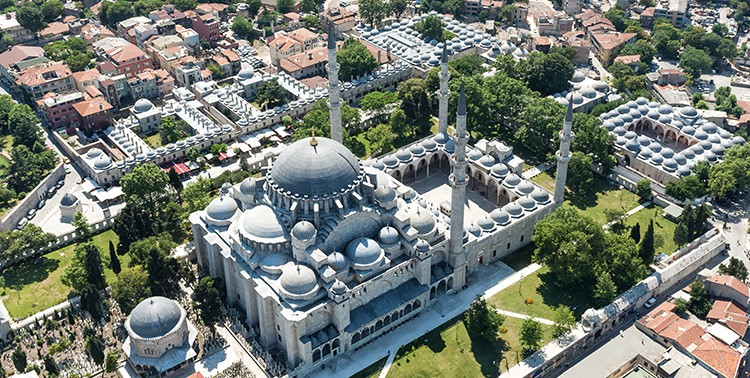
Master Architect Sinan (c. 1500-88), Suleymaniye complex, Istanbul, Ottoman, 1550-1557
Context
ottomans are the first of the three gunpowder empires, the others being Safavid and Mughal.
Their city represented a multi-ethnic, multi-lingual central space. Center for arts, global trade routes, scholarly
Mosque architecture had a tendency to recall “nostalgic” aspects to relate to the past but also and most importantly to push those ideas further, “worthy of the new dynasty.”
Sultan Suleyman the Magnificient
He was very involved in the empire.
Necipoğlu notes that Süleyman selected plans from presentation drawings and approved the symbolically charged plan for the Süleymaniye
when Süleyman visited the construction site, he reminded Sinan of an earlier architect’s failure in a threatening way, showing that court architecture carried real political pressure.
The complex
large central dome on pedentives and 2 half-domes, directly copying Hagia Sophia
Emphasis on light: hanging mosque lamps and metal balls to reflect. Many windows, stained-glass windows by glacier —> divine light
Reinvention: muqarnas in column capitals, building but also cermony of sultan just as important
Large granite monolith columns, stones taken from Egypt/Africa like what Justinian did w/ Hagia Sophia
tiling that covers the walls, piers, mihrab and minbar with stylized european flowers and serrated leaves “saz” style characteristic of Ottoman empire
Sinan always trying to outclass the Hagia Sophia, taller, longer, bigger, etc.
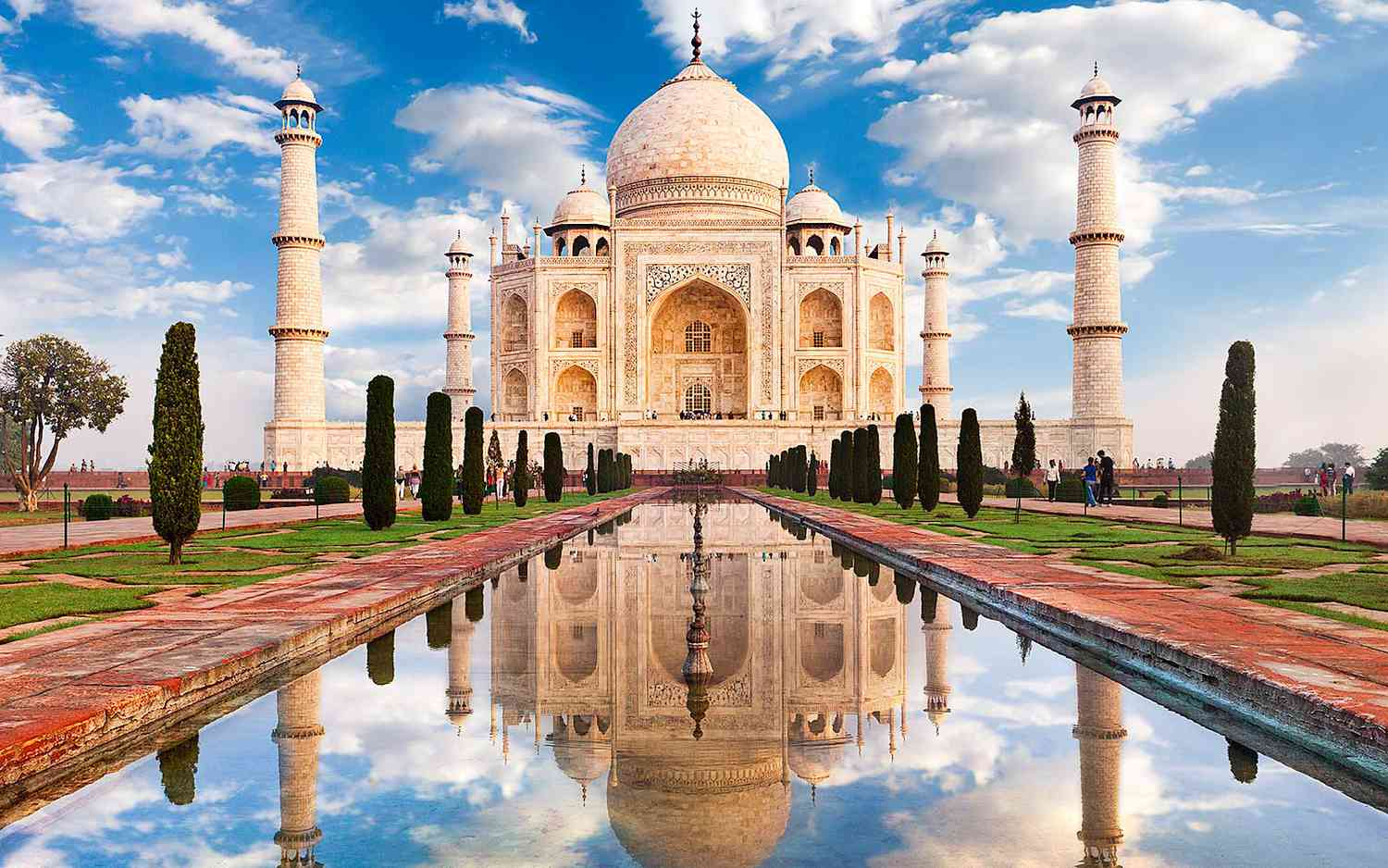
Taj Mahal (Mausoleum for Mumtaz Mahal, died 1631) marble and inlay, Agra, Mughal, Shah Jahan period, 1632-1648
Context
their founder, Babur, claimed descent from Timur and used that as imperial legitimacy
Mughals inherited the Timurid tradition of monumental architecture, gardens, symmetry, geometry, and refined surface decoration.
Adapted local materials, Indian forms, and the riverfront geography of cities like Agra according to Necipoğlu
Art became extremely refined and exquisite
Complex
built for his wife Mumtaz Mahal, who died in 1631.
part of a larger Mughal riverfront garden culture
part of a much larger urban complex that included the tomb garden, forecourt, bazaar streets, caravanserais, attendants’ quarters, subsidiary tombs, mosque, and assembly hall.
Its bazaars and caravanserais helped finance the upkeep of the tomb, showing how the spiritual/funerary zone and worldly/commercial zone were connected.
The Taj Mahal presents Shah Jahan as a ruler of perfect order, refinement, wealth, and cosmic harmony.
symmetry suggests just and balanced rule. qarina
precious materials and craftsmanship display imperial wealth. red sandstone brick masonry with white Makrana marble and inlay of semi-precious stones (parchin kari)
paradise symbolism connects his courtly world to divine order. Gardens of Paradise. inscriptions focus on themes such as judgment, mercy, Paradise, and divine reward
urban planning shows his control over city, garden, commerce, and memory.
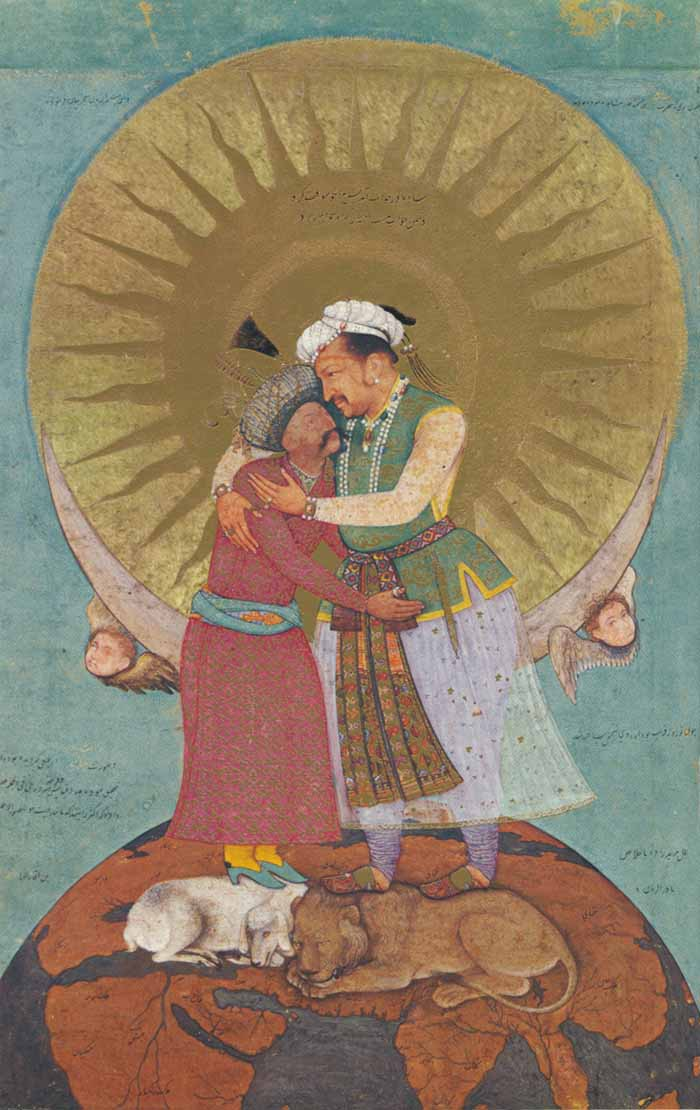
Jahangir Embracing Shah Abbas, (“Jahangir’s Dream”), from the St. Petersburg album signed by Abu’l Hasan (act. 1600-1630), India, Mughal dynasty, ca. 1618
Context
same as Taj Mahal
Jahangir
Jahangir is interesting because he was much less focused on the strict, refined rule like that of Babur.
Very interested in art and divinity, frequently tried to display his tie to divinity through art.
patronage very involved, During Mughal rule artists were singled out for their special talents—some for their detailed work in botanical paintings; others for naturalistic treatment of fauna; while some artists were lauded for their calligraphic skills.
addicted to substances
The painting shows that Jahangir used court art to construct an ideal image of himself as a world ruler, divinely illuminated sovereign, refined patron, and political victor.
Connection to Christian iconography: massive inscribed solar/lunar halo held up by cherubs. connecting Jahangir to cosmic and divine authority.
rulers stand on a globe, which represents earthly rule. By standing on the globe, Jahangir is visually presented as a universal ruler. Jahangir “World Seizer”
Jahangir stands over lion while Abbas stands over lamb: Strength, hunting vs meek, weak
lion even nudges the lamb back toward Iran, implying that Jahangir wants Shah Abbas to stay out of Mughal territory, especially Qandahar.
Jahangir appears larger, more radiant, more richly dressed, and more powerful.
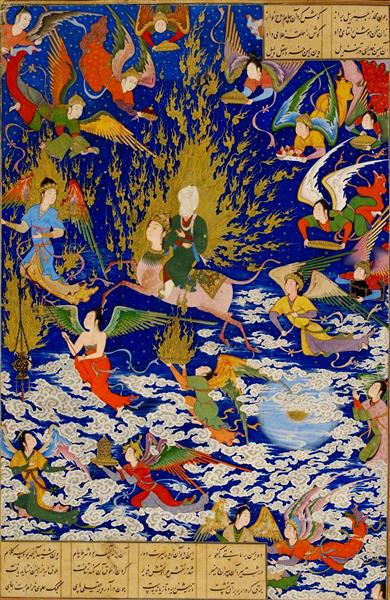
Sultan Muhammad, The Prophet Muhammad’s Celestial Journey (Mi’raj), Tabriz, Iran, Safavid, 1539-1543
Context
piece originally commissioned for Shah Tahmasp
Safavid empire was expansionist, but above all emphasized a standardization of their art style.
established capital in Tabriz and converteed Persia to Shi’a Islam
Sultan Muhammad
Was considered one of the greatest Safavid painters of all time'
He worked on the Shanama of Tahmasp and drew inspiration from the Art School of Herat
His style was marked by illogical perspectives, concealed grotesques, vivid colours, and a strong tendency to see excess as a source of virtue.
The folio
Veristic intention but still with aniconic drives: the prophet is displayed in glory, but his face covered with a white veil and a white turban with a gold rod sticking out on top—Haydar’s Crown
In the treasury note, Nazami notes “The Heart’s not free form false perception” tells the viewer to find guidance in the prophet’s heart not his face. his face is too distracting
Haydar’s crown was worn by Safavid rulers, and also represents Shi’ism. Thus retroactively shi’ifies the prophet, almost displaying him like a founding father
The representation of divine light: The angel holding the mosque lamp and the prophet’s surrounding halo makes the prophet embody the lamp as divine light. Additionally, the moon that sits in the background represents divine beauty
The painting’s physical interaction through smell: the representation of an incense burner creates a connection between the prophet and several smells, notably musk. This creates an interactive aspect where people use multiple senses
visual circumambulation: the composition takes shape as a visual circumambulation. The viewer needs to slow down and look carefully to notice all the aspects
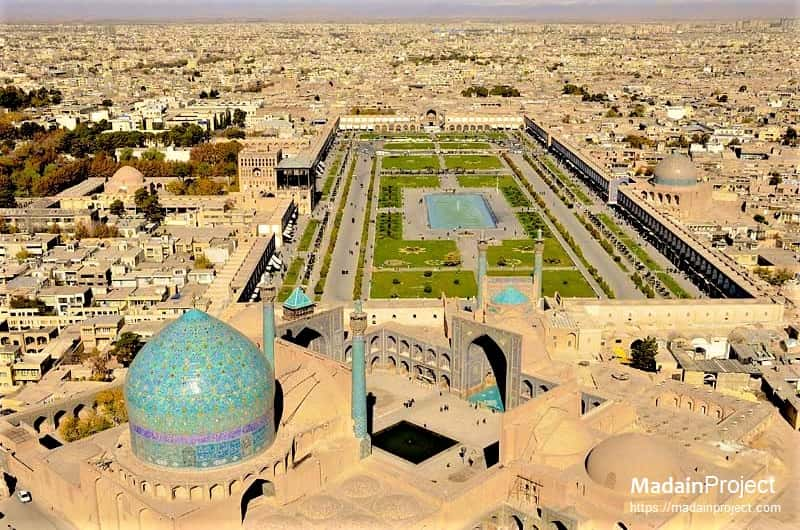
View of Isfahan’s Maidan-I Naksh-i-Jahan (“World-Displaying Quadrangle”) and attached
buildings, 1598-1629
Context
Safavid was an expansionist empire.
They converted Persia to Shi’ia Islam, helping shape a distinct Iranian religious and political identity
Shah Abbas I moved the capital to Isfahan to remake it into a visible image of Safavid power, making Isfahan worthy of the saying “Isfahan is half the world.”
the empire became more centralized, wealthy, and urbanly ambitious.
Chosen for abundant water and Zayandeh river
The new city
unlike old city, which was a traditional weave of living, the new city was orthogonally planned, centered on Zayandeh river
old city Centered around the old Friday mosque, Jami masjid.
Mosques were still oriented towards Mecca, using a triangular space to entry iwan that reconciled the difference in orientation
great bazaar about 2 km long connected old mosque with new city center
this was a new connection but also allowed Merchant communities from places such as Tabriz, Julfa, and India were incorporated into the city.
Kingship thru Ali Qapu palace: where Shah wouuld stand, see parades. Reception room: islamic designs in the room but wiht patinings at eye-level of evident western inspration. Mix of tradition. “Music room” private quarters to show off and give gifts
Shi‘i religion through the mosques, commerce through the Qaysariyya and surrounding shops, public ceremony through the open Maidan
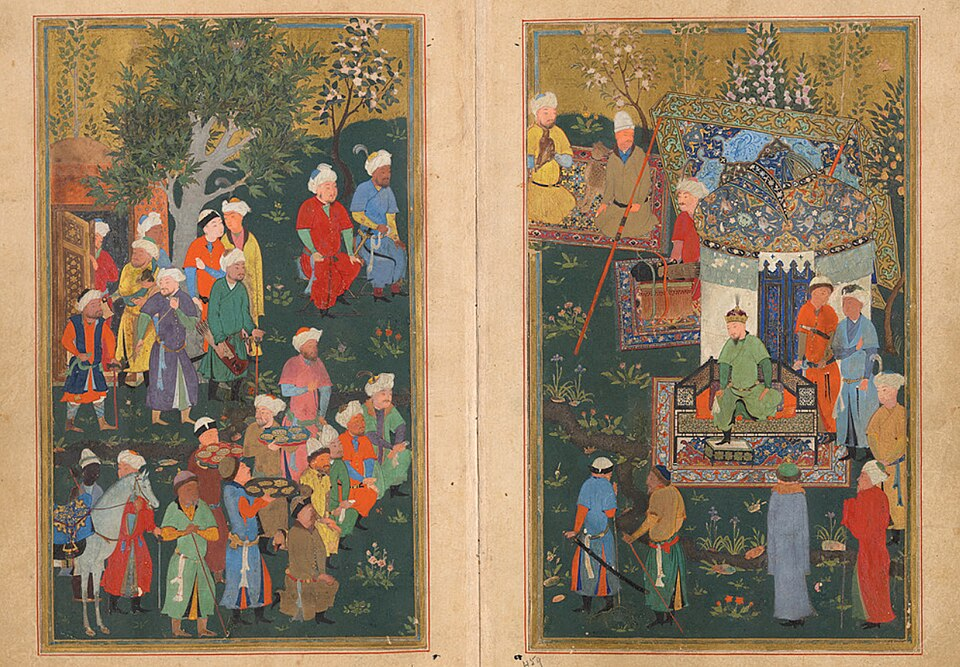
Bihzad, Timur Granting Audience in Balkh on the Occasion of his Accession, Zafar Nama, 1467.
Context
Timur established Timurid dynasty, claimed descendant from Genghis Khan, extremely expansionist.
brought back enormous amounts of booty, materials, and craftsmen to support his imperial building projects.
one of Timur’s most important establishments was the Kitabkhana (royal library or workshop), artistic center. Established cohesive and unified visual language. Library showed power, were important for royal legitimization and images of power
Timur was also of nomadic origin. For him tents were symbols of major royal settings used for ceremonies of allegiance, receiving ambassadors, royal feasts, political display
The tents
Timur to present himself as a ruler who combined nomadic mobility with imperial magnificence.
Surrounding Samarkand was his garden/tent spaces. He built extremely fancy tents with “a labyrinth of fabrics.” Weaponry was laying out, and the textiles were super fancy with animalistic designs
Cheeta + hawk —> shows hunting tradition
He also sits on a throne, providing a display of power for his people
The rugs, shown in a manipulated perspective for the purpose of material exaggeration
Items such as rich textiles, carpets, cushions, metal vessels, trays, ceramics, food, clothing, and decorated tents
Gardens
The garden suggests order, abundance, and paradise. This was established Persian ideas
Timur combined his sedentary rule with nomadic origins in this space
The garden became a representation of royal audience and display of wealth