Nutrition Final//dairy cows
 Call Kai
 Learn
Learn Practice Test
 Spaced Repetition
 Match
Match Flashcards
 Knowt Play
1/69

There's no tags or description
Looks like no tags are added yet.
Name | Mastery | Learn | Test | Matching | Spaced | Call with Kai |
|---|
No analytics yet
Send a link to your students to track their progress
70 Terms
_________ is a metabolic disease of cattle. It’s said to occur when the pH of the rumen falls to less than 5.5. The change in acidity changes the rumen flora, with acid-producing bacteria taking over. They produce more acid, making it worse. The increased acid is then absorbed through the rumen wall, causing metabolic _______, which in severe cases can lead to shock and death.
Acidosis
Feeding a high level of rapidly digestible carbohydrates. In dairy castle, the disease is seen as a result of feeding increased concentrates compared to forage
Cause of acidosis
Reduced feed intake, poor body condition and weight loss, lethargy
Symptoms of acidosis
______________ is a disorder mainly of dairy cows close to calving. It is a metabolic disease caused by a low blood calcium level (hypocalcaemia). Losses are due to deaths (about one in 20 affected cows dies), a reduction in the productive lifespan of each affected cow of about three years, and reduction in milk production following each milk fever episode, as well as costs of prevention and treatment.
Milk Fever
In typical cases cows show some initial excitement or agitation and a tremor in muscles of the head and limbs. Then they stagger and go down to a "sitting" position, often with a 'kink' in her neck, and finally lie flat on their side before circulatory collapse, coma and death.
Symptoms of Milk Fever
About 80% of cases occur within one day of calving because milk and colostrum production drain calcium (and other substances) from the blood, and some cows are unable to replace the calcium quickly enough. High producers are more susceptible because the fall in their blood calcium level is greater.
Causes of milk fever
treated with oral calcium gel or boluses, or calcium gluconate under the skin
treatment for milk fever
The abomasum (or true stomach) normally lies on the floor of the abdomen, but can become filled with gas and rise to the top of the abdomen, when it is said to be ‘displaced’.
Displaced Abomasum
The majority of cases occur soon after calving. During pregnancy the uterus displaces the abomasum, so that after calving the abomasum has to move back to its normal position, increasing the risk of displacement.
cause of displaced abomasum
loss of appetite, drop in milk yield, reduced rumination, mild diarrhea
symptoms of displaced abomasum
Treatment requires replacing the abomasum in its normal position. Preferably, the veterinarian also prevents recurrence by tacking the abomasum to the body wall. Surgery can be performed, however isn't always necessary. Often the abomasum can be returned to its usual place by casting and rolling the animal onto its back, permitting the abomasum to "float" back into its normal position.
treatment of displaced abomasum
Prevention should be aimed at ensuring dry matter intake is maintained in early lactation:
Ensure cattle are not too fat at calving
Feed high quality feeds, with good quality forage;
Feeding a total mixed ration as opposed to concentrates;
Minimize changes between late dry and early lactation ration;
It is likely that a farm with numerous DA problems is feeding the late dry and/or early lactation cows
Prevention for displaced abomasum
________ is a metabolic disorder that occurs in cattle when energy demands (e.g. high milk production) exceed energy intake and result in a negative energy balance.
Ketosis
When large amounts of body fat are utilized as an energy source to support production, fat is sometimes mobilized faster than the liver can properly metabolize it. If this situation occurs, ketone production exceeds ketone utilization by the cow, and this disorder results. In the dairy cow, the mismatch between input and output usually occurs in the first few weeks of lactation, because the cow is not able to eat enough to match the energy lost in the milk.
Cause of ketosis
reduced milk yield, weight loss, reduced appetite, acetone (pear drop) smell of breath/ or milk, some develop nervous signs including excess salivation, licking, aggression etc.
Symptoms of ketosis
The initial aim of treatment is to restore the lack of glucose in the body. A quick-acting glucose supplement is required immediately. Follow-up treatment is aimed at providing a long term supply of glucose.
Treatment of ketosis
The body condition of the dairy cow is important at calving. Cows should be on a rising plane of nutrition up to calving with the aim to calve in good condition. After calving, the cow has the potential to reach maximum efficiency in milk production, but feed requirements for high production are often greater than the voluntary intake pasture can provide.
Therefore an energy supplement is required and there is evidence that this will improve production and reproductive performance, and decrease the risk of ________.
ketosis
Dairy cows need to consume a lot of feed to achieve levels of __________
production
Some cows produce more than _______ lbs milk annually (over ______ gal)
34000, 4200
__________ needs vary tremendously throughout the lactation and dry period cycle
Nutrient
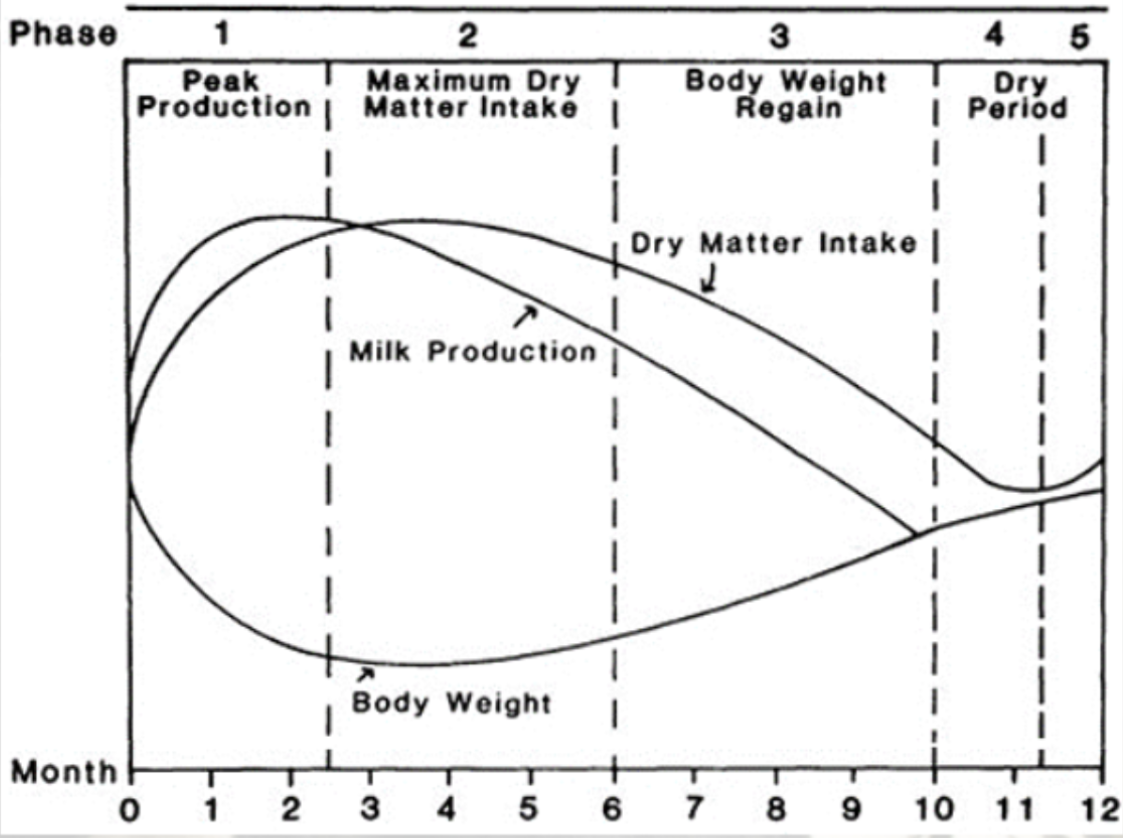
Relationships between milk production, dry matter intake, and body weight changes typically observed during normal lactation/gestation cycle
The cycle of dairy cattle
Cows: Milk production (increases or decreases) rapidly and reaches ______ production 6-9 weeks after calving
increases, peak
Cows: Appetite lags behind production
______ daily dry matter intake occurs 12 to 15 weeks postpartum
Cows are in _________________________ for 8-10 weeks
Makes up these nutrient deficits by borrowing them from _______________
Maximum, negative energy balance, body stores
Cows: Often lose 90-135 kg of body weight during __________________
Support 700-900 kg of milk production
early lactation
Cows: After optimal dry matter intake is achieved, intake follows production requirements and ____________ as production _____________
Tends to consume _____ than she needs during later lactation
Allows her to regain body weight lost in early lactation
Should regain most of lost body weight during _______________
Weight gain during the dry period accounted for by ______________
decreases, decreases, more, late lactation, fetal growth
Cows: For cows injected with _____________________, there may be a second increase in production within a few days of initial injections
May again experience a short time of negative energy balance
Production typically increases about 10% as a result of these injections
Dry matter intake needs to increase 2-3% to supply nutrients needed for increased production
Bovine Somatotropin
Cows, phased feeding: The first 10 weeks of lactation, when peak production occurs, and body stores are used to make up for nutrient intake deficits
Phase 1
Cows, phased feeding: About 10 weeks postpartum for most vows, continuing for 10-20 weeks. Maximum dry matter intake, and intake is in balance with requirements
Phase 2
Cows, phased feeding: Intake exceeds nutrient requirements for production, restoring body reserves
Phase 3
Cows, phased feeding: Phase 4
Period for any final regain of body weight, and involution followed by regeneration of secretor tissue in the udder for the next lactation
Cows, phased feeding: The last 1-3 weeks pre-partum
Phase 5
Cows: Need a short __________ as rest while preparing for the next lactation
6-8 weeks
___________ shorter than 40 days do not allow enough time for udder regeneration, which may cause a decrease in production during the next lactation
dry period, dry periods
Cows: __________________- regenerate new secretory tissue and replace lost body condition
Changes occur in the udder during this period
Active involution
Steady-state involution
Lactogensis
Colostrogenesis
Dry period
Cows, dry period mammary gland: Active _____________ completed by 30 days into the dry period
Milk-secreting tissue is reabsorbed
Second state, steady-state involution
Can exist indefinitely, and the mammary gland remains in a collapsed state
Third stage, lactogenesis plus colostrogenesis
Begins 15-20 days pre-partum
Involves onset of lactation and the secretion of colostrum
involution
Cows: Dry feeding emphasizes maintaining __________________
USDA research demonstrated that cows convert feed energy to body tissue more efficiently in late lactation than during the dry period
If still thin at drying off, need to replenish body stores as well as provide for fetal growth
body condition
Cows: Body condition score of _____ at calving is ideal for high milk yield, fat test, and reproduction performance
On a scale of 1-5 (1 thin, 5 fat)
3.5
Cows: Dry cows nutrient requirements can often be met with only _________
Legume grass hay and corn silage combination needs only vitamins and a small amount of _________
forages, phosphorus
Cows: Dry cow ration can be simple but should include the following consideration
1% of body weight as long stem, dry _________
Free-choice feeding of ___________ should be avoided
________ should be limited to energy and protein needs
forage, corn silage, grain
Cows: Consuming excess energy from grain and or corn silage means the cow is likely to develop a disorder called _________________
High blood lipids and fatty _______
Calving difficulties, displaced abomasums, ketosis, and other health problems
Cows fed hay and or haylage are less likely to have problems than cows receiving free-choice corn silage
Limit corn silage for dry cows to 9.5-11kg/day
Plus a protein and Ca-P supplement
fat cow syndrome, livers,
Cows: Nutrient requirements of bred heifers during late gestation are slightly _________ than of dry cows
Bred heifers will likely need some grain along with forages during the last 3-4 months of gestation (still growing)
Good quality forages can provide all the nutrient needs
If forages are not of good quality, additional grain may be needed to maintain optimal growth (not fat)
greater
Cows: cows ___________ is In the last weeks before parturition
Aimed at adapting rumen microflora to _________ energy diets needed postpartum
Adjustment often achieved by including small amounts of all ingredients of the lactating ration
Gradually increasing __________
Minimize the chances for milk fever and for ketosis during lactation
Most cows experience a sharp _________ in total dry matter intake 24-48 hours before calving
Stabilizing the rumen is important to avoid displaced abomasum, acidosis, and off-feed
transition period, higher, concentrates, decrease
Cows: Parturition until peak milk production is period when appetite lags behind nutritional requirements so peak milk production (phase 1) is _______________ period
1. ___________ feed intake as rapidly as possible, but not to cause digestive upsets and off-feed
2. Once the stress of calving has passed, concentrate intake can increase .5-.7 kg/day
3. If total mixed rations are fed, this equates to a forage-to-concentrate ratio of 55:45 or 50:50
negative nutrient balance, Increase
Cows: Peak milk production
Forage portion of the diet not be less than 45% of dry matter
Successful phase 1 feeding
Maximized peak milk yield
Utilizes some ____________ as an energy source
Minimizes ketosis
Returns cows to a ___________________ by 8-10 weeks postpartum
Cows can compensate for much of their deficit in energy intake
Borrow remaining needed energy from ______________
Cannot borrow very much _________ so it must be supplied in the diet
Early lactation cows will benefit from rumen bypass (escape) proteins
Nonprotein nitrogen (NPN) supplements (will/will not) be efficiently used by these cows
body weight, positive energy balance, body fat, protein, will not
Cows: Peak milk production: acidosis
__________ starch, __________ fiber diets are more apt to cause acidosis, digestive upsets, and milk fat depression
Nonstructural carbs (starches and sugars) should be limited to 30-40% of diet dry matter
Feeds such as distillers grains can replace a sizable amount of high starch feeds, providing more energy and decreasing rumen acidosis
Higher, lower
Cows: Peak milk production
Supplemental dietary fat
May allow increased __________ density and adequate fiber entail
At least 2.25 kg of ____________ in the daily ration helps to maintain normal rumination and digestion, especially during early lactation
energy, dry hay
Maximum dry matter intake
Should be achieved as early in _________ as possible
Conception rates are greater for cows in _________________
Body weights should stabilize, and weight gains should actually start occurring during this phase
Max dry matter intake will reach 3.5-4.5% of body weight
Dry matter intakes are usually __________ for higher producing cows
Not unusual for some cows to consume more than 5% of their body weight
lactation, positive energy balance, higher
Late Lactation
minimize feed cost by ____________ forage-to-concentrate Ratio
lower protein content
protein-to-energy ratio needed for weight gain is _______ than the ratio needed for milk production
NPN sources may be well utilized, where bypass proteins will be ______ cost effective than in earlier lactation, when production was higher
increasing, less, less
Energy for lactating cows
The challenge is to get cows to consume sufficient amounts of energy, especially during ____________________.
Energy intake may be increased by:
_____________ the energy density of the diet
_____________ readily fermentable carbohydrates
____________ dry matter intake
early lactation, increasing, increasing, increasing
Added fat
energy density can be increased by replacing portions of the carbohydrates in the diet with ________
One kilogram of _______ contains approximately 2.25 times as much energy as 1 kg of carbohydrates.
forages and grains contain 2% to 4% fat
fat can be increased to 5% to 7% of total dry matter
more than 8% to 10% fat may reduce feed intake, fiber digestibility, and cause digestive upsets
not all sources of fat are suitable feeds for milking cows.
free _______ such as soybean, sunflower, cottonseed, corn, and fish oils often affect rumen fermentation adversely (poorly)
fat, fat, oils
Feeding groups
Some dairies group cows by reproductive status, keeping cows that need to be bred in one pen
May make it easier for _______________
When moving cows from one group to another, make sure shift doesn't cause undue _____________
Recommended to move ________ of cows rather than _____________ cows
heat detection, stress, groups, individual
Calves: the first critical days
Health and vigor of calves at birth depends on the nutrition of the cow during the last ______ days before freshening
Cows fed properly and immunized against locally prevalent pathogens during this period develop __________ of good antibody qualities
Calves are born _____________ a functioning immune system
Colostrum
60, colostrum, without
Colostrum
Calves should receive a minimum of 2 quarts of colostrum in two feedings in their first _____ hours
12
Newborn calves
Digestive processes are similar to monogastric animals
_____________ is not fully developed until the calf reaches a weight of 200 kg
_____________ doesn't start to be populated with microbes until the calf is approximately 60 days old
Calf must be supplied with whole milk or milk replacer
Rumen, Rumen
The first 60 days
calf must elevate its head to nurse using a nipple, to activate the ________________________
milk flows directly to the omasum and abomasum and bypasses the ____________.
The more calves are fed to approximate natural conditions, the more efficient their performance.
The more frequently young calves can be fed, the more efficient their performance should be.
calves fed by lowering their heads to drink from a bucket (do/do not) activate this esophageal groove as well as those fed with a bottle.
esophageal groove, rumen, do not
Milk replacer
Milk source protein (dried whey, dried skim milk, casein) is ____________ to plant protein sources or to animal protein, such as fish protein concentrate.
many milk replacers contain ____________
Vitamin E has been recommended at levels as high as 135 IU per day for calves during the time prior to weaning
superior, antibiotics
Starter diets
About 1 week of age
Standard ingredients used in dairy feeds can be used for starter rations, but ______________ are not acceptable
Good quality alfalfa hay should be offered in small amounts
Consumption of starter feed is critical to development of an active functioning ___________
fine-ground feeds, rumen
Weaning
wean when calves are consuming approximately 2 kg of _________________ in addition to hay and milk replacer
two approaches to weaning
abruptly remove the ___________________ so calves have to utilize the starter ration
gradually adds increasing amounts of __________ to the milk replacer, until it is only ______________
before weaning, calves should be moved from hutches to small group pens
100 ft2 of space per calf and a maximum of 10 calves per pen
weaned calves can be moved to larger group pens and offered growing rations
separate growing calves by ______
starter feed, milk replacer, water, water, size
Heifers
If heifers were properly introduced to solid feeds before weaning, growing ration can be gradually changed so they reach puberty at 15 months.
goal is ____________ growth/___________ fat deposition
maximum, minimum
Gestation: two phases nutritionally
Breed to 60 days before calving
rations should be designed for ___________, with fat deposition avoided
If fed high-energy, low-protein rations, they tend to deposit fat in the __________, limiting future production capability
Late gestation
grain mix similar to that used when they enter lactation
adjust the rumen population to increase microbes that ferment lactation ration feeds
______________ nutrient intake for storage to support early lactation plus growth
provide for the _____________ demand for nutrients caused by the rapidly developing fetus
growth, udder, increase, increased
___________ can occur anytime, associated usually with a change in diet (high energy diets cause this)
Acidosis
______________ occurs close to calving (usually just prior to it), caused by low blood calcium (hypocalcemia)
Milk fever
Displaced abomasum occurs (usually) right after ______________
calving
____________ usually happens the first few weeks of lactation, animal begins to break down body fat stores because it's not getting enough nutrients
Ketosis
Non protein nitrogen is a cheap source of protein, but when fed to a ruminant, the protein gets _____________
upgraded
Bypass protein is expensive, and in that case you're trying to prevent the rumen bacteria from eating it because they would ____________ it
Bypasses the ___________ and goes straight to the small intestine
downgrade, rumen
Man made milk replacers — super formulated to be amazing products exceeding _____________ found in milk
nutrients
Dairy calves have very strong ________________ reflexes that can be a management challenge
suckling
Cottonseed oil (or any oil) (should/should not) be fed to cows because the bacteria (does/doesn’t) like oil and it can alter bacterial function
should not, doesn’t
Veel— baby male dairy cows (4 months), never even get to a feed based diet they're literally still drinking ________ when they get killed
milk
Cows are mostly _________ based
forage