Restorative Midterm
 Call Kai
 Learn
Learn Practice Test
 Spaced Repetition
 Match
Match Flashcards
 Knowt Play
1/330

There's no tags or description
Looks like no tags are added yet.
Name | Mastery | Learn | Test | Matching | Spaced | Call with Kai |
|---|
No analytics yet
Send a link to your students to track their progress
331 Terms
True or False
Polishing of low-copper amalgams is less important than it is for high-copper amalgams because the low-copper amalgams are less susceptible to tarnish and marginal breakdown.
F
True or False
When using rubber points to polish amalgam, it is important to use the high speed handpiece because high rotational speed of the point is necessary to remove the remaining small voids and scratches that are present after using the finishing burs.
F
When placing pins to enhance retention form of a prepared cavity, which of the following potential pin sites should be avoided?
a. the mid-buccal area of the mandibular first molar
b. the mid-mesial area of the maxillary first premolar
c. the mid mesial area of the maxillary first molar
d. two of the above
e. all of the above
e. all of the above
The interference shown to the right is a(n)
a. working interference
b. nonworking interference
c. protrusive
d. premature contact
b. nonworking interference
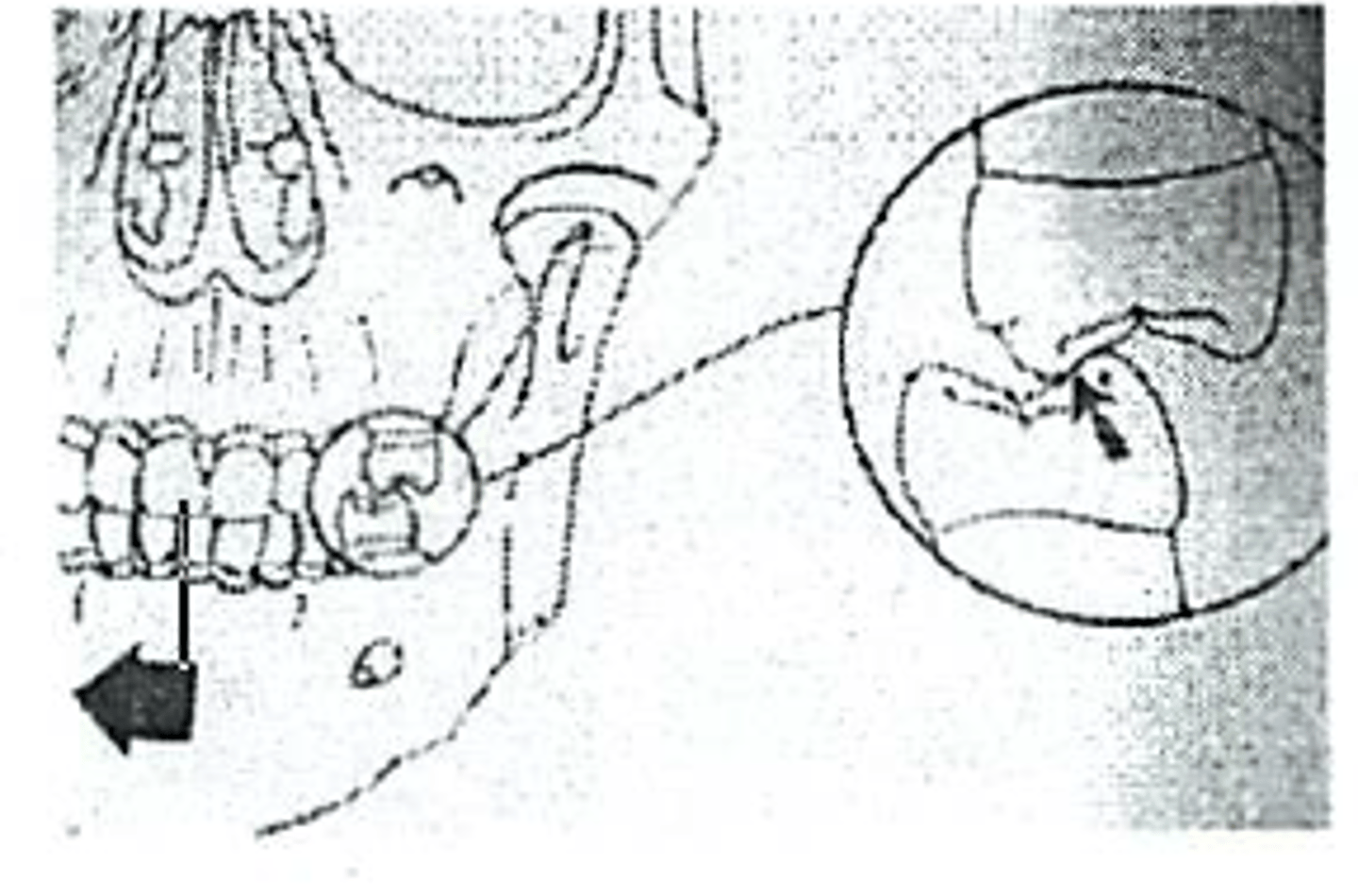
True or False
The level to which a base is built is determined by the thickness of the remaining dentin
F
Cusp reduction (cusp capping) significantly decreases retention form of an amalgam preparation because of loss of height of the vertical walls. When additional retention is indicated, slots and grooves can be placed slightly pulpally from the dentinoenamel junction providing secondary retention
a. both statements are true
b. both statements are false
c. statement one is true; statement two is false
d. statement one is false; statement two is true
a. both statements are true
When advancing caries reaches the DEJ it spreads along the DEJ. When the spread of caries along the DEJ exceeds the caries in the contiguous enamel, caries extends into this enamel from the junction and is termed
a. forward caries
b. backward caries
c. recurrent caries
d. root caries
b. backward caries
Regarding a carbide bur, the number of cutting blades determines its cutting efficiency. Burs with a fewer number of cutting blades results in
a. less efficient cutting and a smoother surface
b. less efficient cutting and a rougher surface
c. more efficient cutting and a smoother surface
d. more efficient cutting and a rougher surface
d. more efficient cutting and a rougher surface
The direction of retention pin holes should be
a. parallel to the long axis of the tooth
b. parallel to the nearest external surface
c. perpendicular to the occlusal or the gingival floor of the preparation
d. at right angles to the dentinal tubules
e. at a 14 degree angle to the long axis of the tooth
b. parallel to the nearest external surface
When placing a base on the pulpal floor, it is important to cover the entire floor of the preparation with the base; because it is better to have the base rather than dentin bear the compressive load of mastication
a. both statements are true
b. both statements are false
c. statement one is true and statement two is false
d. statement one is false and statement two is true
b. both statements are false
Which of the following clinical situations involving direct pulp capping would be the most likely to be successful?
a. A pin-point exposure having sound dentin on the periphery of the exposure, with a mild degree of pulpal inflammation restricted to the exposure site. Poor isolation using cotton roles
b. A carious exposure having decayed or infected carious dentin at its periphery, inflammation in the pulpal tissues beyond the exposure sit. Isolation using rubber dam
c. A pin-point exposure having sound dentin on the periphery of the exposure, with no pulpal inflammation at the exposure site. Isolation using rubber dam
d. An exposure with profuse hemorrhage and great involvement (mechanical) of the pulpal and root tissues
c. A pin-point exposure having sound dentin on the periphery of the exposure, with no pulpal inflammation at the exposure site. Isolation using rubber dam.
Purported advantages of amalgam bonding include which of the following:
a. increased retention of amalgam restorations
b. reduction/prevention of post-placement leakage
c. reduction/prevention of post-placement sensitivity
d. all of the above
e. none of the above
d. all of the above
Dentin which forms in response to moderate-level irritants, such as attrition, abrasion, erosion, trauma, moderate dentinal caries, and some operative procedures is called
reparative dentin
Name two characteristics that help to distinguish dentin from enamel during cavity preparation
color
hardness tested with explorer
_______ are probably the most important organism in the initiation of enamel caries
Streptococcus mutans
The term ________ refers to an operative procedure in which multiple teeth with acute threatening caries are treated quickly by (1) removing the infected tooth structure, (2) medicating the teeth, and (3) restoring the defects with a temporary material
caries control
Whenever dentin has ben cut or abraded, a thin altered surface is created called the
smear layer
If a small pulpal exposure occurs during cavity prepartion and is not due to caries (mechanical pulp exposure) a layer of _______ can be placed over the exposure site to stimulate ___________ across the exposure site. This procedure is called __________.
dycal
reparative dentin
direct pulp capping
After placing the Tofflemire matrix band for restoration of a Class 2 preparation, the operator should test with an explorer in a press-scrape motion along the gingival cavosurface margin. What is the purpose of this procedure? (Give two reasons)
remove rubber dam debris
remove gingival tissue debris
ZOE can be both toxic and therapeutic. Explain why ZOE placed directly on tissue has a toxic effect rather than a therapeutic effect
the eugenol in ZOE is toxic at high levels to the pulp
Loss of tooth structure by chemicomechanical action is called
erosion
Caries that occurs at the borders of a restoration and then under it is called
recurrent caries
Caries that remains in a completed cavity preparation is called
residual caries
What does the letter "W" in the designation for a rubber dam clamp (e.g. W56, W2) mean?
wingless
If the distal cusp of the mandibular first molar requires capping, what is the minimal thickness of amalgam necessary for capping this cusp? (The cusp is in occlusion prior to preparation)
2 mm
What is the main reason "pilot holes" are used when preparing pin holes?
to avoid drillbit crawling
Name the hand instrument which can most effectively round the axiopulpal line angle and remove unsupported enamel rods at the gingival cavosurface margin of a Class II cavity prepared for amalgam
gingival margin trimmer
An internal wall is a prepared cavity surface that does not extend to the external tooth surface. An internal wall that is the long axis of the tooth is called
the axial wall
The earliest clinical evidence of incipient caries on smooth surfaces is called a white spot lesion. Drying the tooth surface causes this lesion to partially or totally disappear from vision.
A. both statements are true
b. both statements are false
c. statement one is true and statement two is false
d. statement one is false and statement two is true
c. statement one is true and statement two is false
Incipient lesions may be reversed by remineralization, restoring the enamel to a sound state. When fluoride ion is part of the remineralization process, the enamel not only is restored to soundness, but also has increased resistance to further caries attacks.
a. both statements are true
b. both statements are false
c. statement one is true and statement two is false
d. statement one is false and statement two is true
a. both statements are true
A favorable prognosis for the pulp after direct pulp capping may be expected if which of the following criteria are
1. The exposure is small (0.5mm in diameter)
2. Tooth sensitivity to a cold stimulus lasts longer than 10-15 seconds after stimulus removal
3. The invasion of the pulp was traumatic with moderate physical irritation to the pulp
4. Preparation was prepared under rubber dam
5. There is excessive hemorrhage from the exposure site
a. all of the above
b. none of the above
c. two of the above
d. three of the above
c. two of the above
The powder component of IRM is essentially
a. EBA with methyl methacrylate
b. zinc oxide with EBA
c. zinc oxide and aluminum oxide
d. zinc oxide and methyl methacrylate
e. zinc oxide and ethyl methacrylate
d. Zinc oxide and methyl methacrylate
According to the material presented in the Sturdevant text, remaining old restorative material on the internal walls of a preparation should be removed if which of the following condition(s) is (are) present:
1. The old material is judged to be thin, non-retentive or both
2. There is evidence of caries under the material (radiographic and/or visual)
3. The pulp was asymptomatic preoperatively
4. The periphery of the remaining restorative material is intact
a. all of the above
b. none of the above
c. one of the above
d. two of the above
e. three of the above
d. two of the above
According to material presented in Sturdevant text, when caries is extensive, reduction of one or more of the cusps for capping may be indicated. Complex amalgam restorations with one or more capped cusps have documented longevity of _______.
a. 44% after 5 years
b. 50% after 9 years
c. 62% after 12 years
d. 72% after 15 years
d. 72% after 15 years
Remineralization of damaged tooth structure first begins to occur as the local pH increases to greater than
a. 4.0
b. 4.5
c. 5.0
d. 5.5
d. 5.5
The reason for using traditional liners or bases is to either protect the pulp or to aid pulpal recovery or both. The remaining thickness of dentin is a key determining factor in material choice.
a. both statements are true
b. both statements are false
c. statement one is true; statement two is false
d. statement one is false; statement two is true
a. both statements are true
Pin retention is used more frequently in preparations with few or no vertical walls. Slots are particularly indicated in short clinical crowns and in cusps that have been reduced 2-3mm for amalgam
a. both statements are true
b. both statements are false
c. statement one is true; statement two is false
d. statement one is false; statement two is true
a. both statement are true
In the hand instrument formula, 13-80-8-14, the number 14 represents the
a. width of the blade
b. blade length
c. blade angle
d. primary cutting edge angle
c. blade angle
Initial pulpal inflammation is thought to be evident clinically by production of sharp pains. A short, painful response to cold with each pain lingering only a few seconds (<10 seconds) in response to the thermal stimulus is suggestive of
a. reversible pulpitis
b. irreversible pulpitis
c. necrotic pulp
a. reversible pulpitis
Color differences in the dentin cannot be used as a reliable index for complete caries removal. In rapidly advancing lesions the softened dentin may show little or no color change while more slowly advancing lesions may have more discoloration
a. both statements are true
b. both statements are false
c. statement one is true; statement two is false
d. statement one is false; statement two is true
a. both statements are true
When placing a base on the pulpal floor, it is important to cover the entire floor of the preparation with the base; because it is better to have the base rather than dentin bear the compressive load of mastication
a. both statements are true
b. both statements are false
c. statement one is true and statement two is false
d. statement one is false and statement two is true
b. both statements are false
A percussion test is performed by gently tapping the occlusal or incisal surfaces of the suspected tooth and adjacent teeth with the end of the
handle of a mouth mirror to determine the presence of tenderness. Pain on percussion suggests possible injury to the periodontal membrane
from pulpal or periodontal inflammation.
a. both statements are true
b. both statements are false
c. statement one is true and statement two is false
d. statement one is false and statement two is true
a. both statements are true
In a Class II cavity prepared for dental amalgam, the facial and lingual proximal walls should be formed
a. approximately parallel to each other
b. at right angles to the gingival floor
c. slightly diverging as the walls approach the proximal surface
d. slightly diverging as the walls approach the occlusal surface
c. slightly diverging as the walls approach the proximal surface
Whenever dentin has been cut or abraded, a thin (only a few micrometers thick) altered layer is created on the surface This layer is
called?
a. sclerotic dentin
b. reparative dentin
c. smear layer
d. hybrid layer
c. smear layer
The ICDAS caries detection system uses visual clues to assess caries development and codes the lesions on a scale from 0 to 6. In the
treatment planning clinic you are asked to evaluate a tooth and code it according to the ICDAS system. This tooth when wet, shows a white
opaque lesion that is wider than the natural fissure. When dry, you observe there is carious loss of tooth structure but no visible dentin. This tooth would be coded as a
a. Code 1
b. Code 2
c. Code 3
d. Code 4
c. Code 3
A dentist is preparing Tooth # 30 for an occlusal amalgam restoration. Once the ideal outline form and depth have been established, the
dentist notes that caries remains in a small area of the pulpal wall of the preparation. The next step in treatment is to
a. extend the outline form
b. deepen the entire pulpal floor
c. remove the caries with a large round bur on high speed
d. remove the caries with a large round bur on slow speed
d. remove the caries with a large round bur on slow speed
True or False
The retention potential differences between pins and slots are not significant
True
True or False
Dentin bonding agents are not recognized as beneficial for dentinal sealing under amalgam restorations
False
True or False
The pH of hard-set calcium hydroxide is about 7 (neutral)
False
True or False
Enamel permeability increases with age because of changes in the enamel matrix
False
Location of the gingival cavomargin (clinically) must satisfy two criteria; these are:
Break contact with adjacent tooth
Go to sound tooth structure
A class II cavity preparation involving the mesial surface of a maxillary first premolar requires special attention because the mesiofacial embrasure is esthetically important. How should the facial wall of the mesial box be prepared (relative to the long axis of the tooth) to minimize an unaesthetic display of amalgam in the faciogingival corner of the restoration
Prepared parallel to long axis
????
After placing the Tofflemire matrix band for restoration of a Class 2 preparation, the operator should test with an explorer in a press-scrape motion along the gingival cavosurface margin. What is the purpose of this procedure? Give two reasons
Remove rubber dam debris
Remove tissue debris
What is the main reason "pilot holes" are used when preparing pin holes?
to prevent drillbit crawling
If a small pulpal exposure occurs during cavity preparation, in a clean operating field under a rubber dam, a layer of _________ can be placed over the exposure site to stimulate _______________
across the exposure site. This procedure is called ___________.
Dycal
Reparative dentin
Direct Pulp Capping
Name the hand instruments which can most effectively round the axiopulpal line angle and remove unsupported enamel rods at the gingival cavosurface maring of a Class II cavity prepared for amalgam
Gingival Margin Trimmer
Give two causes of postoperative sensitivity associated with newly placed amalgam restorations
Conductive nature of Amalgam
Lack of varnish used to seal dentinal tubules
Give three causes of marginal ridge fractures with newly placed amalgam restorations
Marginal ridge placed too high
Poor condensation
Axiopulpal line angle not rounded
Hyperocclusion/ ridge too high
Occlusal embrassure form incorrect
Overzealous carving
Improper removal of matrix band
In the diagram below, angle A is called the _________ and angle B is called
Minimum restorative material angle
Cavosurface Angle
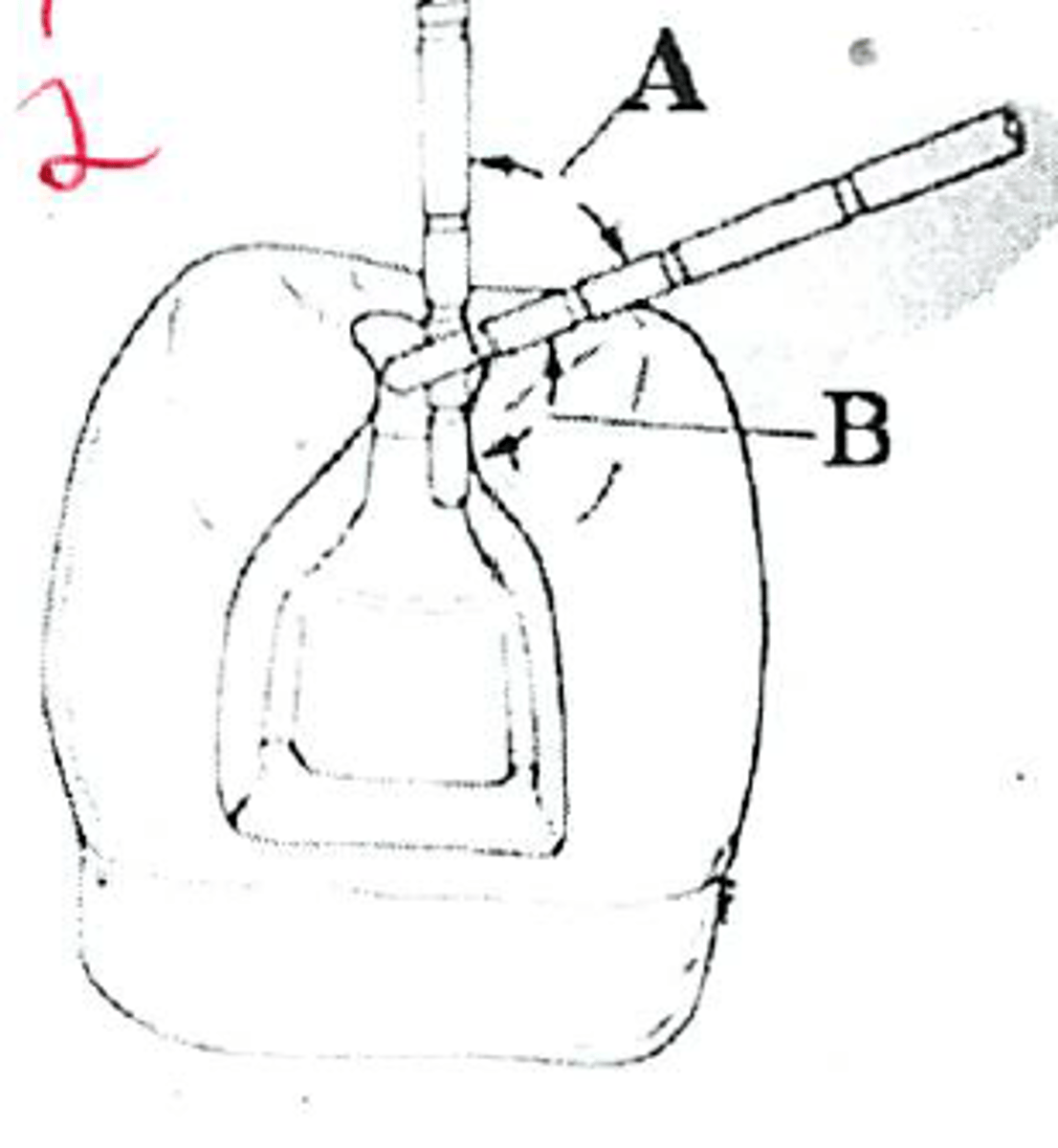
Reparative dentin is formed by replacement odontoblasts in response to moderate-level irritants. Reparative dentin causes a change in the composition of the primary dentin resulting in the perpendicular dentin becoming wider, gradually filling the tubules with calcified material.
a. both statements are true
b. both statements are false
c. statement one is true and statement two is false
d. statement one is false and statement two is true
c. Statement one is true and statement two is false
In cases of severe irritation, the pulp responds by an inflammatory reaction similar to that for any other soft tissue injury. The inflammation may become irreversible and can result in the death of the pulp because the confined, rigid structure of the dentin limits the inflammatory response and the ability of the pulp to recover.
a. both statements are true
b. both statements are false
c. statement one is true and statement two is false
d. statement one is false and statement two is true
a. both statements are true
Principles of cavity preparation are based on properties of the tooth and properties of the restorative material. Enamel is a very brittle structure having a high elastic modulus and a low tensile strength indicates it is a rigid structure.
a. both statements are true
b. both statements are false
c. statement one is true and statement two is false
d. statement one is false and statement two is true
a. both statements are true
Ideally, the oblique ridge of maxillary molars should be preserved during cavity preparation because it retains strength in the tooth. Cutting through the oblique ridge is indicated if it is undermined by decay or the pulpal floor depth exceeds 2.5 mm.
a. both statements are true
b. both statements are false
c. statement one is true and statement two is false
d. statement one is false and statement two is true
c. statement one is true and statement two is false
The preferred cavosurface margin design for a Class 1 amalgam is the butt joint; it provides resistance form for the amalgam.
a. both statements are true
b. both statements are false
c. statement one is true and statement two is false
d. statement one is false and statement two is true
a. both statements are true
When placing a base on the pulpal floor, it is important to cover the entire floor for the preparation with the base; because it is better to have the base rather than dentin bear the compressive load of mastication.
a. both statements are true
b. both statements are false
c. statement one is true and statement two is false
d. statement one is false and statement two is true
b. both statements are false
According to material presented in the Sturdevant text, Amalgam bonding systems may be used to seal underlying tooth structure and bond amalgam to enamel and dentin. Amalgam is strongly hydrophobic whereas enamel and dentin are hydrophilic.
a. both statements are true
b. both statements are false
c. statement one is true and statement two is false
d. statement one is false and statement two is true
a. both statements are true
In a Class II cavity prepared for dental amalgam, the facial and lingual proximal walls should be formed
a. approximately parallel to each other
b. at right angles to the gingival floor
c. slightly diverging as the walls approach the proximal surface
d. slightly diverging as the walls approach the occlusal surface
c. slightly diverging as the walls approach the proximal surface
When placing pins to enhance retention form of a prepared cavity, which of the following potential pin sites should be avoided?
a. the mid-buccal area of the mandibular first molar
b. the mid-mesial area of the maxillary first premolar
c. the mid mesial area of the maxillary first molar
d. two of the above
e. all of the above
e. all of the above
According to the material present in the Sturdevant text, remaining old restorative material on the internal walls of a preparation should be removed if which of the following condition(s) is (are) present:
1. The old material is judged to be thin, non-retentive or both
2. There is evidence of caries under the material (radiographic and/or visual)
3. The pulp was asymptomatic preoperatively
4. The periphery of the remaining restorative material is intact
a. all of the above
b. none of the above
c. one of the above
d. two of the above
e. three of the above
d. two of the above
According to material presented in the Sturdevant text, when caries is extensive, reduction of one or more of the cusps for capping may be indicated. Complex amalgam restorations with one or more capped cusps have documented longevity of ________.
a. 44% after 5 years
b. 50% after 9 years
c. 62% after 12 years
d. 72% after 15 years
d. 72% after 15 years
Using pins to retain amalgam restorations increases the risk of
1. cracks in the teeth
2. thermal sensitivity
3. pulpal exposures
4. periodontal ligament invasion
a. 1 & 2
b. 3 and 4
c. 1, 3 & 4
d. all of the above
d. all of the above
A favorable prognosis for the pulp after direct pulp capping may be expected if which of the following criteria are met:
1. The exposure is small (<1.0mm in diameter)
2. Tooth sensitivity to a cold stimulus lasts longer than 10 seconds after stimulus removal
3. The invasion of the pulp was traumatic with moderate physical irritation to the pulp
4. Preparation was not prepared under the rubber dam
5. There is excessive hemorrhage from the exposure site
a. all of the above
b. none of the above
c. two of the above
d. three of the above
b. none of the above
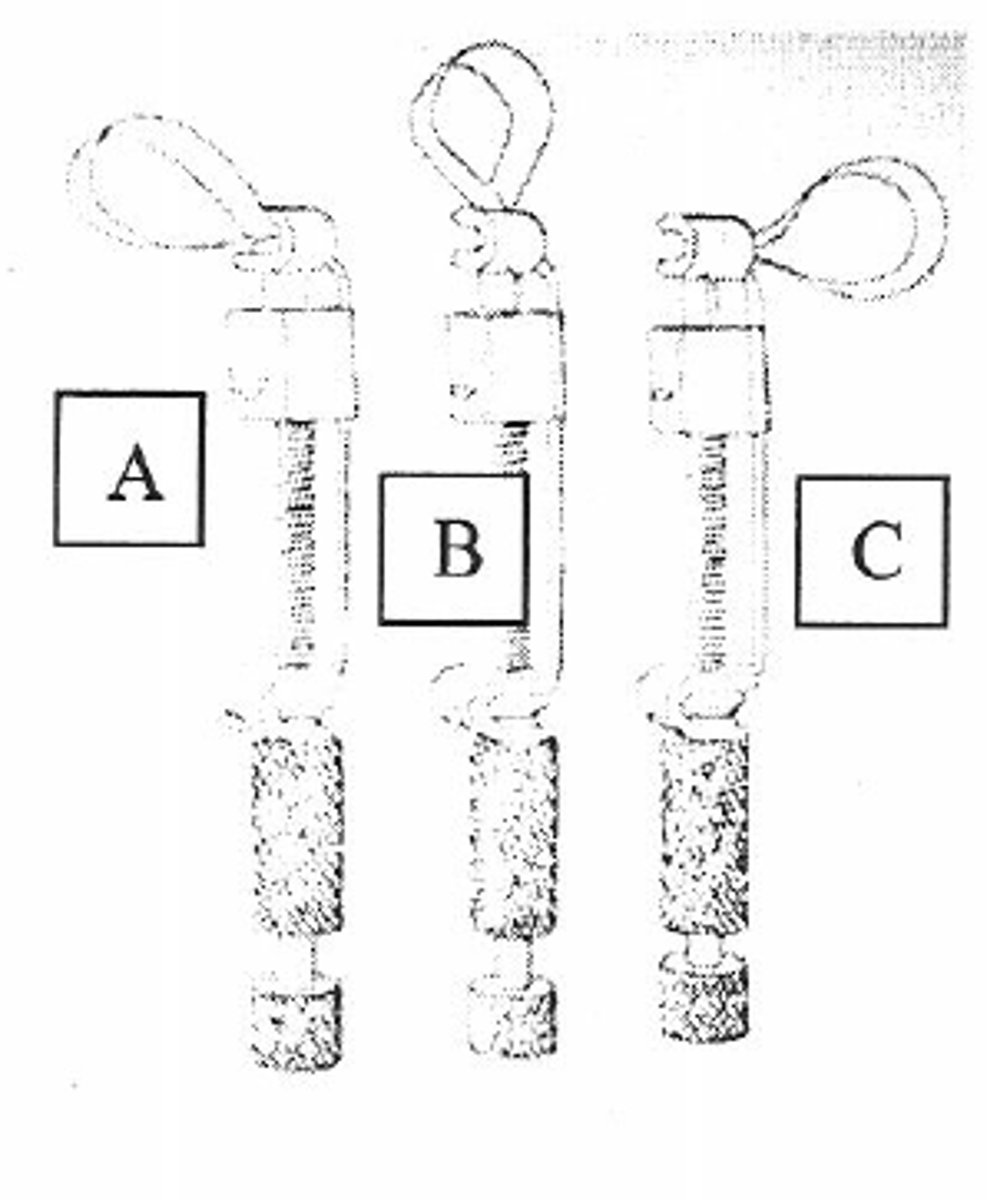
Which Tofflemire matrix retainer orientation shown to the right is best for restoring tooth 3?
a. A
b. B
c. C
a. A
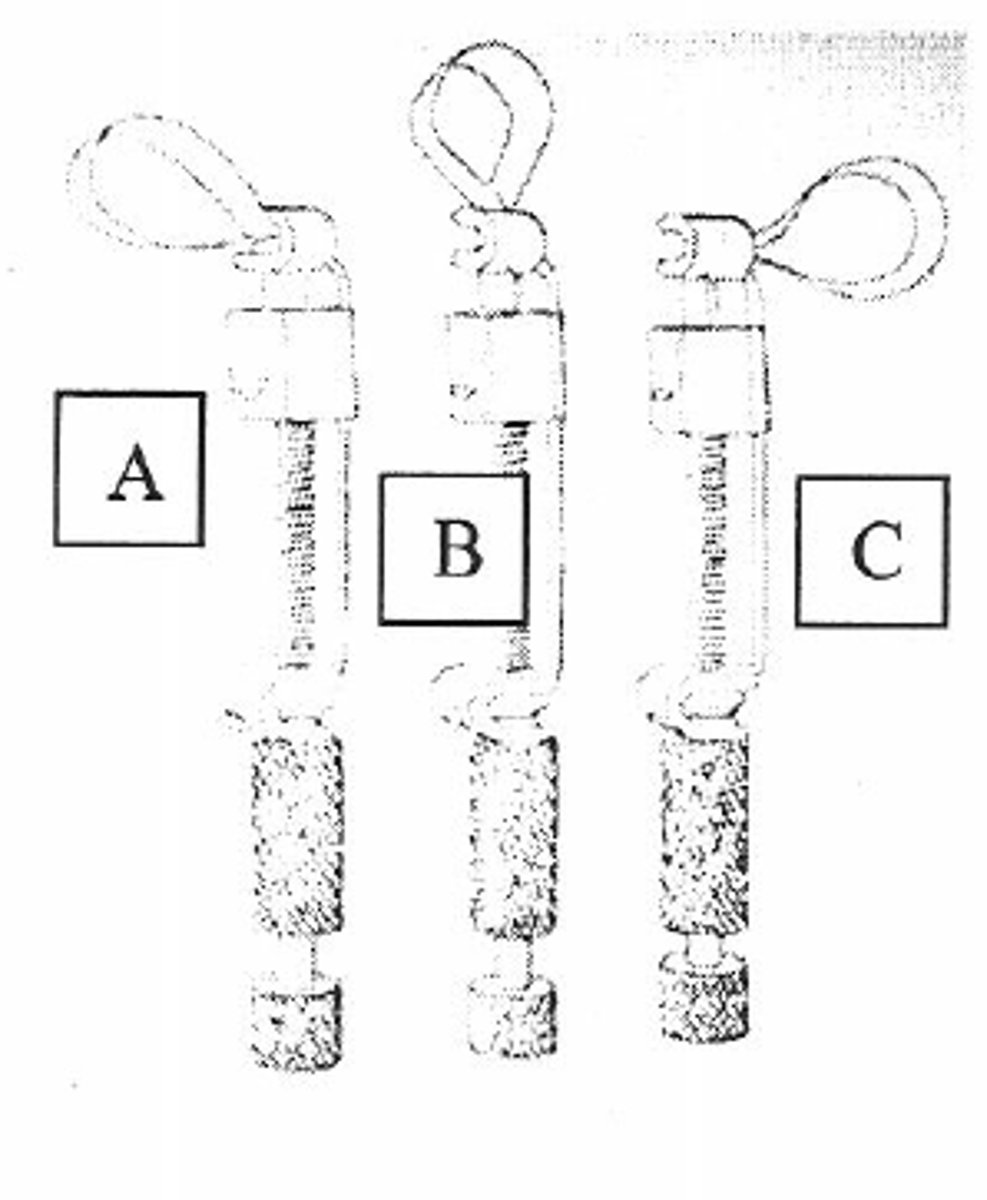
Which Tofflemire matrix retainer orientation shown to the right is best for restoring tooth #30?
a. A
b. B
c. C
c. C
A carbide bur with a numerical code 1556 can be described as a(n)
a. tapered fissure
b. straight fissure
c. round ended crosscut straight fissure
d. end cutting bur
e. round ended straight fissure
c. round ended crosscut straight fissure
Restoration of a cusp using dental amalgam requires that
a. all the enamel be removed from the cusp to provide bulk of amalgam
b. only the enamel be removed to conserve tooth structure
c. at least 2 mm of the cusp be removed to provide retention form
d. at least 2 mm of the cusp be removed to provide resistance form
d. at least 2mm of the cusp be removed to provide resistance form
An MO amalgam restoration is more resistant to fracture if
a. an occlusal dovetail is present
b. the axiopulpal line angle is beveled or rounded
c. pins are placed in the dentin of the cavity preparation
d. the unsupported enamel at the gingivocavosurface margin is planed
b. the axiopulpal line angle is beveled or rounded
A deficient margin at a proximogingival cavosurface angle of a freshly condensed Class II amalgam restoration may have been caused by
1. poor condensation of the amalgam
2. neglecting to wedge the matrix band
3. use of too large an initial increment of amalgam
4. debris in the corner of the proximal box
a. 1, 2 and 3 only
b. 1, 3 and 4 only
c. 2, 3 and 4 only
d. all of the above
b. 1, 3 and 4 only
The bur should be filled lingually when preparing the occlusal aspect of a Class II preparation on a mandibular first premolar in order to
1. remove unsupported enamel
2. prevent encroachment on the facial pulp horn
3. prevent encroachment on the lingual pulp horn
4. maintain dentinal support of the lingual cusp
a. 1 and 2
b. 1 and 3
c. 2 and 4
d. 3 and 4
e. 2 only
c. 2 and 4
Resistance to proximal displacement in the ideal Class II amalgam restoration is provided by
1. the adjacent tooth
2. occlusal dovetail
3. converging proximal walls
4 retention grooves in proximoaxial line angles
a. 1, 2, and 3
b. 1, 2 and 4
c. 1 and 3
d. 2 and 3
e. 2 and 4
e. 2 and 4
Which of the following correctly describes a retentive lock?
1. a retentive groove whose length is in a longitudinal plane
2. a groove placed along the axiogingival line angle
3. A groove placed along the DEJ
4. A groove 0.5 mm depth at the gingival floor level, becoming shallower and terminating at the axiolinguopulpal (axiofaciopulpal) point angle
a. all of the above
b. 1, 2 and 3 only
c. 1, 3 and 4 only
d. 1 and 3 only
e. 1 and 4 only
e. 1 and 4 only
True or False
The lingual surfaces of the posterior teeth usually have their height of contour in the middle third of the crown.
T
True or False
Because caries is an infectious disease, the removal of the caries during the restoration of a tooth reduces the microorganisms involved in the disease and may reduce the potential spread.
T
True or False
In a class I amalgam cavity preparation retention form is provided by mesial and distal walls that converge occlusally
F
True or False
Medium sized self-threading pins may elicit an inflammatory response if placed within 0.5mm of the pulp, whereas slot placement does not.
T
True or False
Infected dentin has bacteria present, is not remineralizable and should be removed
T
True or False
Occaisionally a pin may break during placement. According to material presented in lecture and the reading, the preferred treatment for a broken pin is removal of the pin and drilling a larger hole in the same location
F
True or False
A tapered fissure bur can be described as a slightly tapered cone with the small end of the cone directed toward the bur shank.
F
True or False
The reaction that occurs in a mixture of zinc oxide and eugenol (IRM) is exothermic
F
Dr. Iggy's first patient is a new patient who presents for an exam and cleaning. During the exam Dr. Iggy notices a dark grey/bluish shadow under the mesial marginal ridge of tooth #3. He suspects this is a carious lesion and gives it a code __________
according to the ICDAS system.
What is the best way to diagnose interproximal caries on posterior teeth? ________________
The distal pit and OL groove show staining and decalcification that extends up the lateral walls of the fissure with localized enamel breakdown (without clinical visual signs of dentinal involvement). Dr. Iggy gives this lesion a Code ___________.
4
radiographs (preferably bitewings)
3
A diagnosis of proximal caries is made and after the patient reports cold sensitivity on the tooth a decision is made to perform thermal testing. Describe the technique for cold thermal testing and what the possible results would indicate about the tooth. ____________________
Application of cold using a cotton pellet (and endo-ice) or ice that produces sensitivity lingering less than 10 seconds indicates reversible pulpitis and the possibility of pulpal repair. Sensitivity lasting greater than 10 seconds indicates irreversible pulpitis and minimal chance for pulpal repair. Root canal may be necessary.
Dr. Iggy's next patient just cancelled opening up a block of free time so that the decision is made to perform an operative procedure on tooth #3. What bur should Dr. Iggy use to perform the initial punch cut and outline form? _____________
Why would you choose this bur?
____________________
245
3mm length to the cutting head provides adequate cutting length and "pear shape" provides undercut necessary for retention. Cutting head of a 330 is too short for a molar and not the BEST choice. A straight fissure bur could work (56/57) but it is not the BEST choice because it does not create undercut.
Dr. Iggy is not sure about what to do about the distal pit and OL groove. He remembers a lecture by an extremely bright and knowledgeable professor showing a correlation between the severity of carious lesions and their histological depth. Based on the ICDAS code given to the distal pit and OL groove, describe the histological depth of the lesion you would expect to see.
____________________
extends to the middle 1/3 of the dentin
Based on all the information given, would you perform an operative procedure on the distal pit and OL groove? Yes or no and justify your answer.
Yes
Histological studies show that decay has penetrated into dentin. Self repair/ remineralization is not likely and restoration is recommended
Regardless of your diagnosis, Dr. Iggy decides to perform a Class I preparation on the distal pit and OL groove. As Dr. Iggy prepares to punch cut into the distal pit what preparation modification regarding the pulpal floor should he remember about this preparation? _____________________
Pulpal floor should follow the external surface of the tooth
The ideal Class I preparation outline form is complete on the distal pit and OL groove. Dr. Iggy returns to the Class I preparation in the mesial pit and prepares to drop the mesial box. Teeth 3 and 4 are in ideal position with no rotation or tilting. Dr. Iggy wonders if he needs an "S" curve on this prep. Give 2 reasons for placement of an "S" curve when preparing a proximal box on a Class II amalgam.
__________________
Allows alignment of proximal lateral walls to create a 90 degree cavosurface margin
Conserves tooth structure near pulp horn
Provides bulk of amalgam over the axiopulpal line angle
Given that this tooth is in ideal contact with #4, if an "S" curve is necessary on this tooth what tooth surface would most likely require it and why?
______________________
MB proximal wall. Decay occurs below the contact point and the preparation must remove decay and extend to sound tooth structure. The contact point is located buccal to the central groove and the "S" curve is necessary to blend the two areas of the preparation providing a smooth-flowing continuous outline form without sharp angles.
Dr. Iggy opens the outline form on the buccal and lingual enough to break contact with the adjacent tooth. Before he beings to drop the proximal box he looks for an anatomic landmark on the tooth What is this landmark?
____________________
DEJ
also accepted contact point but DEJ was the best answer
As he begins to drop the box what are the two clinical criteria he is using to determine the gingival extent of the proximal box?
____________________
Break contact with the adjacent tooth
Extend the outline form to sound tooth structure
After completing the ideal outline form and depth for the MO preparation, Dr. Iggy notices that caries remains on the pulpal and axial walls of the MO prep, and the lateral wall of the oblique ridge in the OL groove. All other areas of the preparation are caries free. What should be the next step in treatment?
_____________________
Opening the OL groove outline form to remove decay on the oblique ridge should occur first. Removing decay on the pulpal and axial walls should occur last. (Many responses indicated crossing the oblique ridge but did not give the criteria - 1mm of remaining tooth or undermined by decay-- crossing the oblique ridge should only occur if those criteria are met)