IR Theory Exam Flashcards
 Call Kai
 Learn
Learn Practice Test
 Spaced Repetition
 Match
Match Flashcards
 Knowt Play
1/13

Earn XP
Description and Tags
IR Theory Flashcards
Name | Mastery | Learn | Test | Matching | Spaced | Call with Kai |
|---|
No analytics yet
Send a link to your students to track their progress
14 Terms
Zalewski - All these theories yet the bodies keep piling up’
Is theory helpful or useful in terms of practical application? What is the point? In depends on how we view theory
Theory is not useful as a tool: because it has 3 assumptons: 1. That theory is independent from theorists, meaning that theory as a framework is detached from political actors and that therefore, political actors cant be theorists —> this makes theory look detached 2. That theory is separate from real world events, and that events are only ontologically prior to the theories, this gives an illusion that theory has no effect on world events and makes it look useless 3. That theory as a tool is incompatible with post-modernism, because post-modernism believes that the nature of reality is subjective, thus questioning the objective utility of theory itself. —> This means that all of the natural rights and wrongs of the international system are are not facts but rather subjective —> this takes away a core foundation of modernism and positivist thought (positivism —> believes IR can be studied objectively), thus could theory be biased as a tool?
Theory as a critique: Linklater believes theory could be a critique, where it serves a more active role in critiquing hierarchies and oppressive structures in the system. Therefore this approach believes that theory is not aways ontologically post-events, but that events can be shaped by theory. However, Linklater criticises modernism as only attempting to manage existing order and not to change it, but at the same time post-modernism is limited in its emancipatory effect because if everything is subjective how can we say for certain that there is anything wrong with the current system.
Zalewski—> Theory is more of an everyday practice, it is a verb and there is no rigid criteria for it, therefore we are all theorists theorising every day, - post-modernists: believe the natural obvious choices of what to study are biased and reflect specific interests, which is why theory needs to be fluid and not rigid
The article leans towards a post-modernist stance, arguing that if we start to use theory as a way of life we must rethunk much of the discipline
According to Nicholson, how can we characterise international relations as a discipline
Lakatosian Research Programmes: a set of theories interconnected by an unchanging fundamental set of assumptions called the ‘hard core’ —> the variety in theories of IR helps us understand the significance of this hard core as our shared understanding of the international system —> there is lots of heterogeneity in theory which can b e good because even through there is conflict, conflict can give rise to new models and debates which only nuance and improve our understanding: e.g. Owen’s contribution to democratic peace theory
According to Nicholson what complicates IR as a discipline in practice?
Despite having good policies and theories to implement in policymaking, a huge obstacle is speaking truth to power:
Selfishness: those who have power want to maintain their power so you must offer them alternative profit, convince them of long term benefits, etc. (often gov. says their hands are tied but they could always provide alternative forms of profit)
Orthodoxy: often many actors are constrained by orthodox thinking of their time, for example Keynes was a very brilliant controversialist whose ideas were rejected by Churchill but when the orthodoxy collapsed post World War II, his ideas formed the foundation for the next orthodoxy
Non-rational factors: such as emotion and diction
Essentially, despite having good policy ideas and theories, these cannot be implemented in practice unless they align with decision makers’ presumptions —> major structural weakness of IR
According to Nicholson what does the social world need to look like for policy to be possible?
Policy requires some degree of prediction: we need to know when the social world is strong and stable and when it is vulnerable to change - more when its strong because we can misjudge vulnerability, prediction is central to policy making because to choose one course of action over another means contemplating the consequences of alternative routes
There has to be some agreement on how we view the social world, thus there needs to be some level of intersubjectivity and intersubjective agreement that certain conditions are bad and unwanted - and a certain level of empathy
According to Nicholson, what is a misconception about positivism and how does he address it?
Positivism focuses on studying the world as it is not as it should be, not because it lacks morality but because it is objective. ‘If freedom is the recognition of constraints, we must explore these constraints, find their limits, and stretch these limits in our search for a better world - studying HIV doesn’t cure HIV but it helps us understand it better to find a cure
What are the ordering principles of the international system?
Anarchy
Hierarchy
Rule of Law
Social norms
What are the three cultures of Anarchy?
Wendt:
Hobbesian: enemies
Lockean: Rivals
Kantian: Friends
‘Anarchy is what states make of it’
Bull - The Anarchical Society
Bull bridges liberalism and realism - english school
Defines social order as working towards common goals or joined by common values
Therefore: international order is a pattern of activity that sustains the primary goals of states
International System: two or more states that interact frequently enough to affect one another’s decisions (Not suzerain system)
International society: group of states conscious of certain common values and interests, bound by common rules and insitutions
Common goals of states:
Preservation of the system of states
Maintenance of sovereignty
Peace
Elementary goals of all social life:
Less violence
Keeping promises
Stability of possession (mutual respect of sovereignty)
Waltz
anarchy is the essence of the int. system
Ikenberry: After victory
Ways of organising political order: Balance of power, hegemony, and constitutionalism
Balance of power: coalitions to prevent hegemony
Hegemony: Hierarchy
Constitutionalism: Organised around agreed upon legal and political institutions, bit fuzzy internationally on who will enforce, limits on power, rules not easily altered, reduce implications on winning - less gains generally by setting limits on what actors can gain —> example EU
IKENBERRY IS LIBERAL
Finnemore
Intervention as a mechanism of powerful states to maintain status quo but not just material power - ideational plays a role
Different order —> different intervention, different distribution of power —> different order
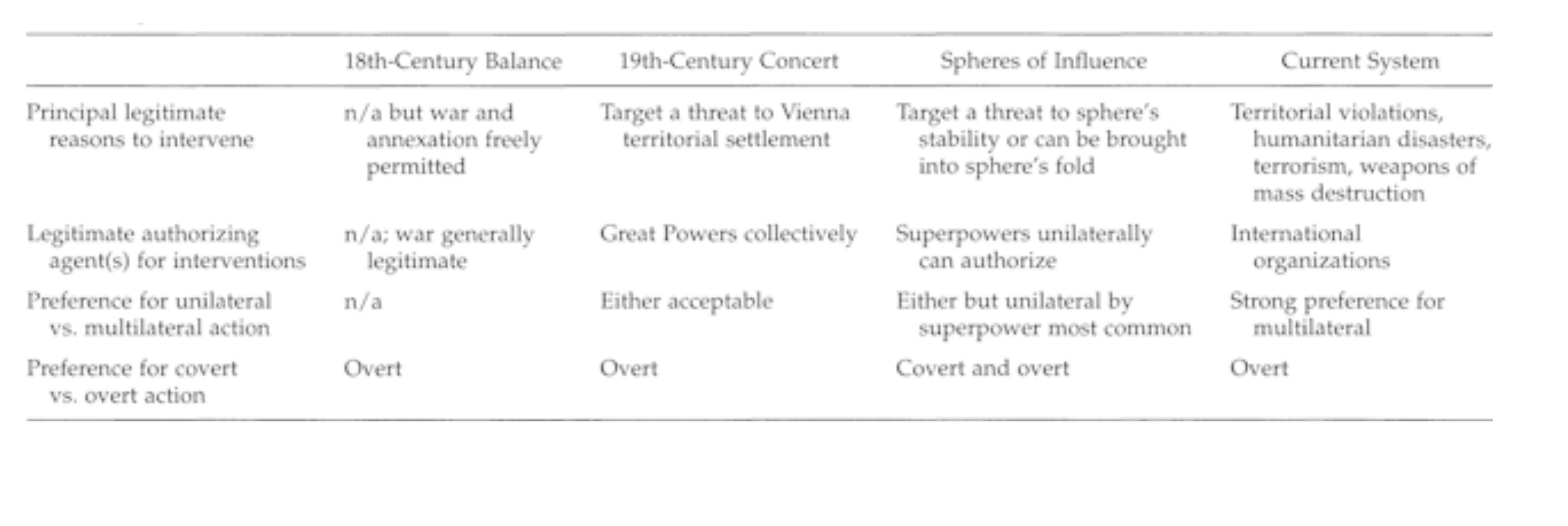
18th C Balance: threat is hegemony, response is balancing
19th C Concert: Great powers are all multipolar but manage the system together due to Vienna Settlement, threat is hegemony, response is collective consultation and working together
Spheres of Influence: ideological, threat: the rise of one sphere, mechanism of maintenance id further division and strengthening of spheres, unilateral intervention
Current system: liberal democracy and human rights, threat: terrorism, weapons of mass destruction, mechanism: collective security agreements and multilateral security - international organisations
Look into who legitimates intervention: 18th no one war was legitimate, 19th great powers, 20th superpowers unilaterally, 21rst is international institutions and organizations, legitimacy in authorisation and purpose change.
Norms and legitimacy play a key role in intervention. —> her contribution, shifts in norms and legitimacy, in authorisation, and in orders themselves
FINNEMORE IS CONSTRUCTIVIST
realist critics would say her normative shifts just follow after material shifts
defence: norms are important too because, we see US legitimation of what they did in Iraq, we see humanitarianism rising in the 1900s, and decolonisation moves fast in delegitimating empire. —> huge normative shift
Devetak
Sovereign state as principal actor, prior to this were absolutist, feudal empires
Weber defines state sovereignty as ‘a human community that successfully claims the legitimate use of physical force within a given territory’ —> highlights use of coercion
Article 1 of the 1933 Montevideo convention on the rights and duties of states listed four key elements of the sovereign state
Territory
Population
Legitimacy from other states - recognition
Government
Which two thinkers did the idea of the sovereign state derive from? —> Detheologised the state
Bodin: single decision maker (King) who has monopoly of force
Hobbes: Leviathan
Globalisation will not ruin the state, it will still retain authority and its monopolies (Brexit)
Agrees with realists and Tilly’s thesis of the state makes war and war makes the state: says that through increased revenue from taxes meant that the state was able to monitor, control, and monopolise the means of violence
Krasner
Organized hypocrisy:
Krasner’s taxonomy of sovereignty:
International legal: mutual recognition - authority
Westphalian: Exclusion of external actors in domestic affairs - authority
Domestic: sole authority and its effectiveness - control and authority
Interdependence: flow of goods, ideas, people across borders - control
Why is it hypocrisy:
A state can have one without the other, one type can undermine the other for example the EU and ws FOR ILS
International legal sovereignty as a tool of foreign policy PRC 1940s
IMF, intervention
March and Olsen’s logics of appropriateness and consequences
States prioritise consequences in the international system
Constructivists overemphasise the importance of norms and underestimate importance of material power
Not appropriateness because there is no mechanism for deciding between rules should be chosen, and power asymmetries enable some states to pick which rules suit their ideational and material interests at a given time
sometimes, with certain violations associated with ILS, other norms are used to justify such as cooperation and mutual benefit
Why do norms persist?
No alternative logic of appropriateness, they prevailed and are important when it suits the powers but otherwise are violated - when it suits them, but they are also used by weaker states as well and serve broader interests. Broader systemic interests - weaker tates pro nonintervention and stuff
Outcomes in the system are determined by rulers whose violation or adherence depends on material and ideational interests