Research Methods Questions
 Call Kai
 Learn
Learn Practice Test
 Spaced Repetition
 Match
Match Flashcards
 Knowt Play
1/26

There's no tags or description
Looks like no tags are added yet.
Name | Mastery | Learn | Test | Matching | Spaced | Call with Kai |
|---|
No analytics yet
Send a link to your students to track their progress
27 Terms
Outline what is involved in self-report. (3 marks)
The participant gives information to the researcher
Involves responding to questions on a questionnaire / during interview
Open/closed questions in questionnaire, structured/unstructured interviews
Explain one limitation of a self-report technique (2 marks)
Participants are likely to be subject to social desirability as they want to look good for the research
This questions the validity
People's perception of how they spend their time at the gym is often not very accurate. Some spend more time chatting than on the treadmill. A psychologist decides to observe the actual behaviour of an opportunity sample of gym users at a local gym.
Explain why it is more appropriate for the psychologist to use an observation than a questionnaire in this case. (3 marks)
An observation would be more appropriate for the investigation
As a questionnaire may give rise to social desirability bias
For example, people may be inclined to overstate how much exercise they do and for how long in a bid to appear more fit and healthy than they are
A researcher placed an advert in a university psychology department asking for third year students to participate in a sleep experiment.
Every morning, after viewing the sleep data, each student completed a questionnaire about the previous night’s sleep. One of the questions asked the students to rate how well rested they felt, on a scale from 1-10, after the previous night’s sleep.
Apart from the question about how well rested the students felt, the researcher’s questionnaire contained nine other questions. The responses to these additional questions were not analysed.
Explain one reason why the researcher decided to include these additional questions on the questionnaire. (2 marks)
The additional questions act as a distractor; diverts the participant’s attention away from the critical question
This is to avoid demand characteristics in the form of the participants guessing the aim of the study
Explain one limitation of assessing sleep quality using a rating scale of 1-10. (2 marks)
Sleep quality is subjective - what would be given a rating of seven by one student may be rated as five by another student
This would affect the validity of the findings
Students self-reported their stress levels on a scale of 1–10.
Explain how this might have affected the validity of the data collected. (4 marks)
May not give a truthful rating of their stress levels due to social desirability bias e.g., under-reporting how stressed they feel; therefore not a valid measure
Stress level is a subjective measure so a slightly stressed student may rate themselves as 8 whereas another student with a similar level of stress may rate themselves as 6, decreasing the validity of the data
Students may produce more valid data as only they know how stressed they feel - too difficult to asses stress via a researcher’s observation
An interview might reduce validity as they may feel under pressure, increasing nervousness
Psychologists have carried out research into the use of cognitive interviews. One possible ethical issue which might arise during this research is protection of participants from harm.
Explain how psychologists could deal with this ethical issue. (3 marks)
If participants are showing signs of distress
Psychologist should remind the participants
of their right to withdraw
A researcher investigated the working memory model using a laboratory experiment. Forty students from a local college volunteered to take part.
In Condition A, 20 students performed the following two tasks at the same time:
mentally counting backwards from 100
tracking coloured shapes on a computer screen.
In Condition B, 20 different students performed the following two tasks at the same time:
mentally counting backwards from 100
reading a poem out loud
Briefly explain two ways in which the working memory experiment described above could be improved. (4 marks)
improving the sample/sampling method/target population – details of alternative method, eg stratified
changing the design – use of an alternative design (repeated measures, matched pairs) and brief details of how this would be implemented
changing the nature of the tasks – suggestions for tasks that are more reflective of real-life behaviour, eg reading e-mails whilst talking on the phone, etc
changing the type of experiment – suggestions for alternative, eg field study – carry out the research in a more natural setting, eg an office environment or a classroom
participants should be randomly allocated to each experimental condition; brief explanation of how this would be done
Investigator effects may influence this study (interview). Explain how the investigation might be modified to reduce these effects. (2 marks)
Have an interviewer who does not know the aims of the study so that they would not be affected by their own perception
Use open-ended questions so that the interviewees were able to give a more detailed and accurate version of what they saw
Use questionnaire (or other means) to collect data without face to face interaction.
Explain one or more reasons why it might be better to conduct a case study than a questionnaire. (4 marks)
case studies can be longitudinal and so changes (in Patient X’s experience) can be observed over time whereas questionnaires tend to provide just a ‘snapshot’ of experience
case studies usually involve several methods (observation, interviews, etc.), enabling checks for consistency/reliability/validity whereas a questionnaire is a single method of data collection
case studies produce rich, detailed qualitative data, whereas questionnaires tend to produce less detailed information.
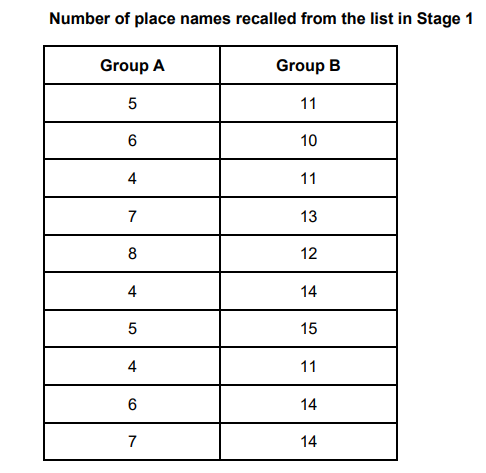
What is the most appropriate measure of central tendency for calculating the average of the scores, from the table, in each of the two groups? Justify your answer.
Mean
The mean is the most sensitive method as it takes all the scores in each data set into account
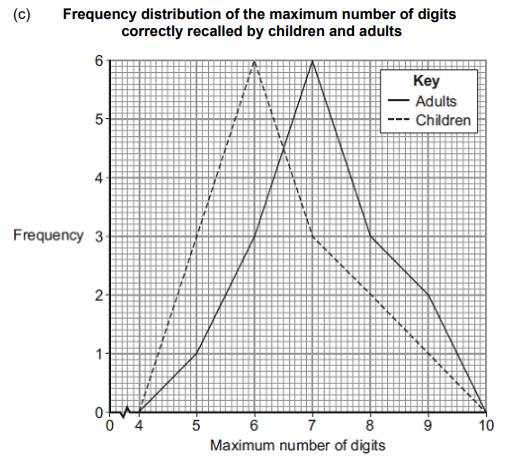
What does the frequency distribution show about the results? (3 marks)
The frequency distribution shows that there is a difference in results between the two age groups.
Adults recalled more digits than children.
However, the difference is small and some children recalled more digits than some adults
Investigator effects sometimes occur in interviews.
Explain two modifications that would help to minimise investigator effects in this study. (4 marks)
Have an interviewer who did not know the aims of the study so that they would not let their own expectations influence how they ask the interview questions (double-blind technique)
Have an interviewer who was not the students’ teacher so that the students would not be influenced by wanting to impress their teacher
Use open-ended questions/avoid leading questions so that the students are less likely to be led and are able to give a more detailed and accurate explanation of their views in their own words
Video the interviews and have another investigator watch and analyse them, improving the objectivity of the results
Use a questionnaire (or other means) to collect data without face-to-face interaction, so the students are not affected by the presence of another person
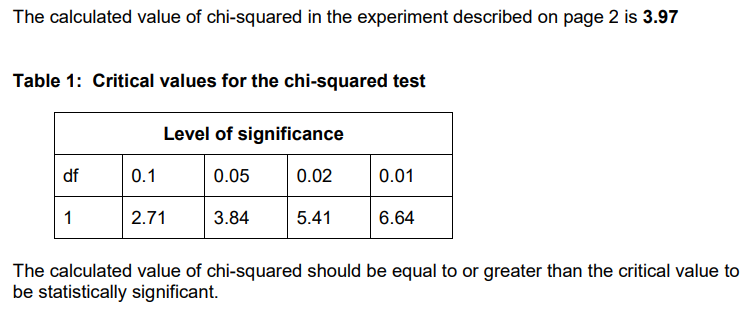
With reference to the critical values in Table 1, explain whether or not the calculated value of chi-squared is significant at the 5% level. (2 marks)
the value of chi squared is significant (at the 5% level)
the calculated/observed value (3.97) is more than/exceeds the critical/table value of 3.84/at 5%
The results of the study are given in Table 1 below.
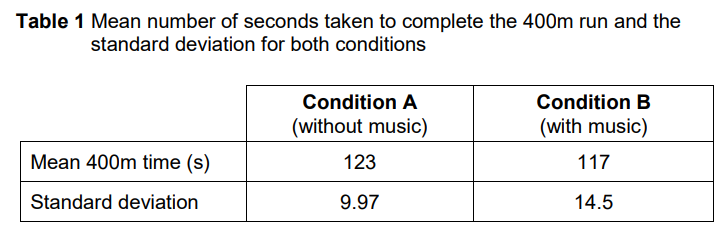
Explain why a histogram would not be an appropriate way of displaying the means shown in Table 1. (2 marks)
1 mark for explaining either you need to have continuous data or scores for each participant in order to draw a histogram.
Plus
1 mark for identifying that the data represents two separate conditions (with music/without music). Accept categorical/nominal.
Note: credit can be given for two separate conditions if the student explains clearly why this would make a histogram “inappropriate”.
What is meant by a Type II error? Explain why psychologists normally use the 5% level of significance in their research. (3 marks)
A Type II error would occur where a real difference in the data is overlooked as it is wrongly accepted as being not significant, accepting the null hypothesis in error (a false negative).
The 5% level is used as it strikes a balance between the risk of making the Type I and II errors (or similar)
The psychologist was interested in finding out whether dream themes differed between box males and females, particularly in terms of social interaction. She decided to conduct a pilot study. Twenty undergraduate students (8 male and 12 female) volunteered for the study. For a six-week period the students were interviewed at 9 am each morning when they arrived at university. Interviewers, who did not know the purpose of the study, carried out and recorded the dream interviews.
What is meant by a pilot study? Explain one possible reason why the psychologist decided to conduct a pilot study for this investigation. (3 marks)
Pilot studies are small-scale investigations conducted before research.
to identify whether there needed to be any modifications in the design, eg whether the interview questions were sufficiently relevant to dream content
to identify whether it would be feasible to conduct a study on the differences in dream themes across gender
What are investigator effects? Suggest one way in which they could have been minimised during the dream interviews. (3 marks)
Any (unintentional) influence of the researcher’s behaviour/characteristics on participants/data/outcome
provide a standardised script for the interviewers to use so that they all asked the same questions in the same way to avoid any bias in the students’ responses
the interviewers could have been trained to greet the students in the same way and ask questions with a neutral tone
ensure all interviewers were female or all interviewers were male
ensure that the students were interviewed by someone of the same gender as themselves
Another researcher, who did not know the purpose of the study, carried out a content analysis of the interview data. Explain how this content analysis could have been conducted. (4 marks)
identify/devise important categories/themes (from the interviews)
example of possible category/theme (eg references to aggressive interactions)
work through transcribed conversations / repeatedly listen to segments of the recording
count/tally the number of occurrences of each of the categories/themes
The psychologist wanted to assess the reliability of the content analysis. Explain how the reliability of the content analysis could be assessed. (4 marks)
Test-retest reliability
content analysis repeated on a second occasion using the same interview data
compare the results of the two separate analysis (number of occurrences of each)
researchers could calculate the correlation between the two ratings
researchers generally accept 0.8 correlation (accept 0.7-0.9) between the test and the re-test.
Inter-rater reliability
use a second person to work with the original researcher
they could read the interviews (separately) and devise a set of categories (and agree operational definitions)
they could tally the occurrences of each of the categories of the interviews (separately)
they could compare their tally charts looking for agreement
researchers could calculate the correlation between the two ratings
researchers generally accept 0.8 correlation (accept 0.7-0.9) between the test and the re-test.
Researchers wished to study the link between attachment and parasocial relationships. They surveyed a stratified sample of 100 18-year-old students from four different schools. Some schools had a large number of students and others had a smaller number of students. The students were asked questions about their childhood, their feelings towards celebrities and about their friendships at school.
Explain how the researchers could have obtained a stratified sample from the four different schools. (4 marks)
identify strata/sub-groups in their population, eg the four different schools
calculate the required proportion from each stratum based on the proportion in the population
select sample at random from each school/stratum/sub-grop
use a random selection method, eg assign each student a number then use a computer, calculator or random number table to select specified number of numbers between 0 and X (or hat method)
At the end of the survey, researchers wished to treat the students ethically. They used the following statement in their debriefing: ‘Thank you for taking part in the survey. Your data will be very useful. Have you any questions?’
Suggest two additional points that could be added to the debriefing statement to better ensure ethical treatment of the students. (4 marks)
confidentiality: advise students that their data is to be kept confidential so their individual responses will not be identifiable and will not be accessible to anyone other than the researchers/their agents
withdrawal of data: ensure students are told they have the right to withdraw their data after the event even if they consented to the survey and were aware of the aim at the start
protection from harm: ensure that no one has been upset or offended by questions on the survey, eg if they were felt to be intrusive or offensive, or upset by feelings aroused during the survey. If so, then discuss that these feelings are normal etc
debrief: explain the full purpose/aim of the survey, check again that they are willing to allow their data to be used
Describe the process and purposes of peer review. (6 marks)
Process
other psychologists check the research report before deciding whether it could be published
independent scrutiny by other psychologists working in a similar field
work is considered in terms of its validity, significance and originality
assessment of the appropriateness of the methods and designs used
reviewer can accept the manuscript as it is, accept with revisions, suggest the author makes revisions and re-submits or reject without the possibility of re-submission
editor makes the final decision whether to accept or reject the research report based on the reviewers’ comments/recommendations
research proposals are submitted to panel and assessed for merit.
Purposes
to ensure quality and relevance of research, eg methodology, data analysis etc
to ensure accuracy of findings
to evaluate proposed designs (in terms of aims, quality and value of the research) for research funding
In 1992, a book about human relationships was published in London. The book was written by Steve Duck from the University of Iowa. The title was ‘Human Relationships’. The book was published by Sage. A researcher needs to modify the above information to include Duck’s book in the references section of a scientific report. Write the full reference for this book as it should appear in the reference section of the researcher’s report. (2 marks)
Duck, S. (1992) Human relationships. London. Sage.
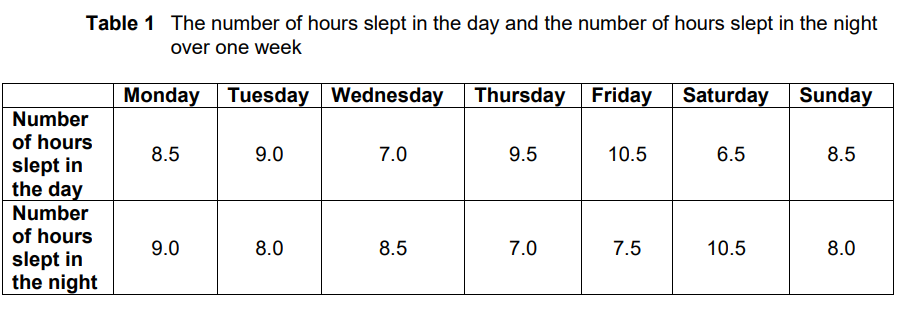
Explain one reason why the mean is the most appropriate measure of central tendency for this set of data. (2 marks)
there are no extreme values (not skewed) so distortion will not be a problem with this data set
the mean takes into account/uses all the data so is more representative of the data than other measures
data is time and is therefore interval data
A psychologist is investigating causes of aggressive behaviour. She interviews teenagers who have been in trouble at school. She asks them to describe their family and early childhood, recording everything that they say. She also looks at information in the teenagers’ school reports.
Explain how the psychologist could continue her investigation by carrying out thematic analysis of the interview recordings. (2 marks)
use the recordings to make a transcription of the interview
use coding to initially analyse the transcripts
review the transcriptions/codes looking for emergent themes/ideas that might be linked to violent crime eg family violence, parental argument, alcohol misuse.
Write a brief consent form that would have been suitable for use in this experiment. The consent form should:
include some detail of what participants might expect to happen
refer to ethical issues
be in an appropriate format/style
(6 marks)
Outline of what the experiment entails:
an explanation of the general purpose of the research
they would need to watch an assigned horror film every night before going to bed for 7 nights and would need to watch an assigned romantic comedy every night before going to bed for 7 nights
a daily requirement to truthfully respond to a text message asking whether they had experienced a nightmare
the two-week duration of the experiment.
Ethical guidelines:
no pressure to consent
they can withdraw at any time
they can withdraw their data from the experiment
their data will be kept confidential and anonymous
they should feel free to ask the researcher any questions at any time
they will receive a full debrief at the end of the programme
Format and style of consent form:
will require the participant’s agreement
could be written as a form that participants need to sign
could include space for the participant to sign the consent form
could include a space for the participant to write the date
could include a space for the participant to print their name