Psych 100 Week 1-4
 Call Kai
 Learn
Learn Practice Test
 Spaced Repetition
 Match
Match Flashcards
 Knowt Play
1/123

There's no tags or description
Looks like no tags are added yet.
Name | Mastery | Learn | Test | Matching | Spaced | Call with Kai |
|---|
No analytics yet
Send a link to your students to track their progress
124 Terms
Psychology
Psychology is the study of behavior and mental process
Mental Processess
private thoughts, emotions feelings and motives
Scientific study
approach to gaining knowledge using systematic observation
Linking to research
The knowledge gained from psychological research can be used to assist people
Link to practice
Practicing Psychologist should only use techniques and procedures that are effective as shown by research
Knowledge gained from practice can suggest new research
Areas in Psychology
Clinical Psychologist - evaluation, diagnosis, treatment - focus on mental health conditions - mild to sever and complex
Clinical Neuropsychologist - evaluation, diagnosis, treatment - focus on clients with brain disorders - memory, attention, language
Educational and Developmental Psychologist - evaluation, diagnosis, treatment - developmental and educational difficulties across the lifespan
Counselling Psychologist - (Career, Marital, Greif) - conflict resolution, can diagnose some disorders - mainly people with everyday problems
Forensic Psychologist - within legal and justice systems - assessment, evaluation, interventions
Organisational Psychologist - business, industry, government - recruitment training, career development, increasing productivity
Health Psychologists - working to promote good health or assist those who already have health problems - working with individuals or public health programs
Community Psychologist - promote mental health at community level - focus on communities at risk
Sport and Exercise Psychologist - works to improve performance of athletes
Where does knowledge come from?
Empiricism (Aristotle, John Locke)
All humans came into the world as blank slates
All behavior is learned from environment
Nativism (Descartes) contrasts with empiricism
Born with innate knowledge common to all humans independent of personal experience
Structionalism
Wundt made psychology and independent discipline
Medical doctor
Wundt believed psychology should be a science
Scientific approach
Controlled observations - introspection and reaction times
Wanted to explore consciousness (awareness of experience)
Wundt believed that sensations and feelings were key
Identify elements of consciousness - how they combine
Titchener (1892) coined the term structuralism
Examine how elements of consciousness are related (sensations, feelings, images)
(basic elements of consciousness through introspection)
Limitations Structionalism
Not possible to directly observe workings of the mind
Subjective experiences
Thus developed systematic introspection
Rigorous descriptions
Selected sensation and perception as seemed easier to establish the elements
Taste: salty, bitter, sour sweet
Functionalism
James (1872) Investigation of function of consciousness rather than structure
Believed that structuralists missed the point of consciousness
Flow of thoughts
Explored the formation of habits and self (personality)
Need to understand overall goal rather than how parts combine
Darwins natural selection was influential - why does trait persist
Therefore, what is the adaptive value of psychological process
Led to more research topics
Interaction with environment
Individuals difference
Allows human behavior to be explored
explain psychological processes in terms of the role and there function
Limitation
Immediate conscious experience is the focus
Introspection
Many psychologists believed introspection was not scientific
Subjective
Cannot test accuracy
Iimitated population who can be participants
Freud additional
Freud (1900) attempted to treat mental disorders
Psychanalysis for fears and anxieties
Led to the notion of unconsciousness
Thoughts, memories and desires that drive behavior
Believed childhood experiences are key - stores
Highlighted that possibility that we are not masters of our own mind
The method of psychodynamic approach seeks to interpret meanings
Infer underlying wishes
Interpretation of dreams and fantasies
Psychodynamic psychologists rely on clinical data to support their theories
Subjective interpretation
In dept observation of one or two people
Behaviorism - Watson
Psychology is the study of observable behavior
Behavior is seen as any overt response
Thought to be strengthening scientific approach
Allows objective replication
Redefined psychology
No reference to consciousness or unconsciousness
Studied the link between behaviors and the environment
Stimulus response psychology
Behavior based on previous experience (rewards and punishments)
Skinner
Skinner (1953) supported strict behaviors
Believed in mental states, but argued not necessary to explain behaviors
Reinforcement and punishment
Critics
Critics viewed behaviorism as de-humanising and lacking free will
Psychoanalysis to have a pessimistic view of humans
Humanism
Rodgers (1902-1987) behavior relates to our sense of self
Maslow (1908-1970) Humans have a desire to reach their potential
Humanistic Psychology: focus on unique qualities of humans allowing for freedom, personal growth and self awareness
Driven by the desire to reach your full potential
Focuses on persons unique perspective and experience
Not powerless victims, strive to reach potential
Goals influenced by experience
Personal centered
Therapist is supporter rather than the judge
Maslow Heirachy of needs
self actualisation
esteem needs
belongingness needs
saftey needs
physiological needs
Cognitive Psychology
Psychology has a renewed interest in consciousness (1950s/1960s)
Cognitive revolution
Cognition: processes in acquiring knowledge
Piaget: How Children's cognition develops
Chomsky: How language develops
Led to people arguing psychology should explore the way people think
Information Processing Model
Input
Transformed
Stored
Retrieved
Response
Biological Psychology
Psychology observed relationships between physiology, behavior and thoughts
Brain stimulation
Brain injuries
Biological psychology argues that much behavior can be explained by brain structures and chemical processes
Hemispheric specialisation
Advances in technology have supported research
Helps understand typical and atypical brain activity
Increase in understanding of the link between biology and behavior
Chemicals in the brain relate to psychological disorders
Evoultionary Psychology
Due to the rise in behaviorism, evolutionary psychology was ignored until recently
Explanations offered are often deductive - begin with a characteristic
Explain how this may have supported natural selection
Why behaviors have adaptive value over time
Natural selection favors behaviors that will increase reproductive success
Assumes that we are born with mental processes to guide behavior
Acquired through natural selection
Helps solve adaptive problems
Language - communication
Finding mate - reproductive success
Positive Psychology
Seligman believed psychology to be negative
Much attention towards disorders with little attention towards building positive aspects of life
Positive subjective experiences: happiness, love
Positive individual traits: personal strengths
Positive institutions: supportive communities
Timeline
1879: Wundt first psychological lab
1860: William James - Structionalism, Functionalism
1900: Freud - Psychodynamic approach
1910-1920: Watson, Pavlov, Skinner Behaviorist approach
1950: Cognitive revolution - Humanistic
1980: Biological and Evolutionary
1990: Positive Psychology:
Now Eclectic mix
Culture and Psychology
Culture plays a large role in modern psychology
Shared values, customs, beliefs
Obvious characteristics: race or social class
Other characteristics: religious or political beliefs
Culture influences all aspects of behavior and mind
Until recently Psych explored the environment and an individual person
Universal laws of group behavior
Cross cultural differences?
Culture influences out behavior as the environment influences our social and cognitive development
Vygotsky: thoughts originate from social interactions
Culture affects psychological principles
Need to consider how an individual is within their social and cultural context
Boundaries and Borders of Psychology
Biopsychology = examines the physical basis of psychological phenomena such as motivation, emotion and stress
Sociocultural perspective = a modern approach to psychology that emphasises social interaction and the cultural determinants of behavior and mental processes
Cultural and cross- cultural psychologists = each adopt and approach content and context of a culture rather than absolute universal truths are important in the study of human behavior
Parts of Brain oringinal theory
1839 Dr Marc Dax suggested lesions in left side of brain were associated with language disorders
Paul Broce (1824-1880) discovered brain injured people with lesion in front section of left hemisphere could not speak but could comprehend language
Carl Wernicke (1848-1904) showed that damage behind Broca could lead to another kind of aphasia - could speak fluently and follow grammar but could not understand language or speak in a way that others could understand
Wundt theory
Methods included introspection - involved looking forwards and reporting on ones consciousness experience
Not like introspection of philosophers - speculated freely
Wundt trained observers to report verbally everything in their mind when presented with stimulus or task
By varying objects Wundt concluded that the basic elements of consciousness are sensations (colours) and feelings
These elements combined to make more meaningful perceptions eg a face
Structionalisn vs Functionalism
Wundt's student Edward Tichener (1867-1927) advocated using introspection with the hope of devising the elements of human consciousness
Because of his interest in the structure of human consciousness - he created structuralism
Unlike Wundt, Titchener believed that experimentation was the only appropriate method and concepts like attention implied too much free will
Experimental psychologists post Tichener went further, viewing the study of consciousness as unscientific because data was sensation and feelings , could not be observed except person reporting
Instead of focusing of concepts in the mind functionalism emphaises the function of psychological processes that helped individuals adapt to their environment
Founder of functionalism William James (1842-1910)
James believed that knowledge of human psychology could come from many sources including introspection and experimentation
Key propositions psycoanaytic theory
Aspects of personality emerge in childhood
Mental representations of self, others and relationships guide peoples interactions
Mental processes including affective and motivational processes operate simultaneously - individuals can have conflicting feelings outside awareness
Personality developments involved learning to regulate sexual and aggressive feelings but moving from immature and dependent to mature and independent
Life is unconscious
Origins of Cognitive Perspective
Comes from Greek Philosophers like Descartes, Plato
The mind itself generated knowledge
Aristotle emphasises the role of experience in generating knowledge
Locke proposed that complex ideas arise from mental manipulation of simple ideas
Behaviorists reject Descartes view of an active reasoning mind
Ethology, Socicobilogy and Evolutionary Psychology
E.O Wilson 1975 invented sociobiology which explores possible evolutionary and biological bases of human social behavior
Sociobiologists and evolutionary psychologists propose that genetic transmission is not limited to physical traints
Parents pass on behavioral and mental tendencies
Behavioral genetics - examines the genetic and environmental bases of differences amount individuals on psychological traits suggest heredity is strong in determining personality and intellectual skills
Central to evolutionary psychology is the notion that the brain, eye, heart as evolved for survival and reproduction
Steps in a scientific method
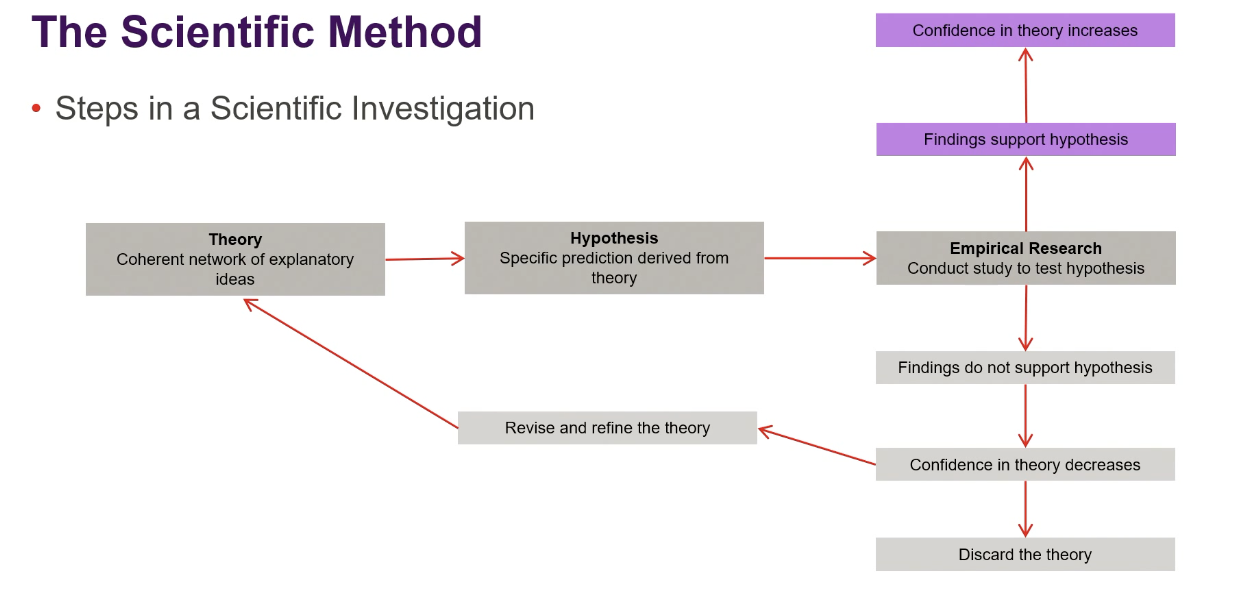
Genrelisability
Interval validity = measure what you intend to measure
External validity = can be generalised outside the lab
Scientific method advantages
Clear and precise
Operational definitions so we know exactly what is being discussed
Intolerant of error
Scientists test their ideas
Scientists scrutinise other peoples research
Objective data must be used
Reliability and validity
Reliability = closeness of repeated measurements to each other
Validity = closeness of a measured value to its true value
Descriptive methods
Simply describe the phenomena
Benefit = can explore questions which cant be looked at experimentally
Negative = cannot determine cause and effect
Naturalistic observation
Naturalistic observation: In depth observation in a naturalistic setting
If someone knows they are being watched they may act differently
Be a participant- observer
Only describes behavior and cannot determine cause and effect
researcher bias
limited generalisability
Case Study
Case Study: in depth investigation of one person, or a small group
Good when examining rare disorders
Techniques include
Interviews
Psychological testing
Clinical Psychologists and clinical neuropsychologists commonly conduct case studies
Limitations:
Need to compare multiple case studies to look for commonalities
obsserver bias
low sample size
Survey
Survey: Questionnaires or interviews gather data about specific topics
Look for relationship between the data
Surveys can obtain information on difficult to observe behavior
Limitations:
Less willing to complete surveys due to identify theft concerns
Self report data - social desirability affect
Correlational research
Correlational Research: Exploring how much two variables are related
Correlate: extent that the variables are co-vary
Positive correlation: as ones increases, so does the other
Negative correlation: as one increases the other decreases
Limitations:
Correlation to not imply causation
quasi experimental design
differ naturally, but matched on other charcteristics
cannot provide cause and effect
Conducting experiment includes
Hypothesis
Operationalising variables
Developing standardised variables
Developing standardised procedures
Selecting and assigning participants
Applying statistical techniques
Drawing conclusions
Limitations include difficulty bringing complex phenomena into a lab
Characterisitcs of quaitiative resarch methods in psychology
Qualitative research involved deep dive into research topic
Has a holistic view - takes inductive approach and is in naturalistic settings
Key theoretical perspectives that underpin qualitative research include:
Positivism
Interpretivism
Critical theory
Epistemology examine the nature of knowledge using three key approaches - objectivism, constructionism and subjectivism
How to evaluate study critically
Ask questions abut theoretical framework, sample, measures and procedures, broader conclusions and ethics
Experiment or study is replicatable is it can produce same results when repeated
Critical thinking is essential in psychological research - making logical and rational assessment of information
Quantitaive research in psychology
Quantitative research involved using experiments to gather data that can be statistically analysed
Normal process is:
Carry out survey
Tabulate data
Analyses it using standard statistical packages and protocols
Draw conclusion based on hypothesis
Normally based on large sample - representative
Research has high reliability
Analysis of the results is more objective than qualitative research
3 main goals of psychological research:
To describe, predict and explain or understand behaviour and mental processes
Some studies require attempts to describe or classify behaviours and mental processes through observation
Scientific method represents standardised procedures of research used to gather and interpret objective information
The scientific method
observation and litrature reiview
testable hypithesis
research design
data collection and analysis
publication
theory development
Reliability
Reliability refers to measures ability to produce consistent results
Reliable psychological measures should not fluxuate based on presence of random factors
Retest Reliability = refers to the tendency of a test to yield similar scores for the same individual over time
Internal Consistency = a measure is internally consistent in several ways of asking the same question yield similar results
Interrater Reliability = if two different interviews rate an individual on some dimension both should give person similar scores
Validity
To ensure validity of a psychological measure - researchers conduct validation research
Validation = demonstrating that a measure consistently relates to some objective criteria or to other measures that have already demonstrated validity
Experimental research
Psychology takes a scientific approach to research using empirical methodologies to gain knowledge
Empirical methodologies involve a process where hypothesis are tested - experiments, observations
Involved rigorous testing of a theory
Description = summarising data your research has produced in a way that makes events and relationships understandable
Prediction = using outcome of research to identify what would happen in future
In experimental research some aspect is manipulated and examine response
Experimental methods establish causation - one variable leads to predicted changes in anothe
Steps in conducting an experiment
frame hypothesis
opertionalising the variables - turning abtsract concept into varaibles defined by actions
developing a stndardised procedure
selecting and assingming participants
applying statistical techniques to the data
drawing conclusions
Advantages and Limitations of experimenter research
Advantages:
No other method can determine cause and effect so unambiguously
Experiments can be replicated to see whether the same findings emerge with different sample
Limitation:
Many complex phenomena cannot be tested
Researchers can never be certain how closely phenomena in a lab parallels real life
Aims qualitive research
Crotty 1988 4 elements
What methods do we propose to use - how to collect data
What methodology governs out choice and method - how to Analyse data
What theoretical perspective lies behind methodology
What epistemology informs this theoretical perspective - branch of philosophy associated with nature, origin and human knowledge
Different types of research processes
Positivism = perspective that suggest a straightforward relationship between world and out understanding of it - favors objective research
Interpretivism = concerned with subjective issues like feelings, values, experiences and meanings
Critical theory = requires the researcher to delve below the surface to uncover the real structure of the material world, concerned with power expression in society e.g feminism
Objectivism = contends that phenomena exist independently of our beliefs or consciousness of them
Constructionism = there is not one objective knowledge
Subjectivism = meaning is assigned to phenomena by the observer - subjective and individual
Approaches to qualitive research
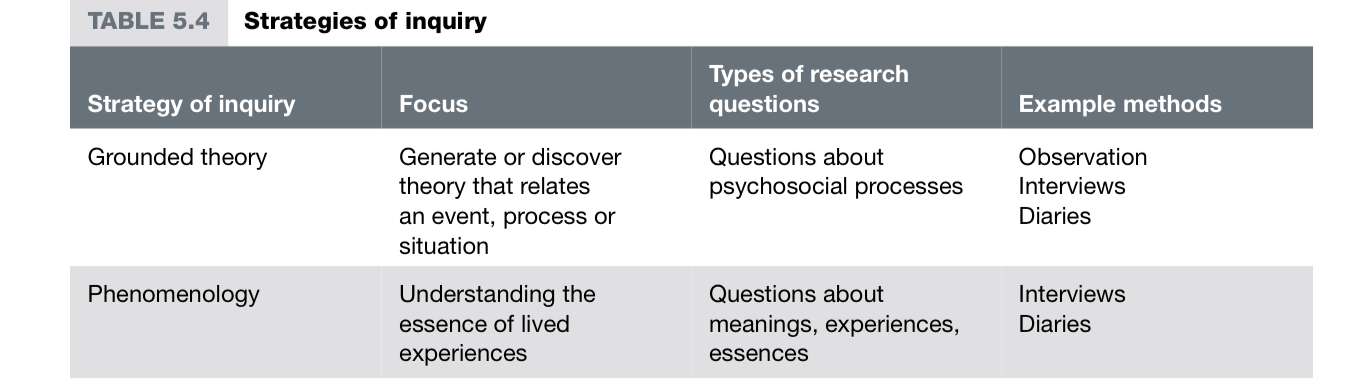
Aspects to designing a qualitative study
Not that different to quantitative study
More general approach to the topic
Considerations of how much literature to include
Actual format of the study
Assumptions and philosophical issues that guide the study
Janice Morse (2000,2016) what qualitative research should:
Be systematic and rigorous
Be strategic and sensitive to contextual demands
Be reflexive - keep track of engagement in the research and knowledge production process
Involve small number of participants but does not mean it is to remain limited
Conducted in ethical manner and sensitive to social, cultural and political context
Critical Thinking
Involves carefully examining and analyzing information to judge its value
Making a logical and rational assessment - assessing strengths and weaknesses
Skepticism = questioning assumptions to conclusions and analyzing whether the evidence presented supports the results
Objectivity = taking an impartial or disinterested approach
Open mindedness = considering all sides of an issue
Fallacies in arguments
Straw man = authors deliberately attacking an opposing argument to strengthen their own argument
Appeals to popularity = refers to the fallacy that a popular and widespread argument is true
Appeals to authority = refers to the fallacy that an argument must be true because the authority of the person making it
Arguments directed to the person = refers to the approach in which authors try to strengthen their own argument by attacking the authors alternative arguments
Internet and Psychology research
Benefits:
Online sources mean easy access to research and data on topic
Recruitment for participants
Cost and efficiency benefits
Automation of data entry
Having people do surveys from home - more comfortable
Challenges:
Information can be questionable
Internet connectivity is not universal
Reduced control of researcher
Data is easier to be shared - ethics
Completing surveys at home can make it difficult to determine harm
Difficult for debriefing
Leisons vs Modern
Lesions
Brain injury
Electrical stimulation
can only be certain one area has been damaged
limitation include few participants
Modern
EEG
TMS
Brain imaging
PET, CT and MRI/FMRI
Electroenphalography (EEG)
A device that detects amplified and record electrical activity of the brain
Electrical activity can be recorded
Measure clusters of brain activity over time
Use of electrodes
Line tracing aka brain waves
Used to understand mental activity
Diagnosis of brain damage and epilepsy
Can be used to identify sleep stages
Transcranial Magnetic Stimulation (TMS)
Magnetic coil over persons head
Virtual lesions
Painless and non-invasive
Limitations
Cannot be used for deep areas of the brain
Possible use as intervention, ED, GAD
Computerised tomography (CT) scan:
X ray of the brain
Computer combines multiple images
Horizontal slice
Least expensive
Can be used to explore structure and abnormalities
Positron emission tomography (PET) scan:
Explores function
Maps activity over time
Radiative chemicals illustrate blood flow
Magnetic resonance imaging (MRI) scan:
Magnetic fields and radio waves
Brain structure
3D image with high resolution
Function magnetic resonance imaging (fMRI) scan:
Monitors blood flow and oxygen use
Function
Great precision
Statistics
make sense and intrepret data
There are different ways to use statistics to inform decisions
Descriptive statistics: condense the data to make it useful
Inferential statistics: get more in depth
Testing scientific hypothesis
Calculating effective sizes
Measures of centre vs spread
Median: Score that falls in the middle, middle point when data in order
Mean: average, sum of data, divide by number of data points
Most useful
Sensitive to outliers
Mode: most frequent score
Centre isn't everything
Measures of spread:
Range
Standard deviation
Variance
Stratagies of inquiry
Grounded theory
Generates a new theory
Phenomenology
Understanding lived experienced
Ethnography
Description and interpretation of cultural/social group
Case study
In depth study of single/few cases
Action research
Research + action
Research animal vs humans
For humans
Treated with respect
Voluntary participation
Should not be harmed
Debriefed after deception
Confidentiality
Informed consent
For Animals
Harmful procedures should not be used unless the end justifies the means
Live in decent conditions
Code of Ethics Principles
Respect for rights and dignity of people
Informed consent, privacy, confidentiality, access to own information
Propriety
Competence and professional responsibility
Integrity
Reputable behavior, impartial, non-exploitative
Flaws in research
Sampling bias
Placebo effect
Distortion in self- report data
Experimenter bias - expectations
Importance of replication
Replication: repeating a study
Can lead to contradictory results
Science works to explain these contradictions
Meta- analysis = combing results from many studies to test genrelisability of studies
What is a neural impulse
How do neurons communicate with one another
Neural impulse is an electrochemical reaction
Electrically charged molecules (ions) inside and outside neuron
Positive: Sodium and Potassium
Negative: Chloride
Flow across membrane at different rates
More negative inside the neuron
Resting potential: stable negative charge - inside neuron
Resting Potential and action potential
Channels allow ions to past through cell
70 mv is resting potential - negative
Changes in concentration of ions
Increase sodium - more positive depolarization
30mv is peak in a reduction in charge of cell - repolarization
Charge of cell can drop below resting potential - hyperpolarization
Absolute refectory period - neuron cannot be reactivated
Relative refectory period - difficult for cell to have another action potential - needs a strong action potential
Action Potential Propagation
How does the neural impulse move through the neuron
When activated positive ions, rush into the neuron - sodium
More positive
Triggers action potential along the axon
The channels then close and resting potential is restores
Absolute refractory period: minimum time before another action potential can begin
1 or 2 milliseconds
Relative refractory period - heightened threshold
Process
Presynaptic neuron start
Synaptic cleft
Action potential from cell body through axon
Vesicles contain neurotransmitters will fuse
Then neurotransmitters will be released
Travel to receptor sites then it binds and can be absorbed
Postsynaptic potential
Postsynaptic potential (PSP) voltage change at the receptor site caused when neurotransmitter and receptor combine
Vary in size - increase or decrease the change of neural impulse in the receiving cell
Excitatory PSP: Positive voltage shift
Inhibitory PSP: Negative voltage shift
Lasts only milliseconds
Neurotransmitters drift away and enzymes may break them down
Neurotransmitters can undergo reuptake
Neurotransmitters
Bind to receptor sites
May be broken down by specific enzymes in synaptic cleft
May undergo reuptake at pre-synaptic button
Types of Neurotransmitters - Small Molecules
Acetylcholine:
Memory, movement
Malfunction - Alzheimer's disease
Norepinephrine:
Mood, sleep, learning
Malfunction - depression
Serotonin:
Mood, appetite, impulsivity
Malfunction - depression
Dopamine:
Movement, reward
Malfunction - Parkinsons disease, schizophrenia
Types of Neurotransmiiters: Amino Acids
GABA:
Depressant
Sleep, movement, regulation of anxiety
Malfunction - anxiety, Huntington's disease, epilepsy
Glutamate:
Excitatory
Memory, learning
Malfunction - damage after stroke
Other Neurotransmitters
Endorphins:
Pain control
Also linked with mood elevation
opium elevae mood
Nitric Oxide:
Memory
Agonist and Antagonist
Receptor sites can be fooled by other chemicals
Agonist: chemical that mimics the action of a neurotransmitter
Produces the same effect then the original neurotransmitters - e.g nicotine
Antagonist: opposes the action of a neurotransmitter
Block the neurotransmitter by occupying its space
E.g curare stops muscles moving
Endocrine System
Endocrine system also relays messages
Secretes hormones into bloodstream
Binds to many receptor sites throughout the body at once
Hormones often similar to neurotransmitters
Adrenaline and Noradrenaline = epinephrine and norepinephrine
Physiological arousal vs anxiety and fear arousal
Oxytocin:
Neurotransmitter = nurturing behaviors
Hormone = breast milk production
Components of Endocrine System
Pituitary gland: pea sized structure in the brain
Master gland
Releases many hormones
Connected to CNS
Thyroid Gland: found in the neck
Growth and metabolism hormones
Energy levels and mood
Underactive thyroid = depression and sluggish behavior
Overactive thyroid = increased metabolism
Adrenal Glands: above the kidneys
Adrenaline during emergencies
Cortisol
Gonads: located in testicles or ovaries
Sexual development, sex drive and secondary sex characteristics
Testosterone vs estrogen/progesterone
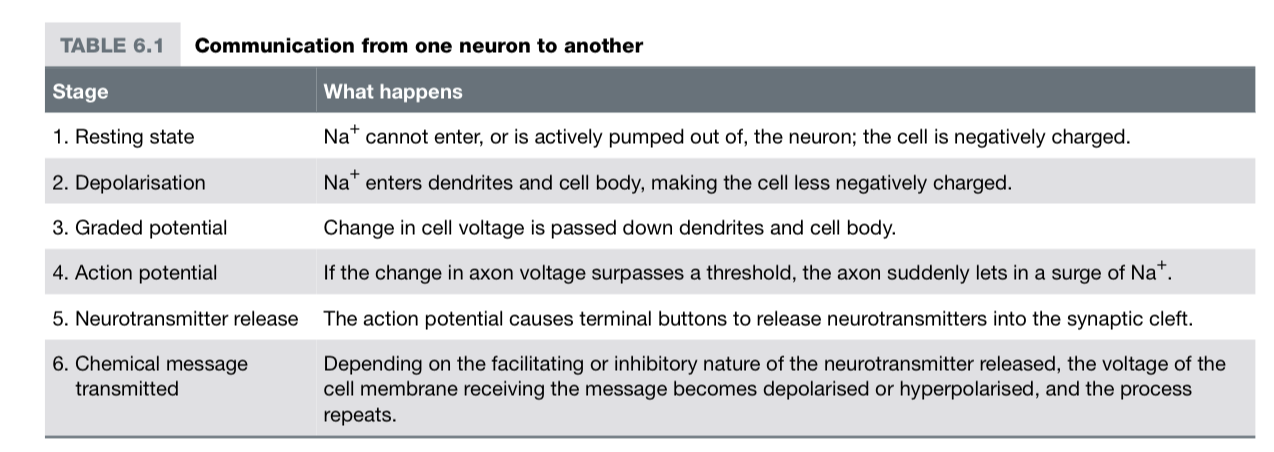
Action Potneial and Gradient
Electrical gradient
Difference in electrical charge between inside and outside the neuron
Maintained by cell membrane
More positive ions one side and more negative on the other side
Resting potential (resting neuron)
Neuron not firing, but is ready
Polarization - inside negative charge outside positive charge
How does action potneial actually work?
Ion channels open in membrane (wall of the neuron)
Positive ions (Sodium Na+) rush into neuron
Once charge reaches (+30/40 millivolts)
Original ion channels (Na+) close
Other ion channels open (Potassium K+
Positive ions leave the neuron
Charge goes below resting potential -90mv ion channels close Na- K pump returns to resting potential
Change in electrical charge in one areas causes change in electrical charge in next area - as impulse moves along neuron
Threshold of excitation, stimulation needed to cause action potential -50mv
Below threshold no action potential
All or none law
Strong stimuli fire more often
Graded Potentials
Stimulation causes change in the electrical change of the neuron but not action potential
The change is graded: the amount of change depends on the amount of stimulation
Change causes change in surrounding areas - does not travel length of neuron
Change can be:
Polarization - increasing the negative charge inside the neuron
This makes it less likely neuron will fire action potential
Depolarization: decrease in negative charge inside the neuron
This makes it more likely the neuron will fire an action potential
Process
Stimulus causes action potential
Travels down axon
Terminal buttons
Synaptic vesicles
Synaptic gap
Receptor sites on Post Synaptic neuron
Can trigger action or graded potential
What can neurotransmission trigger
action or graded potential
Stimulus causes action potential - Action potential travels down axon to terminal button
NT released
NT released into synaptic cleft, NT bind to complementary receptors in postsynaptic neuron dendrites - NT triggers change in action potential or graded potential.
Triggering action potential = process repeated
NT released from receptors are broken down or reuptake back into presynaptic neuron axon.
CNS
Sensory Neurons: transmit information from sensory receptors to the brain either directly or via the spinal cord
Interneurons: output is received by interneurons, nerve cells that connect other neurons with one another
Motor Neurons: transmit commands from interneurons to muscles, organs and glands of the body
Carry out voluntary and involuntary actionsforebrain, midbrain, hindbrain
brain and spinal cord
PNS
Neurons in the PNS carry messages to and from the CNS
Somatic NS - carries sensory information to the brain and motor neurons to direct skeletal muscles
Autonomic NS - controls basis life processes like heartbeat and breathing
Autonomic NS consists of sympathetic and parasympathetic
heritability
Heritability = refers to the proportion of variability among individuals on an observed characteristic that can be accounted for by genetic variability
Characterisitcs of graded potential
Their strength diminishes as they travel along the cell membrane to the source of stimulation
Graded potentials are cumulatively if a neuron is depolarized by -2mv at one point on a dendrite and hyperpolarized by -2mv at an adjacent point the two graded potentials add up to zero and cancel each other
Transmission of information between cells
Glutamate
Glutamate is a neurotransmitter that excites neurons in NS
Involved in memory, synaptic plasticity, learning
High glutamate linked with neurodegenerative diseases like Huntington's disease and Alzheimer's
Neuroimaging and research with mice helps understand knowledge of glutamates activities in the NS - help treat Alzheimer's
Trearment using dopamine
Treated using L- Dopa chemical that converts to dopamine
Dopamine cannot be administered because it cant cross blood barrier
Blood brain barrier results from the fact that cells in blood vessels are tightly packed meaning large molecues cannot enter
Serves as an adaptive function preventing toxic substances from disrupting neural functioning
It also rejects medicine that could treat brain disease
Only small percent of L- Dopa gets past blood brain barrier
Causes side effects like nausea, vomiting, shortness of breath
The L-Dopa that does make to brain is used for different purposes
Can produce disordered thinking
Autonomic NS
Conveys information to and from internal bodily structures that carry out basic life processes like digestion and respiration
Consist of sympathetic and parasympathetic
Sympathetic NS
Activated in response to threats
Fight or flight
Stops digestion, diverting blood away from the stomach and redirecting it to muscles which may need extra oxygen
Increases heart rate, dilates the pupils, caused hairs on body and head stand erect
Also involved in ejaculation of males
It is an adaptive function
Can also be activated when unwanted - anxiety, tremors, sweating, dry mouth
Parasympathetic NS
Maintain body's store of energy, regulating blood sugar levels, secreting saliva and eliminating aste
Participates in regulating heart rate and pupil size
Parasympathetic involved in returning body back to homeostasis after sympathetic NS is activated
Differnet ares of brain - M, H, F
Forebrain - specialized for sensation at immediate level, small and eventually taste
Midbrain - controlled for distance stimuli - vision and hearing
Hindbrain/brainstem - specialized for movement and balance