Symbolism Art History Midterm Flashcards - Lauren Antonacci
 Call Kai
 Learn
Learn Practice Test
 Spaced Repetition
 Match
Match Flashcards
 Knowt Play
1/8

There's no tags or description
Looks like no tags are added yet.
Name | Mastery | Learn | Test | Matching | Spaced | Call with Kai |
|---|
No analytics yet
Send a link to your students to track their progress
9 Terms
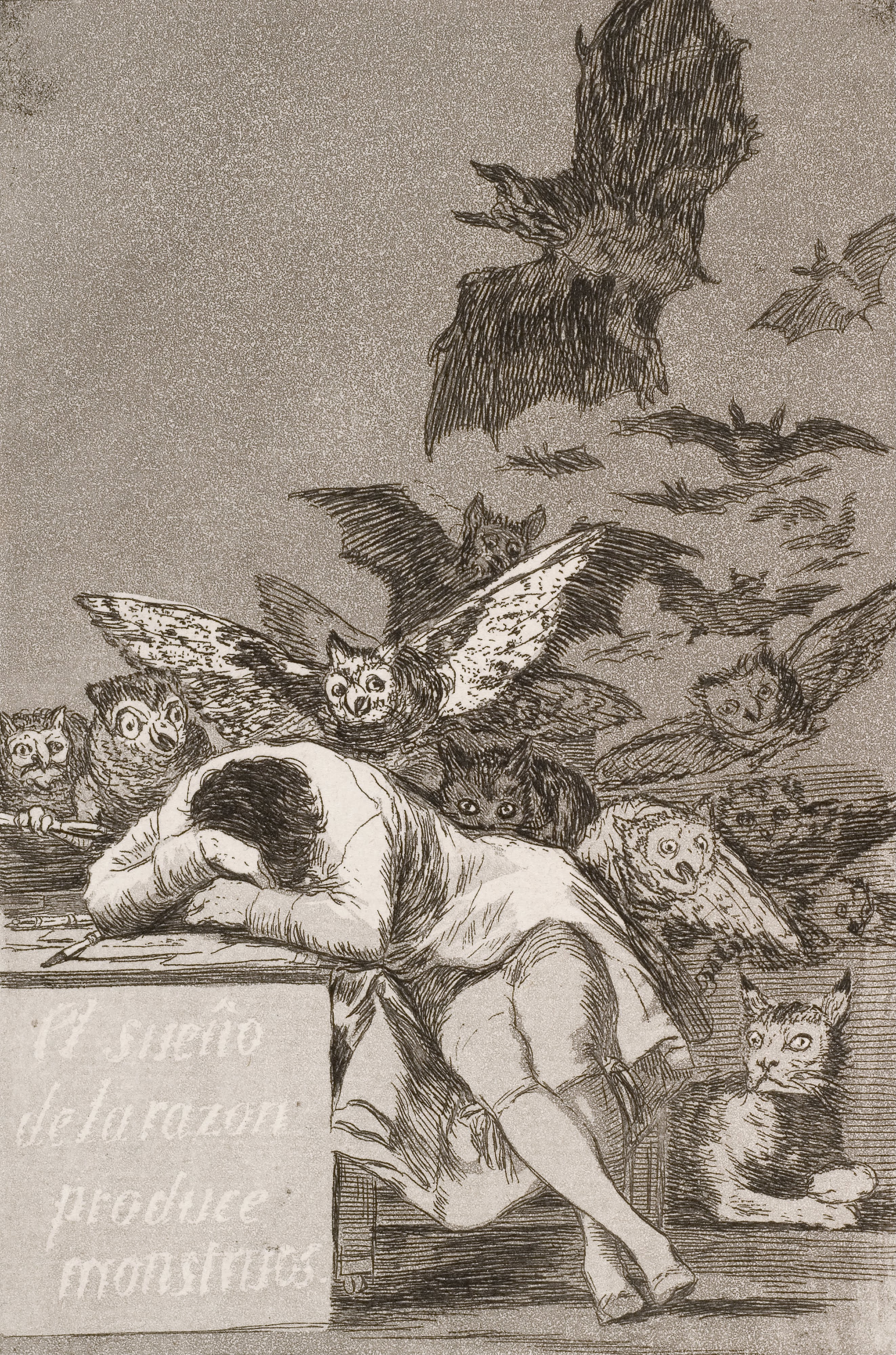
Francisco Goya
The Dream of Reason Produces Monsters
1797-99
Los Caprichos is a collection of 80 etchings (printmaking) published in 1799 by Goya, where he drew inspiration from local folklore and the political/social/religious controversies of his time period. In this specific artwork, Goya positions himself hunched over his desk, with the artwork’s title plastered in front of him. Goya uses a caricature style with his subjects, giving them a cartoonish look. Goya appears asleep next to his drawing and carving tools, his reason dulled by slumber, with creatures of the night ambushing him from behind. The creatures that appear in the work are often associated in Spanish folk tradition with mystery and evil - the owls represent folly, and the bats are ignorance. The title calls back to the main beliefs of the Enlightenment, emphasizing that without reason, evil will prevail. Reason can also be read alongside imagination, and critique how an abundance of imagination without logic may produce “monsters”.
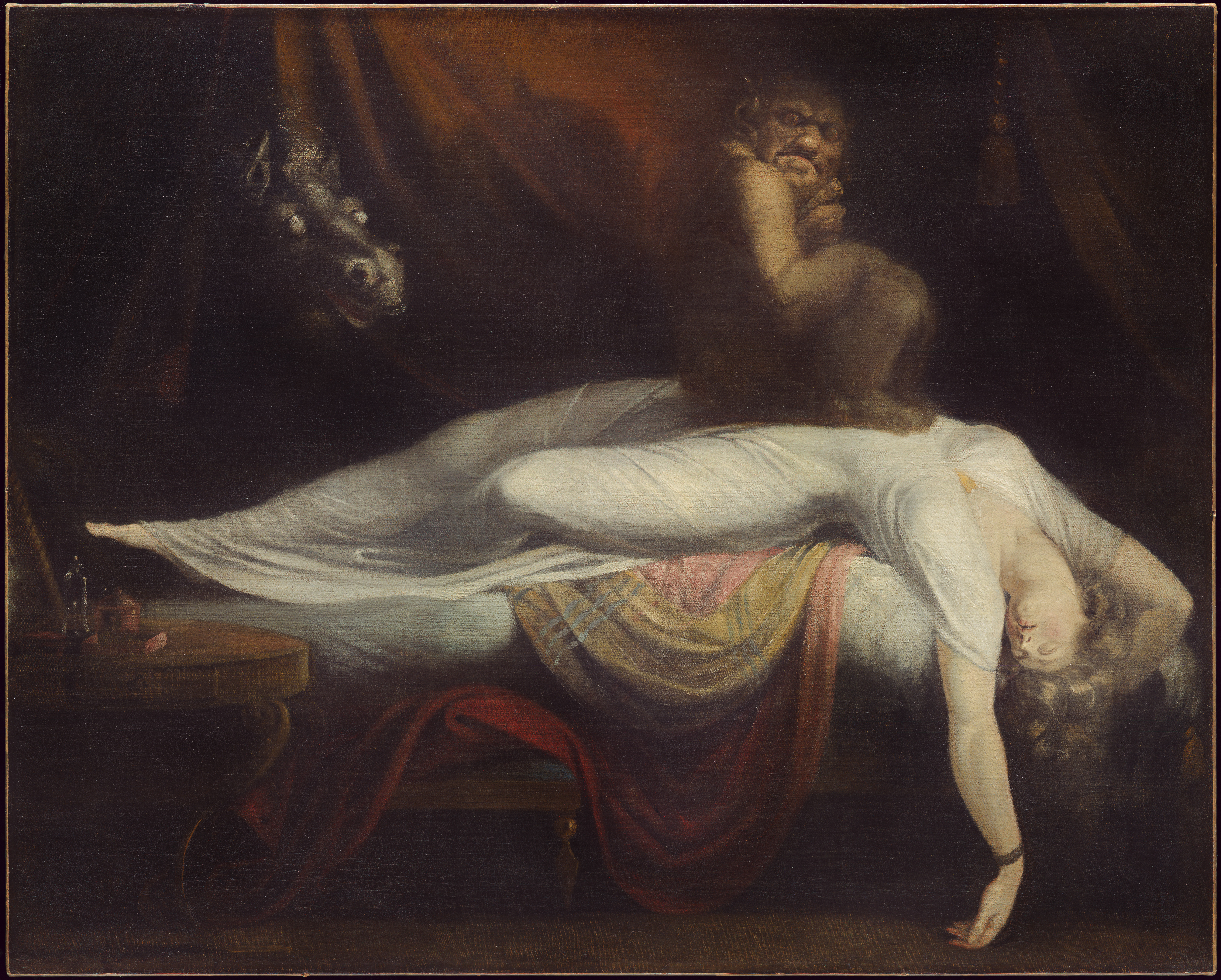
Henry Fuseli
The Nightmare
1782
Also created during the Enlightenment, Fuseli’s The Nightmare is anything but reasonable, and depicts a much darker, more supernatural force. In Fuseli’s bold composition, a woman bathed in white light stretches across a bed, contorting her arms, neck, and head wildly. A gargoyle/demonlike figure crouches on her chest, while a ghostly horse with glowing eyes emerges from the shadowy background. The Nightmare’s subject is neither historical nor biblical, and is drawn completely from the depths of Fuseli’s imagination. The painting can be read as a precursor to late nineteenth-century psychoanalytic theories regarding dreams and the unconscious mind. The imp is described as an incubus, a type of spirit said to lie atop people in their sleep or even to have sexual intercourse with sleeping women. The loose hair and “mouth half open” emotion on the woman’s face has very sexual implications, suggesting an orgasmic experience. Fuseli’s painting is suggestive but not explicit, leaving open the possibility that the woman is simply dreaming. Yet, her dream appears to take frightening, physical form in the shapes of the incubus and the horse. Fuseli’s use of chiaroscuro heightens the drama of the scene, as the overwhelming darkness of the composition drowns out the light.
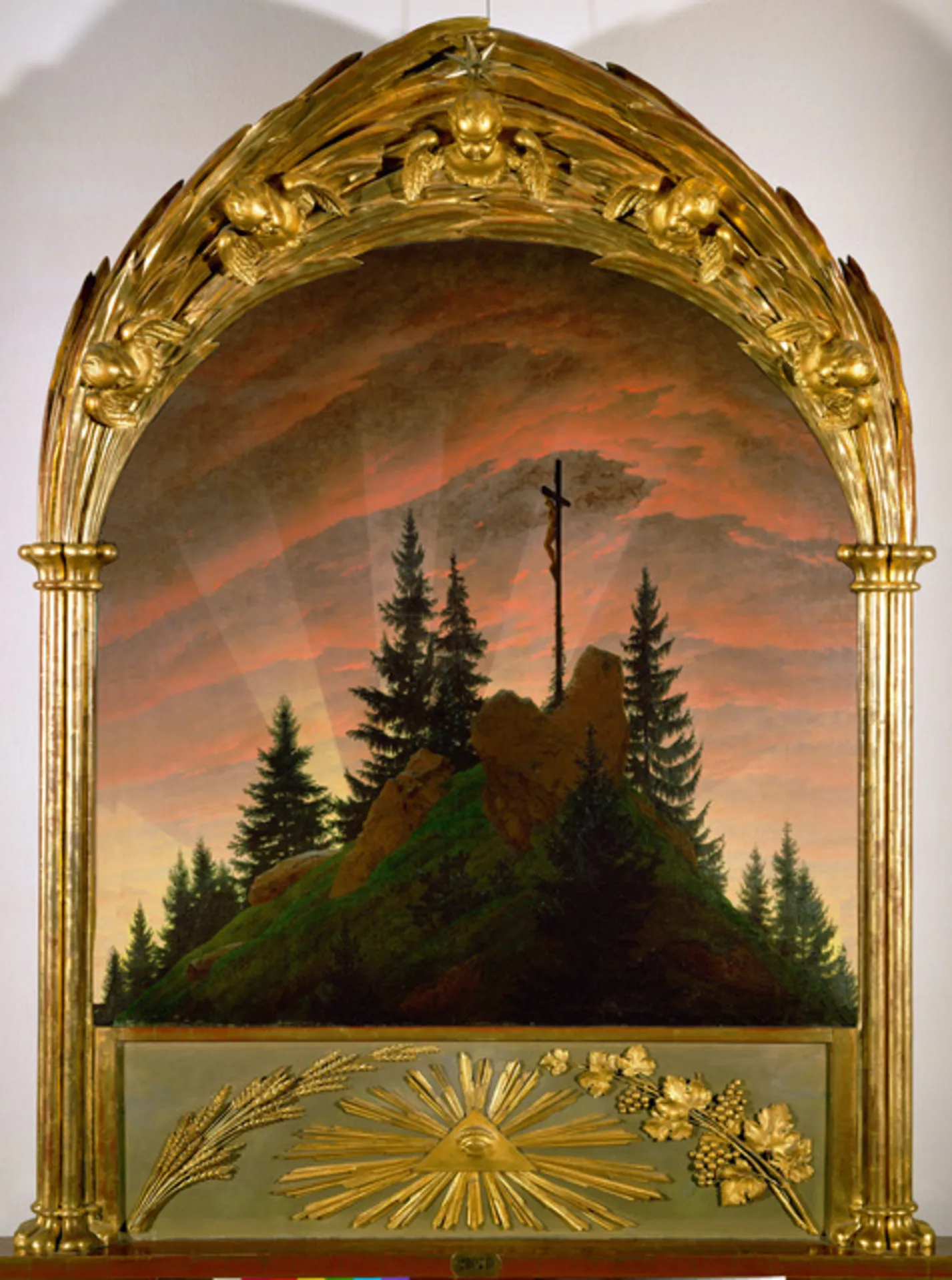
Caspar David Friedrich
The Cross in the Mountains
1808
Designed as an altarpiece, Friedrich’s giant oil painting is unique in its iconography, combining biblical stories with landscape painting. The canvas depicts a golden summit cross with the crucified Jesus silhouetted in profile on a rock atop a mountain, surrounded by fir trees below. The cross faces towards the sunlight, which is radiating up from a distance. The image is almost two-dimensional, and by lacking any foreground, the scene feels distant from the viewer. The low sun may be rising or setting, implying either a new day or a new evening. The frame includes other Christian iconography - at the base, the Eye of God is within a triangle with wheat and a vine, symbols of the Eucharist. Travelling up the frame, gothic columns support palm branches where five angels emerge. The painting is deeply romantic, showing how nature is as much a work of God as the church, with God showing himself through nature.
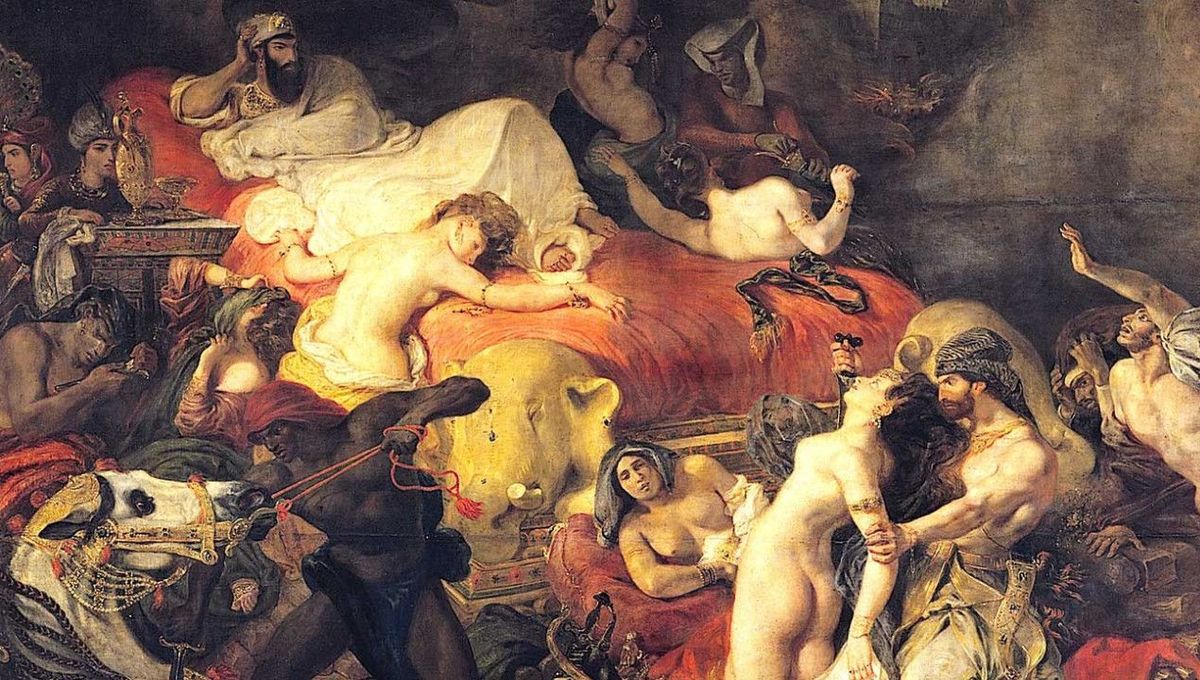
Eugene Delacroix
The Death of Sardanapalus
1827
This painting is the height of Romantic artwork, and the story itself comes from a Romantic poet, Lord Byron. It shows the Assyrian king Sardanapalus, who is being vanquished in battle, but rather than surrender, has decided to not only kill himself, but destroy everything he find’s pleasure in. His women, his clothing, and his treasure will all be burned, and everything will come to an end. Sardanapalus looks indifferently towards his helpless harem, showing his deep corruption. The composition is maximalist, with objects and flailing limbs thrown up everywhere. The frenzied violence is romanticized through the sensual poses of the women and the opulence of Sardanapalus’s wealth. This Romantic piece directly contrasts the Neoclassical movement, which was previously popular, as it’s raw, unkempt emotion compares to the stoic, organized figures of Neoclassical work - it’s an orgy of violence, luxury, and corruption.
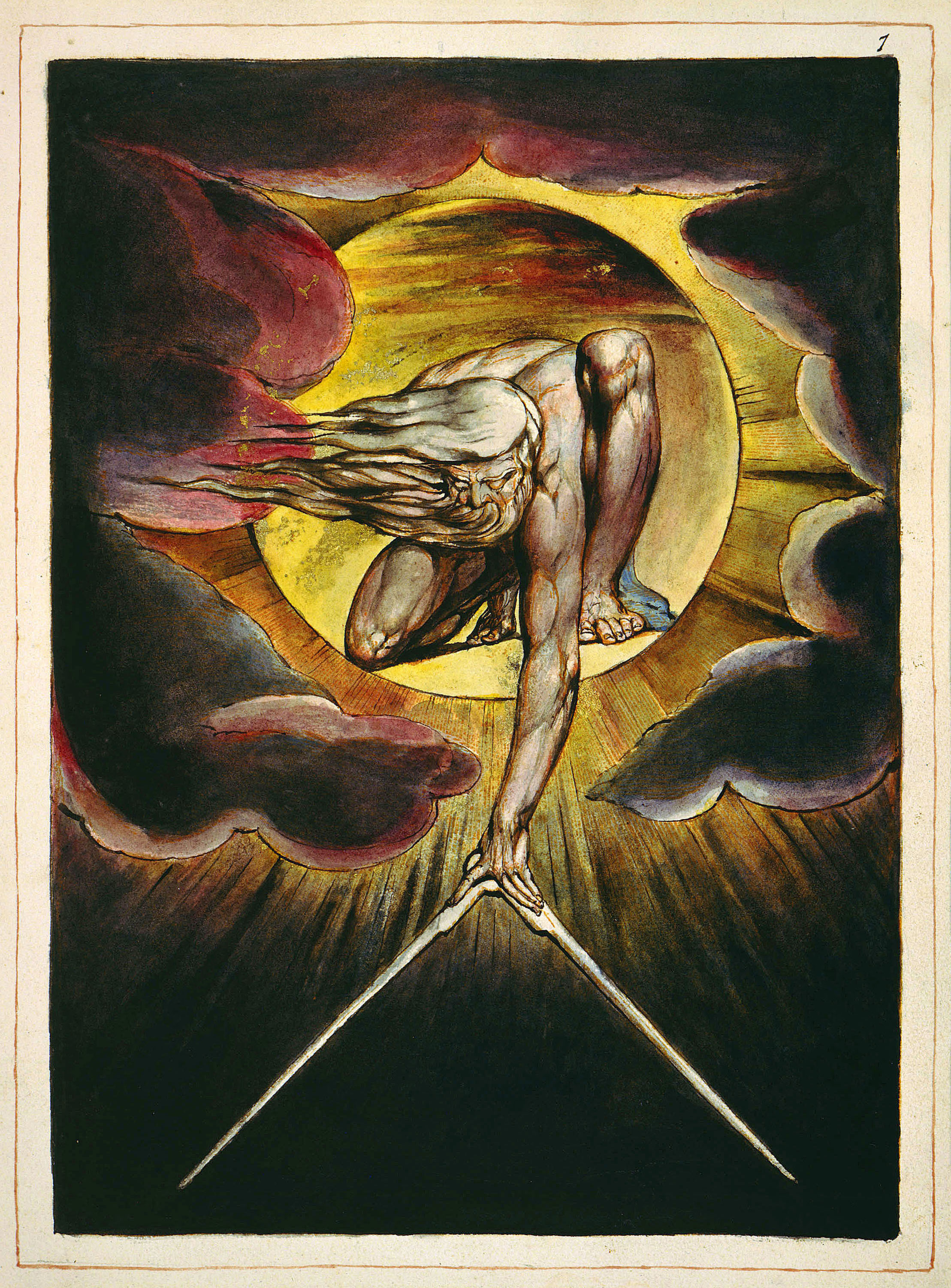
William Blake
The Ancient of Days
1794
Ancient of Days is a famous illuminated print created by English printmaker William Blake in 1794 as a part of his book Europe: A Prophecy. The image depicts a powerful, godlike figure crouched within a radiant sun, stretching downward with a compass to measure and shape the universe. The figure represents Urizen, Blake’s mythological embodiment of reason, law, and order, who imposes structure onto the chaos of creation. The compass is a masonic symbol, and the figure within the print can also be read as the biblical “demiurge”, the character foil of God who confuses and leads the masses in the book of Revelation.
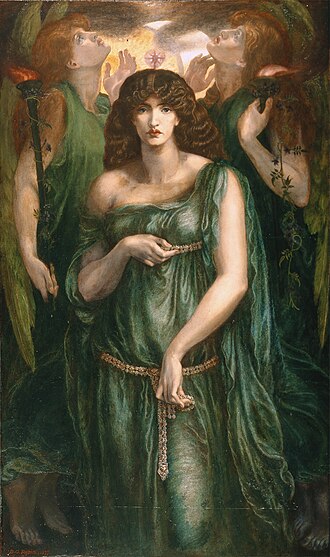
Dante Gabriel Rossetti
Astarte Syriaca
1877
A dominant, full-length female figure, in sea-green robes, gazes towards the viewer, her long, wavy hair flowing down her back. Beneath her robes, she has one leg placed forward, as if she might be striding toward the viewer. Her left hand holds an ornate, floral metal girdle under her bosom, her right hand contorts to hold a second similar girdle resting around her hips. Her hands, limbs, and bosom are massive, and her lips are very full and pink. She is framed on both sides by two winged female torch bearers behind her, dressed in grass green robes; their wings are also green. Their bare feet standing on tiptoe can be seen in each lower corner of the picture. A twining plant that might be deadly nightshade is curled around the long handles of their torches, which burn with a deep pink flame. The painting features Rossetti’s muse Jane Morris, wife to William Morris, who was his unrequited love.
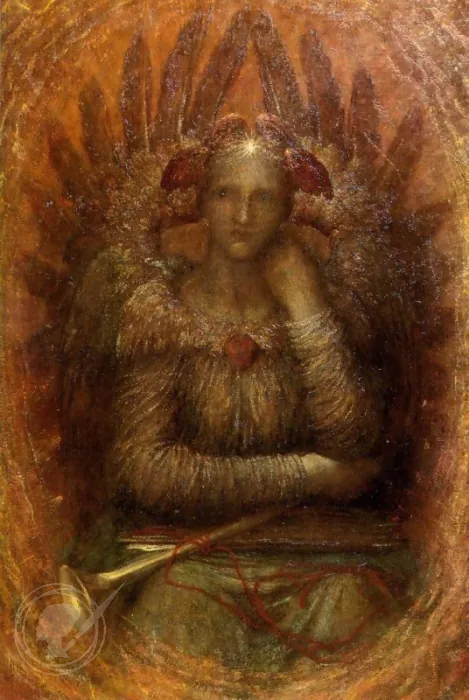
G.F. Watts
The Dweller of the Innermost
1885-86
Watts described this painting in 1896 as ‘Conscience ... seated facing, within a glow of light; on her forehead she bears a shining star, and on her lap lie the arrows that pierce through all disguise, and the trumpet which proclaims truth to the world’. Here we behold an extraordinary window into an angelic being, pensively seated, with a trumpet and arrows upon her lap. Though the figure is articulately rendered, she is in low contrast compared to the light that really activates our vision. Surrounding her shimmers a radiant mandorla. Its rippling energy vibrates as the auric field of the angelic figure, and it seems to sanctify our vision and mind upon beholding such a holy being.
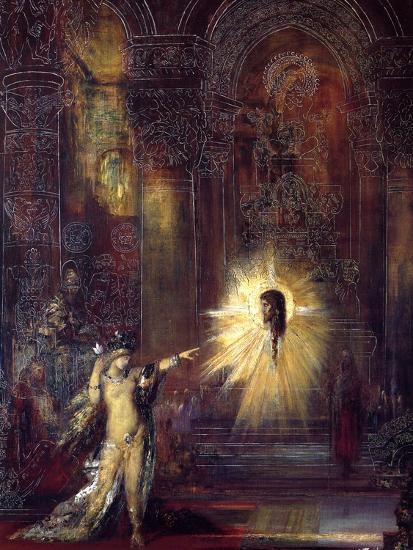
Gustave Moreau
The Apparition
1876
This artwork features the trope of the “femme-fatal” - the fatal woman who uses her sexuality to lure and attack men. Against the backdrop of a lavishly decorated palace inspired by the Alhambra, Salome stands out in an array of bejeweled veils, her body facing the viewer, her left arm pointing up in the air to John the Baptist's hovering head, enclosed by a halo. At the back in the half-light stands the executioner with his sword, at his feet the silver charger. Seated in ascending position on Salome's side are a lutanist, Herodias, and Herod Antipas. They face the foreground events seemingly lit by John's halo and its reflections on Salome's costume. Since no one, including Salome, reacts directly to the vision central to the composition, it is unclear if it is real, imagined by the princess, or a collective hallucination. These disparate elements and the use of complex techniques like highlighting, grattage, and incisions, create a sublime ideal of the Orient. Excessive detail given to foreign costumes and background elements as strange mural reliefs on the palace's columns proves characteristic of Moreau, whose artistic style tends towards exoticism and orientalism and was often referred to as "Byzantine."
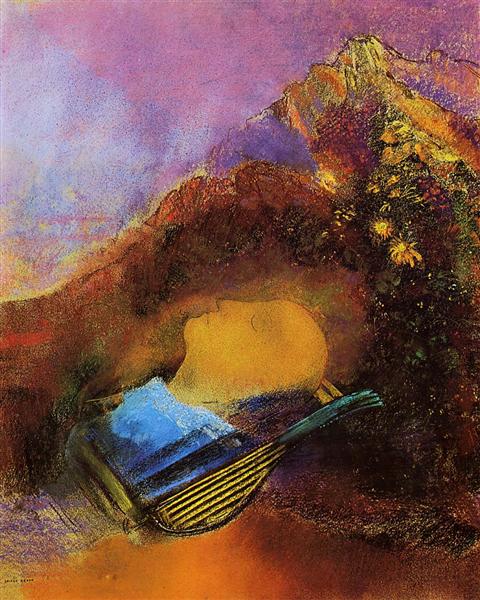
Odilon Redon
Orpheus
1913-16
Drawn in vivid layers of pastel crayon, this work depicts the head of the poet and musician Orpheus. The story of the god of music, whose music carried on after his death through his lyre and head, fascinated Redon, who related to Orpheus's dedication to his art. In Greek mythology, the tragic hero Orpheus was renowned for his divine musical talent. His skill was so great that upon his death the muses preserved his head so that he could continue singing forever. The subject also aligned with Redon's broader interest in dreams and spirituality around this time and he represented Orpheus several times throughout his career, in various media. Here, the god's head floats as if in stasis while Mount Parnassus—the home of Apollo and the Muses—soars from behind.