7: astigmatism .
 Call Kai
 Learn
Learn Practice Test
 Spaced Repetition
 Match
Match Flashcards
 Knowt Play
1/43

There's no tags or description
Looks like no tags are added yet.
Name | Mastery | Learn | Test | Matching | Spaced | Call with Kai | Chat |
|---|
No analytics yet
Send a link to your students to track their progress
44 Terms
what is astigmatism
a condition of a refraction in which the image of a point objects is not a signle point, but two focal lines at different distances from the optical system
the 2 focal lines are perpendicular to eachother
causes of astigmatism: toroidal surfaces
rugby balled shape: has maxiumum curvature in one and minimum in another at right angles to eachother
radius of curvature has a meridian of max curvature and other has minimum curvature
if an eye has a toroidal refractive surface eg cornea or les then the power of the eye will not be the same in all meridians
how do we measure the curvature of the front surface of cornea
done using a keratometer
the keratometry reveals that the cornea is truly sphercal even in the central cornea near optical axis
front surface of cornea is steepest( shortest radii) in vertical meridian
shorter radius of curvature = more myopic
more causes of astig
cyrstalline lens
either or both of its surfaces may be toroidal
even if corneal and crystalline lens surfaces are spherical, decentration or tilting of the crystlline lenses with respect to the cornea will give rise to astigmatism
what is lenticular astigmatism
astigmatism that is caused by the lens corneal astig caused by cornea
how is astigmatism corrected
sph/cyl lenses are used to correct astigmatsm by equalising the difference in power between the principal meridians of the eyes
e.g if the vertical meridian of the eye is 2.00D more powerful than the horizontal : -2.00 × 180 will correct it
oblique astigmatism - first meaning
if light from a point object passes obliquely through a spherical surface or lens then it will not form a point image
different object distance when off axis so image is different distance
point object is well below the principal axis, it gives rise to the same imagery we get in astigmatism that is caused by toroidal surface
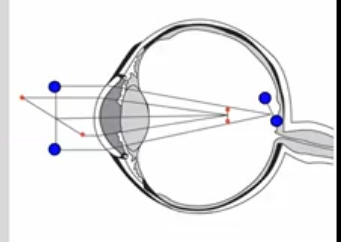
image of a point object in an astigmatic eye
incoming rays of light are parallel
a vertical focal line is formed in front of the retina and a horizontal one is just next (infront) to the retina
vertical meridian (bue) forms a horizontal line focus (blue)
meridian formes focal lines at right angles
horizontal meridian in red forms the vertical line focus in red
both line foci formed in front of retina but one line is much closer
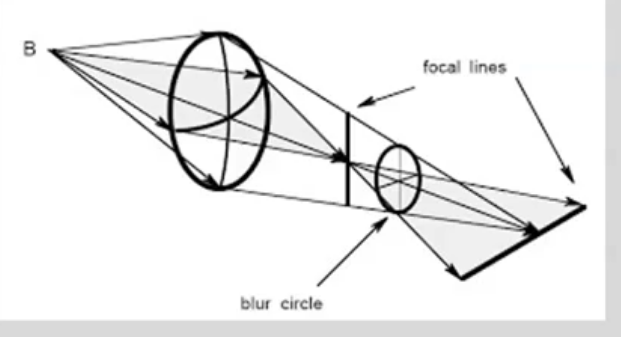
how do we end up with line images when we start with a point object
between the 2 focal lines of a toroidal lens: halfway between is a blur circle
rays of light diverge from point object B and are refracted by a toroidal surface/ gives rise to astagmatic images
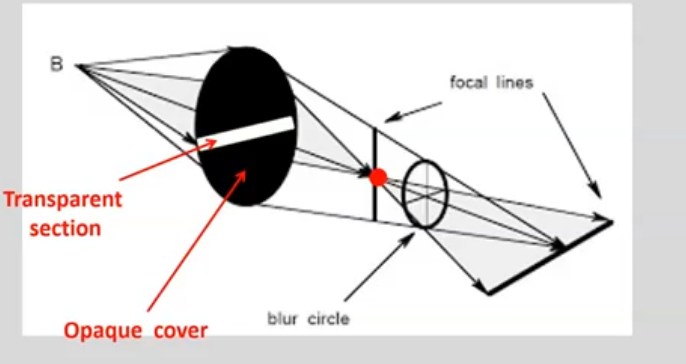
forming a point image
covered over the lens besides the transparent section through which light can travel through
if light travels through the horizontal section a point image is created
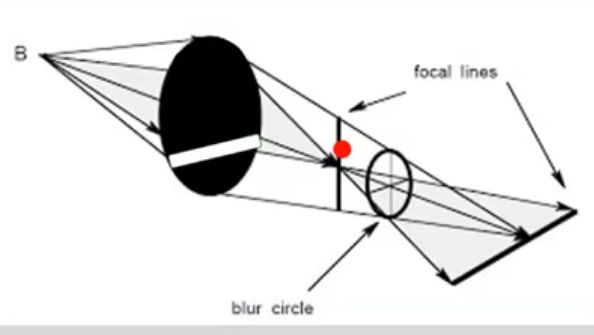
if horizontal gap ov opaque cover is moved down, what happens to focal line
light only travels through portion of lens
point image moves up
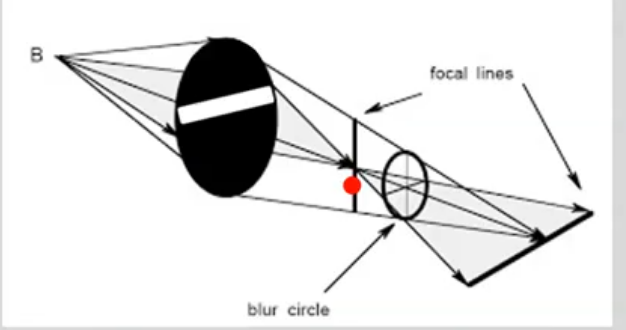
if gap is placed at the top where is the focal point
focal point forms at the bottom part
light coming throgh different portions of the lens is imaged in different places
point images join to form line focus
horizontal meridian of the lens is giving rise to point images which when joined together form a vertical line image
whats the interval of sturn
measurement of the distance between the 2 focal lines
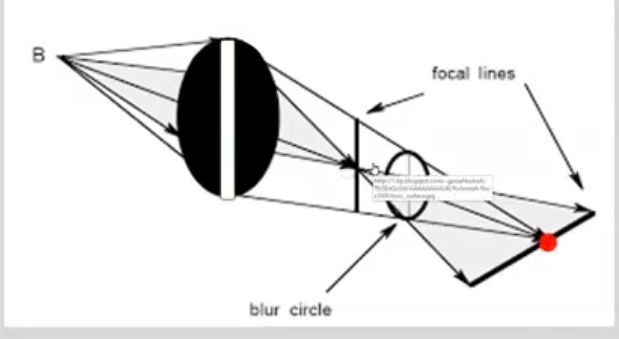
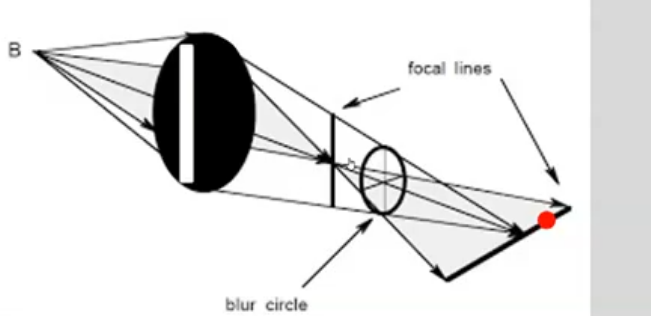
what produces the horizontal focal point
if you place a lens where portion viewed is a vertical stip , it forms a focal point on the horizontal focal line
vertical meridian of the lens is giving rise to a point images which when joined together form a horizontal line image
when vertical slither is moved to the left :
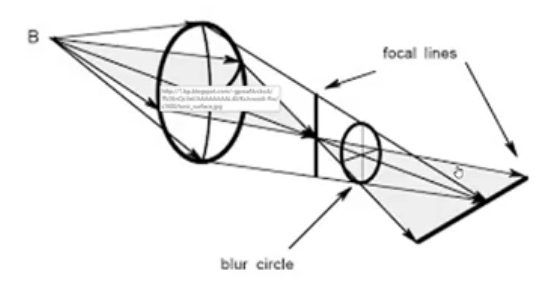
what does the eye see
depends what falls on the retina
if vertical line is in front then the image formed on the retina is mostly influenced by the horizontal focal line
the horizontal focal line corresponds to blur that makes horizontal detail sharper and vertical blurrier
so person sees the vertical lines blurred, horizontal clear
what is seen if the retina is closer to the vertical focal line?
vertical focal line is in front of the retina
produces horizontal blur on the retina
so vertical images look blurred, horizontal appear clear
what is seen if the reitna is closer to the horizontal focal line
horizontal line is in front of the retina
produces vertical blur on the retina
therefore horizontal objects appear blurred
vertical lines look clearer
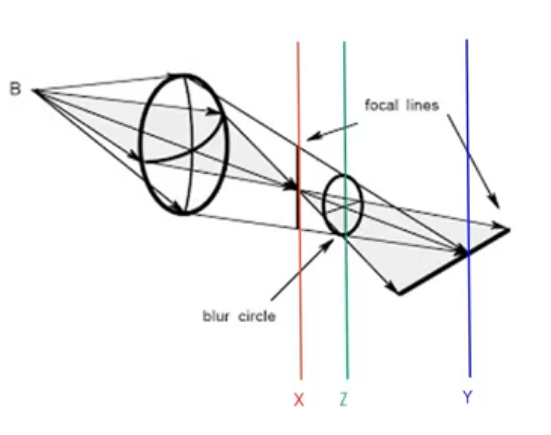
what is see when retina is located ON the vertical/horizontal lines
if retina located at X: vertical lines will be seen clearly
if located at Y: horizontal lines will be seen clearly ( V lines hugely out of focus)
if retina is located at Z then all orientations will be equally blurred
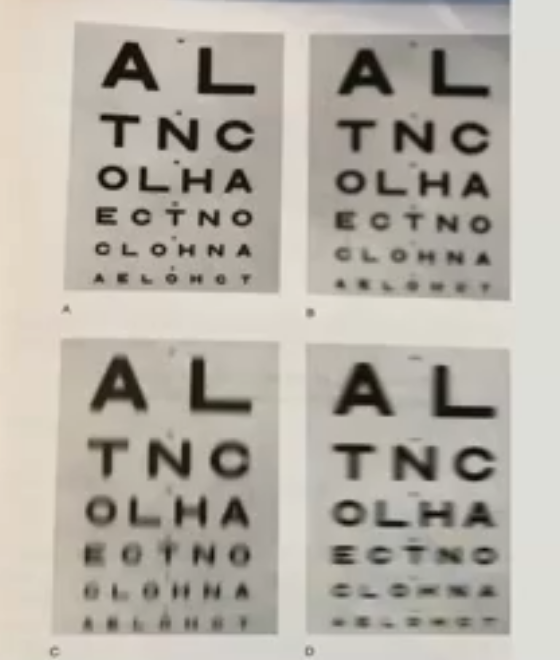
spherical vs astigmatic defocus
top right shows spherical blur: not astig as blurred in all directions
C: : astigmatism shows horizontal lines are blurred , vertical clearer
means that the vertical meridian of the eye is too flat so light travelling along vertical focuses differently from light travelling along vertical
D: astigmatism, horizontal is more clear than vertical
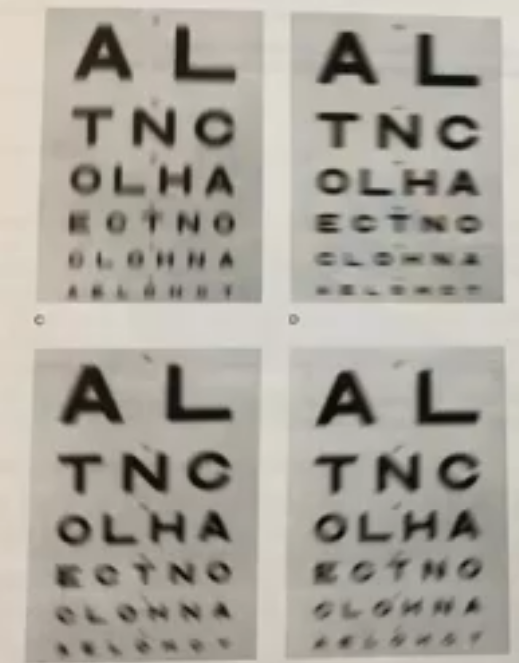
astigmatic defocus when the cyl axis is not H or V
C&D same as last photo
E and F show oblique astigmatism: prinicpal meridians are not at 90 or 180
E: plano/ -1.00 × 45
F: plano/ -1.00 × 45
cyl axis at 45 or close to 45, or 135 or close to 135 shows most oblique
threshold reached during VA measurement: difference in spherical ametropia and astig
in spherical, since all lines are blurred, many can only read up to a certain line
with astig, some letters on lowest line can be read, spherical cannot proceed further beyond a certain line
orientation in the same place as lines of alphabet
what is the with rule of astig
the steepest meridian of the cornea is vertical 90 degrees or at least near
vertical meridian focuses light sharply ,
blur vertical lines more, horizontal less
what is the against rule of astigmatism
the steepest meridian of the cornea is the horizontal one
horizontal meridian focuses light sharply so horizontal lines more blurry
oblique astigmatism
the principal meridians are not near 90 or 180
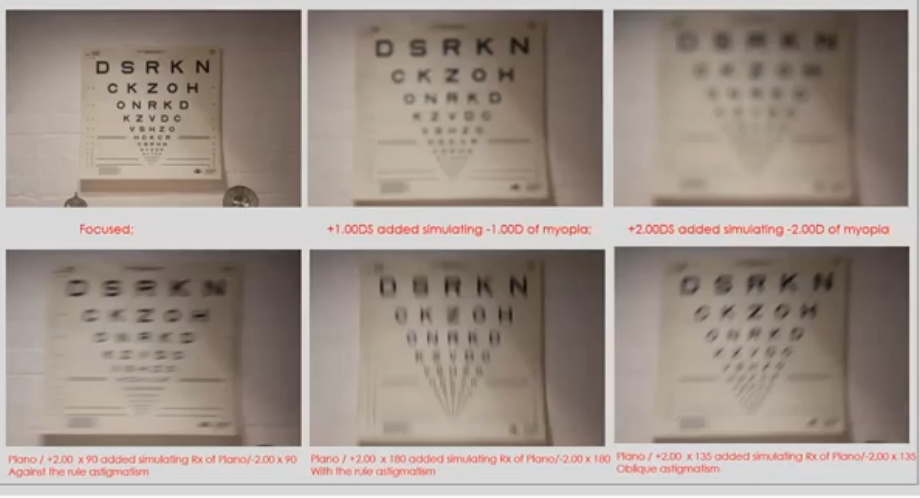
horizontal / vertical and oblique on letter chart
bottom left: against the rule of astig as axis is at 90 or near 90. 180 line is blurred
bottom middle: with the rule as axis is at 180. +2.00 added to simulate a -2.00
why might it be easier to read letters with astig and not spherical blur
some letters have vertical elements: P, D, H, N, T
some have horizontal : H L, T , A
impact of astigmatism on distance vision
uncorrected astig reduces distance vision
hyperoppes rely on accomodation to see clearly, so even mild astigmatism can interfere with near and distance vision
myopes less affected by astig as naturally focus for near tasks
what is irregular astig
cornea is distored- cone shaped;
principal meridians are not at right angles to eachother
if cause of irregular is corneal, a contact lens can provide much better correction than spectacle lens
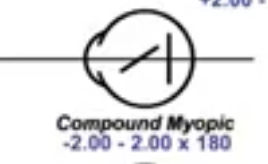
what is compound myopic astigmatism
both focal lines are in front of the retina
eg -2.00/-2.00 × 180
along 180 eye is myopic by -2.00D
along 90 the eye is myopic by -4.00D
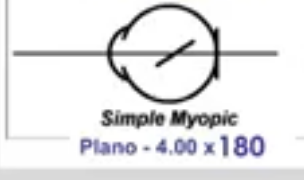
simple myopic astigmatism
one focal line on the retina, other focal line in front
eg
plano/ -4.00 × 180
along 180 is emmetropic, along 90 is myopic by -4.00D
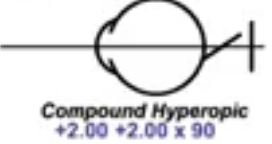
compound hyperopic astigmatism
both focal lines behind the retina
eg +2.00/+2.00 × 90
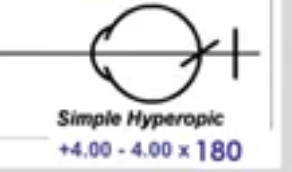
simple hyperopic astigmatism
one focal line on the retina, other focal line behind
+4.00/-4.00 × 180
along 180 : hyperoopic by +4.00 , along 90: emmetropic
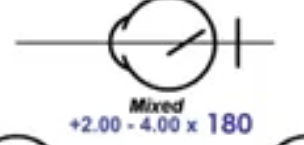
mixed astigmatism
one focal line behind the retina, the other line in front
+2.00/-4.00 × 180
along 180: hyperopic by +2.00D
along 90: myopic by -2.00D
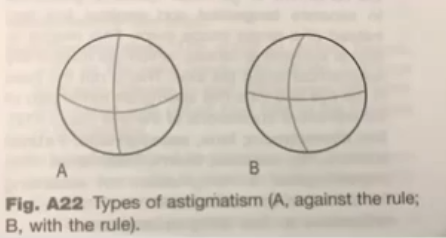
with and against rule
more curvature means a shorter/smaller radius of curvature
with: steepest vertical
against: steepest horizontal
what is with rule astig corrected with
corrected with -ve with an axis of 180 or near 180
or corrected with a +ve with axis of 90 or near 90
hyperopia in an eye means eye or meridian is under powered
since 90 meridian is less hyperopic, its less underpowered than 180 meridian, hence this eye has WTR
-3.00/+1.25 × 80 : Why is this with the rule?
eye is myopic by -3.00D along 80 meridian and myopic by -1.25 along 170
the 80 is more myopic so more powerful than the 170
against rule astig corrected with?
corrected with - ve cyls with axis of 90 or near 90
or with +ve cyls with axis 180 or near 180
+2.00/-1.00 × 90
eye is hyperopic by +2.00D along 90 meridian and hyperopic by +1.00D along 180
since the 180 meridian is less hyperopic , its less underpowered than 90 meridian
so this has ATR
+1.00/+1.25 × 10 : why is this against
eye is hyperopic by +1.00D along 10, and hyperopic by +2.25D along 100
since the 10 meridian is less hyperopic its less underpowered than 100 meridian ( more powerful than 100)
so this eye is against the rule
oblique astigmatism (2nd meaning)
ocular astig in which the two principal meridians are neither approx horizontal nor vertical
corrected with cyls with axis 45 or 135 or near
doesnt matter if cyl power is + or -
-1.50 /-1.00 × 45 : why is this oblique
the eye is myopic by -1.50D along 45 meridian , and myopic by -2.50D alog 135
since principal meridian are not V and H and not near this eye has oblique astig
Accomodation and astigmatism
Accom shifts the interval of sturn left towards the cornea so the eye may be able to moce the blurred circle onto the retina or to accomodation to place one or both focal lines on the retina
uncorrected hyperopic eyes with astig accomodate so that the blurred circle is on retina and vertical focal line is on/near retina
doesnt apply to myopia
how astig is corrected with sph/cyl lenses:
plano/ -2/00 × 180
H meridian is emmetropic: forms its focal line V on the retina
V meridian myopic: forms its focal line H, in front of the reitna
V has 2D more positive power than the H meridian
if plano /-1.00 × 180 is added, -1.00D is added to the V meridian
so half astig is corrected
V line stays where it is as nothing is added to the V , H line moves closer yo retina: both focal lines get shorter as interval is reduced
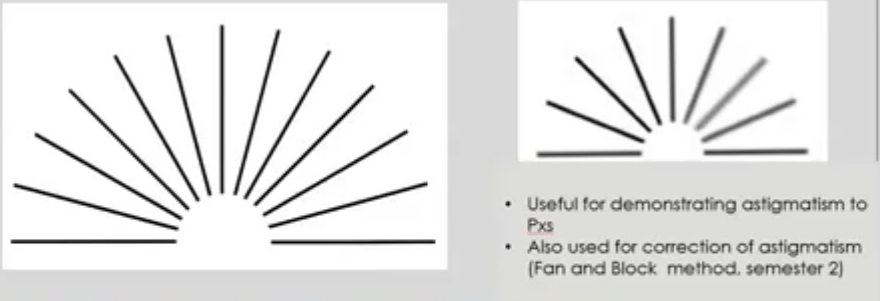
astigmatic fan chart
if the lines are clear and equally clear theresno astigmatism
if some blurred and some not then astug