Week 2B: Neurotransmitters and Psychopharmacology
 Call Kai
 Learn
Learn Practice Test
 Spaced Repetition
 Match
Match Flashcards
 Knowt Play
1/29

Earn XP
Description and Tags
These vocabulary flashcards cover the basics of psychopharmacology, synaptic transmission, and major neurotransmitter systems including Acetylcholine, Dopamine, Serotonin, Glutamate, and GABA.
Name | Mastery | Learn | Test | Matching | Spaced | Call with Kai |
|---|
No analytics yet
Send a link to your students to track their progress
30 Terms
Psychopharmacology
The study of the effects of drugs on the nervous system and on behavior.
Agonist
A drug that facilitates the effects of a particular neurotransmitter on the postsynaptic cell.
Antagonist
A drug that opposes or inhibits the effects of a particular neurotransmitter on the postsynaptic cell.
Sites of Action
The location at which drugs interact with molecules in cells, thus affecting biochemical processes of these cells.
Direct agonist/antagonist
A drug that binds with and activates a receptor; this drug mimics the effects of a neurotransmitter.
Indirect agonist/antagonist
A drug that attaches to a binding site on a receptor and facilitates the action of the receptor; does not interfere with the binding site of the principal neurotransmitter.
REUPTAKE
The process of termination of the postsynaptic potential where drug attach to transporter molecules to inactivate them or bind with enzymes that destroy neurotransmitters.
Glutamate
An amino acid that serves as the most important excitatory neurotransmitter in the brain and is involved in synaptic plasticity, learning, and memory.
GABA
Gamma-aminobutyric acid; an amino acid that acts as the most important inhibitory neurotransmitter in the brain.
Glycine
The primary inhibitory neurotransmitter located in the spinal cord.
Acetylcholine (ACh)
The primary neurotransmitter secreted by the efferent axons of the CNS, involved in muscular movement, REM sleep, perceptual learning, and memory.
Cholinergic Synapses
Synapses that utilize acetylcholine as their neurotransmitter.
Acetylcholinesterase
An enzyme that breaks down acetylcholine in the synaptic cleft.
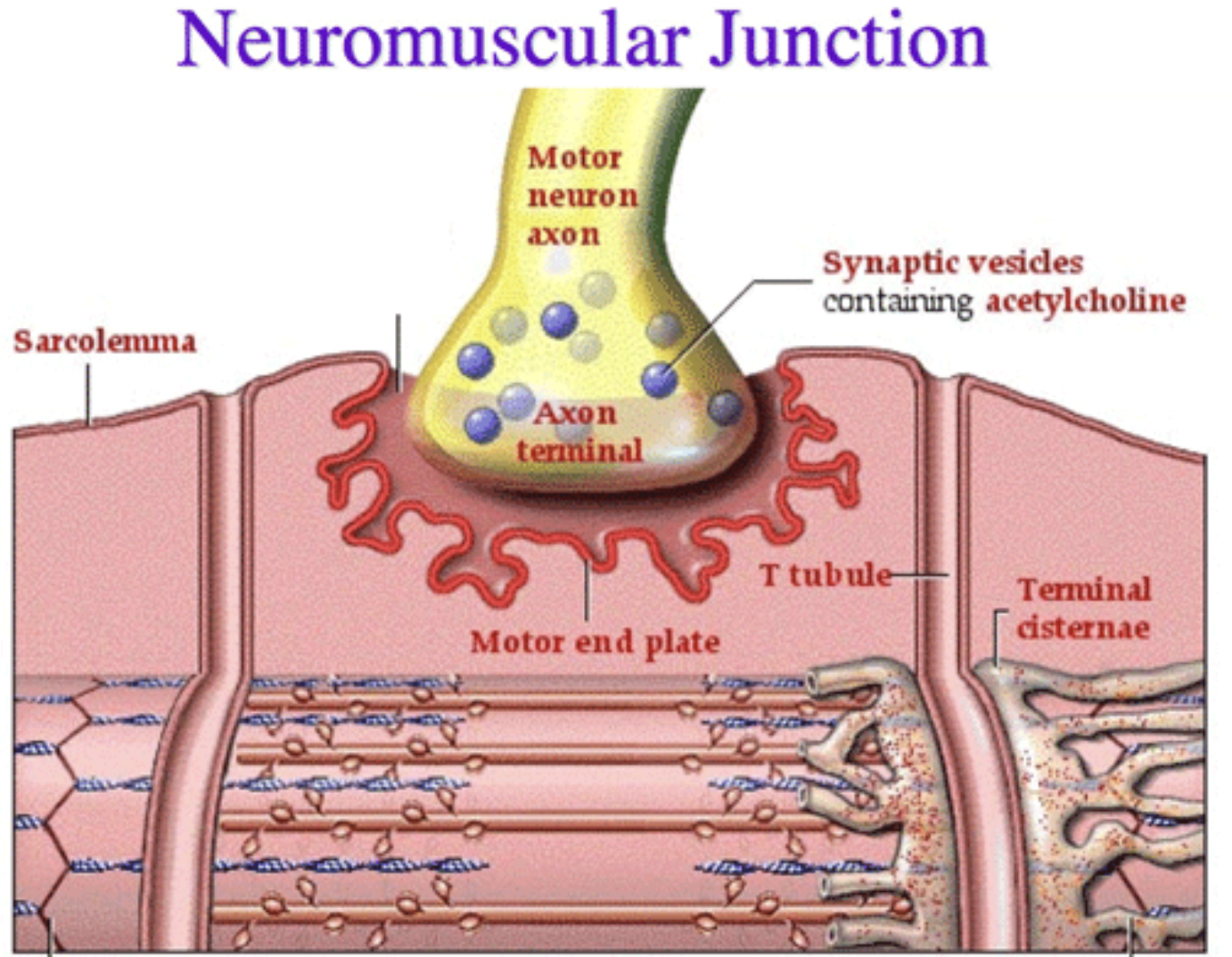
Neuromuscular Junctions
A cholinergic synapse where the postsynaptic membrane is the muscle fibre membrane, also known as the Sarcolemma.
Connects a motor neuron → to a skeletal muscle fiber
Nicotinic receptor
An ionotropic acetylcholine receptor stimulated by nicotine and blocked by curare.
Muscarinic receptor
A metabotropic acetylcholine receptor stimulated by muscarine and blocked by atropine.
Atropine
A drug that prevents acetylcholine from depolarising the post-synaptic membrane and increases heart rate by blocking muscarinic receptors.
Curare
A drug that acts at the junction between nerve cells and muscles causing paralysis by blocking nicotinic receptors.
Botulinum toxin
An acetylcholine antagonist that prevents the release of the neurotransmitter by terminal buttons.
Black widow spider venom
A poison that triggers the release of acetylcholine, acting as an agonist and causing convulsions.
Monoamines
A family of neurotransmitter compounds that includes Dopamine, norepinephrine, epinephrine, and serotonin.
Dopamine
A neurotransmitter associated with reward and movement control; its depletion is linked to Parkinson’s disease.
Nigrostriatal system
A system that starts in the substantia nigra and terminates in the basal ganglia, playing a critical role in the control of movement.
Cocaine
A drug that inhibits dopamine reuptake, leading to increased activation of the reward system.
Serotonin (5-HT)
A neurotransmitter involved in regulation of mood, eating, sleep, dreaming, arousal, and the regulation of pain.
MDMA
Also known as "ecstasy"; a noradrenergic and serotonergic agonist that prevents reuptake and can cause serotonin transporters to work in reverse.
LSD
A psychedelic drug that stimulates sympathetic nervous system centers and has a serotonin-blocking effect.
Norepinephrine (NE)
Both a hormone and a neurotransmitter that works with epinephrine to produce the "fight or flight" response during stress.
Benzodiazepine
A category of anxiolytic drugs like Valium or Xanax that act as indirect agonists for the GABAA receptor.
Placebo
An inert substance given to an organism in lieu of a physiologically active drug to control for the effects of mere administration.