ling alles
 Call Kai
 Learn
Learn Practice Test
 Spaced Repetition
 Match
Match Flashcards
 Knowt Play
1/219

There's no tags or description
Looks like no tags are added yet.
Name | Mastery | Learn | Test | Matching | Spaced | Call with Kai |
|---|
No analytics yet
Send a link to your students to track their progress
220 Terms
When did language arise?
about the same time humans arised: about 130 000 years ago in Africa
Is language an innate capacity?
Most linguist think this is a gradually developed capacity
BUT Noam Chomsky (1996): supports a “sudden” emergence based on genetics
Where is the source of all languages? and how do we know this?
Out of Africa theory also applies to language: earliest languages stem from Africa
Languages develop from more complex to less complex: to look at the sources of languages we look at where the most complex languages are situated
How do languages evolve/ develop?
From more complex to less complex.
To counter this you need standardization
What is an idiolect?
The unique language an individual speaks.
We are able to communicate with one another because we are able to interpret each others idiolects. + because of standard language
What is typology
classifying things through certain standards
What does language typology do and what is it?
explores cross-linguistic diversity and genetic relationships
it is a sub-field of linguistics
focusses on linguistic structures and patternsW
Why is language typology important?
Important for the grouping of language families, as well as language acquisition and language learning
studying how sociocultural phenomena impact language structures (e.g. honorific system)
How does language typology generally work?
compares several languages based on similarities and differences in the linguistic structure and genetic relationships
What is the search for language universals?
introduced by Greenberg in 1963: looks for universal features all languages encompass
relates to Noam Chomsky’s search for “Universal Grammar”
BUT since the 80s more focus on language diversity
What are some language universals found?
all languages have verbs and nouns
all spoken languages have consonants and vowels
all languages have a second person pronouns
+ some tendencies discovered:
if a language has an SOV order, they are likely to have postpositions
What are some other approaches than “Language Universals”?
Systematic Functional Linguistics (Halliday)
multilingual and multicultural diverse approaches (MAtthiessen)
What is SFL?
Systematic Functional Linguistics
developed by Halliday
takes communication as the primary function of language
linguistic structures are formed by sociolinguistic norms
looks beyond single sentences and examines the whole discourse including modality features
typological features are based on real spoken and written language (not on generated sentences)
maps lexicogrammatical sentences (merges vocabulary and grammar into one system)
What are some practical application of Matthiessen’s approach on “multilingual and multicultural diversity”
language acquisition
language learning
intercultural communication
multilingualism
translation
How does previous typlogy differ from current typology?
in the past:
used as an alternative method to determine the limits of possible human languages and contribute to a universal theory of grammar
current:
explaining why linguistic diversity is the way it is
a science of population typology
what’s where and why?
history of Language typology
pre-19th century:
European maritime expansion + documenting languages spoken in these areas (Tamil, Japanese, Vietnamese, Tibetan, Hindi, Singhalese)
Sir William Jones: comparative work on Indo-Iranian languages
von Schlegel: compares grammatical features in order to establish relationships
19th century:
term Indo-European
von Klaproth grouped Tibetan, Chinese, and Burman
John Logan uses the term “Tibeto-Burman”
Georg von Gabelentz: uses the word typology regarding languages
Linguistic survey of India
20th century:
Greensberg: basic classification of constituents of clause
until middle of 20th centurymorphological typology was the main concern
explain the “dark side of the history of typology”.
19th century: mixing notions of race and language
Johann Rüdiger: difference in structure of language is the result of de differences in the stage of development of the ppl
creation of models of “language evolution”: 12 levels of “refinement”
→ were rediscovered in Nazi Germany
→ these views excluded Chinese from forming a group with the morphologically more complex Tibeto-Burman languages
What are the counter reactions against the racial language theories?
especially apparent in Germany
Willhelm von Humboldt:
observed that the absence of grammatical relationship in Chinese are often defined through their word order
thought that all languages are fully apt to express refined ideas
types of linguistic typologies?
morphological typology
word order typology
complement structures
passive and cuasative structures
phonological typology (and tones)
What is morphological typology?
classifying languages according to its morphological structures (analytic vs synthetic)
What are analytic languages?
= isolating languages
one word has one morpheme
e.g. Chinese, Vietnamese, Thai, Lao
what is a morpheme?
the smallest meaningful constituents within a linguistic expression and particularly within a word
e.g.: unbreakable: morphemes are un- and -able
What are synthetic languages?
when more than one morpheme per word
e.g. European languages
What are polysynthetic languages?
languages wich combine a multitude of morphemes into one word
e.g. Inuit, Native American languages, …
What are the two main types of synthetic languages?
agglutinating
flective/ inflective
What is an agglutinating language?
a synsthetic language where:
one morpheme has one meaning
morpheme does not adapt to root, it is unchanging
boundary between morphemes are obvious
use of affixes and suffixes

What is a flective/ inflection language?
synthetic language with:
accumulation of morphemes
morphemes can have several meanings (e.g. -s can be plural or genitive)
fusing of morphemes
introflection: sound changes in morphemes
What is accumulation?
a characteristic of fusing synthetic languages
one suffix multiple meanings
e.g. Spanish: abl-o = 1st person present tense AND 3rd person past tense
What is fusion?
a characteristic of fusing synthetic languages
e.g.: English: your + possesive -es → fusion to yours
what is introflection/ inflection?
a characteristic of fusing synthetic languages
the vowel inside the word changes to show something, ROOT CHANGE
e.g.: German: gehen; ging; gegangen
how many morphemes in the word “singers”?
sing (ROOT) + er + s
→ 3 morphemes
5 character traits of analytic languages:
predominantly monosyllabic morphemes (and sometimes words)
extensive use of tonemes
extensive use of function words
relatively fixed word order
less rigid grammatical rules
What is the difference between Northern and Soutern sinitic languages (morphological typology)?
north is influenced by agglutinating languages
south is influenced by isolating/ analytic languages
What are the morphological characteristics of Chinese?
no inflection
S en O are often optional
function words are often optional
word boundaries and sentence boundaries are fuzzy
apart from the noun-verb distinction, word class distinctions are fuzzy (but often determined by word order!)
contextualized (pragmatically determined)
topic prominence
serial verb constructions
great number of discourse final perticles
classifier language
What is the word order typology for Chinese?
SVO (but not purely)
has Rel-N and prepositional phrase - V structures!!
and A-not-A question patterns
SOV order is possible with 把
use of prepositions (在,从,。。。) and postpositions (到,里,之前,。。。)
coverbal phrases precede the verb
What question does the typology of word order of Chinese raise?
wether there has been a change from SOV to SVO in the history
evidence: pronominal objects appear before verb in Ancient Chinese
but: 94% of oracle bones in SVO
Was the ancestral language of Chinse SOV?
What are the two main types of complement structures?
Verb-framing
Sattelite framing
What is verb-framing?
when certain features are encoded in the verb, such as motion, direction,…
e.g.: enter, exit, entrar,…
What is sattelite-framing?
The use of other mechanisms (instead of encoding in the verb) to express motion, direction,….
use of prepositions: e.g. uitgaan
What about the typology of complement structures in Chinese?
very special because of its complex complement structures
uses sattelite-framing to give extra meaning to the verb
probably a development from verb-framing to sattelite framing
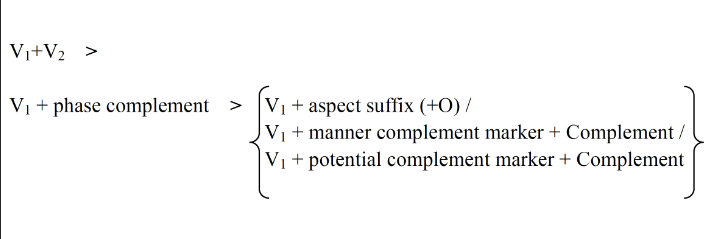
2 examples of verbs evolving into passive markers
V [+ suffer] > instrumental > passive marker
V [+ give] > V [+ causative] > passive marker
![<p>V [+ suffer] > instrumental > passive marker</p><p>V [+ give] > V [+ causative] > passive marker</p>](https://assets.knowt.com/user-attachments/4a93c1ff-25d6-4c06-88f3-b1b338af3624.png)
how are causatives marked in Southern Min language?
tone alternation: e.g. break (tng7) - cause to break (tng2)
initial alternation: e.g. ascend (chiu7) - cause to ascend (chhiu7)
non-aspirated - aspirated contrasts
reflects Middle Chinese voiced - non-voiced contrasts
with ho 與
how are causatives marked in Chinese?
with 让:
als transitief ww betekent het toestaan/ afstaan
张三让李四哈哈大笑。
als transitief ww met twee objecten in het semantische veld van geven: 把。。。让给。。。
what is 让 used for in Chinese?
causative
long passive: zelfde functie als 被
那本书让张三借走了
那本书让张三给借走了
NOOIT ZONDER AGENS: 那本书让借走了 IS FOUT
What is phonological typology?
involves comparing languages according to the number or type of sounds they contain
tries to establish phonological patterns and contrasts them in different languages/ dialects
e.g.: multilateral systems ( /p/ , /ph/, /b/, and /bh/) vs bilateral systems ( /p/ and /b/)
What is a language family?
a group of languages with a common origin
currently: 7000 spoken languages, from 90 language families
def: proto-language
ancestor language (which is not spoken anymore and is purely based on data)
e.g. Classical Chinese
def: genetic relationship
relationship between languages, which is not biologically transmitted but defined by cultural transmition from generation to generation
def: cognates
word (pairs) with a common etymological origin
def: false cognates/ false friends
words which appear to have a common origin but DO NOT
e.g.: much (eng) and mucho (Spanish)
e.g.: pao (Portuguese) and bao (Chinese)
def: comparative method
feature-by-feature comparing of two (or more) languages to reconstruct the proto-language
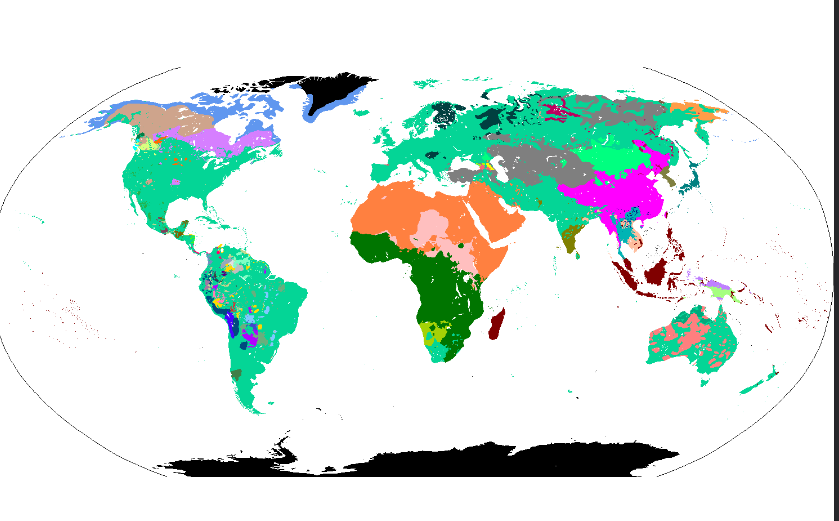
Language families of the world
.
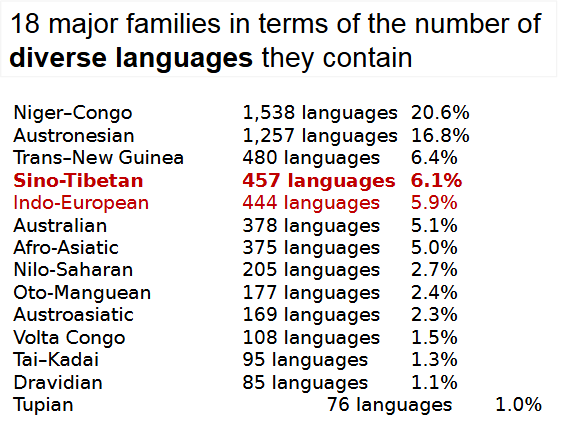
.
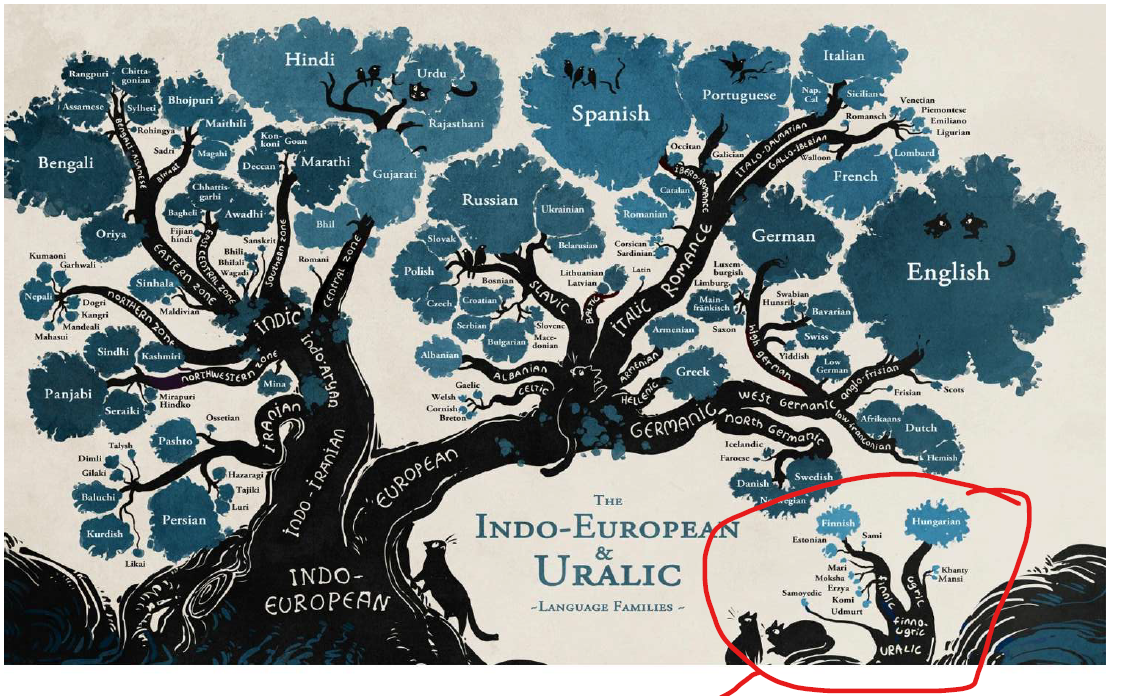
What is this called?
a language isolate
What are the most common hypotheses on family relations between languages?
…
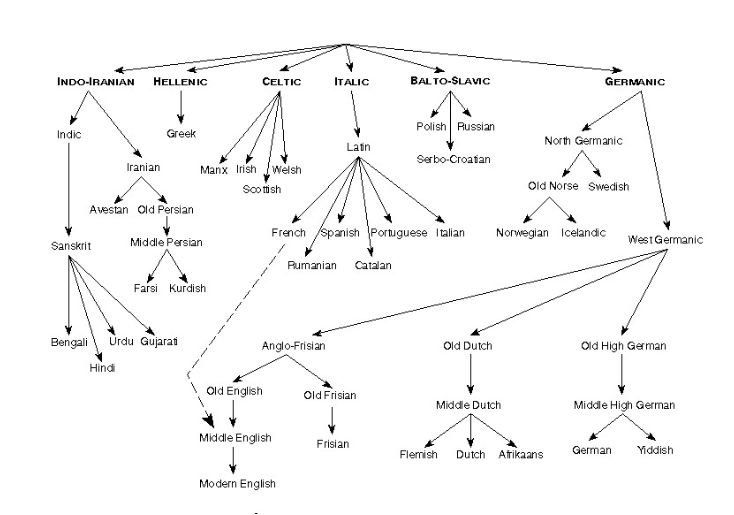
What is this
a tree diagram of the Indo-European language family
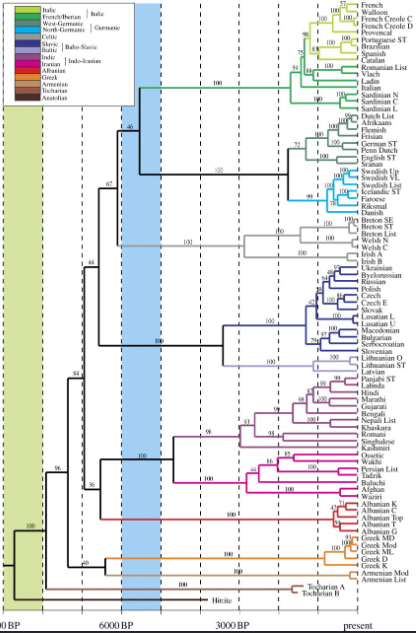
What is this? And what does it tell us?
a dated phylogenic tree
tree diagram of the Indo-European language family
incorporating the temporal dimension
methodology adopted from biology
tells us that:
initial movement out of Anatolia 8700 years ago
major radiation 6000-7000 years ago from Russia and Ukraine
—> the majority of the Indo-European languages are about 6000 years old BUT the deeper sub-groups are older!
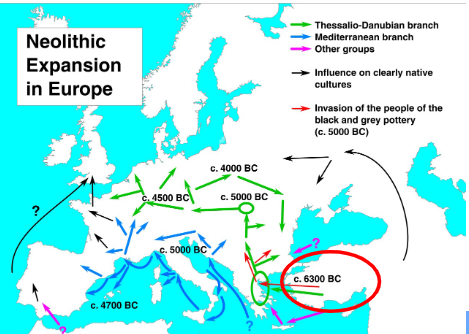
What are the main hypothesis on the origin of Indo-European?
Anatolian hypothesis
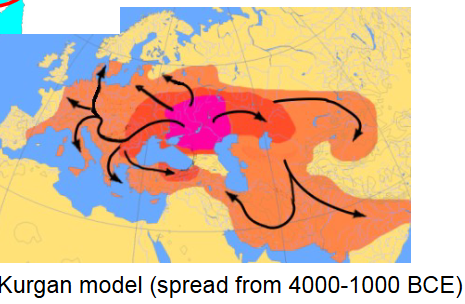
Kurgan hypothesis
What is the Anatolian hypothesis?
Anatolia (Turkey) as the center of expansion
What is the Kurgan hypothesis?
Ukraine as the center of expansion
What is the Wave model?
an alternative of modern research to the tree model
esp in dialectology
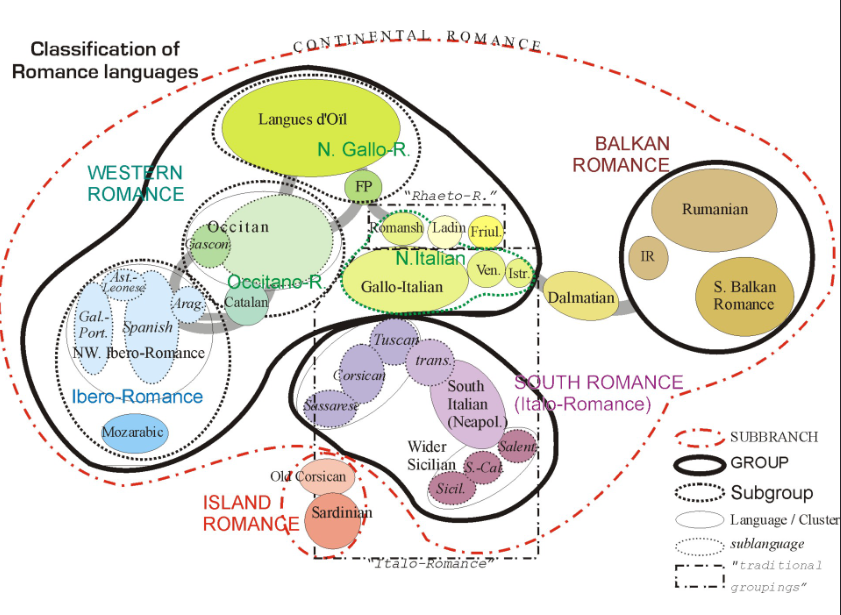
What are the main hypothesis on the origin of languages?
monogenesis
polygenesis
What is monogenesis?
The idea that all languages come from a common proto-language (less probable)
What is polygenesis?
The idea that all languages come from multiple proto-languages (most likely)
What does the comparative method do?
comparison of cognates
finding shared retentions (features that are kept between desc and parent)
shared linguisic innovations
How does the comparative method actually work?
collecting cognates (phonetic structure/ sematics, important to use basic vocabulary)
establishing sound correspondences (e.g. english /f/ always correspondents with the Latin /p/)
determine complementary distribution (why sounds differ)
e.g. Language A had -t- between vowels and language B has -d- between vowels —> which language changed? and which preserved the original?
reconstruction of proto-phonemes: assertation of *-t- as the original
systematization in terms of typology: check if this hypothesis works in the general universal patterns
What are the basic research problems of ‘sound change’?
what changes are possible
how is the change embedded in the linguistic system?
why does one language change, and another one not?
==> the cause is not a problem because it cannot be known!
What are some patterns of sound change?
assimilation
dissimilation
metathesis
tonogenesis
sandhi
haplology
loss of sounds
prothesis
nasalization
vowel fronting
What is assimilation (sound change)?
e.g.: cupboard → cuboard
e.g.: octo → otto
What is dissimilation (sound change)?
e.g.: peregrinus → pelegrin → pellegrino → peligrino
What is metathesis (sound change)?
when two sounds change place
e.g.: periculum → peligro
What is tonogenesis (sound change)?
When a language gains tones
What is sandhi (sound change)?
e.g.: n + p feels awkward → m + p
e.g.: tone sandhi: tone 3 + 3 is awkward → tone 2 + 3
What is haplology (sound change)?
e.g.: Englaland → England
What is loss of sounds (sound change)?
e.g.: castle loss of the /t/ sound
What is prothesis (sound change)?
Addition of a sound in the beginning
e.g.: status → estado
What is nasalization (sound change)?
vowels followed by consonants are nasalized
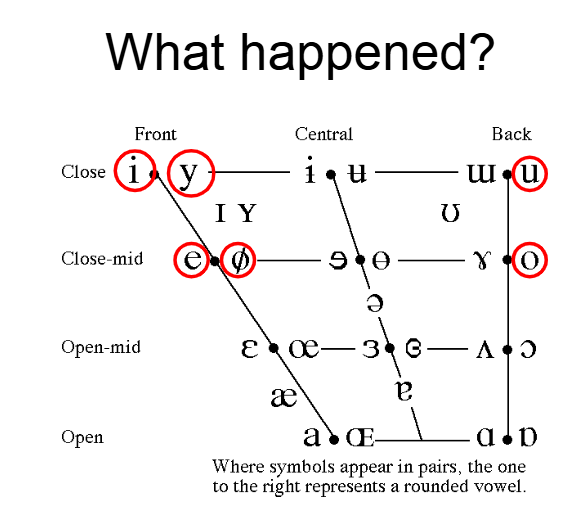
What is vowel fronting (sound change)?
When a vowel is pronounced more to the front of the mouth
e.g. backvowel fronted to the umlaut under the influence of the /i/ or /j/ in German
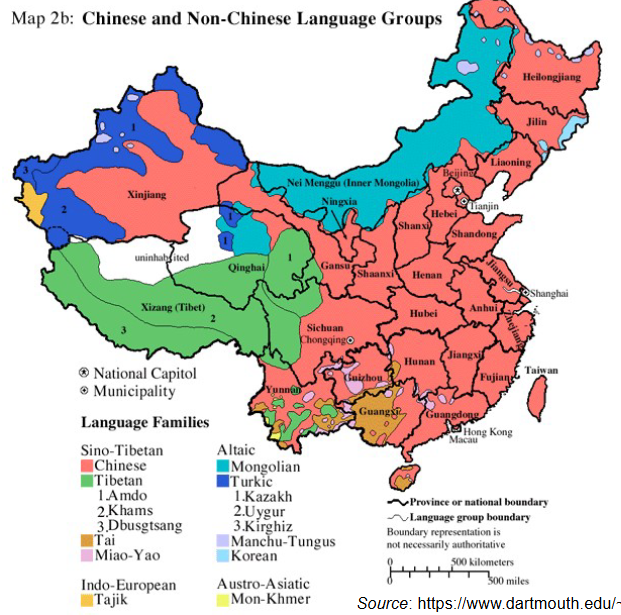
How many language families in China?
Sino-Tibetan
Austro-Thai (Thai-KAdai and Austronisian)
Miao-Yao
Mon-Khmer
Turkic (Altaic)
Mongolic (Altaic)
Manchu-Tungus (Altaic)
Korean
Indo-European
Speakers of the Sino-Tibetan language family
ca. 400 members
largest groups: Chinese and Tibeto-Burman
many small language communities
exact relationships difficult to establish
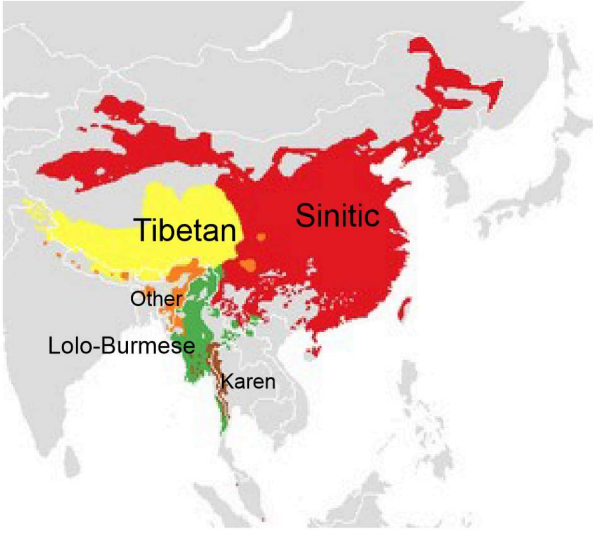
What are the main branches of Sino-Tibetan?
Tibetan
Sinitic
Lolo-Burmese
Karen
Other
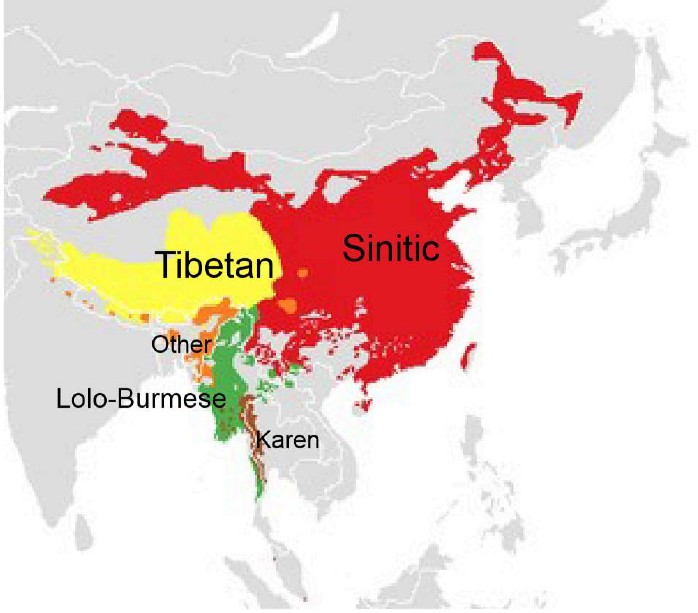
What is the Bai 白 language?
Sino-Tibetan language spoken in various parts of Yunnan
several dialects
8 tones
all open syllables
difficult to establish exact family relations: many layers of loan words from Chinese
own script adopted from Chinese

What is the Karen language?
spoken mostly in Myanmar
tonal language
SVO word order
script adapted from Burmese
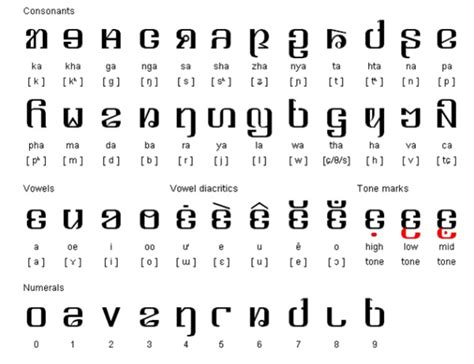
Short history of research on Sino-Tibetan language family
18th century: 1st theories of similarities between Tibetan and Burmese
19th century: establishment of more relations
“Tibeto-Burman” by James Richard Logan (also added Karen)
mid 20th century:
Matisoff: “Sino-Tibetan Philology Project”
Paul Benedict: established the Sino-Tibetan Linguistics as a research field + Proto-Tibeto-Burman language reconstruction
Karlgren: reconstruction of Old and Middle Chinese and field studies
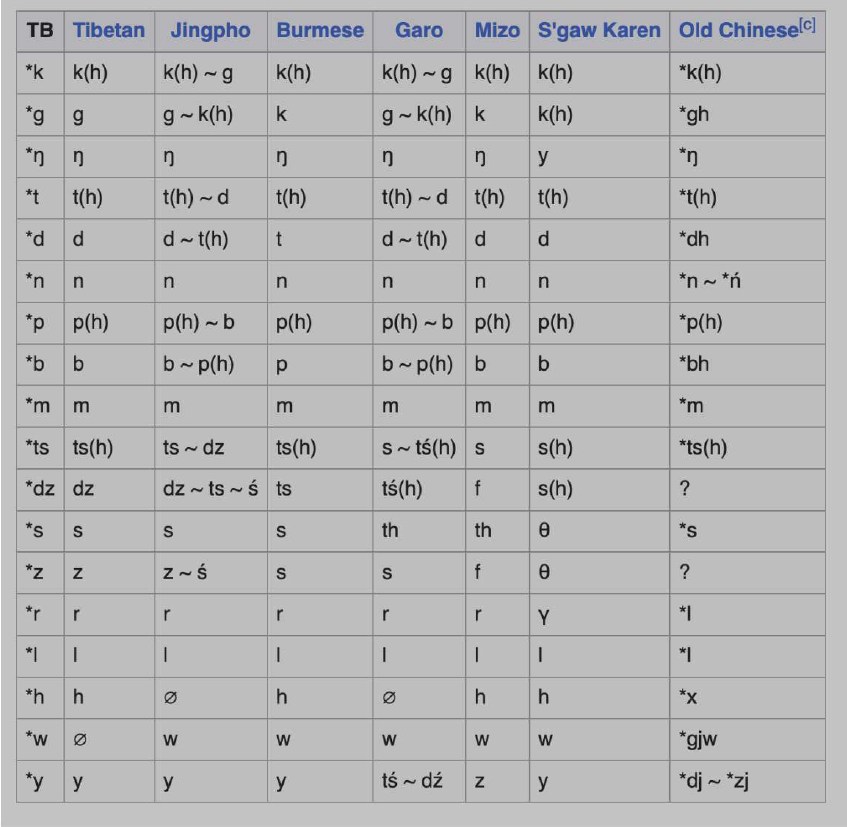
Tibeto-Burman proto-initials reconstructed by Paul Benedict
history of the main theories about the lower branches of Sino-Tibetan:
1937: Li Fang-Kuei: greater Sino-Tibetan (Chinese, Tai, Miao-Yao, Tibeto-Burman)
1942: Benedict: Sino-Tibetan without Vietnamese and Tai-Kadai
1955: Shafer: Sino-Tibetan
1978: Matisoff: Sino-Tibetan consisting of Chinese + Tibeto-Burman
1997: Van Driem: Tibeto-Burman (including Chinese)
‘Greater Sino-Tibetan’?
theory by Li Fang-Kuei not supported by the majority of linguists
→ exclusion of Kra-Dai and Hmong-Mien by Benedict
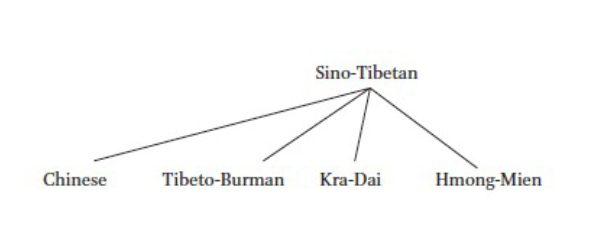
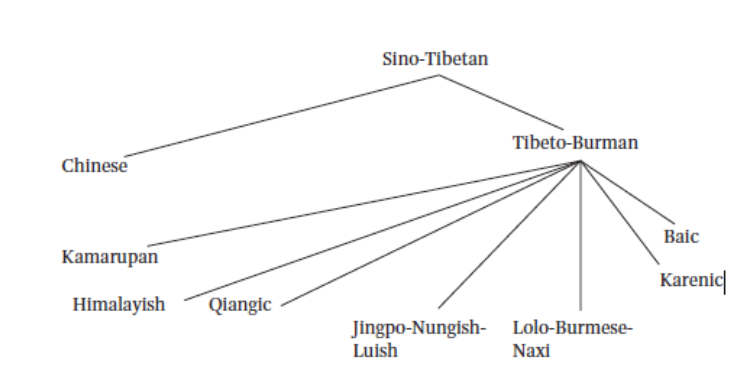
model by Matisoff
most important and most recent standard model
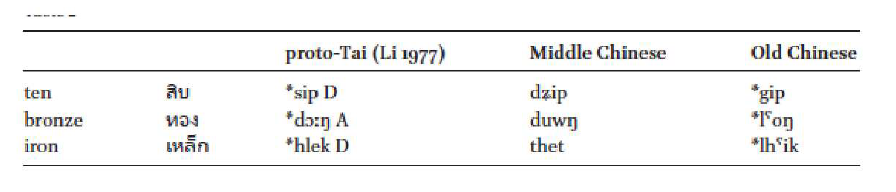
Why was Tai part of the earlier models of the Sino-Tibetan language families?
they found cognates BUT these were FALSE FRIENDS
these similarities were the result of contact, and not bcs of a shared ancestor
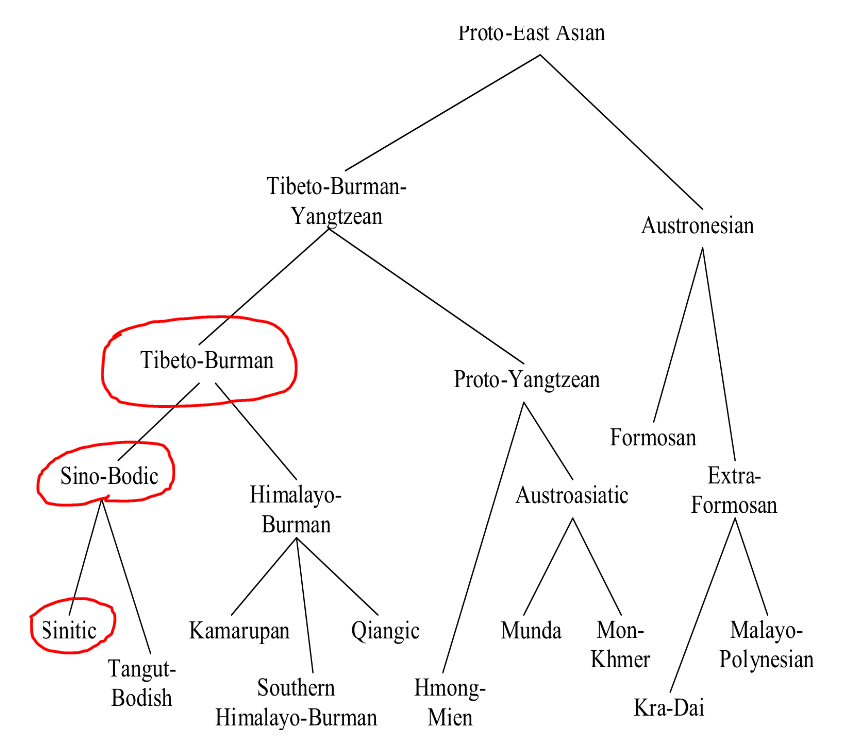
model by Van Driem
projecting an ancestor called Proto-East Asian (Starostin)
he integrated the Tibeto-Burman and the Austronesian family in this system
What did Starostin do?
reconstructed proto-languages
projects black ancestors in several language families (rather speculative)
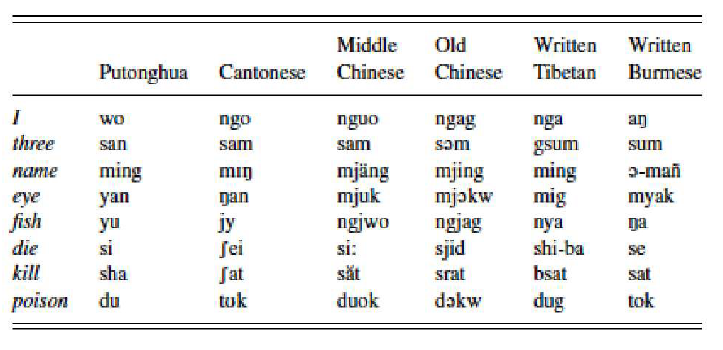
why is a family relationship between Sinitic and Tibetic accepted by nearly all linguists
in the field?
because of a sufficient number of cognates
historical texts with reconstructed pronounciations we can compare to find these cognates
methodology recent research project
combination of historical linguistics with computational methods
50 lang, 180 basic voc items
determining a list of cognates
Bayesian phylogenic method
determine tree
outgroup
timing
comparison wit archaeological data
findings recent research project
Sino-Tibetan originating with north Chinese millet farmers around 7200 BCE (late Cishan and early Yangshao cultures)
high diversity in isolated regions of the Himalaya
Succes of dominating languages (like Sinitic, Tibetan, and Lolo-Burmese) has eroded linguistic diversity in China
What theory is derived from the recent research projects?
Language families arise through demographic processes driven by favorable changes in food procurement → when looking for the origins of a language one should look at its domesticates
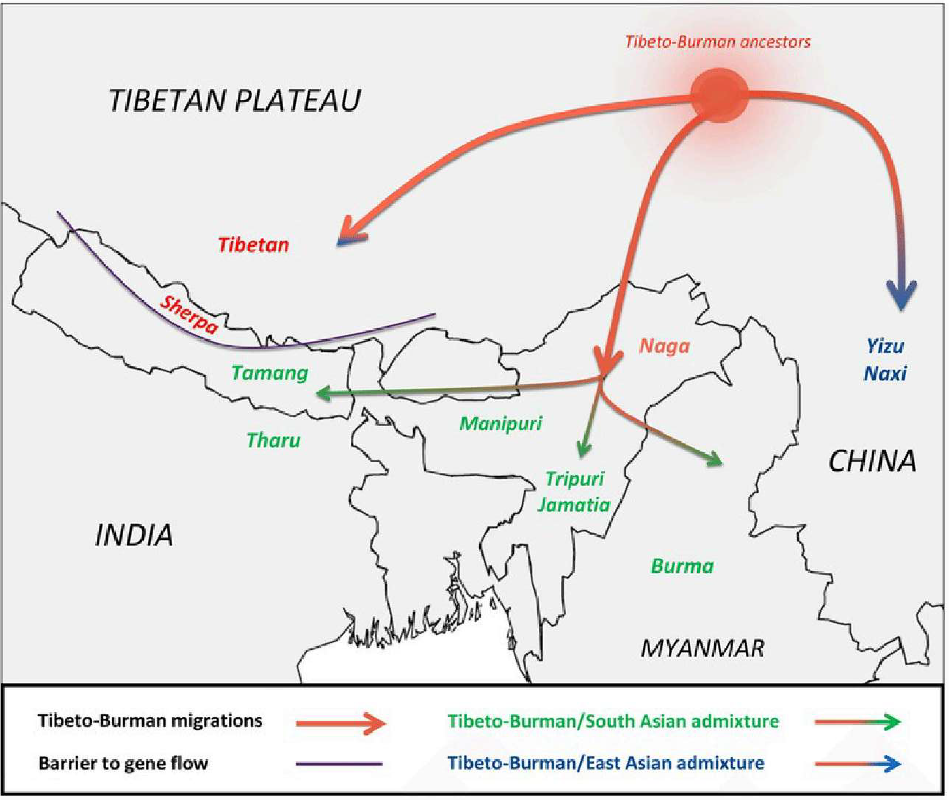
.
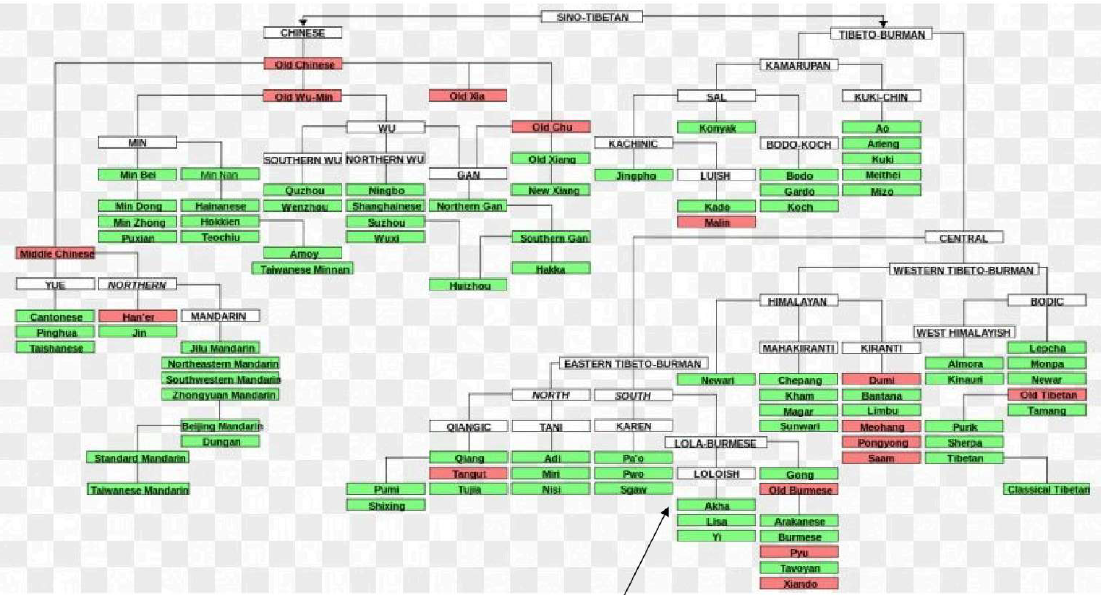
red are dead languages that have been reconstructed
Seven traditional dialect groups in China:
Guanhua (Mandarin)
Wu
Gan
Xiang
Kejia
Yue
Min
history of the Sinitic languages
2nd millenium BCE:
Chinese ancestral language in North China Plain
spread not clear
8th - 5th cent BCE:
indications for dialects/ languages: e.g. people of Chu spoke Chu but the junzi spoke Yawen (cultured language like putonghua)
importance of wenyanwen as it was a standardized writtig languages that overcame dialects
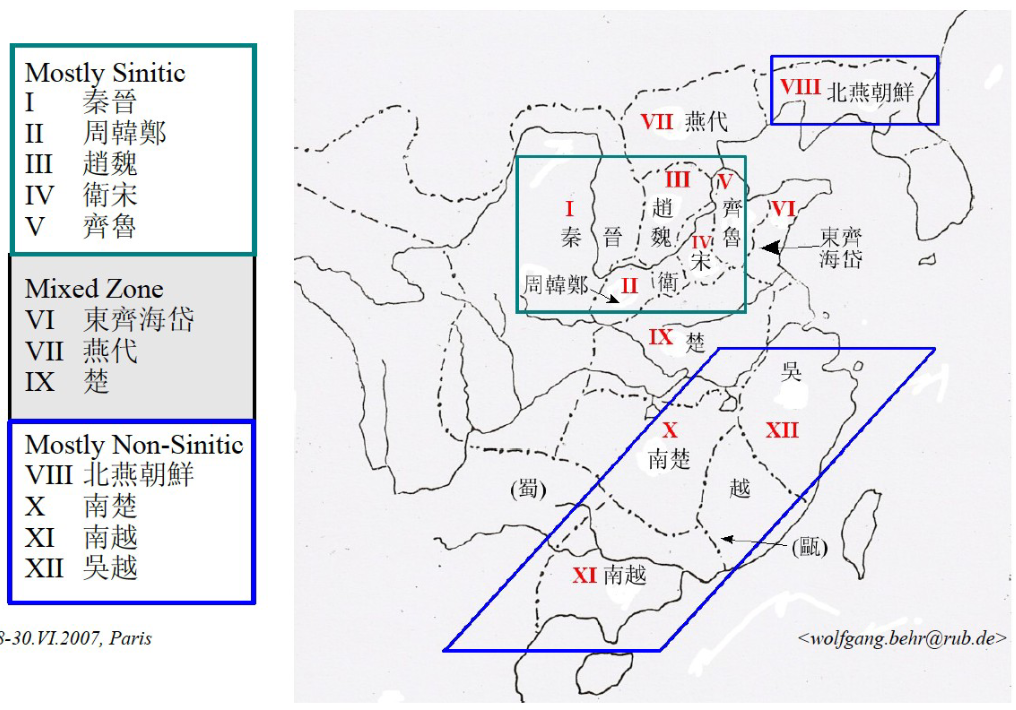
pre-modern dialects
ancient chu language preserved in some Southern variants of Chinese
Chu had own version of character forms
some scholars think that all old dialects either come from Northern varieties or the Chu variety
Yue language (state of Yue and Wu)
Chu and Yue could not communicate
differentiation between common language (Tai-Kadai probably) and Yawen (cultured language)