painters
 Call Kai
 Learn
Learn Practice Test
 Spaced Repetition
 Match
Match Flashcards
 Knowt Play
1/63

There's no tags or description
Looks like no tags are added yet.
Name | Mastery | Learn | Test | Matching | Spaced | Call with Kai |
|---|
No analytics yet
Send a link to your students to track their progress
64 Terms
Who was El Greco?
Doménico Theotocópuli, a 16th-century Spanish painter known for religious themes, elongated figures, distortion, and dramatic light/color
What are the main characteristics of El Greco's style?
Elongated figures, pale faces, nervous hands, green/black colors, distortion, religious themes
Which king supported El Greco?
Felipe II
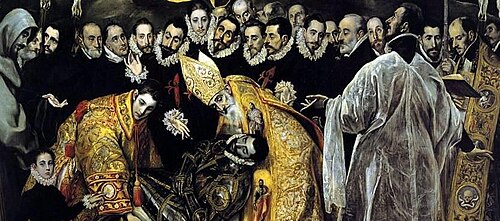
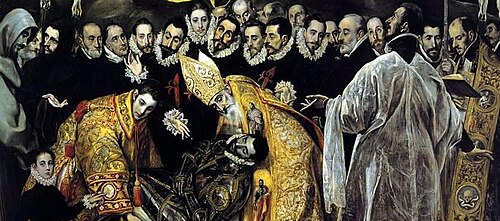
What is "El entierro del Conde de Orgáz" about?
Saints Esteban and Agustín bury the Count while heaven and earth are shown together
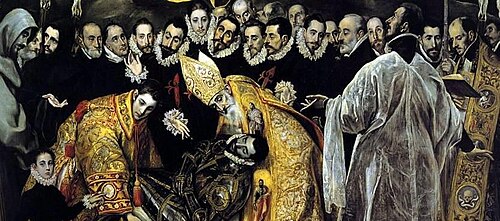
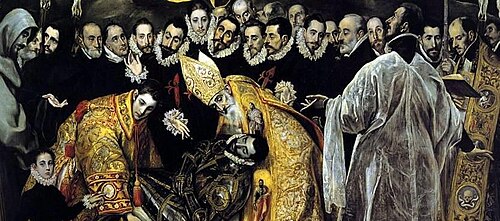
Important details in "El entierro del Conde de Orgáz"
Angel represents the soul, includes El Greco and Felipe II, contrasts sadness and ecstasy
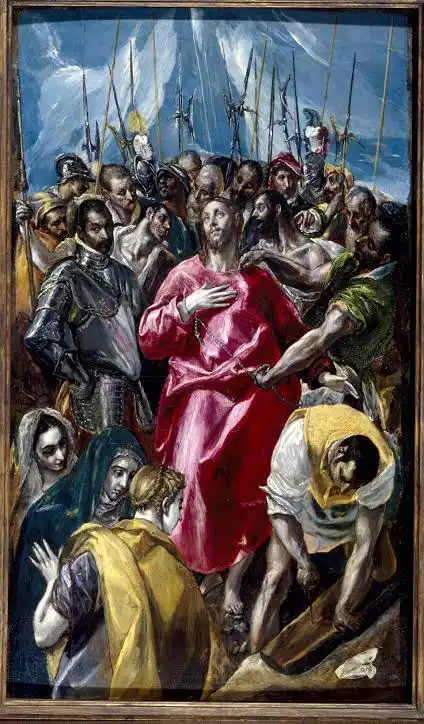
Why was "El espolio" controversial?
Christ's robe was too vivid and it included 16th-century soldiers
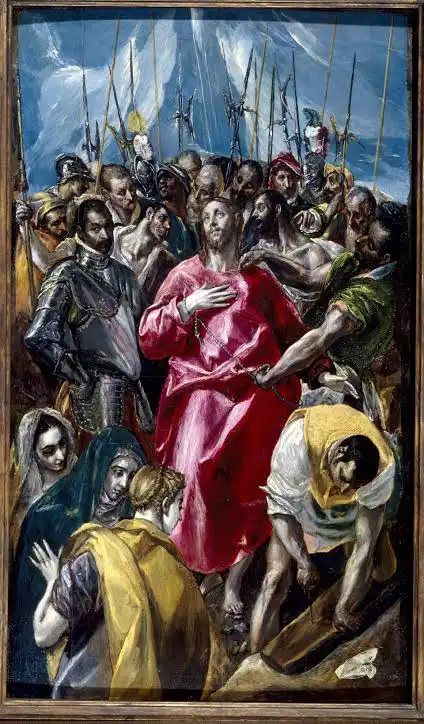
What is significant about "Vista de Toledo"?
One of the few pure landscapes of the era; captures Toledo's spirit rather than realism
What might the stormy sky in "Vista de Toledo" symbolize?
The threatening atmosphere of the Inquisition
Who was Velázquez?
A 17th-century Spanish court painter known for realism, light, and aerial perspective
What are the main characteristics of Velázquez's style?
Realism, dark tones, atmospheric depth, light creating reality, little movement
Which king employed Velázquez?
Felipe IV
What is aerial perspective?
A technique using atmosphere and light to create depth
What is "Las Meninas" about?
A palace workshop scene centered on Infanta Margarita Teresa with attendants, dwarfs, and Velázquez himself
Important details in "Las Meninas"
King and Queen reflected in mirror, doorway adds depth, viewer feels like an invisible observer
Who was Juan de Pareja?
Velázquez's assistant and the subject of one of his most famous portraits
Why is "Retrato de Juan de Pareja" important?
It shows compassion and realism and became one of the most expensive paintings ever sold
Who was Goya?
An 18th-19th century Spanish painter whose art evolved from joyful scenes to dark, emotional protest works
What major event changed Goya's life?
He became completely deaf in 1792
Who were Goya's three artistic masters?
Velázquez, Rembrandt, and Nature
What are the four stages of Goya's art?
Joy/Acceptance, Criticism/Fantasy, Protest/War, Disillusionment/Darkness
What characterized Goya's first stage?
Bright colors, joy, tapestry cartoons, scenes of everyday life
What is "El quitasol"?
A joyful tapestry cartoon with strong diagonals and triangular composition
What characterized Goya's second stage?
Satire, fantasy, pessimism, witches, and criticism of society
What are "Los caprichos"?
82 satirical etchings criticizing human weakness and superstition
What is "El sueño de la razón produce monstruos" about?
When reason sleeps, irrationality and monsters appear
Why was "La maja desnuda" scandalous?
It celebrated realistic female beauty and was confiscated by the Inquisition
Why is "La familia de Carlos IV" considered satirical?
Goya subtly portrayed the royal family as weak
What characterized Goya's third stage?
War, brutality, protest, emotional intensity
What are "Los desastres de la guerra"?
Etchings protesting violence and the horrors of war
What is "El tres de mayo" about?
French troops executing Spanish rebels after an uprising
Why is "El tres de mayo" important?
It powerfully condemns war and human brutality
What characterized Goya's fourth stage?
Horror, fear, madness, darkness, witches, ghosts
What are the "Pinturas negras"?
Dark paintings filled with terror and despair
What is "Saturno devorando a un hijo" about?
Saturn violently consuming his son as a symbol of time and destruction
Who was Picasso?
A 20th-century Spanish artist and co-founder of Cubism known for constantly reinventing his style
What major movement did Picasso co-found?
Cubism
What are the overall characteristics of Picasso's art?
Multiple perspectives, geometric forms, emotional and political expression
What was Picasso's Blue Period?
A sad period dominated by blue tones and themes of poverty and isolation
What caused the Blue Period?
The suicide of his friend Carlos Casagemas
What is "El viejo guitarrista ciego" about?
A poor blind guitarist symbolizing suffering and isolation
What was Picasso's Rose Period?
A warmer, more playful period focused on circus performers and love
What subjects appeared during the Rose Period?
Acrobats, harlequins, couples, families
What characterized Picasso's African/Black Period?
Angular, mask-like figures inspired by African art
What is "Les Demoiselles d'Avignon"?
A revolutionary proto-Cubist painting with fragmented female figures
What is Cubism?
An art style showing multiple perspectives at once using geometric shapes
What is "Los tres músicos"?
A Synthetic Cubist painting of three musicians made of flat geometric forms
What characterized Picasso's Classical Phase?
A return to large, calm, classical figures after World War I
What is "Mujer e hijo"?
A serene mother-and-child painting inspired by classical sculpture
What is "Guernica"?
Picasso's massive anti-war painting about the bombing of Guernica during the Spanish Civil War
Important symbols in "Guernica"
Bull = brutality/Spain, horse = suffering people, screaming mother, dead child, fractured chaos
Why is "Guernica" important?
It is one of the most powerful anti-war paintings ever created
Who was Salvador Dalí?
A 20th-century Spanish Surrealist painter known for dreamlike imagery and eccentric behavior
What is Surrealism?
An art movement based on dreams, the unconscious, and irrational imagery
What are the main characteristics of Dalí's style?
Photorealism mixed with impossible dream scenes, optical illusions, double images
What symbols commonly appear in Dalí's works?
Melting clocks, ants, eggs, elephants, crutches
What is "La persistencia de la memoria"?
A surreal painting with melting clocks symbolizing the flexibility of time
What do the ants in Dalí's paintings symbolize?
Decay and death
What is the "Mae West Room"?
A room designed to look like Mae West's face from a distance
What is "Lincoln en Dalivisión"?
A double-image painting that becomes Abraham Lincoln when viewed from far away
Which painter is associated with elongated religious figures?
El Greco
Which painter is associated with realism and atmosphere?
Velázquez
Which painter evolved from joy to darkness?
Goya
Which painter co-founded Cubism?
Picasso
Which painter is associated with Surrealism?
Dalí