Anatomy respiratory study
 Call Kai
 Learn
Learn Practice Test
 Spaced Repetition
 Match
Match Flashcards
 Knowt Play
1/27

There's no tags or description
Looks like no tags are added yet.
Name | Mastery | Learn | Test | Matching | Spaced | Call with Kai |
|---|
No analytics yet
Send a link to your students to track their progress
28 Terms
What is the name of the enlargement at the top of the trachea that houses the vocal cords called?
Larynx
What is the name of the large branches of airways in each lung that serve only for conduction?
Bronchi
Which of the following most accurately defines Boyle’s law?
As pressure increases, volume decreases
What is the amount of air that can be forced in or out by taking a deep breath?
Vital capacity
What is the name of the process of gas exchange between the alveoli (lungs) and the blood?
external respiration
Respiration involves 4 steps. Name and describe each step.
Pulmonary ventilation (breathing)
This is the movement of air in and out of the lungs (inhalation and exhalation).External respiration
Gas exchange between the lungs and the blood in the alveoli. Oxygen enters the blood, and carbon dioxide leaves the blood.Transport of gases
Oxygen is carried by the blood (mainly by hemoglobin in red blood cells) from the lungs to the body tissues, and carbon dioxide is carried back to the lungs.Internal respiration
Gas exchange between the blood and body cells. Oxygen moves into cells for energy, and carbon dioxide moves into the blood to be removed.
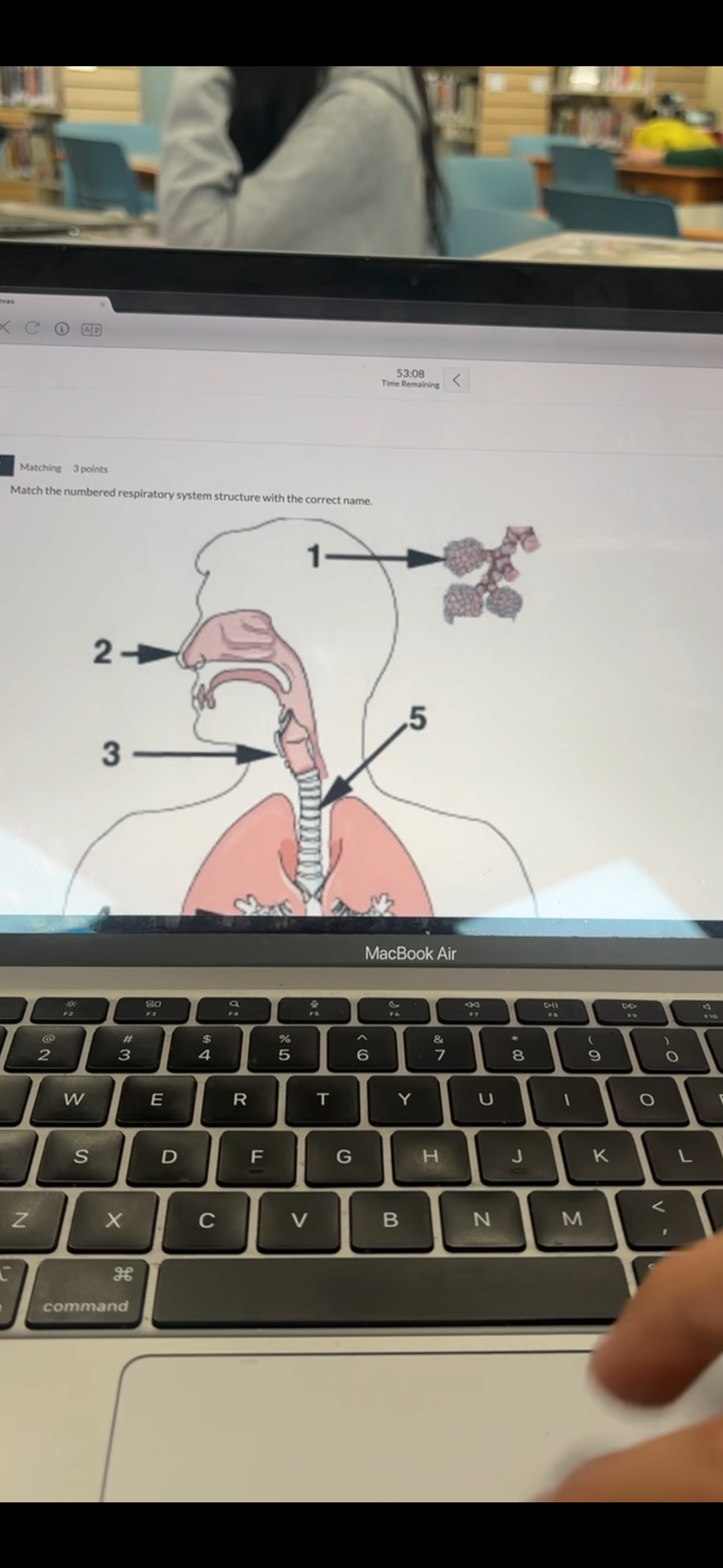
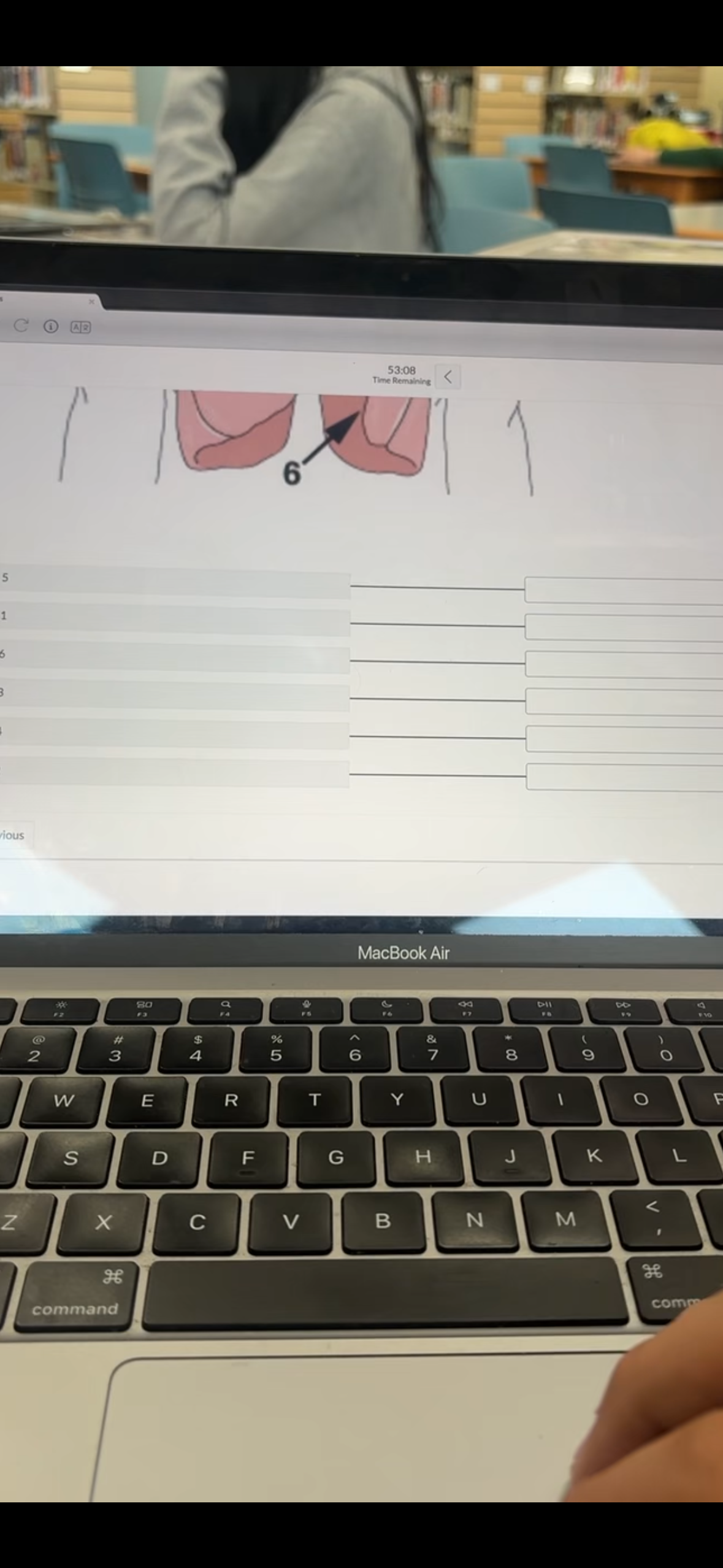
Match the numbered respiratory system structure with the correct name
1 - Alveoli — tiny air sacs where oxygen enters the blood and CO2 exits
2 - Pharynx — the throat; passageway for both air and food
3 - Larynx — voice box; contains vocal cords
4 - Bronchi — two tubes that branch off the trachea, one going into each lung
5 - Trachea — the windpipe; carries air from throat down to the lungs
6 - lungs — two large, spongy organs in your chest responsible for gas exchange.
what is the name of the flap that closes when you swallow, preventing food from going down the airway?
Epiglottis
Name and explain the process that gets oxygen into the bloodstream
Oxygen enters the bloodstream through a process called gas exchange in the alveoli of the lungs. Oxygen diffuses from the air in the alveoli into the surrounding capillaries because of a concentration difference. Once in the blood, it binds to hemoglobin in red blood cells and is transported throughout the body.
How do you measure lung capacity?
Spirometer
What gas is breathed in during respiration?
Oxygen
What is the name of the site where gas exchange occurs between the capillaries and this structure?
Alveoli
This part of the respiratory system is responsible for warming and humidifying incoming outside air.
Nasal cavity
The diaphragm is relaxed during…
Exhalation
What type of respiratory disorder has trouble breathing in oxygen?
Restrictive
What is the name of the muscle that changes the pressure in the pleural cavity?
Diaphragm
What is perfusion?
Problem with blood supply around the alveoli
During inhalation, the lifting of the rib cage and flattening of the diaphragm causes a lower air pressure in this area, drawing air into the lungs.
thoracic cavity
What is the inflammation of the larynx that makes the voice hoarse called?
Laryngitis
The smallest branches of the respiratory tree that are capable of some gas exchange by diffusion
bronchioles
What is the name of the blood vessels that surround the alveoli, where gas exchange occurs?
Pulmonary capillaries
The last twigs of the respiratory tree that terminate without branching again are called
alveolar ducts
At the lungs, what gas has a high concentration in the bloodstream and therefore diffuses into the lungs?
carbon dioxide
What is the name of the first stage of respiration, which is composed of breathing in and breathing out?
ventilation
As air is breathed in, it goes from the trachea to what area next?
bronchi
as pressure on the lungs increases, what happens to them?
collapse
The process of a dissolved solute flowing from an area where it is in higher concentration to an area of lower concentration
diffusion
As the diaphragm contracts, how does that impact the pressure in the thoracic cavity?
pressure decreases