Lecture 17: Changes in Communities and Succession
 Call Kai
 Learn
Learn Practice Test
 Spaced Repetition
 Match
Match Flashcards
 Knowt Play
1/16

Earn XP
Description and Tags
These flashcards cover key concepts and definitions related to changes in ecological communities, focusing on topics such as succession, disturbances, and the contrasting theories of community development.
Name | Mastery | Learn | Test | Matching | Spaced | Call with Kai |
|---|
No analytics yet
Send a link to your students to track their progress
17 Terms
Mount St. Helens Eruption
A significant volcanic event in 1980 that caused extensive changes in the surrounding ecological community.
Abiotic Factors
Non-living chemical and physical parts of the environment that affect living organisms and the functioning of ecosystems.
Biotic Agents of Change
Factors related to the presence and interactions of living organisms that cause changes in species composition, such as competition and predation.
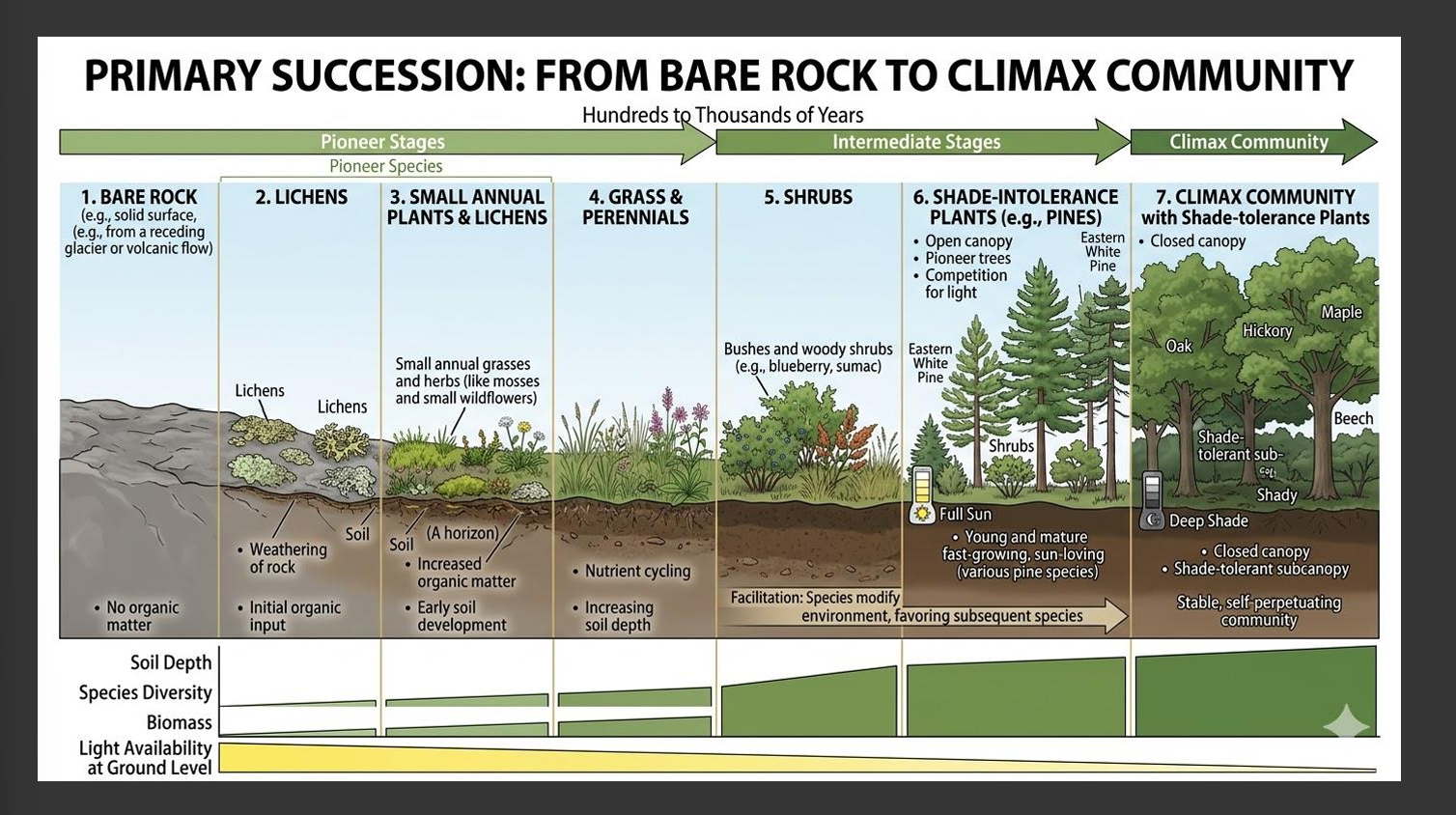
Succession
A series of changes in species composition in communities over time, driven by both biotic and abiotic factors. Succession involves colonization and extinction due to abiotic and biotic agents of change. Theoretically, it progresses through stages to a climax stage—a stable end point that changes little.
Primary and Secondary
Primary Succession
The development of a community in an area that was previously devoid of life, such as after a volcanic eruption or glacial retreat.
Climax Community
The final, stable community in the process of succession that changes little over time in the absence of disturbance.
Gleasonian’s View of Succession
The concept that communities are shaped by individual species' responses to environmental changes rather than a fixed predictable process. Communities are loose groupings, so there is no single fixed climax community.
Clementian’s View of Succession
The idea that succession occurs in a predictable, deterministic manner leading to a stable climax community. Communities act like a tightly connected “superorganism.”
Biotic Agents of Change Examples
competition, predation, herbivory, disease, mutualism
Abiotic Agents of Change (two categories of change)
Disturbance - Events that injure or kill some individuals and create opportunities for others to grow, including fire, storms, and climate change.
Stress- Abiotic factors that reduce growth, reproduction, or survival of individuals, e.g., increasing temperature
Abiotic Agents of Change Examples
Wave currents: storm, hurricanes, floods, sea-level rise etc.
Wind: storm, hurricanes & tornados etc.
Water supply: drought, flooding, mudslides
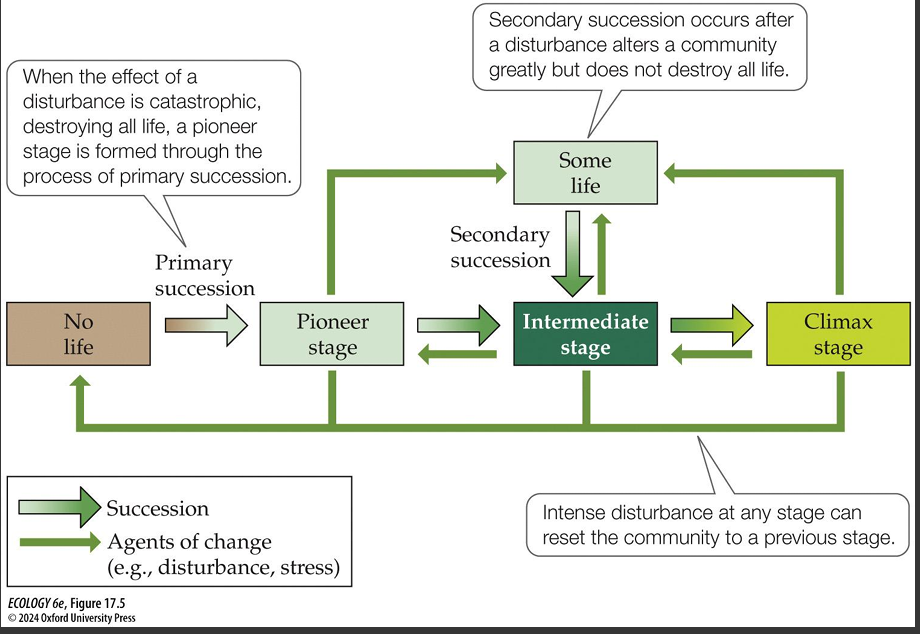
Primary vs Secondary Succession
Primary succession starts with colonization of areas devoid of life, whereas secondary succession involves re-establishment of a community in which most, but not all, of the organisms are destroyed.
Secondary Succession
Occurs in previously inhabited areas after a disturbance, allowing for rapid recovery and re-establishment of the community.
Biotic Factors
Refers to living components of an ecosystem that affect community structure and dynamics, including plants, animals, fungi, and microorganisms.
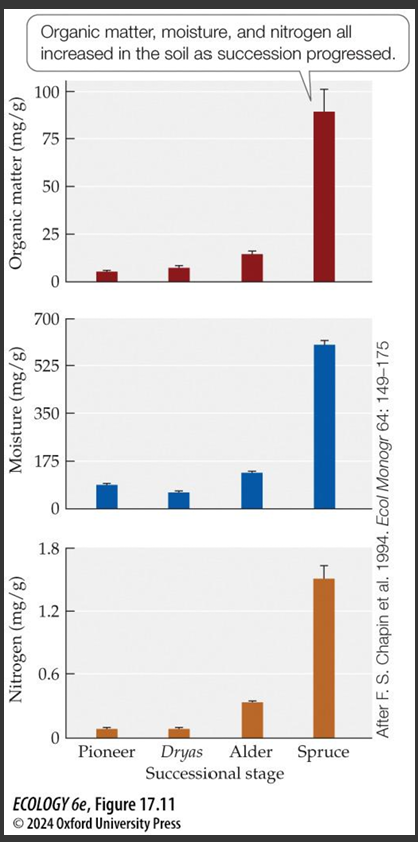
Glacier Bay, AK (two mechanisms)
Studied starting in 1915 by William Cooper.
In the 90’s, Chapin studied mechanisms for succession
Facilitation– plants modify the habitat in positive ways for other species
Inhibition- species modify conditions in negative ways to hinder later successional species
Glacier Bay, AK Conclusion
Chapin concluded that species both facilitate and inhibit the ecosystem for others
1. Facilitation in early stages plants modify the habitat in positive ways for other species (increasing soil, moisture, and N)
2. Later species such as alders have negative effects on other woody species via competition for nutrients and light 3. Spruce eventually dominates as it is tolerant of many conditions
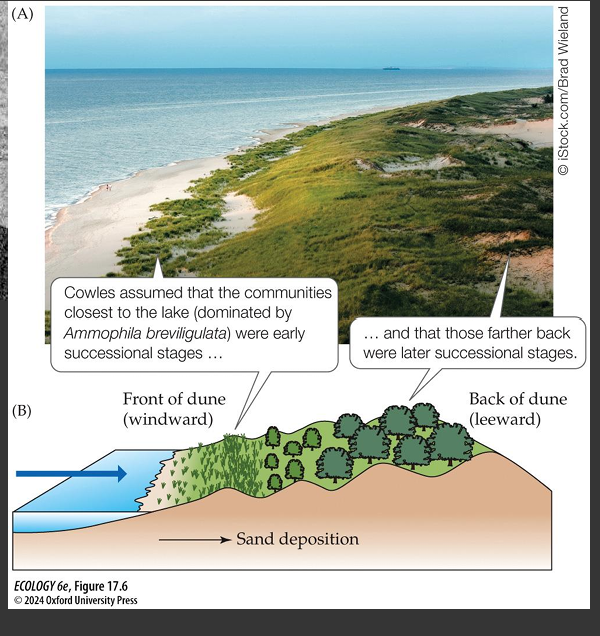
Henry Cowles (1899)
Studied succession on sand dunes along Lake Michigan.
Space-for-time approach:
• Widely used in ecology: an ecologist can only live for so long
• Assume that time is the main factor causing communities to change – also widely debated