SBI4U: Molecular Genetics
 Call Kai
 Learn
Learn Practice Test
 Spaced Repetition
 Match
Match Flashcards
 Knowt Play
1/61

There's no tags or description
Looks like no tags are added yet.
Name | Mastery | Learn | Test | Matching | Spaced | Call with Kai |
|---|
No analytics yet
Send a link to your students to track their progress
62 Terms
Structure of DNA — (header)
header
DNA stands for?
deoxyribonucleic acid
DNA is a huge ____; it can be thousands of monomers long
polymer
DNA is the ______ ______ of information concerning protein structure of all organisms
storage form
What are monomers of DNA called?
nucleotides
Structure - a typical nucleotide is composed of 3 subunits:
deoxyribose sugar (5C)
a phosphate group (negative part)
an organic nitrogenous base (different nucleotides)
TWO types of nitrogenous bases:
purines (double ring):
→ adenine
→ guanine
pyrimidines (single ring):
→ thymine
→ cytosine
Double Stranded DNA — (header)
(header)
The “sides” of the DNA molecule are composed of a _____-_______ backbone
sugar-phosphate
These bonds are held together by…
phosphodiester bond
Strands of DNA are bonded together by _______ _______ b/n nitrogenous bases
hydrogen bonds
the ratio of adenine in DNA is equal to the amount of _____
thymine
the ratio of cytosine in DNA is equal to the amount of _____
guanine
What’s this ratio rule called?
Chargraff’s rule
Strands run in opposite directions (________) which allows _____ _______ to occur between a purine and pyrimidine
antiparellel & base pairing
RNA — (header)
header
Structure:
→ ribose sugar
→ different pyrimidine called uracil (instead of thymine / A=U)
→ single stranded and shorter
DNA replication — (header)
header
Each daughter cell must have an exact copy of the parent’s cell DNA for proper _________, ________ & ________
growth, development & repair
Who conducted an experiment to prove that DNA was “_____________”?
Meselson & Stahl / “semi-conservative”
Semi-conservative:
the mechanism by which a double helix is copied; resulting in two DNA molecules each consisting of one orginal (parental) strand & one newly synthesized (daughter) strand
Experiment:
a. 🌱 Grew E.col bacteria on a nurtient medium containing a heavy isotope of nitrogen -¹⁵N
b. 🔨 Nitrogen is used to make the bases: A, T, G, C
c. 👯♀ Some bacteria were placed onto a medium with a light isotope of nitrogen-¹⁴N and allowed to replicate TWICE
d. 📝 Density Gradient Centrifiguration results → next flashcard
Density Gradient Configuration results
a) layer of heavy DNA at the bottom (one DNA strand)
b) layer of intermediate DNA (two DNA strands)
c) layer if light DNA closests to the top (multiple DNA strands)
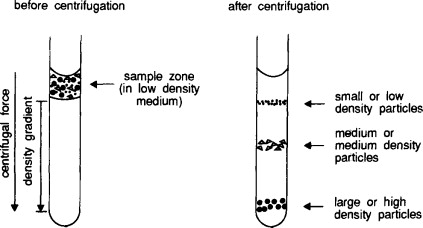
They confirmed that DNA was _____________
semi-conservative
Process of DNA Replication
🥣 1. Prepping the DNA
🧪 2. New DNA is synthesized (5’ → 3’ direction) by DNA polymerase III
✨ 3. The Finishing Touches
🥣 1. Prepping the DNA
Helicase - unwinds and seperates the DNA strands by breaking the hydrogen bonds between the bases
Single stranded binding proteins - prevent hydrogen bonds from reforming
Topiosomerase - relieves tension by cuttung both strands of DNA, allowing them to swivel and then reseeling them
🧪 2. New DNA is synthesized (5’ → 3’ direction) by DNA polymerase III
a. RNA primase - makes an RNA primer and attaches it to the parent strand
b. DNA polymerase II - can now begin making complementary DNA strands using deoxyribonuceloside triphosphates *can only attach a new nucleotide to the 3’ end
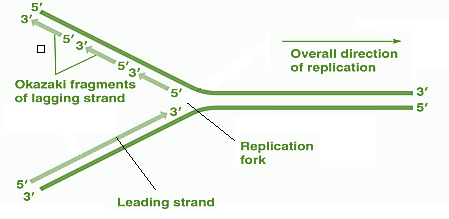
c. Leading strand - continuous, built toward the replication fork
c. Lagging strand - discontinuous, built away from the replication fork, Okazaki fragments are made
What are Okazaki fragments?
short, newly synthesized DNA segments formed on the lagging template strand during DNA replication
✨ 3. The Finishing Touches
a. DNA polymerase I - cuts out the RNA primers and adds the appropriate DNA nucleotides
b. DNA ligase - forms the phosphodiester bonds that joins the Okazaki fragments together
c. Two new daughter strands each twist into a double helix
a. 1-3 occur _______________ at many spots along the DNA strand
simultaneously
What proofreads during DNA replication?
DNA polymerase I & II
DNA polymerase I & II proofread the _____ ______, if a mistake is found, it is cut out and the correct nucleotide is inserted
base pairing
Translation — (header)
header
Translation:
the encoded mRNA message is read by a riboseome to construct a polypeptide chain
Translation requires: (HINT: 4 things)
mRNA
a ribosome
tRNA
GTP (guanosine triphosphate)
a riboseome which is…
made up of TWO subunits
contructed in the nucleus
composed of protein and rRNA (←ribosomal RNA)
functional when they attach to a mRNA molecule
tRNA (← transfer RNA)
RNA strand which is folded forming loops
Has an amino, binding site and an anticodon loop
Carries amino acids to the ribosomes; each different tRNA binds to a specific amino acid
GTP (guanosine triphosphate)
Closely related to ATP
Provides energy needed for initiation and elongation of translation
Translation consists of THREE steps:
🏁 1. Initiation
🤸🏻 2. Elongation
🛑 3. Termination
🏁 Initiation
Met-tRNA forms a complex with the small ribosomal subunit
The complex binds to the 5’ cap of the mRNA and scans until it reaches the AUG start (←nucleic & sequence)
The large ribosomal subunits binds
🤸🏻Elongation
An aminoacyl tRNA (amino acid bonded to it) with the next complimentary anticodon binds to the site (aminoacyl site - for tRNA’s bringing the next amino acid). A peptide bond is formed between the first and second amino acids. *GTP is the source of energy for this synthesis
The ribosome moves downstream one codon. This shift results in the second tRNA being in the P site and the A site is open to receive another tRNA
The intiator tRNA moves to the E site and is released to obtain more methionine
The ribosome continues to move downstream one codon at a time and the tRNA’s continue to bring corresponding amino acids to form the polypeptide chain
🛑 Termination
The mRNA contains stop codons that will stop the process of translation as there are no tRNA’s with corresponding anticodons
When the ribodome comes to a stop codon (UGA, UAG or UAA) at the A site, the stop codon is recognized by release factor protein
This protein aids in the dismantling of the ribosome-mRNA complex. The polypeptide chains is released from the ribosome and the large and small subunits of the ribosome are split apart. These can be used again for translation. The mRNA can also be translated again
Facts about the initiator tRNA:
→ the only tRNA that can bind directly to the P site (peptidly site)
→ other tRNA’s bind to the A site once they have a growing peptide attached to them
Facts about single mRNA:
→ has many ribosomes travelling along it, in various stahes of synthesizing the polypeptide
→ this complex is known as a ‘polysome’
→ many polypeptides can be synthesized from a single mRNA transcript
The Fate of Protein — (header)
header
During and after the synthesis of a polypeptide, the polypetide will ______ and ______ spotaneously, thus forming a protein with a specific structure
coil & fold
__________ ribosomes, those ribosomes attached to the ER, produce proteins destined for the _____ ________. These proteins will be processed and packaged into _________ for interal use or into vesicles for secretion of exocytosis
Bound, golgi complex & lysosomes
The synthesis of all proteins begins in the ______
cytoplasm
4 Protein structures:
Primary
Secondary
Tertiary
Quaternary
Primary
→ polypeptide chain (AA sequence)
Secondary
alpha = helicase
beta = sheets
Tertiary
→ 3D shape of one polypeptide
Quatenary
→ interaction of multiple polypeptide subunits
Mutations — (header)
header
Two types of Mutations:
Large scale mutations: the movement of entire genes
Point mutations: small-scale mutations include mutations of an individual pair
→ The substitution of one base for another
→ The insertion or deletion of a single base pair
→ The inversion of 2 adjoining base pairs
Types of Point Mutations:
Base-Pair Substitutions
Frameshift mutations
Base-Pair Substitutions
a) Silent Mutation: a change in a DNA sequence that does not alter the resulting amino acid sequence or final protein structure
b) Missense mutations: a specific type of genetic change where a single DNA nucleotide is altered
c) Nonesense mutations: a genetic alteration in a DNA sequence that prematurely signals the cell to stop building a protein
Frameshift Mutations
a) Insertion: a type of genetic change where one or more extra nucleotide bases are added into a DNA sequence (→ results in a nonesense codon)
b) Deletion: a type of genetic change where one or more nucleotide bases are deleted from the DNA
What are the consequences of mutations?
→ if occurs in somatic cell: cell goes through apoptosis and perform uncontrolled cell division (cancer)
→ if occurs in gamete: impact the resulting offspring rather than the parent
What causes mutations?
→ spontaneous mutations: a mutation that is caused by an error in DNA replication
→ induced mutations: a mutation that is caused by an environmental agent (ex. antigens like smoking)
Gene regulation — (header)
header