Indirect Realism
 Call Kai
 Learn
Learn Practice Test
 Spaced Repetition
 Match
Match Flashcards
 Knowt Play
1/22

There's no tags or description
Looks like no tags are added yet.
Name | Mastery | Learn | Test | Matching | Spaced | Call with Kai |
|---|
No analytics yet
Send a link to your students to track their progress
23 Terms
The view that the external world exists independently of the mind (realism) and we perceive it via sense data (indirect)
What is sense data?
The immediate, mind-dependent objects of perception.
the things we are directly aware of in experience, such as colours, shapes, sounds, and textures
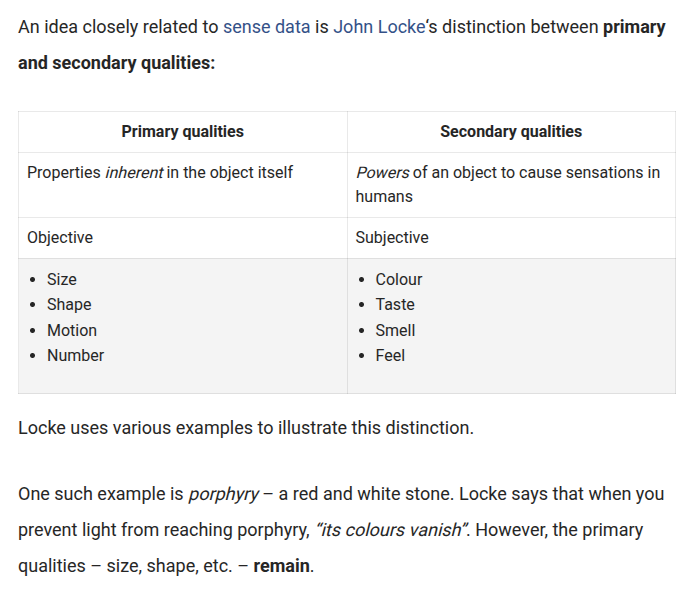
What are Locke’s primary qualities?
Properties inheretent in the object irself that are not objective: size, shape, motion and number. These remain even when not perceived (e.g, when light is removed from porphyry)
Measurable
What are Locke’s secondary qualities?
Arbituary powers of and object to cause senssations in humans that are subjective: colour, taste, smell and feel. These depend on perception (e.g, colour vanishes from porphyry without light)
Not measurable
How Locke distingushes between his primary and secondary qualities
How does sense data solve the perceptual variation problem?
The sense data changes (e.g., table looks square then diamon shaped), but the object itself stays the same. This explains differences between reality and perception without contracting the claim that objects have fixed properties.
How does the primary/secondary quality distinction support indirect realism?
It explains the difference between reality (primary qualities - what objects actually have) and our perception of it (secondary qualities - how objects appear to us)
Why do indirect realists reject direct realism?
The many differences between reality and our perception of it (e.g.perceptual variation) makes direct realism implausible. Sense data better explains these differences
What is Berkeley's argument against indirect realism?
Sense data and mind-independent objects are completely different kinds of things, so sense data cannot resemble mind-independent objects. E.g., sense data constantly changes but objects don't; how can sense data be 'square' in the same way a table is square?"
"What quote does Berkeley use about sense data vs mind-independent objects?"
How then is it possible, , that things perpetually fleeting and variable as our ideas, should be copies or images of anything fixed and constant?"
- likeness principle and argues that primary and secondary are the same thing because we cant sepeate an apple from the colour red
What example demonstrates Berkeley's point about the difference between sense data and objects?
Perceptual variation: sense data changes from square to diamond-shaped when viewing a table from different angles, but the mind-independent table doesn't change. They're too different to resemble each other."
What is the veil of perception problem?
If we only perceive sense data and never the external world itself, we cannot know if sense data accurately represents the external world — or even if the external world exists at all. We can't get beyond the 'veil' of sense data to check."
Why does the veil of perception lead to scepticism?
From the perceiver's perspective, there would be no difference between: (1) sense data caused by a real external world, and (2) sense data with no external world at all. We have no way of checking which is true."
What is Russell's response to scepticism about the external world?
We can't prove the external world exists, but we should treat it as a hypothesis. The existence of mind-independent objects is the best explanation for our perceptions (better than alternatives)."
What is Russell's cat example?
Hypothesis A: The cat exists independently and walked from sofa to floor while I was away. Hypothesis B: The cat stopped existing while unperceived and reappeared elsewhere. Hypothesis A better explains the observations and why the cat gets hungry when not perceived."
What is Locke's involuntary nature of perception argument?
We cannot avoid having certain sense data when looking at objects (unlike memory/imagination which we control). This proves something external to our mind causes perceptions: 'if I turn my Eyes at noon towards the Sun, I cannot avoid the ideas".
What is a response to Locke's involuntary perception argument?
Even if this proves something external exists, it doesn't prove sense data accurately represents the external world. The external world could be completely different to our perception of it.
What is Locke's coherence of different senses argument?
Different senses confirm each other's information, suggesting the same mind-independent object causes both perceptions. E.g., you can see fire and feel its heat; you can see writing and hear it read aloud
What is Locke's fire example for coherence of senses?
He that sees a Fire may, if he doubt whether it be any thing more than a bare Fancy, feel it too; and be convinced, by putting his Hand in it. Visual and tactile senses confirm the same object.