Molecular Transport
 Call Kai
 Learn
Learn Practice Test
 Spaced Repetition
 Match
Match Flashcards
 Knowt Play
1/25

There's no tags or description
Looks like no tags are added yet.
Name | Mastery | Learn | Test | Matching | Spaced | Call with Kai |
|---|
No analytics yet
Send a link to your students to track their progress
26 Terms
What controls exchange in a cell?
plasma membrane
What is stable internal environment called?
homeostasis
Do plant cells lack membranes?
False
What is the structure of the phospholipid bilayer?
hydrophobic tails inside
What does selective permeability mean?
allows some, blocks others, some need ATP
Which of the following is NOT a transport method: Active, Diffusion, Hydrolysis, Osmosis?
Hydrolysis
Which transport methods require energy: Active, Osmosis, Facilitated, A & C?
A & C
Is transport against the gradient impossible?
False
Does osmosis mean spreading substances?
False
What is passive transport?
no ATP, high → low
What factors affect diffusion?
temp, size, gradient
If a solute cannot diffuse, what happens?
water moves to balance across the membrane (via osmosis)
What direction does water move in osmosis?
(draw arrow)
What type of transport is shown in the diagram?
Active transport
What happens to tissue in distilled water?
swell water
What happens to a cell in a 5% solute solution?
water out
What type of solution is a hypertonic solution?
hypertonic
Can plant cells survive in hypotonic solutions?
False
What is the result for animal cells in hypotonic solutions?
cytolysis
What is transport using proteins called?
facilitated diffusion
What type of transport uses ATP?
active transport
How does diffusion differ in cold vs hot tea?
slower in cold
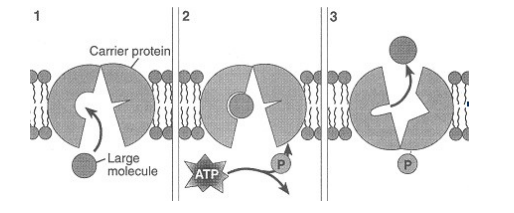
Identify the method of molecular transport shown below.
Active Transport
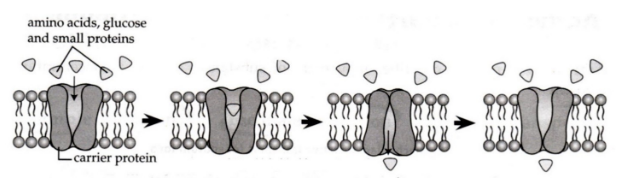
Identify the method of molecular transport shown below
Facilitated diffusion
If you soak an animal cell in a solution with 5% solute,
what type of molecular transport will occur?
Water will exit the cells through osmosis.
A plant cell exposed to an extremely hypotonic environment cannot
survive.
False